How to Heat an Inground Pool Efficiently

Walk up to enough equipment pads and the pattern repeats itself. Oversized gas heater, cycling hard, a gas bill that looks like a car payment. The owner is convinced the unit is defective.
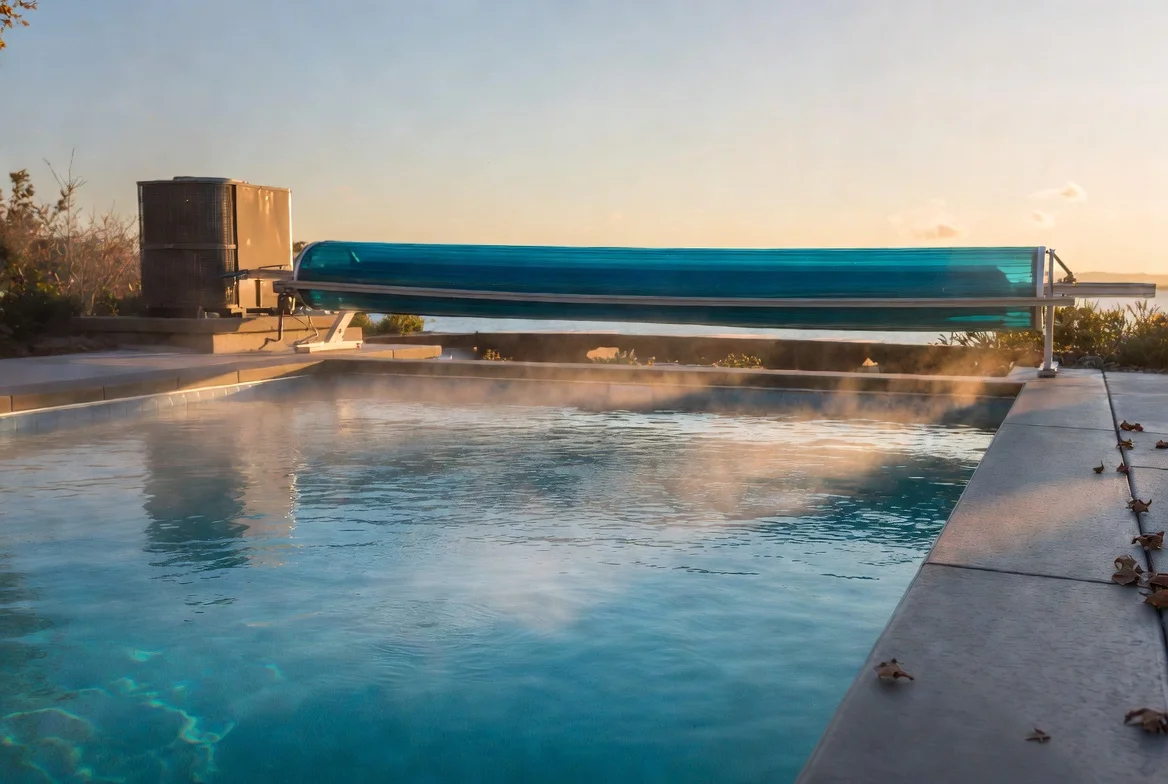
Then look at the pool: 800 square feet of open water, four in the afternoon in October, ambient air at 58 degrees, a faint mist lifting off the surface that nobody thinks twice about.
That mist is the money.
Everything below is secondary to that one observation. Heating an inground pool efficiently is roughly 60% loss prevention, 30% equipment selection, and 10% operational discipline. The industry sells it in the reverse order, because covers carry terrible margins and heat pumps don’t.
The Heat Is Leaving Through the Top
Evaporation accounts for somewhere around 70% of the heat an uncovered outdoor pool loses.
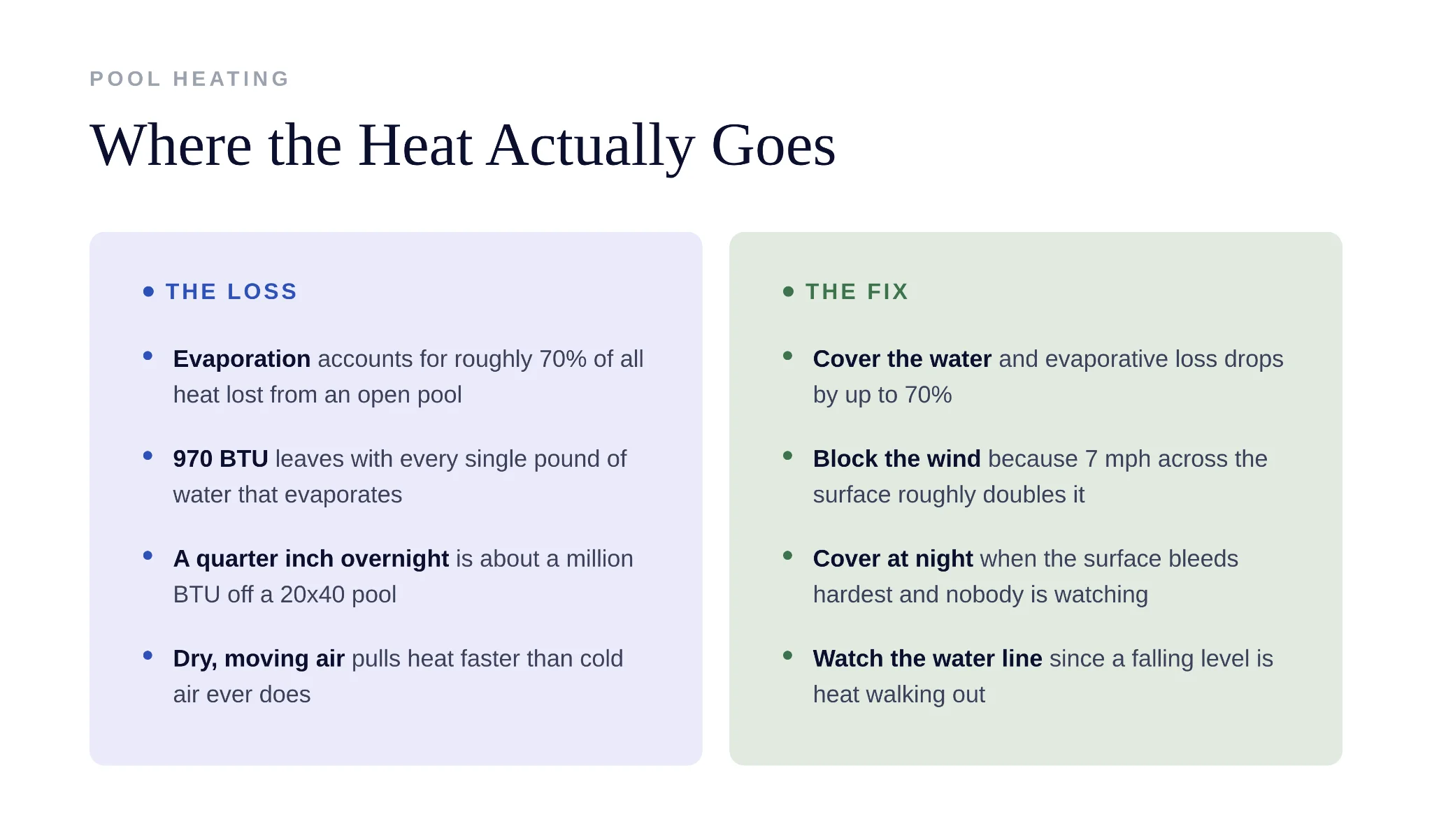
The physics is unforgiving and worth internalizing once, properly, because it explains almost every strange thing a heater does. Water needs about 970 BTU to convert one pound of itself into vapor.
One pound. That’s roughly a pint. So every pint that lifts off the surface on a breezy evening takes nearly a thousand BTU with it, and it takes that energy from the water left behind.
Now run the arithmetic on a pool losing a quarter inch overnight.
A 20×40 pool is 800 square feet. A quarter inch across that surface is about 125 gallons, call it 1,040 pounds, which is roughly a million BTU walking off into the dark. A 125,000 BTU heat pump runs eight hours to replace what one still autumn night removed for free.
That is the entire game.
Cold air doesn’t cool a pool nearly as fast as dry air and moving air do. Which is why a pool in Phoenix in October, 85 degrees at noon, can bleed heat faster than a pool in humid coastal Florida at 70. Low humidity is an evaporation engine, and it runs whether or not anyone is swimming.
Covers, Ranked by the One That Actually Gets Used
The best cover is the one that goes on the water.
A 12-mil bubble blanket cuts evaporative loss by something like 70% and costs a couple hundred dollars.
Plenty of them spend an entire season rolled up against a fence, sun-rotting, because dragging 800 square feet of wet plastic across concrete at ten at night is genuinely miserable work. Theoretical performance is irrelevant if the thing never touches the water.
So the ranking that matters isn’t thermal. It’s behavioral.
Automatic cover
Expensive to install, four to fifteen thousand depending on whether it was designed into the pool or retrofitted onto it. Also the only cover that gets deployed every single night for ten years, because it’s a key turn.
For a seriously heated pool in a climate with a real shoulder season, in a house someone plans to stay in, this is the purchase. The payback is slow on paper and immediate in practice.
Bubble blanket on a reel
The reel is not optional. Without one, it’s a two-person job, and it stops happening by June. With a good reel on a slight deck slope, it’s ninety seconds for one person.
Liquid solar cover
The monolayer alcohol products. They’re real, they work, and they buy maybe a 10 to 15% reduction in evaporation on a calm surface.
Wind or heavy swimmer traffic breaks the film. Reasonable for pools where a physical cover is genuinely impossible, and as a supplement. Never as a strategy.
Solar rings sit somewhere in the middle, and almost nobody who buys them loves them.
One more thing on covers, because it gets missed. The cover is doing double duty. It’s blocking evaporation, and on a sunny day a translucent blue blanket is also transmitting solar gain into the water and trapping it.
A properly used blanket on an unheated pool in June will hold water 8 to 12 degrees above where it would otherwise settle. That’s free heat, and it’s the reason some households in mild climates never buy a heater at all.
Sizing a Heat Pump Is a Surface Area Problem
A lot of installs go wrong before anyone turns a wrench.
Contractors size heaters off pool volume, because volume is easy to calculate and it’s what the customer asks about.
But volume only tells you how long the initial heat-up takes — and for heating an above-ground pool affordably and efficiently, a smaller volume is the advantage you start with. Surface area tells you how fast heat escapes, and therefore what size unit is needed to hold temperature on the worst day that matters.
A shallow, wide 900-square-foot pool loses heat considerably faster than a deep 700-square-foot pool holding the same gallonage, and it needs a bigger heater.
Rough working numbers for a heat pump on a covered inground residential pool in a temperate climate: 100,000 to 125,000 BTU for something in the 600 to 800 square foot range. Go up from there for an uncovered pool, an exposed site, high altitude, or an April swim season.
Understand what a heat pump actually is before buying one.
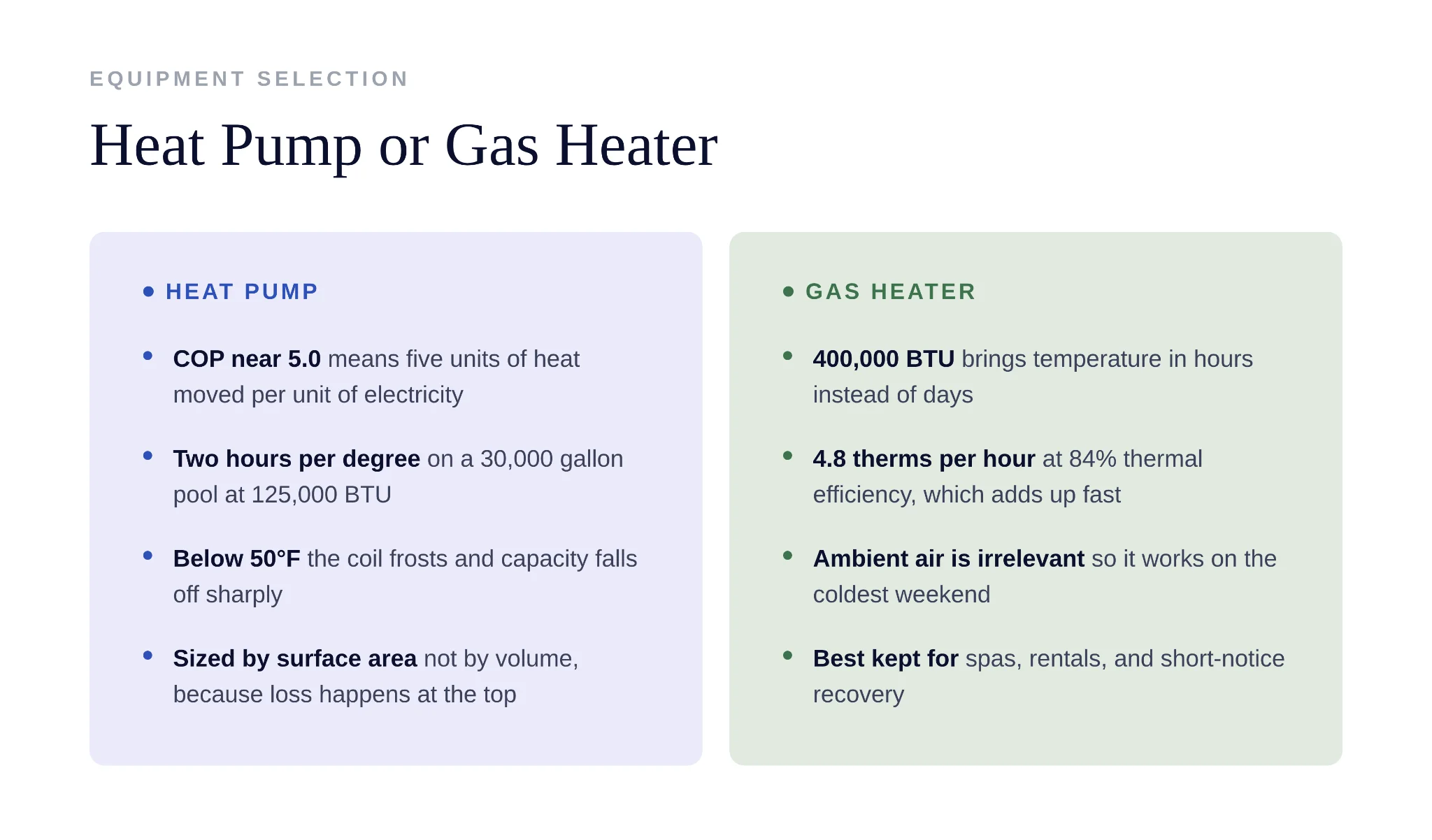
It’s a refrigeration circuit running backwards, harvesting low-grade heat out of ambient air and pumping it into the water through a titanium exchanger. That’s why the efficiency numbers look absurd. A COP of 5.0 means five units of heat delivered per unit of electricity consumed. Nothing is being made. Heat is being moved.
The catch is that the heat has to be there to move.
As ambient temperature drops toward the mid-40s, the coil starts frosting, the unit spends more of its cycle in defrost, and the COP falls off a cliff. Below about 50 degrees Fahrenheit, most residential units work very hard for very little.
Manufacturers publish performance at 80/80/80 conditions, which is a marketing temperature, not a March temperature. Ask for the low-ambient rating and get it in writing.
And plan for the ramp. A 30,000-gallon pool needs roughly 250,000 BTU to rise a single degree, before accounting for anything lost during the climb. A 125,000 BTU/hr unit therefore needs two hours per degree in perfect conditions. Two days to go from 68 to 82.
Gas Has One Job
Fast recovery on demand.
400,000 BTU, temperature in a few hours instead of a few days, and an operating cost that gets attention. At 84% thermal efficiency, a 400k unit burns roughly 4.8 therms an hour. Price that at local rates and it becomes obvious why nobody heats a pool with gas all season anymore.
Keep it for spas, for rental properties, for the November weekend when family visits, or as a second stage behind a heat pump. Not as the primary.
Solar Works
Unglazed polypropylene panels on a south-facing roof are the cheapest BTUs available to a homeowner.
There’s no argument about this. Operating cost is the marginal pump energy required to push water uphill, and that’s the whole bill.
The constraints are what disqualify most sites:
- Panel area needs to equal roughly 50 to 100% of the pool’s surface area, which for that 800-square-foot pool means a serious amount of roof.
- Orientation needs to land within about 45 degrees of south in the northern hemisphere, with unshaded exposure from mid-morning through late afternoon.
- The pump needs enough head to lift water two stories and still maintain flow through the array.
- A vacuum relief valve belongs at the high point so panels drain when the pump shuts off, and in freezing climates that drain has to actually happen or spring means replacing headers.
Get all of it right and solar carries a pool through the shoulder season for close to nothing. Get the flow rate wrong, and the result is a two-degree rise and an owner telling the neighborhood that solar doesn’t work.
Where the Unit Sits
Heat pumps eat air. A 125,000 BTU unit moves thousands of CFM across that coil, and it discharges air 10 to 15 degrees colder than what it took in.
Tuck that unit into a fenced corner under a deck overhang and it will re-ingest its own discharge. The coil sees progressively colder air, capacity drops, the unit runs longer to do less, and the homeowner concludes the model was undersized. That exact complaint has been solved by moving a fence panel.
Clearances: a couple of feet on the sides, several feet of unobstructed space above, nothing that funnels exhaust back toward the intake.
Keep shrubs trimmed away from the coil. Hose the fins out gently once a season, because a coil packed with cottonwood fluff and grass clippings is a coil that isn’t exchanging heat.
Flow
Every heater has a minimum flow requirement, and below it the pressure switch or flow switch opens, and the unit shuts down:
- Dirty filter
- Clogged pump basket
- Half-closed valve
- Air leak on the suction side
Check filter pressure against the clean starting pressure that should have been written on the tank with a marker at the last cleaning.
If it wasn’t written down, that’s the first thing to fix. And on variable speed pumps, confirm the heating schedule runs at a speed that satisfies the heater rather than the slow overnight filtration speed. This trips up more people than it should.
Setpoint Discipline
Every degree above about 80 costs disproportionately, because loss scales with the difference between water temperature and air temperature. Going from 82 to 86 doesn’t cost 5% more. It can cost 30% more.
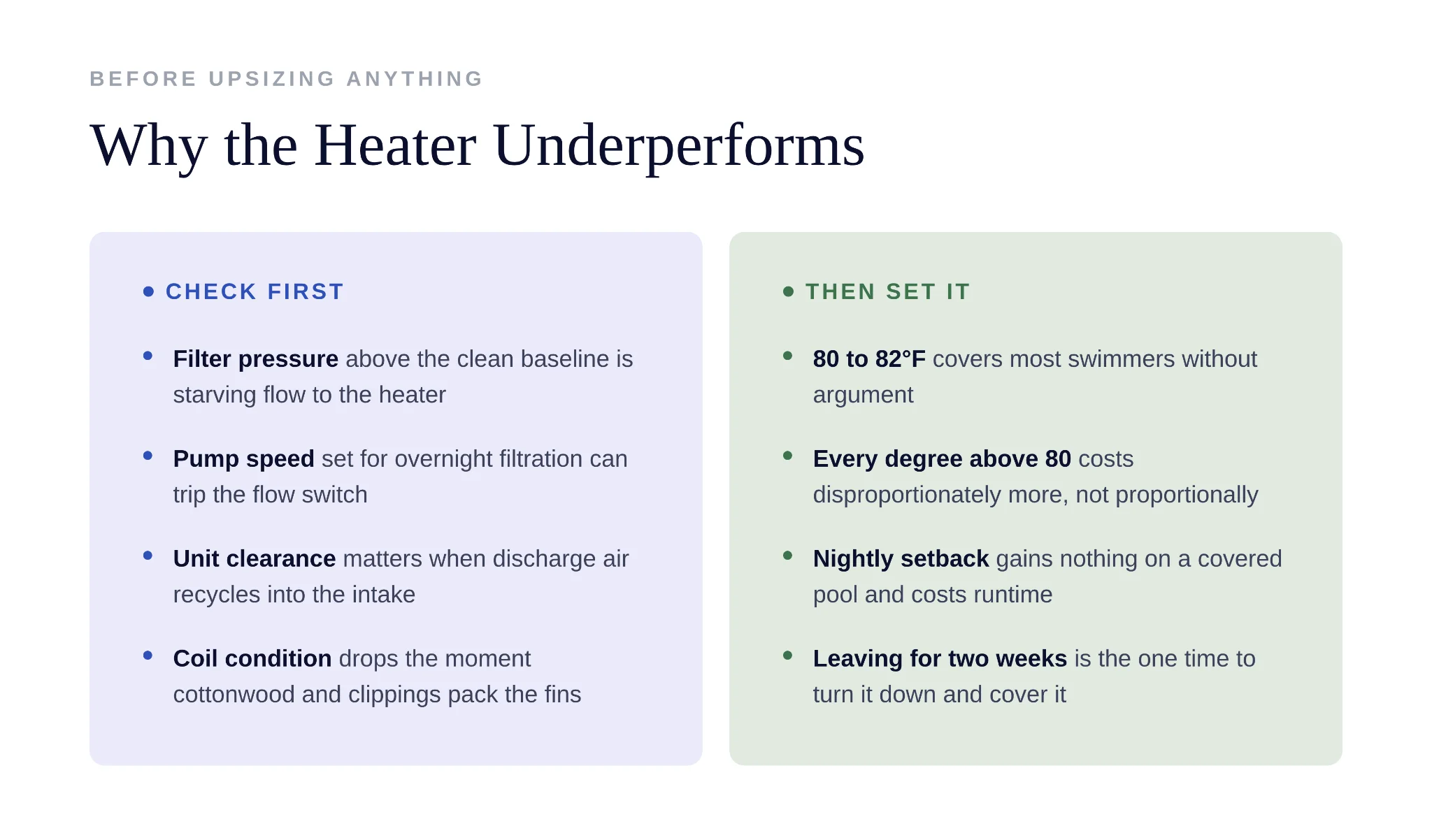
Most adults are comfortable at 80 to 82. Kids will get in at 78 and not mention it. A household with an elderly swimmer or someone doing slow therapy laps genuinely needs 86 to 88, and that’s a legitimate reason to spend the money. It should be a decision rather than a default.
Then there’s the question everybody asks: turn it off between swims?
For a day or two, no. A covered pool is a very large thermal battery, and it holds temperature well overnight.
Setting back four degrees and clawing them back the next morning gains nothing and costs eight hours of runtime. For a two-week vacation, absolutely turn it down, and put the cover on before leaving.
Where a Robot Earns Its Place
Leaves and silt on the floor load the filter faster, and a loaded filter chokes flow to the heater. Debris on the surface keeps a solar blanket from lying flat and blocks the solar gain the blanket exists to capture.
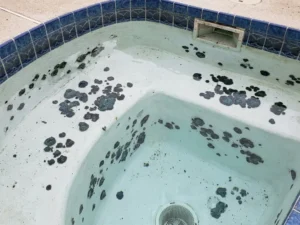
Biofilm on the waterline and steps means more chemical, more brushing, and more reasons to pull the cover off. Then the big one: vacuuming through the skimmer means running the pump for hours purely to clean, on a pad that’s already burning money to heat.
A cordless robotic pool cleaner runs independently of the pool’s plumbing — that’s the whole point. On a heated inground pool, a capable robotic cleaner handles floor, walls, and waterline in a single cycle, with ultra-fine filtration that captures the fine silt otherwise destined for the cartridge element and the heater’s flow switch.
Run it while the pump is off. The filter stays cleaner longer, flow through the exchanger stays where the manufacturer wants it, and the blanket goes back on over water that’s actually clear.
Get more pool and lawn care guides from Aiper on Google