Pool Safety Nets vs. Fences: How Each One Actually Protects

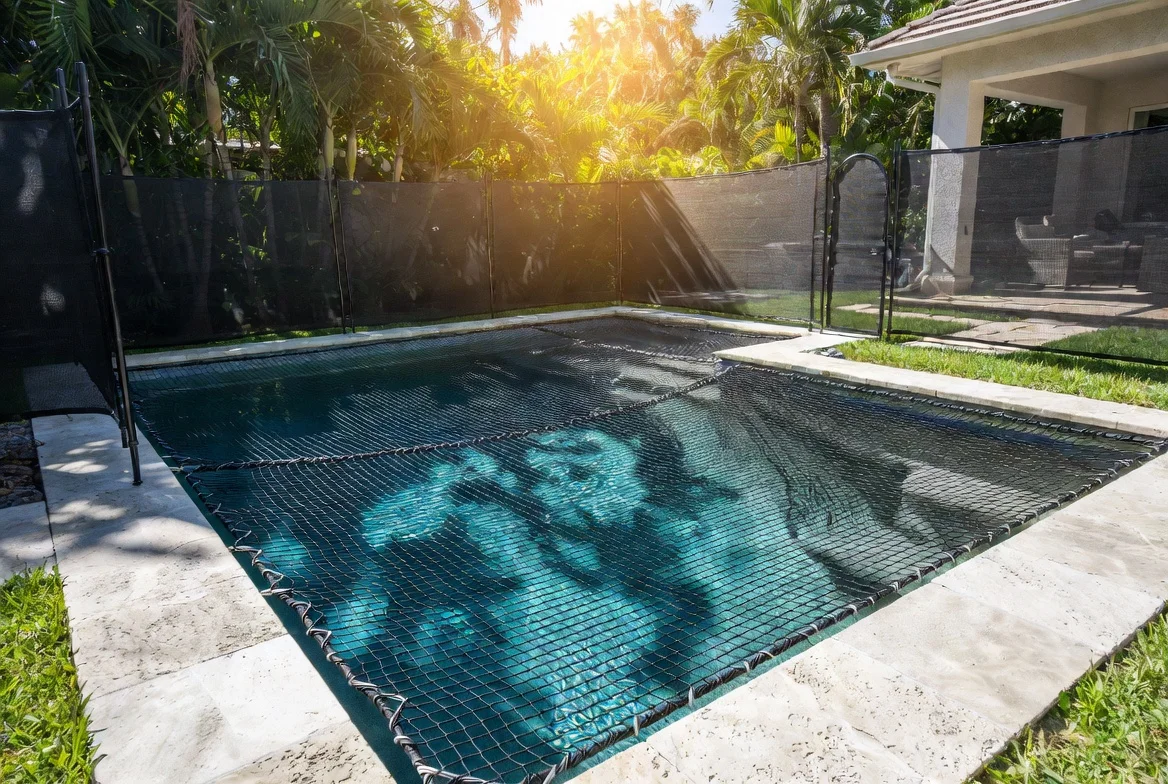
A properly installed safety net and a properly installed mesh fence will each stop a toddler from reaching the water.
The differences are about how you live, what your local code demands, and which failure mode you’re more likely to create yourself, because the barrier that fails is rarely the product.
What a Net Actually Is, Because Most People Picture It Wrong
A pool safety net is not a cover. Water goes through it. Leaves go through it. It does nothing for winterizing, nothing for debris, nothing for heat retention.
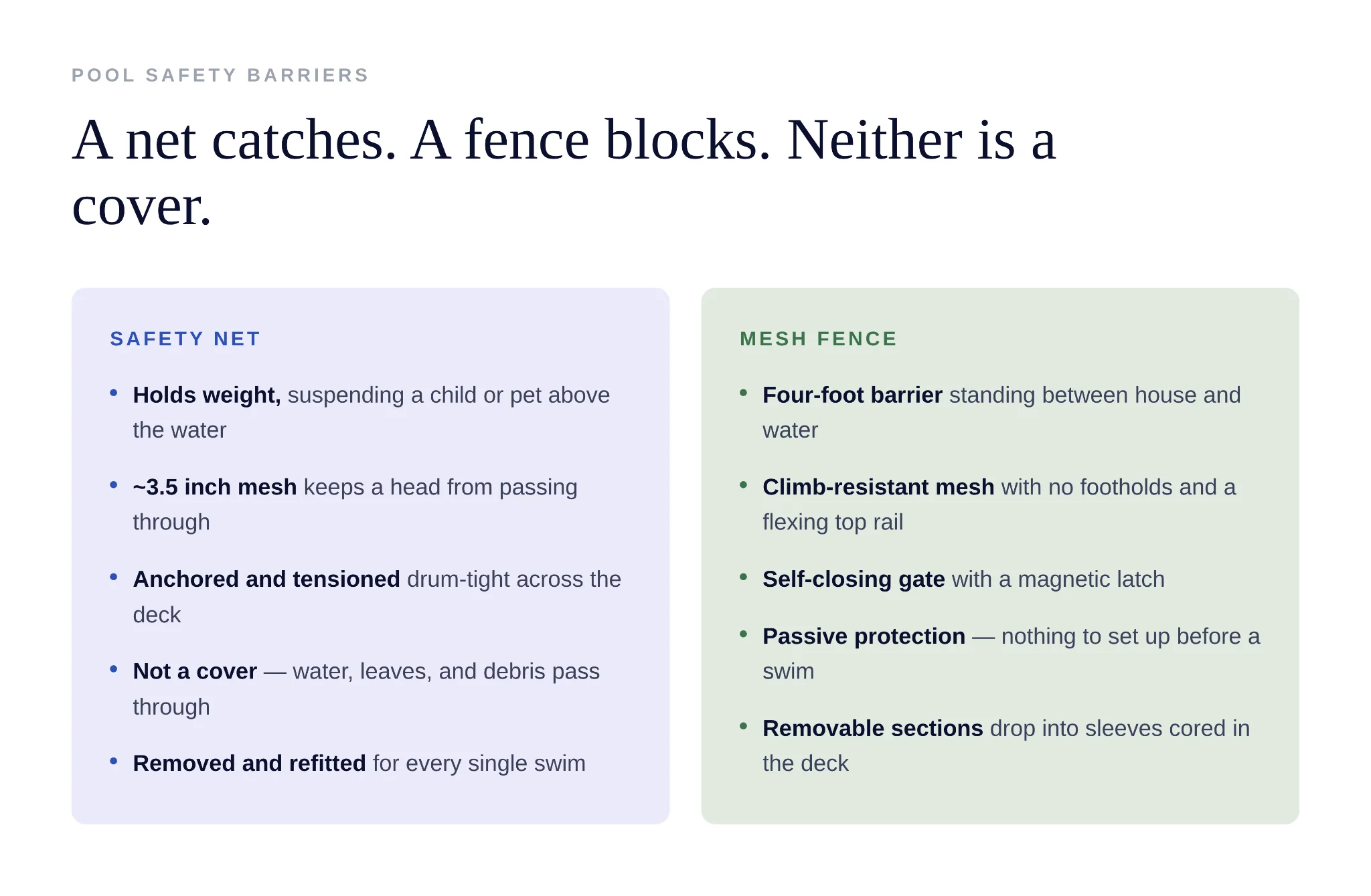
What it does is hold weight. A good one catches a child or a large dog that walks or falls onto it, suspending them above the water in squares small enough that a head can’t pass through, mesh openings usually run around 3.5 inches.
Installation means drilling brass anchors into the deck around the perimeter, roughly every couple of feet, then running the net through a central tensioning device that pulls the whole thing drum-tight.
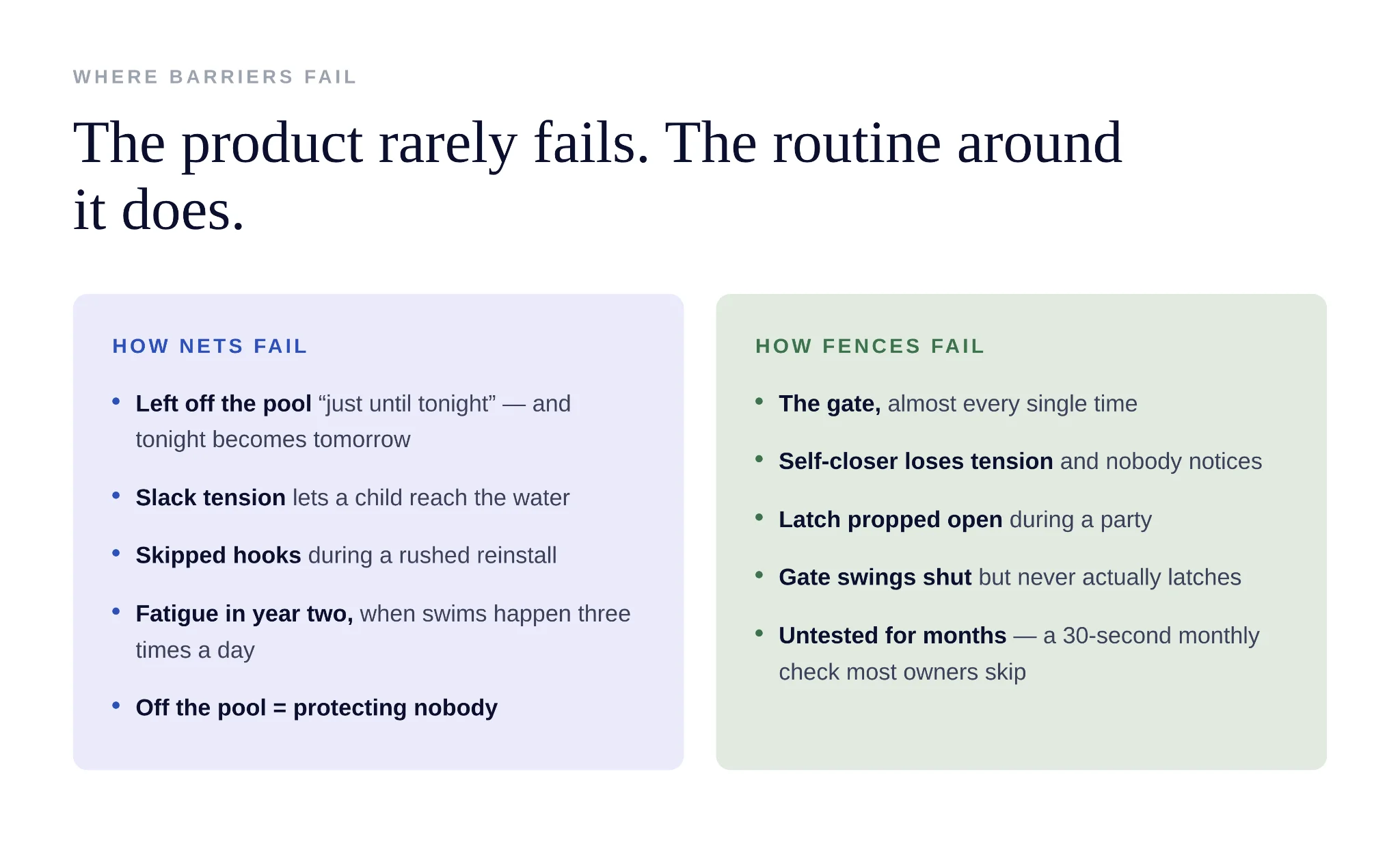
Loose is useless. A slack net lets a child reach the water, and a slack net is what you get when someone reinstalls it in a hurry and skips half the hooks.
That sentence is the entire argument against nets, so sit with it.
Every single swim, an adult removes the net. After every single swim, an adult puts it back and tensions it properly. Five to ten minutes each way once you’re practiced, longer on a big freeform pool.
In week one, everyone does it. By August of year two, when the kids swim three times a day, you start putting it off till tomorrow. The net that isn’t on the pool protects nobody.
Fences don’t have this problem. A fence doesn’t ask anything of you on a Tuesday afternoon.
What a Fence Asks of You Instead
A removable mesh pool fence, the four-foot climb-resistant kind with sections dropped into sleeves cored into the deck, is passive protection. It stands there. You don’t interact with it to swim; you walk through the gate.
Which is exactly where fences fail.
Nearly every fence breach traces back to the gate:
A self-closing hinge that lost tension and nobody noticed.
A latch propped open with a pool noodle during a party because people were carrying food through.
A gate that swings shut but doesn’t actually latch unless you push it.
The perimeter itself rarely gets defeated by a small child. Mesh is hard to climb, there’s no foothold, the top rail flexes. But a gate standing open converts the entire installation into decoration.
So the fence’s maintenance load is small but non-negotiable: test the self-closer and the magnetic latch monthly, the way you’d test a smoke detector. Thirty seconds. Most people never do it.
One more honest point on climbing. A determined five- or six-year-old with a patio chair defeats a four-foot fence.
Nothing about a barrier replaces knowing where your kid is. The barrier buys you the two minutes you didn’t know you needed, not an afternoon of not paying attention. That’s true of the net too.
Code, Insurance, and the Part Where the Decision May Not Be Yours
Check your local ordinance before you fall in love with either option, because in a lot of jurisdictions the choice has already been made for you.
Most municipal and state pool barrier codes are written around fences when it comes to minimum height, gap spacing, and self-closing self-latching gates.
A net, whatever its actual safety performance, frequently doesn’t satisfy the legal definition of a barrier. Some areas accept it as a supplementary layer only. Some don’t mention it at all, which in practice means your building inspector decides on the spot. Above-ground pools sometimes sidestep this fight entirely, since a tall enough wall can satisfy the barrier requirement on its own — worth checking before you assume you need either option, and our comparison of resin vs steel above-ground frames covers what those walls are actually built from.
Homeowner’s insurance runs the same direction. Insurers ask about fencing. They rarely ask about nets. If a fence is required for coverage or a pre-sale inspection, a net doesn’t get you out of it, and now you’re pricing both.
This is the least interesting section of the comparison and the most decisive one. Verify it first.
What Does Each Cost?
A professionally installed safety net on a standard residential pool usually lands somewhere between $1,500 and $2,500, more for very large or oddly shaped pools where the anchor count climbs.
Mesh fencing prices by the linear foot. Installed, expect roughly $15 to $25 per foot depending on region and deck material, so a typical perimeter comes out between $2,500 and $4,500.
Coring through pavers is cheap. Coring through a cantilevered stone coping or a deck with radiant heating underneath is not, and that’s where quotes surprise people. The shell underneath plays into that too — anchoring a net or fence sleeve around a fiberglass pool’s clean deck line is a different job than working around the cantilevered coping common on gunite pools, which our fiberglass vs concrete comparison gets into.
Nets win on upfront cost most of the time. Fences win on cost per year of actual protection, because the fence is protecting the pool every hour it stands, while the net is only protecting the pool when someone has bothered to put it on.
There’s also resale to think about. A fence transfers to the next owner as a working system. A net transfers as a rolled-up bundle in the garage and a ring of brass anchors the buyer may or may not understand.
How the Yard Feels Afterward
This matters more than people admit in the showroom.
A net keeps the sightline open. Stand at your kitchen window, and the pool looks like a pool with a faint grid over it. For homeowners who fought hard for that view, or whose pool is the centerpiece of a small yard, this is the whole reason nets exist as a category.
A fence changes the space.
Even the good mesh ones, near-transparent from a distance, thin black poles, put a visible boundary through the yard and shrink the usable deck. On a compact patio, a fence can leave you with a walkway instead of a lounging area. On a big yard, you’ll stop noticing it within a month.
The counterweight: a fence lets the pool stay ready. Walk out, open the gate, swim. A net means every spontaneous swim starts with five minutes of labor and ends with five more, and spontaneity is most of why people wanted a pool.
Where Each One Actually Belongs
A net makes sense when the pool is used infrequently and on a schedule, we’re talking weekend swimmers, holiday homes, snowbird properties, grandparents whose grandchildren visit twice a month. Long stretches of the net staying on, occasional planned removals. That rhythm plays to its strength.
A fence makes sense when the pool is part of daily life, when there are multiple caregivers with different levels of diligence, when a dog or a neighbor’s kid can wander in, or when code and insurance are going to force the issue anyway.
A barrier only handles the getting-in part. The other half of watching a pool is being able to see into it, and cloudy water hides a lot, including a small body under the surface. Keeping the water clear is a safety task disguised as a chore.
The Aiper’s robotic pool cleaners handles that part without asking anything of you: they vacuum the floor, climb the walls, and skim the surface on their own schedule, so the pool stays visible top to bottom whether you swam today or not.
Get more pool and lawn care guides from Aiper on Google