How to Keep Mosquitoes From Breeding In or Near Your Pool

A homeowner gets eaten alive in their own backyard every evening in July, looks at the largest body of water on the property, and reaches an obvious conclusion.
Then a mosquito control tech walks the yard for eleven minutes and finds the actual nursery six feet away: an inch of black rainwater sitting on a folded safety cover in the side yard, thick with leaf tea, crawling.
A properly chlorinated, circulating swimming pool is one of the most hostile places on a residential lot for a mosquito. What surrounds it is usually paradise.
Why a Maintained Pool Doesn’t Breed Mosquitoes
The life cycle needs still water and about seven to ten days of it, depending on temperature.
Eggs, then four larval instars, then a pupal stage, then an adult that flies off and starts biting. Interrupt any part of it, and nothing emerges.
A pool interrupts all of it at once:
- Free chlorine at 1 to 3 ppm is genuinely lethal to larvae, though it isn’t as fast as most people assume.
- Circulation matters just as much, because larvae have to hang at the surface film and breathe through a siphon, and moving water makes that miserable work.
- Then there’s the food problem: larvae eat microorganisms and organic detritus, and a filtered pool with no biofilm and no leaf mulch on the floor doesn’t feed anything.
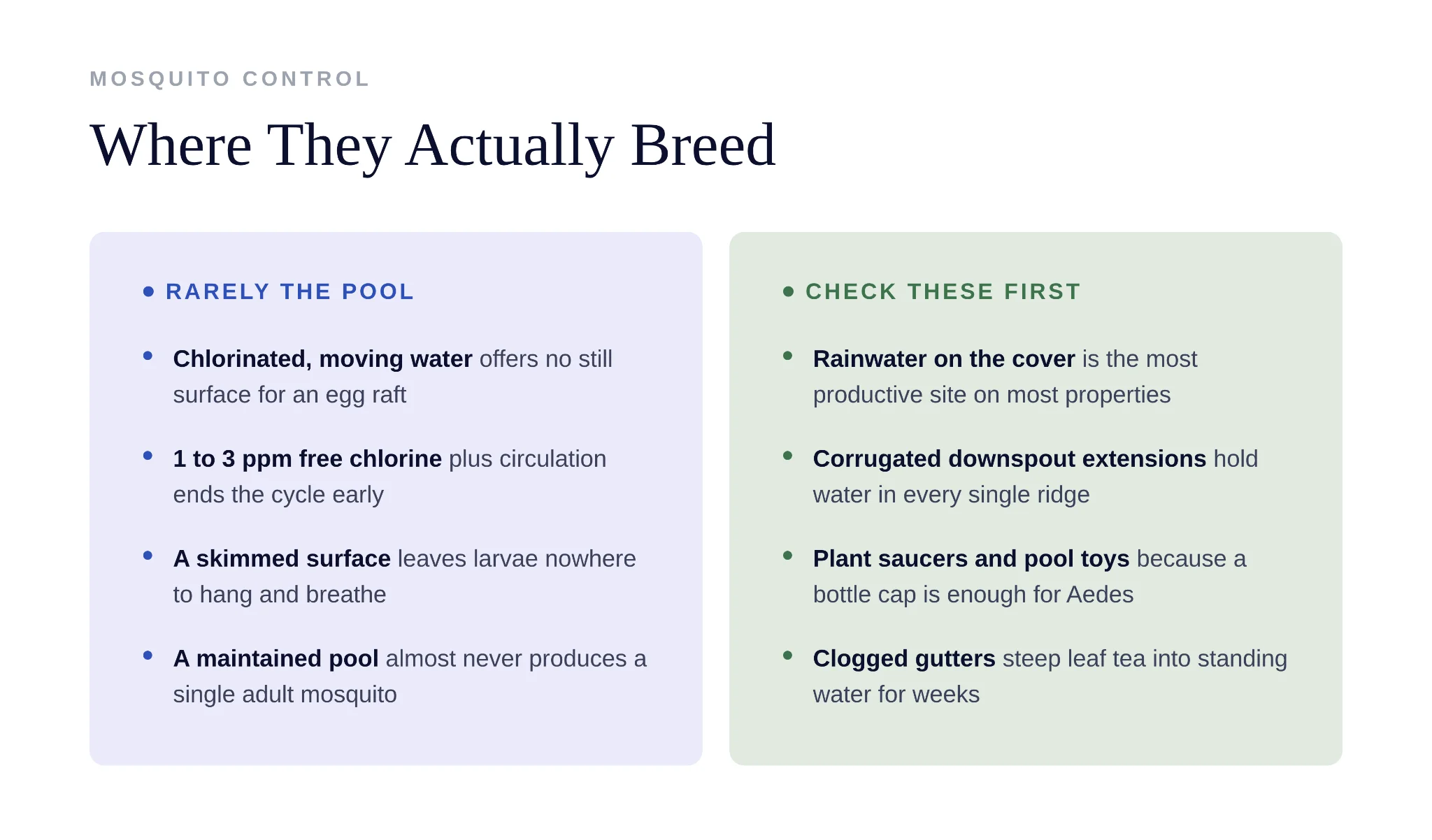
So the pool sits there, 20,000 gallons of it, sterile as a hotel lobby.
Meanwhile the pot saucer under the hibiscus holds a quarter cup of water and produces a hundred adults every ten days.
The Cover Is the Problem
If there’s one place to look first, it’s the cover. Every time.
A mesh safety cover drains, mostly. A solid winter cover doesn’t. Rain lands on it, collects in the sag, and within a week that puddle has leaves, pollen, and enough decomposed organic matter to be a genuinely excellent Culex habitat.
Better than a marsh. An inch of standing water across even a small section of an 800-square-foot cover is a lake by mosquito standards, and it is sitting three feet from the patio furniture.
Automatic covers do the same thing in miniature. Rainwater pools in the tracks and in the low spots when the cover is closed, and unless there’s a functioning cover pump, it stays there.
The fix is unglamorous.
A $60 submersible cover pump, ideally one with an automatic float switch, sitting in the deepest sag. Check it after every heavy rain. If the cover holds water for more than four or five days at a stretch during warm weather, something is emerging from it.
Same story for the cover that’s been folded and shoved behind the shed since April. Every fold holds water. And when the water is uncovered, bigger wildlife moves in — keeping ducks off your pool and deck is its own project.
Two Mosquitoes, Two Completely Different Habits
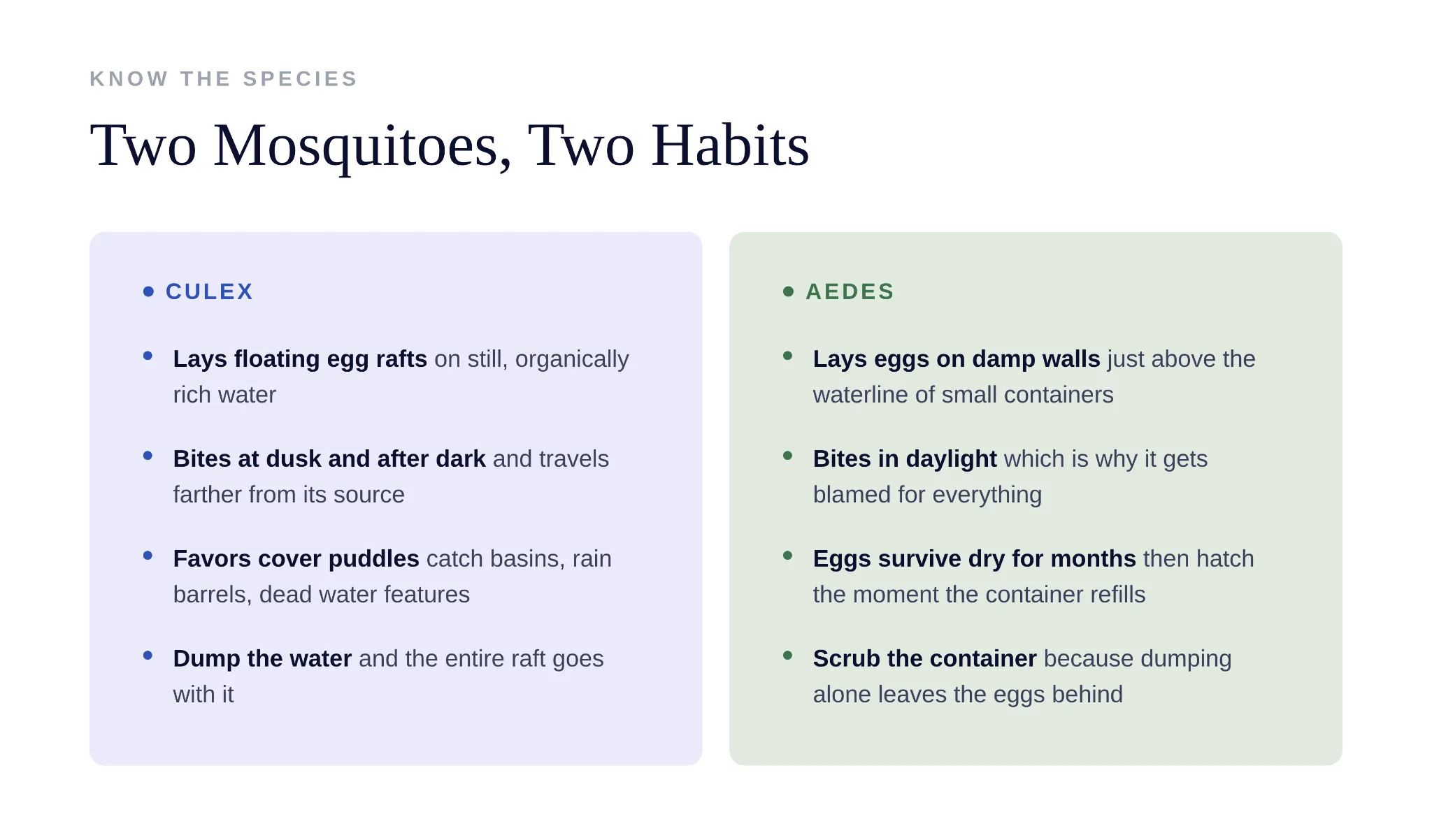
Most backyard frustration comes from treating mosquitoes as one animal. They aren’t, and the two that matter around a pool want opposite things.
Culex
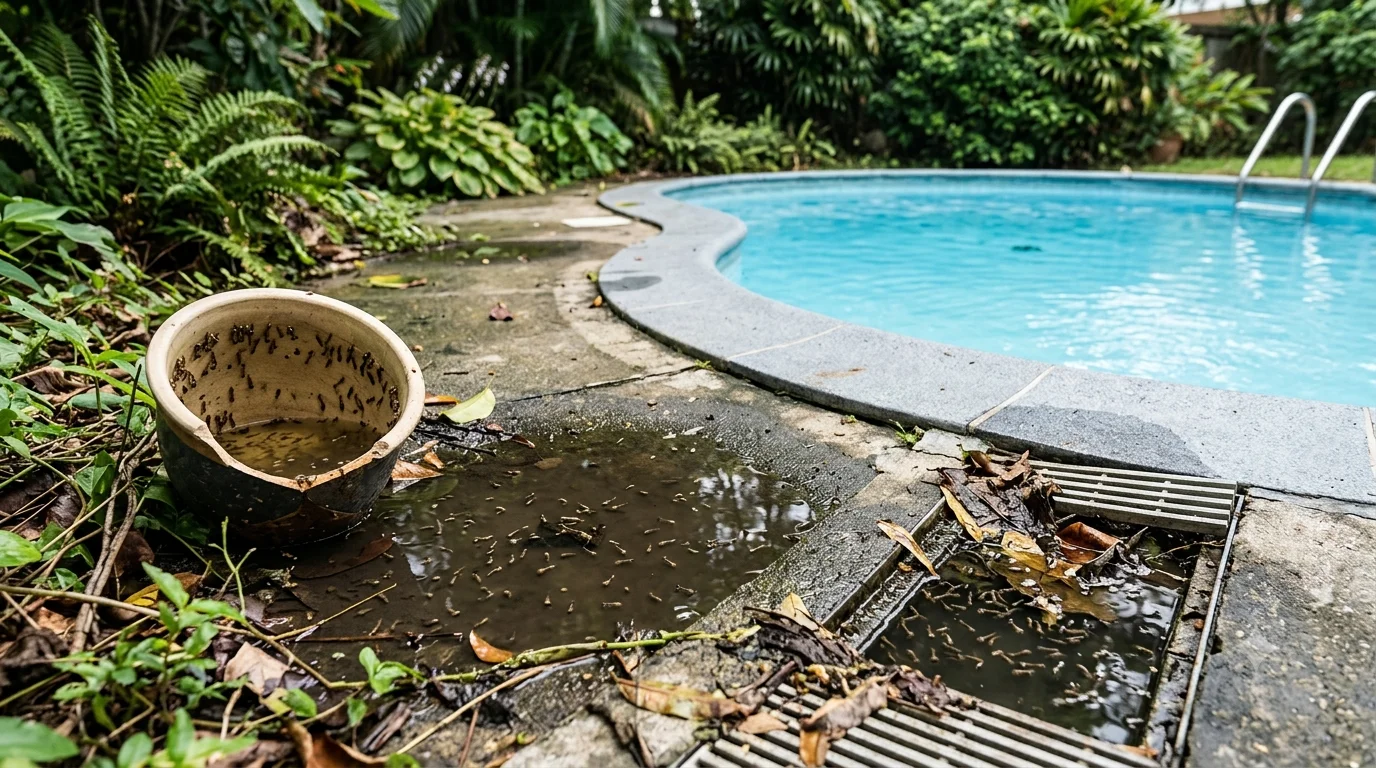
Lays floating egg rafts, a couple hundred eggs at a time, on still water that’s already rich with organic material. Cover puddles, catch basins, rain barrels, the dead water feature nobody drains, the bucket behind the pump pad. Bites at dusk and through the night, and it will fly a considerable distance from where it hatched, which is why the source can be two properties over.
Aedes
The daytime biter, the ankle specialist, the one people actually swat at. It doesn’t lay on water at all. It lays on the damp inner wall of a container just above the waterline, and those eggs survive drying out for months, then hatch within minutes when the container refills. A bottle cap of water is enough. Aedes rarely flies more than a couple hundred feet, so an Aedes problem is a problem originating on the property.
The practical difference is what dumping accomplishes. Dumping a Culex site removes the raft and ends it. Dumping an Aedes site removes the larvae and leaves a wall of viable eggs waiting for the next rain.
Scrub the container. A stiff brush and ten seconds.
The Seven-Day Walk
Once a week, walk the property with a bucket and dump everything.
That’s the whole program, and it outperforms every product sold for the purpose. Seven days because it’s shorter than the cycle. Nothing gets to finish.
What gets missed, in rough order of how often: corrugated black downspout extensions, which hold water in every single ridge and are seldom checked:
- Plant saucers
- Kid’s toys and sandbox lids
- The wheelbarrow left tipped up at the wrong angle
- Ladder feet
- Folded tarps
- Unused pool floats stacked in a corner, each one cupping an inch of rain
- Gutters, especially the section behind the garage that nobody can see from the ground
- Boat and trailer covers
- Tire swings
- The tray under the outdoor refrigerator
- Low spots in the lawn where the auto-cover drains and the grade never got fixed
- Recycling bins with a broken lid
What an Abandoned Pool Produces
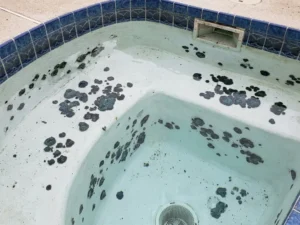
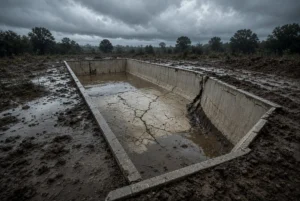
Green pools are a different category of problem, and it’s worth knowing the scale.
A neglected, algae-choked pool can produce mosquitoes in numbers that affect an entire neighborhood.
Vector control districts in California and Florida track foreclosure-era green pools specifically because a single one can generate on the order of a million adults per season. That water is warm, still, and packed with exactly the organic material larvae eat.
If a pool is going to sit unmaintained, it needs either mosquito fish or Bti, and most county vector control programs will supply Gambusia at no charge and drop them in for free.
They eat larvae continuously, and they cost nothing to keep.
A pool that’s simply been let go for three weeks in August, cloudy and starting to turn, is not yet a mosquito factory. Shock it, run the filter continuously, and clean the floor. Prevention here is measured in days.
Bti, and Where It Belongs
Bacillus thuringiensis israelensis is a soil bacterium that produces a protein toxic to mosquito, blackfly, and fungus gnat larvae, and to essentially nothing else. It doesn’t harm fish, birds, pets, or people. It comes as floating dunks or granules.
It does not belong in a swimming pool that’s being maintained, because there’s nothing there to kill.
It belongs in every place on the property that holds water on purpose. Rain barrels. Bromeliad axils, if there are bromeliads, which in Florida are a serious and frequently overlooked source. The catch basin at the bottom of the driveway.
Ornamental ponds without fish. Gutter sections that never fully drain. Cover puddles that can’t be pumped out immediately.
One dunk treats about 100 square feet of surface for roughly thirty days.
Adult Harborage
Adults don’t spend the day flying. They rest in cool damp shade, close to the ground, and then they come out at dusk.
Dense low shrubbery against a fence line. Ivy on a wall. Tall unmown grass along the back of the property. Leaf litter under a deck.
Thinning that vegetation and letting air and light through it removes the daytime harborage, and it makes a noticeable difference to how many mosquitoes are around at six in the evening even when breeding sites are already under control.
Airflow does the rest. A single oscillating fan on a patio genuinely works, because mosquitoes are weak fliers and they won’t fight a breeze.
The Things That Don’t Work
Bug zappers. Study after study has found the overwhelming majority of the catch is moths, beetles, and beneficial insects, with mosquitoes making up a trivial fraction. They also draw insects toward the patio.
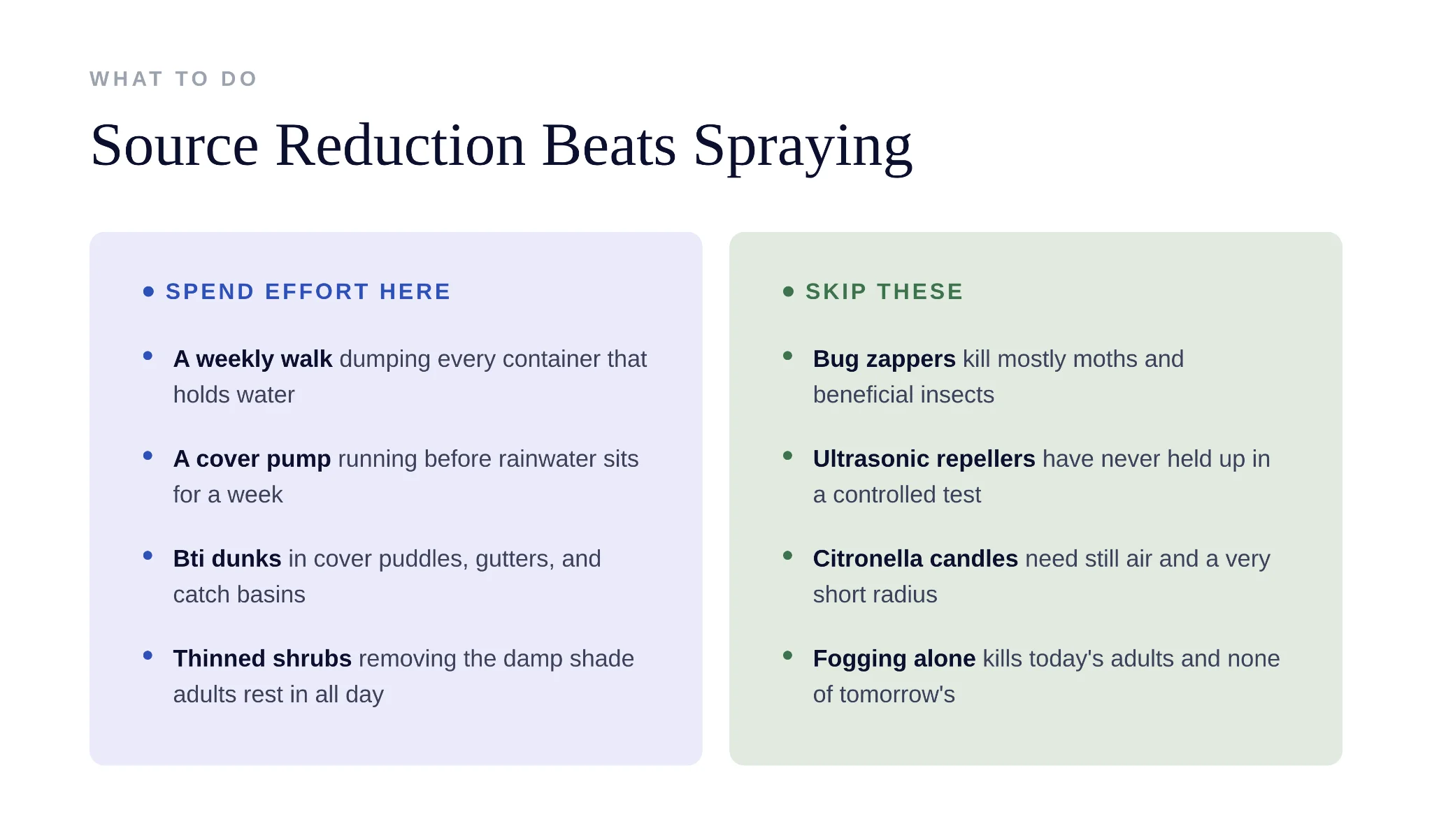
Ultrasonic repellers, whether plug-in or app. No controlled trial has ever supported them.
Citronella candles, at anything beyond about two feet in still air.
Fogging as a standalone strategy. It kills the adults present at the moment of application and does nothing to the larvae that will replace them by the weekend. As a supplement before a party, fine. As a plan, it’s a subscription to the problem.
Late August
The worst infestations show up in the back half of the season, when nobody’s paying attention anymore.
The cover pump has a clogged intake. Two float toys have been sitting deflated in the grass since the Fourth of July. A downspout extension came loose and now dumps into a low corner of the bed, and there’s been enough rain that the low corner never really dries.
None of it is dramatic. That’s the whole reason it works.
Go look at the cover.
Circulation Is the Quiet Part
Everything above hinges on the pool staying the way it started: circulating, skimmed, and free of the organic load that turns a chlorinated pool into something a mosquito would consider.
That’s harder than it sounds during a heavy leaf drop or after a storm, and it’s precisely when surfaces go still.
A solar-powered cordless skimmer is the right tool for that specific job. It runs continuously on the surface, pulling floating debris into a basket before it waterlogs and sinks, and its constant movement keeps the surface film disturbed in the corners the circulation system was never going to reach.
Get more pool and lawn care guides from Aiper on Google