


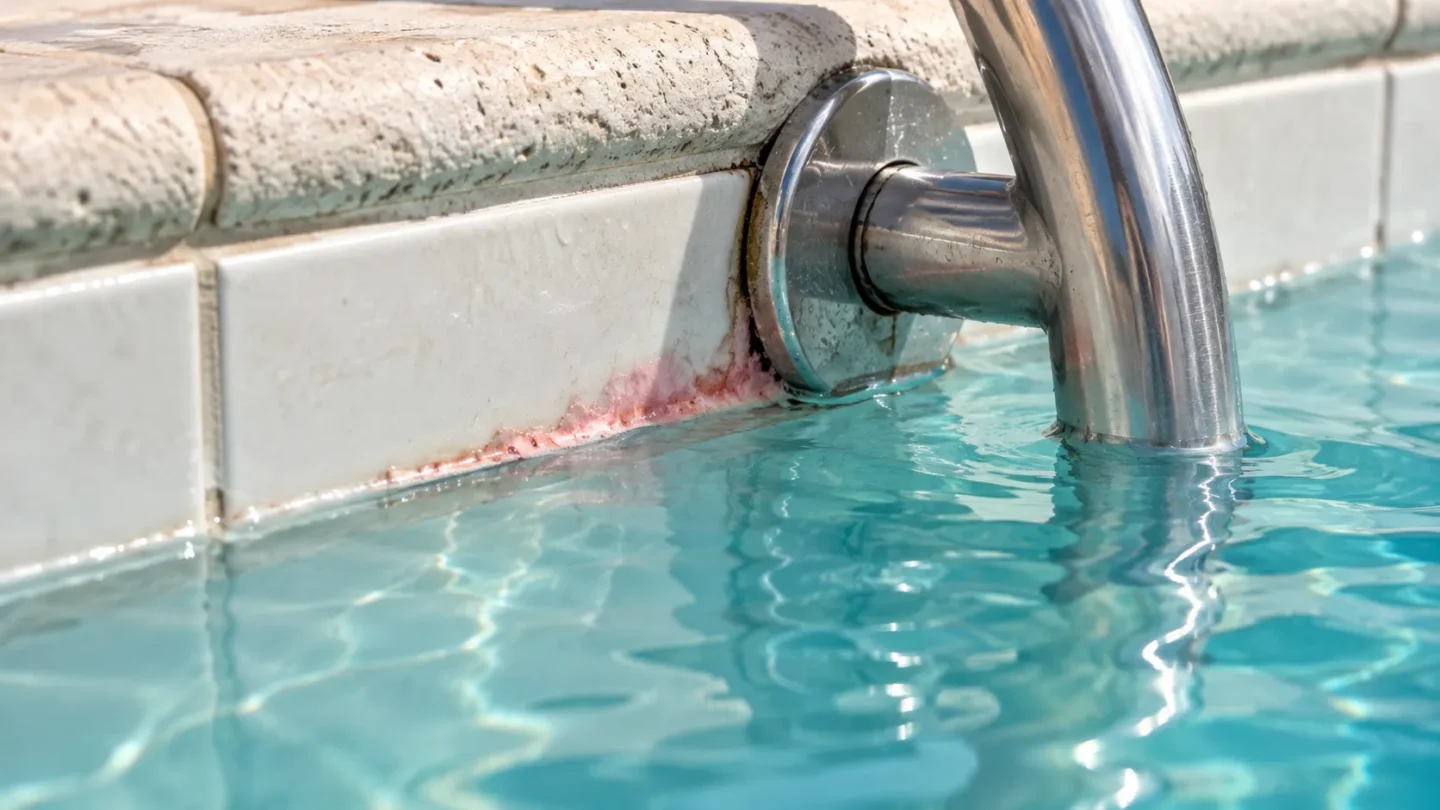
The pink streaks show up where nothing else grows. Behind the ladder, in the creases of the skimmer, along a return fitting, down inside the pipes where you can’t even see them, a pinkish-orange slime, slick to the touch, clinging on in the spots the water barely moves.
Most people see pink and reach for algaecide, because it’s called pink algae and algaecide is what you use on algae.
Weeks later it’s still there, they’ve dumped three bottles of product into the pool, and they’re convinced they have some super-resistant strain.
They don’t. They have the wrong name for the problem. Pink algae is not algae at all.
It’s a bacterium, Serratia marcescens, most of the time, and almost everything true about fighting algae is false about fighting this. The name is the trap. Shake the name and the whole treatment reorganizes itself around what this thing actually is.
It Doesn’t Need Light, Which Is Why It’s in Your Pipes
Algae is a plant. It photosynthesizes, so it needs sunlight, and that single fact governs where green and mustard algae grow and how you fight them, with shaded walls and sunny steps. The light exposure is a lever you can pull.
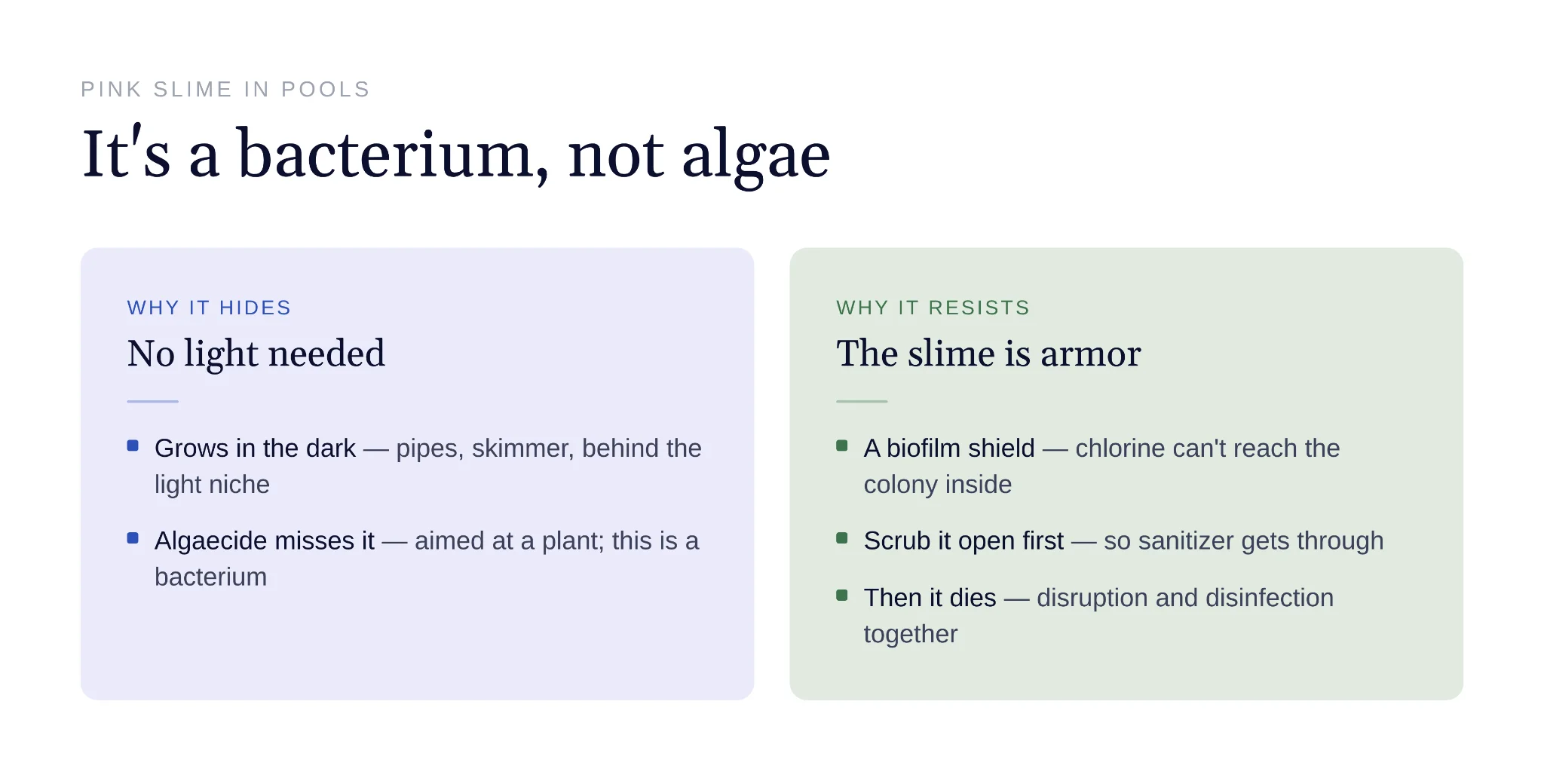
Serratia is a bacterium, and it doesn’t photosynthesize. Light is irrelevant to it.
It grows perfectly well in total darkness, which is exactly why it turns up in the places algae never would: inside the plumbing, down in the skimmer basin, behind the light niche, in the guts of the filter, under the lip of a fitting where sun has never reached.
The classic pink slime hides in the dark, cool, low-flow corners of the system, and a lot of what you’re seeing on the visible surface is the overflow from a colony living somewhere you can’t see at all.
That changes the whole geometry of the job. Green algae is a surface you can see and scrub. Serratia is a system-wide infection with a visible symptom, and treating only the pink you can see leaves the source untouched behind the wall.
The Slime Is Armor, and Algaecide Can’t Get Through It
Here’s the mechanism that explains every failed treatment.
Serratia builds a biofilm. The slime is a protective matrix the bacteria secrete around themselves, a physical shield that chlorine and chemicals struggle to penetrate.
The colony lives inside the slime, and the slime keeps the sanitizer out. This is the same trick that makes biofilm such a problem in medical tubing and industrial pipes, and it’s doing the identical job in your skimmer.
Algaecide is formulated to kill algae. Serratia is a bacterium wearing armor. The product is aimed at the wrong organism and can’t reach it through the biofilm anyway, so pouring it in accomplishes close to nothing. People read the failure as resistance. The reality is the treatment never made contact.
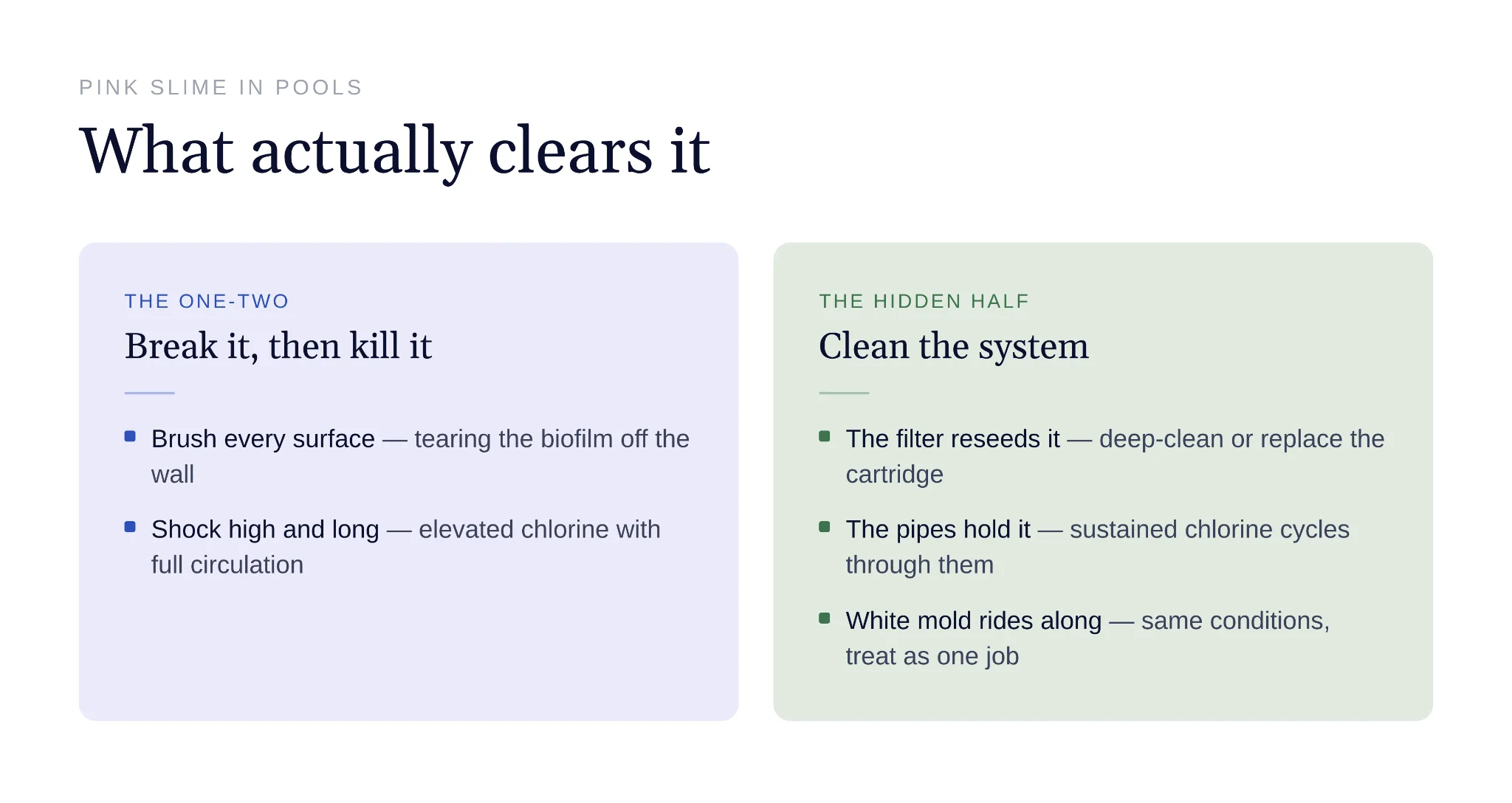
What gets through biofilm is a combination, and the physical half matters as much as the chemical.
You have to break the slime open, scrub it, physically disrupt the matrix, so the sanitizer can reach the bacteria sheltering inside. Brushing isn’t tidying up here. It’s the step that lets everything else work.
Scrub the biofilm off the surface, then hit the exposed colony with chlorine high enough to actually kill it, and the one-two of disruption-then-disinfection is the thing that clears it. Either half alone fails. Chlorine on intact biofilm bounces off. Scrubbing without killing just spreads live bacteria around to reseed.
It’s Telling You the Sanitizer Slipped
Serratia takes hold when the chlorine’s been low. That’s the condition it waits for.
A pool held at proper sanitizer levels, circulating well, doesn’t grow pink slime, the bacteria can’t establish before the chlorine kills them. Pink showing up means there’s been a window: a stretch of hot weather that burned through chlorine faster than it was replaced, a pump running too few hours a day, a neglected week, a dead zone where circulation never reaches.
The slime is a readout of a sanitation gap, and the gap is usually both a chemistry problem and a circulation problem at once.
So two things get fixed, not one.
The chlorine, obviously, goes back up to where it belongs and stays there. But also the flow.
Those low-circulation pockets where the slime sets up are low-circulation for a reason, and if they stay stagnant after you’ve cleared the outbreak, the outbreak comes back to the same corners.
Aim a return jet at the dead zone, run the pump longer, clear whatever was restricting flow. The stagnation is half the cause.
The Filter and the Pipes Are Part of the Infection
This is the step that separates the people who clear it once from the people who fight it all summer.
The biofilm that’s visible on the wall has a twin inside the equipment. The filter, especially a cartridge or a sand bed harboring Serratia, will reseed the whole pool days after you’ve scrubbed every surface clean, because every time the pump runs, it’s pumping live bacteria back out through the returns.
Clean the filter hard as part of the treatment. A cartridge may need a deep soak or outright replacement; a sand or DE filter needs a thorough backwash and ideally a chemical clean. Treating the water while the filter stays infected is bailing a boat with the hole still open.
The plumbing’s the harder part because you can’t reach it. Running a high chlorine level through the system for an extended period, with the pump circulating the whole time, is what pushes sanitizer into the pipes and fittings where the slime hides.
This is why the shock on pink slime is held high and held long — not a quick hit, but elevated chlorine sustained for a day or more with full circulation, so the treated water actually cycles through every dark length of pipe the colony’s living in.
Brush, clean the filter, shock high, keep it circulating, and give it the time to reach the hidden ground.
White Mold Often Rides Along
Pink slime travels with company. A white, tissue-ish, mucousy growth (white water mold) shows up in the same conditions and frequently in the same pools at the same time, drifting in the water or clinging in the same low-flow spots as shredded-looking white bits.
It’s a different organism, but the conditions that invite one invite the other, and the treatment overlaps almost entirely: disrupt it physically, clean the system, shock high and long, fix the circulation.
If you’ve got pink, check for the white, and treat them as one job. Clearing the pink while leaving the white means you’re back in the same fight in a fortnight.
A Word on the Health Side
Serratia marcescens is an opportunistic human pathogen. In hospitals, it’s associated with urinary tract, respiratory, and wound infections, mostly in people already vulnerable.
That reads scarier than the backyard reality usually is. For a healthy swimmer, pink slime in a pool is not a medical emergency, and a properly chlorinated pool kills it.
The point isn’t to panic. The point is that this is a genuine bacterium with genuine infection potential, not a cosmetic green smudge, and it earns a bit more seriousness than “unsightly.”
Keep people out of a pool with an active bloom until it’s cleared and the chlorine’s back to normal, and don’t let a kid with a cut or anyone immunocompromised swim in it while it’s visibly growing.
Why It Keeps Coming Back for Some People
A pool that grows pink slime once, clears it, and grows it again next month almost always has one of two things still wrong.
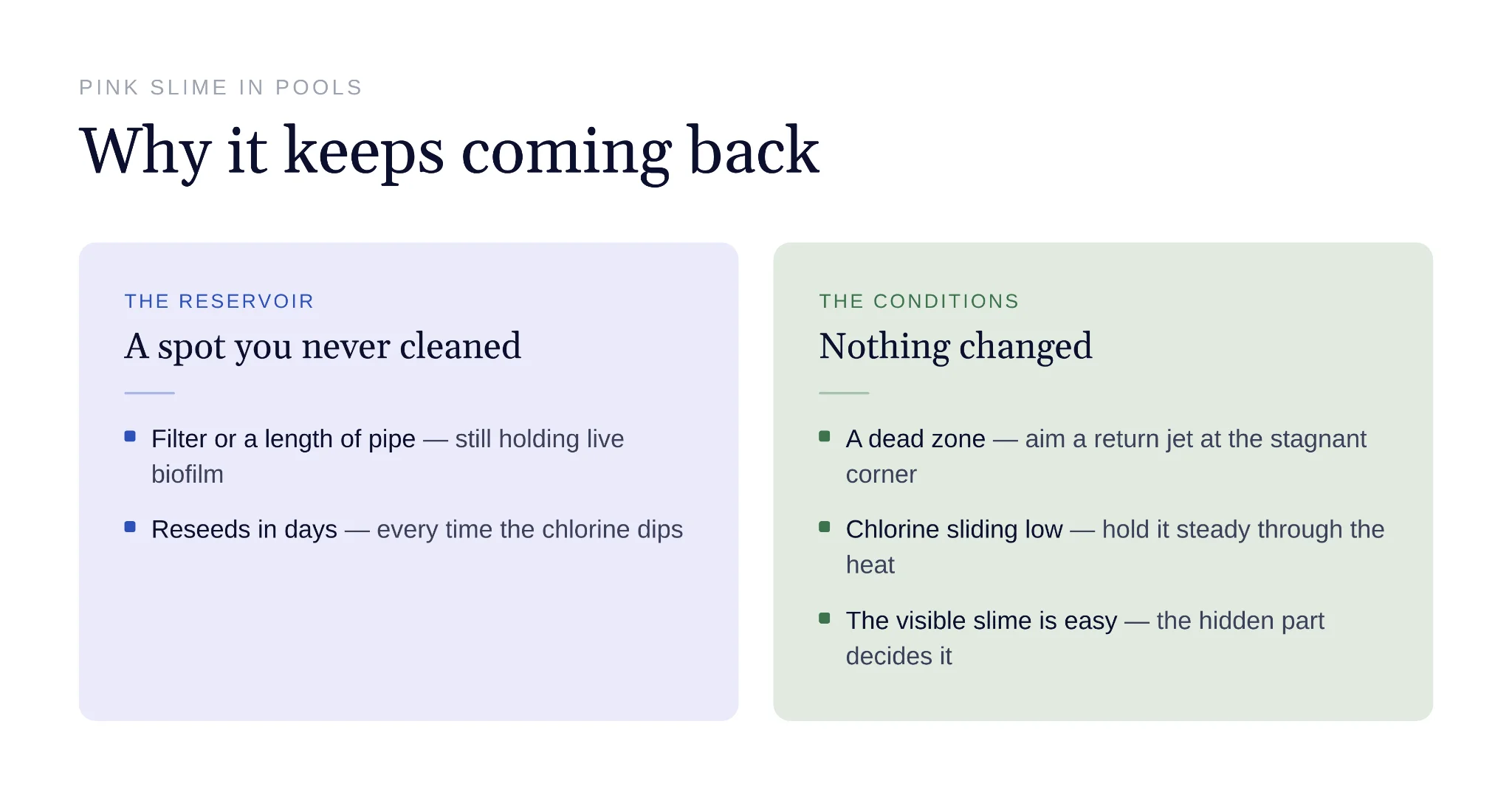
The system never got fully cleaned, the filter or a stretch of pipe still holds a reservoir of biofilm, and it reseeds every time conditions dip.
Or the conditions themselves never changed: the same dead zone, the same under-run pump, the same chlorine sliding low in the heat. Serratia is a recurrence specialist precisely because it hides where treatment is easy to skip and thrives the moment maintenance lapses. Clearing the visible slime is the easy 80 percent.
The hidden 20 (the filter, the pipes, the stagnant corner, the discipline on chlorine) is what decides whether it stays gone.
Part of what lets the slime take hold is visible surface sitting undisturbed in the low-flow corners between manual cleanings. A cordless robotic cleaner working the floor and walls on a daily cycle keeps those surfaces agitated and clear, which removes one of the standing invitations.
Get all of it and pink slime is a one-time annoyance. Get only the part you can see, and it becomes the thing you fight every few weeks for the rest of the season, each time wondering why it won’t die, while the colony sits in the filter you never opened, waiting for the chlorine to dip again.
Get more pool and lawn care guides from Aiper on Google