How to Lower pH in a Pool (Without Over-Correcting)

When pool pH climbs above 7.8, chlorine loses much of its ability to kill germs, and the water starts to scale and irritate eyes. The fix is acid. The common mistake is adding the full dose at once, overshooting, and spending the next two days pushing pH back up.
The safer method is to test, add part of the dose, let the pump mix it, and retest before adding more. It takes a few extra hours and avoids a second chemical correction.
Why High pH Is a Problem
pH controls how well chlorine works. The CDC notes that as pH rises, chlorine’s ability to kill germs decreases, especially above 8.0.
High pH also shows up in ways you can see and feel. Water turns hazy, a white crust forms at the tile line, and swimmers complain about red eyes even when the chlorine reading looks normal.
Low pH causes the opposite set of problems. Below 7.0, chlorine works faster, but pipes, heaters, and metal fittings are more likely to corrode.
Target Numbers
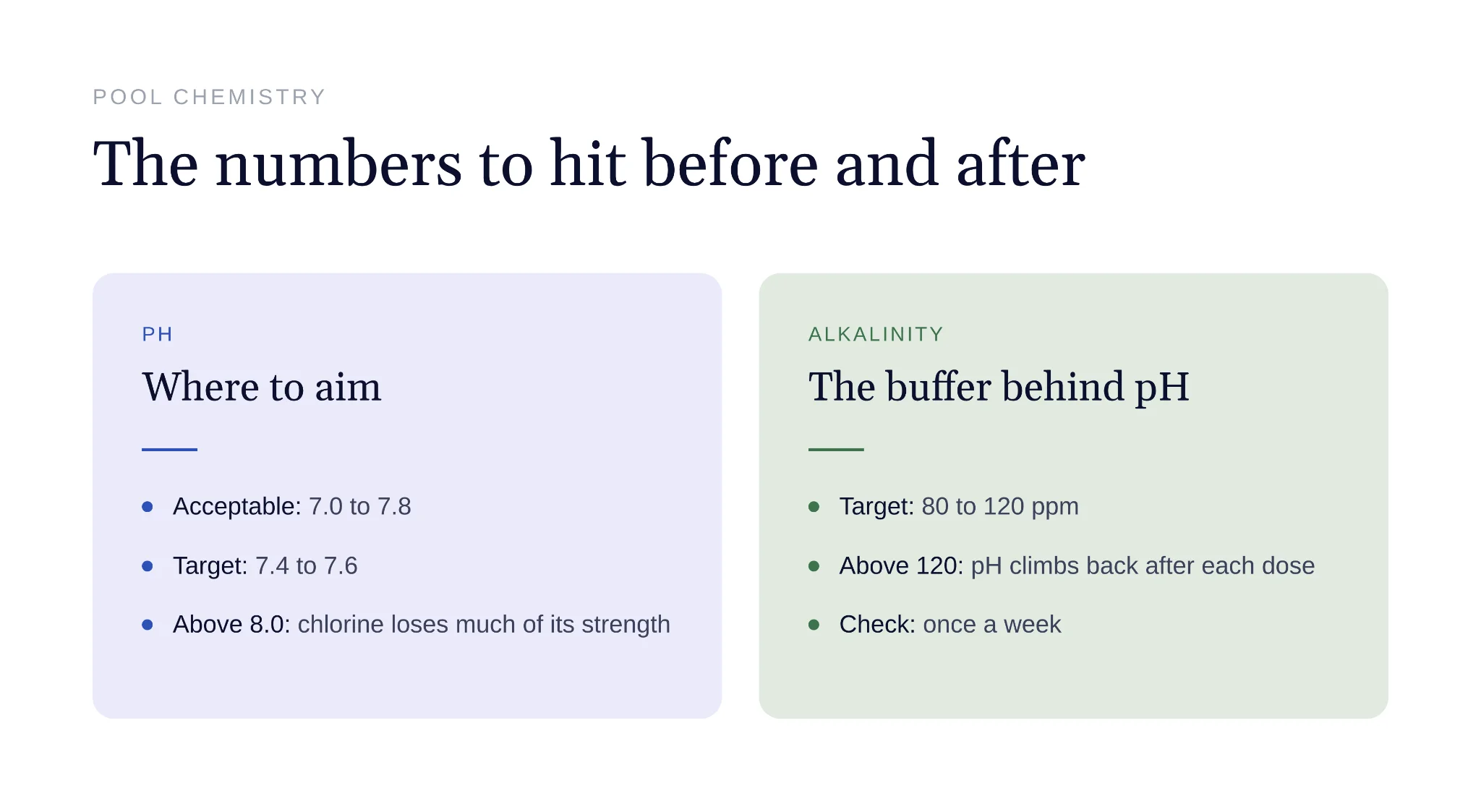
pH and total alkalinity move together, so test both before you add anything. Total alkalinity is the water’s buffer; it controls how easily pH moves when you add acid.
| Reading | Acceptable range | Recommended target | Check |
|---|---|---|---|
| pH | 7.0 to 7.8 | 7.4 to 7.6 | Every time you test chlorine |
| Total alkalinity | 60 to 180 ppm | 80 to 120 ppm | Weekly |
| Free chlorine | At least 1 ppm (2 ppm with stabilizer) | 2 to 3 ppm | Every time you test pH |
Ranges from the Florida Department of Health pool chemical standards and CDC guidance for home pools.
Aim for the middle of the recommended pH range. A pool at 7.5 has room to drift in either direction before it needs attention.
Muriatic Acid or Dry Acid
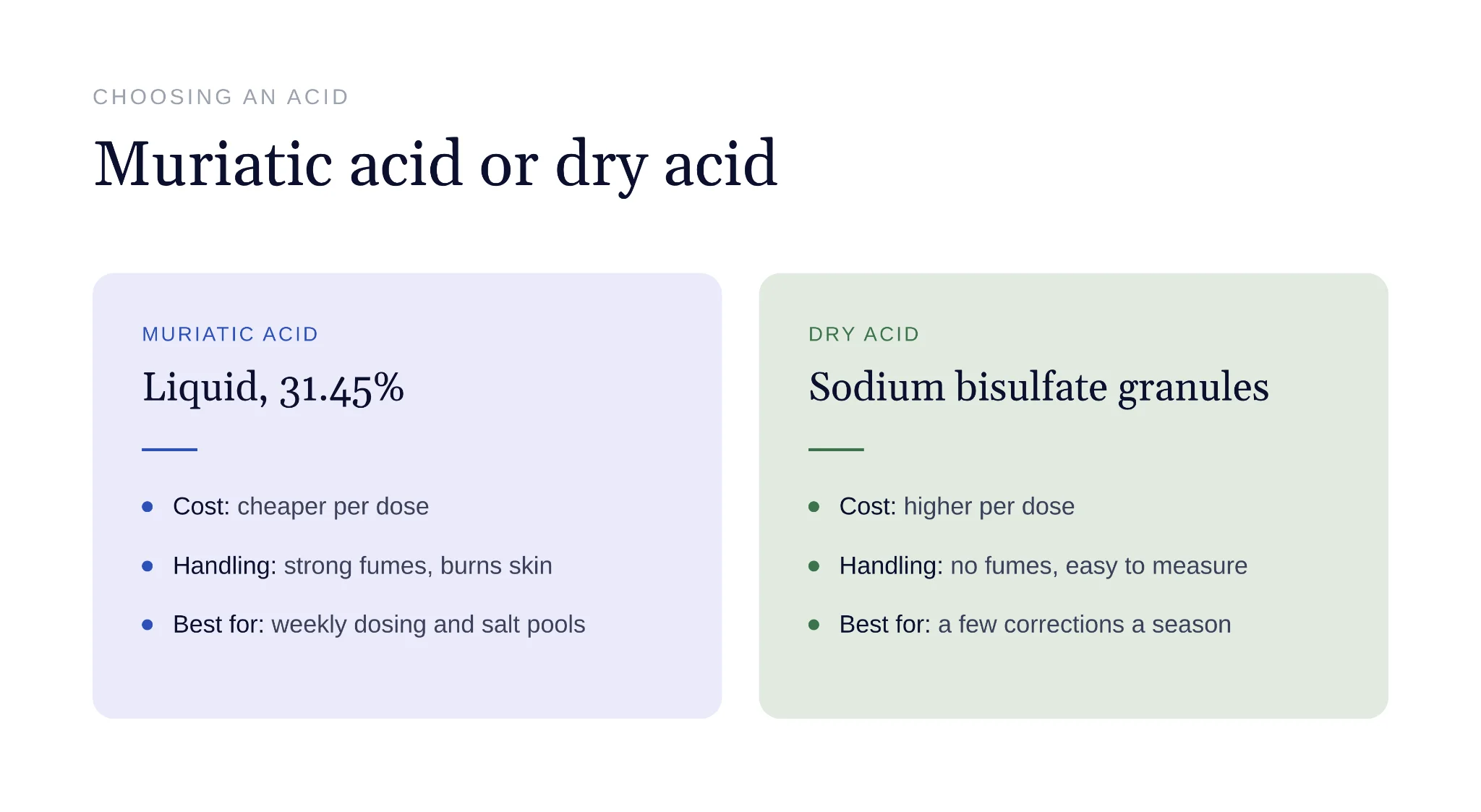
Both products lower pH and total alkalinity. The choice comes down to handling and how often you dose.
- Muriatic acid is liquid hydrochloric acid, usually sold at 31.45% strength. It is cheaper per dose and adds nothing to the water except chloride, but it gives off strong fumes and burns skin on contact. Low-fume versions at 14.5% strength need roughly twice the volume for the same effect.
- Dry acid is sodium bisulfate, sold as granules labeled “pH decreaser” or “pH down.” It is easier to measure and store, and there are no fumes. Over many doses, it builds up sulfates in the water, which can damage plaster and salt cells over time.
For a few corrections a season, dry acid is the easier choice. Pools that need acid every week, especially salt pools, usually do better with muriatic acid.
Check Alkalinity Before You Dose
If total alkalinity is above 120 ppm, pH will creep back up within a day or two of any acid dose. Lowering alkalinity first saves you from dosing the same pool over and over.
Acid lowers both readings at the same time. To bring alkalinity down without leaving pH too low, add acid in larger doses to reduce alkalinity, then run fountains, waterfalls, or return jets pointed at the surface. The splashing drives off carbon dioxide and raises pH back up while alkalinity stays down.
How Much Acid to Add
The dose depends on three things: pool volume, how high the pH is, and the strength of the acid. Estimate your volume first, because every dose chart is built on gallons.
You can use our pool volume calculator to do this.
For a rectangular pool, multiply length × width × average depth in feet, then multiply by 7.5 to get gallons. A 32 × 16 foot pool with an average depth of 5 feet holds about 19,200 gallons.
As a starting estimate, one chemical supplier puts the dose for a 15,000-gallon pool at about 9 ounces of 31.45% muriatic acid when pH is 7.6 to 7.8, 18 ounces at 7.8 to 8.0, and about 30 ounces at 8.0 to 8.4. For a 10,000-gallon pool, that works out to roughly 6, 12, and 20 ounces.
Treat any chart as the upper limit for your first dose. Add half, retest, and add the rest only if the reading calls for it. Pools with high alkalinity need more acid to move pH; pools with low alkalinity need less and drop faster.
How to Add Acid Step by Step
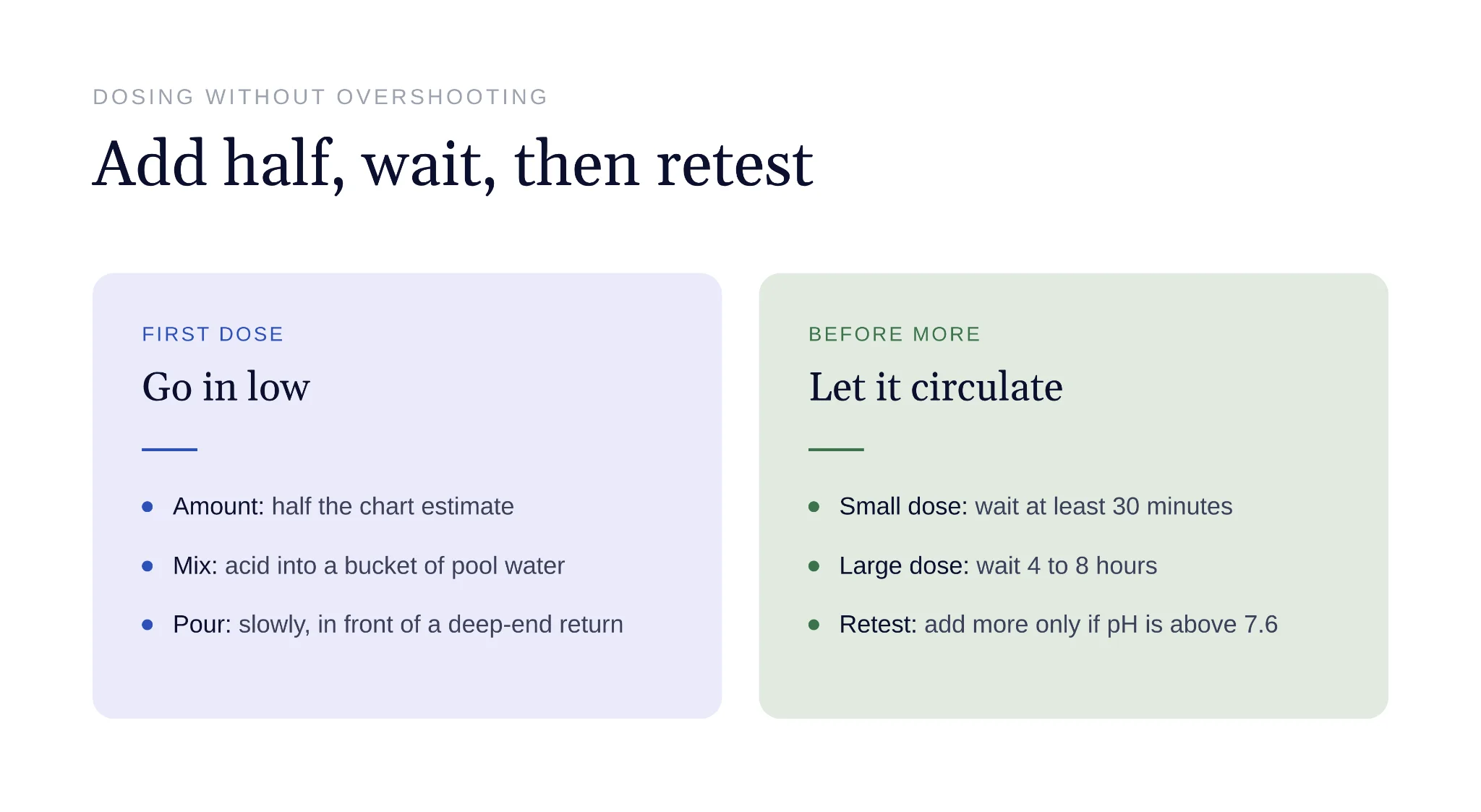
Most over-corrections happen during this step, when the full dose goes in at once, or the retest comes too early. Follow the order below every time.
- Put on safety gear. Wear chemical splash goggles and acid-resistant gloves, and work outdoors or in a well-ventilated area.
- Test pH and total alkalinity. Use a fresh test kit or strips and write down both numbers.
- Measure half the estimated dose. Use a dedicated plastic measuring cup that never touches chlorine products.
- Dilute in a bucket of pool water. Fill a plastic bucket about three-quarters full with pool water, then pour the acid into the water. Never add water to a pool chemical, because the reaction can be violent.
- Pour slowly in front of a return jet in the deep end. Keep the pump running so the return spreads the acid across the pool. Pour close to the water surface to avoid splashing.
- Keep the acid off the floor. Acid is heavier than water and can sit on the floor long enough to etch plaster. Brush the area where you poured, or run a robotic cleaner to keep the water moving along the floor. The Aiper robotic pool cleaners scrub the floor and walls as they run, which keeps water moving along the floor after a chemical dose.
- Wait before retesting. After a small dose, wait at least 30 minutes with the pump running. After a larger dose, wait 4 to 8 hours so the pump can circulate the full volume.
- Retest and decide. If pH is still above 7.6, add a second, smaller dose and repeat steps 4 through 7.
Keep swimmers out until the retest shows pH back in range.
Handling Acid Safely
Pool chemicals send thousands of people to the emergency room each year. The CDC recommends these steps for anyone handling them at home:
- Read and follow the directions on the product label.
- Wear goggles and a mask when the label calls for them.
- Store pool chemicals where children and pets can’t reach them.
- Keep young children away while you work.
- Never mix different pool chemicals, especially chlorine products with acid.
Store acid away from chlorine in a cool, dry spot, with the cap tight. Mixing the two, even through a shared scoop or a spill on a shelf, releases chlorine gas.
If pH Drops Too Low
A reading below 7.2 means the dose overshot. Fix it before anyone swims, because low pH stings eyes and starts corroding metal parts.
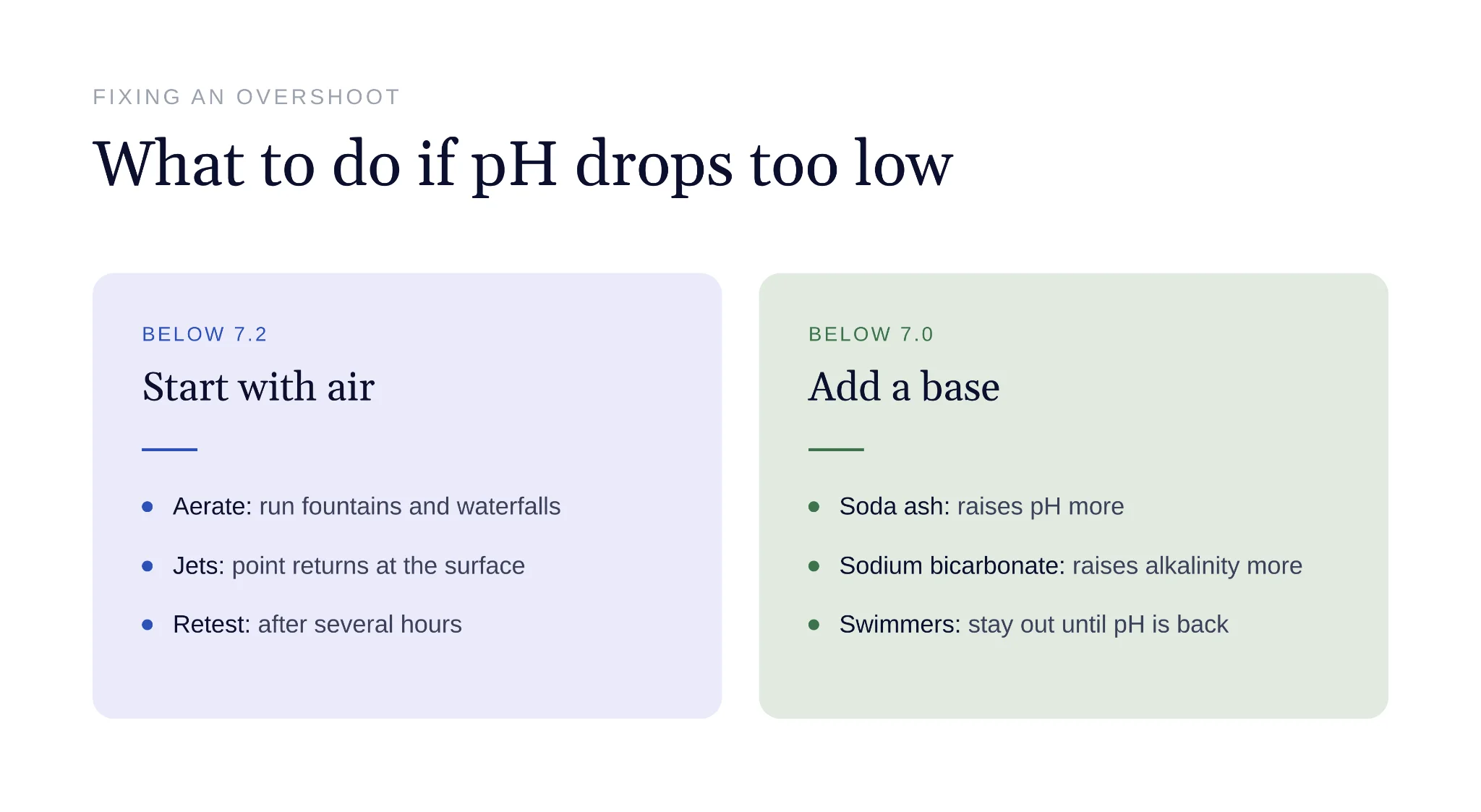
Aerate first if alkalinity is still in range. Running water features and pointing return jets at the surface raise pH without adding chemicals. Retest after several hours.
Add a base if pH is below 7.0 or aeration isn’t enough. Raise pH with soda ash or sodium bicarbonate. Soda ash raises pH more; sodium bicarbonate raises alkalinity more. Add it in small amounts following the label, with the pump running, and retest after a few hours.
Why pH Keeps Rising
Some pools need acid every week, and the cause is usually built into the pool itself. If pH climbs back within days of a correction, check for these:
- Salt chlorine generators. The chlorine-making process pushes pH up steadily while the cell runs.
- Aeration. Waterfalls, spillovers, and fountains drive off carbon dioxide and raise pH.
- New plaster. Fresh plaster raises pH for its first several weeks.
- Fill water. Tap water with high pH or alkalinity raises both every time you top off.
- High alkalinity. Anything above 120 ppm keeps pushing pH back up.
For these pools, a small weekly acid dose based on a test holds pH steadier than waiting for it to drift high and correcting all at once.
Get more pool and lawn care guides from Aiper on Google