How to Lower Alkalinity in a Pool (and When You Actually Need To)

Half the people who lower their alkalinity don’t need to. And when alkalinity runs low instead, soda ash vs baking soda in pools shows which powder to use.
They saw a number above 120 on a test strip, panicked, and dumped acid in without checking whether anything was actually wrong.
The other half ignores a real problem for weeks because the water still looks fine, until the pH won’t budge no matter what they add, and the tile line starts feeling rough under a thumb. Both groups are reacting to a number instead of to what the number is doing. Lowering alkalinity often nudges pH down as a side effect, so it’s worth reading how to lower pH in a pool as a companion step.
Total alkalinity isn’t the thing you’re trying to fix.
It’s the thing that decides whether everything else holds steady or bounces around. Lowering it is a real, useful move, but only when the water is actually telling you it’s necessary, not just because a strip turned a darker shade of blue than the chart said it should. High alkalinity is one of the main drivers of scale formation, which is why how to remove calcium silicate scale from pool surfaces is worth reading alongside it.
What High Alkalinity Actually Costs You
The textbook range is 80 to 120 ppm. Above that, a few things start happening, and they don’t all show up at once.
pH gets stubborn. This is the big one. High alkalinity buffers pH so aggressively that it resists moving even when you throw acid at it. You add a dose, test an hour later, and it’s barely shifted. People respond by adding more acid, which is exactly backward. You’re fighting the buffer instead of adjusting it.
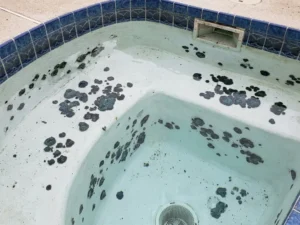
Scale starts forming. Calcium carbonate drops out of solution more readily when alkalinity runs high, especially paired with hard water or warm temperatures. It shows up first at the waterline, then on heater elements, where it actually costs money, a scaled heat exchanger loses efficiency fast and can fail outright.
Cloudiness creeps in for no obvious reason. Chlorine works less efficiently in water that’s chemically locked at the high end, so you can be dosing normally and still losing the clarity battle.
None of this happens instantly. It builds. Which is exactly why so many people misjudge the urgency in both directions.
The Case for Leaving It Alone
Here’s the part most guides skip: a reading of 130, even 140, isn’t automatically a fire to put out.
If your pH is holding in the 7.4–7.6 range without a fight, your water is clear, and your chlorine is doing its job at normal dosing, you don’t have a problem.
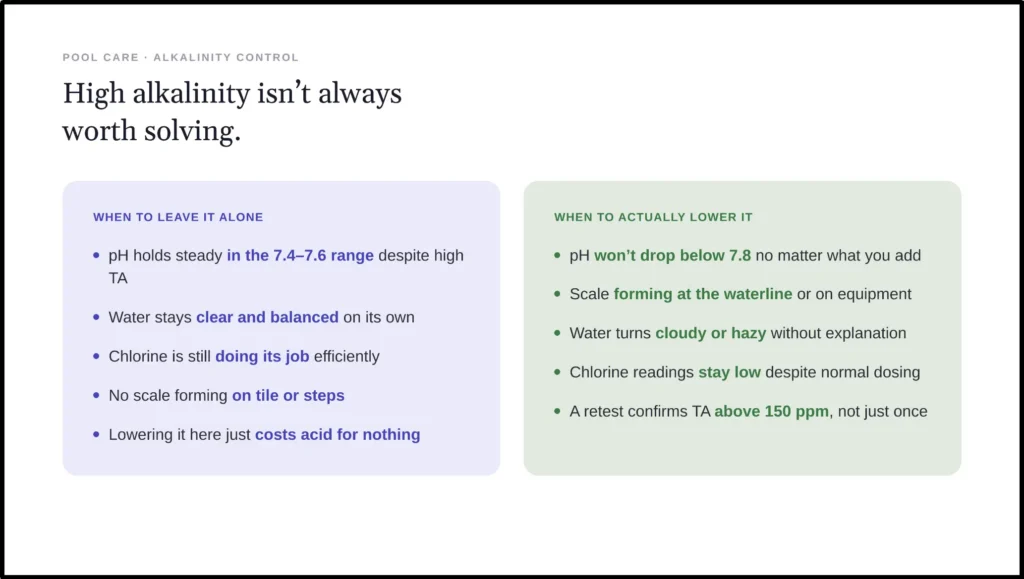
You have a number that’s slightly outside a textbook range, while every practical indicator says the water is fine. Dumping acid into chemically stable water to chase a number on a chart is how people end up bouncing their pH low and starting a whole new fight they didn’t need.
The actual triggers worth acting on: pH that won’t drop below 7.8, no matter what you add. Visible scale forming at the tile line or on equipment.
Chlorine readings that stay low despite dosing that’s worked fine for months. A retest, not a one-off strip, an actual retest a day later, confirming alkalinity sitting above 150.
If you’ve got one or more of those, proceed. If you’ve just got a slightly high number and nothing else, test again in a week before you touch anything.
The Tool Is Acid
Lowering alkalinity comes down to adding acid, and you’ve got two real options.
Muriatic acid is liquid hydrochloric acid, sold cheap at any pool store, and it’s what most experienced owners reach for. It reacts fast, drops both pH and alkalinity together, and costs a fraction of the alternative.
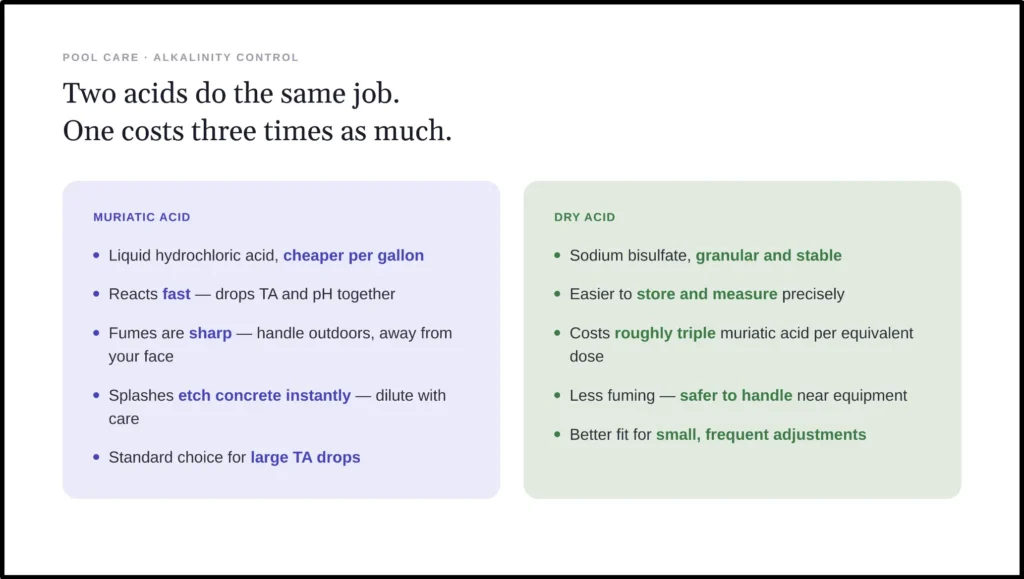
The tradeoff is handling. The fumes are sharp enough to back away from, and a splash on concrete will etch it within seconds. Outdoors, gloves and eyes away from the container when you pour.
Dry acid (sodium bisulfate) is granular, easier to measure, and far gentler to be around. It also costs roughly three times as much per equivalent dose.
For small, routine adjustments, it’s worth the premium. For a real correction on a pool that’s badly out of range, the cost difference adds up fast.
Most people doing this regularly land on muriatic acid for anything beyond a minor tweak.
The Slug Method
This is the part that actually determines whether your acid works or gets wasted.
Turn the pump off first. Pour the full dose into one spot, the deepest point in the pool, away from steps, lights, and liner seams, and walk away. Let it sit undisturbed for 30 to 60 minutes before you turn the circulation back on.
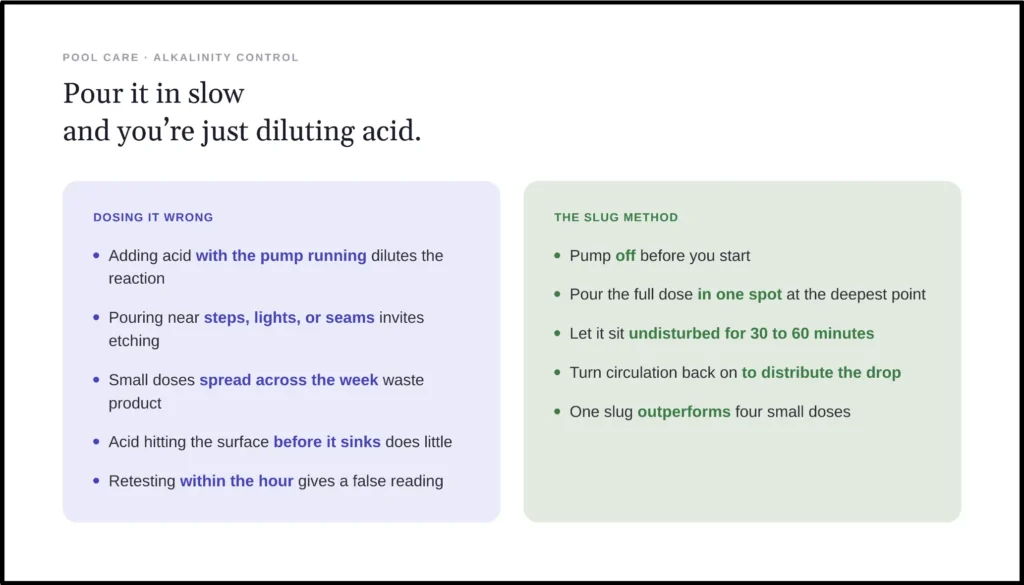
The reason this works better than slow dosing across the whole pool is that concentrated acid sitting in one spot reacts fully against the water immediately around it before it ever gets diluted.
Add the same total amount while the pump is running, spread thin across the whole volume, and you’re fighting dilution the entire time. The reaction happens, but it happens against far more water per molecule of acid, which means you need more acid to get the same drop.
People who add acid a little at a time, running pump day after day, are spending more money to get fewer results.
One slug, properly placed, beats four small doses every time.
Bringing pH Back Up Without Undoing the Work
Acid drops pH and alkalinity at the same time.
Sometimes that’s exactly what you want. Both were high. Sometimes you only need the alkalinity down, and now your pH has dropped further than you’d like.
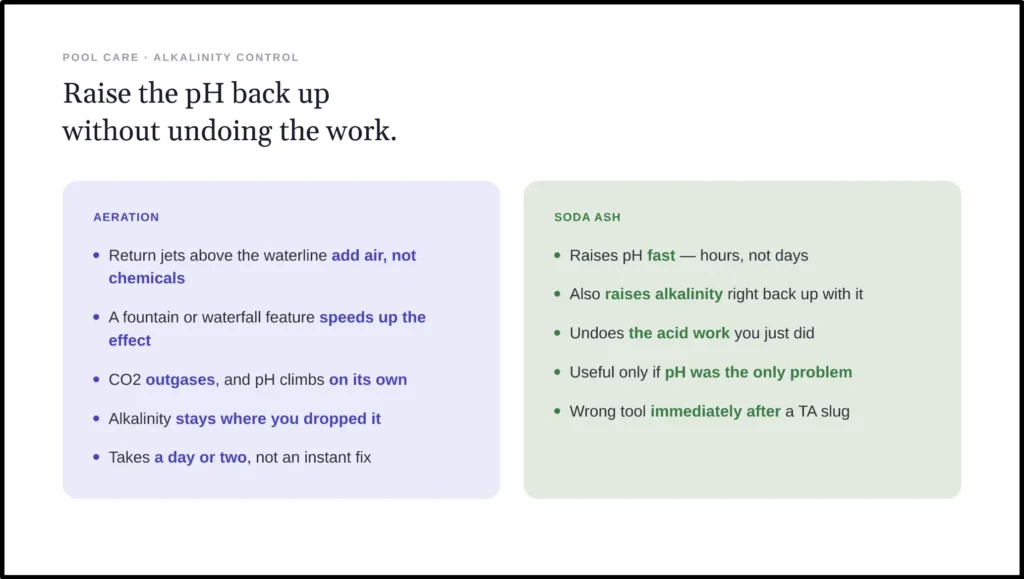
Don’t reach for soda ash to fix that. Soda ash raises pH fast, but it raises alkalinity right back up with it, which erases the work you just did.
Aeration is the actual fix. Return jets angled above the waterline, a fountain feature, anything that agitates the surface and works air into the water, this drives off dissolved CO2, and pH climbs back up on its own without touching alkalinity at all.
It’s slower, a day or two instead of an hour, but it’s the only method that moves pH without dragging alkalinity with it.
When to Retest
Not in the next hour. The acid needs time to fully react and circulate, and testing too soon just measures a transitional state that isn’t where the water is going to settle.
Wait at least four to six hours after circulation resumes. Overnight is better.
Test again the next day before deciding whether you need a second dose, and if you do need one, repeat the slug method rather than topping off with a smaller amount while the pump runs.
Less to Fight With Between Tests
Chemistry problems compound when there’s more organic load in the water for chlorine and pH to fight against, bather waste, sunscreen, leaves, and the film that builds on walls between cleanings. A mechanically clean pool holds its chemistry more predictably, which means fewer surprise swings and less acid spent correcting things that wouldn’t have drifted as far in the first place.
Aiper’s robotic pool cleaners handle that physical side on their own schedule — floor, walls, and waterline, so the water has less working against it between the tests you actually remember to run.
Get more pool and lawn care guides from Aiper on Google