Pool Chlorine vs Bleach: What the Concentration Difference Means

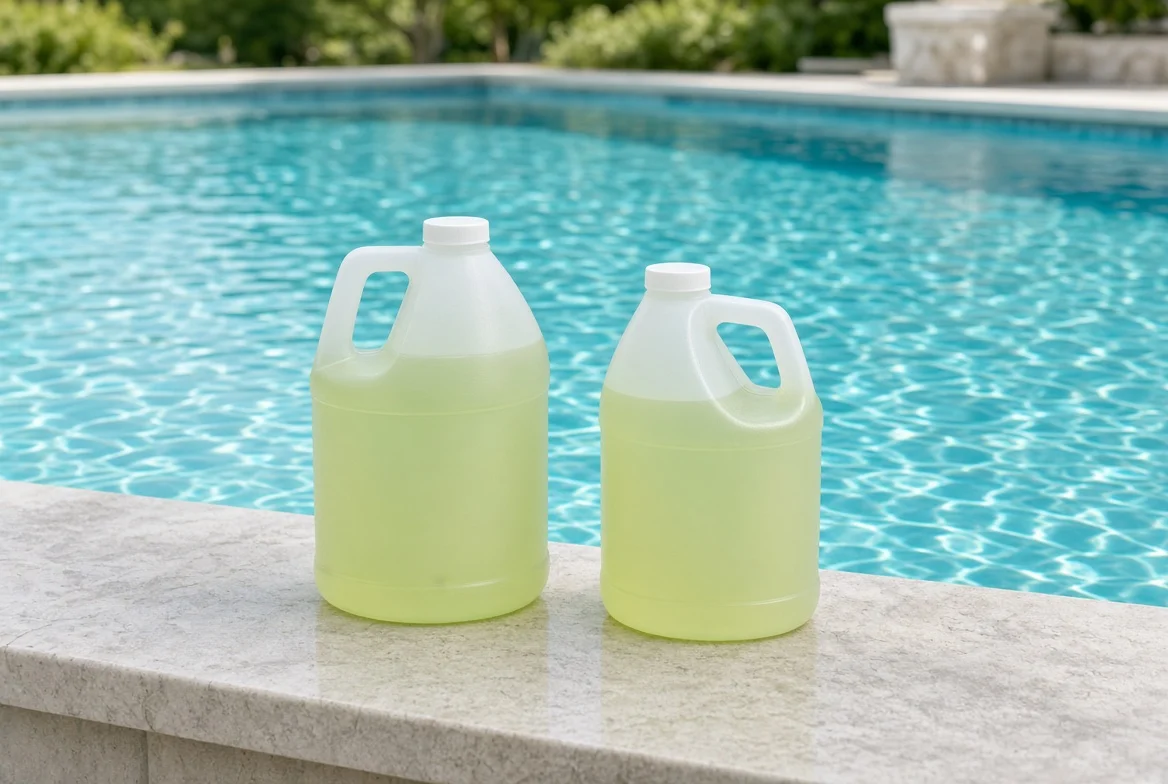
Someone at the pool store will tell you that bleach isn’t made for pools. Someone in a forum will tell you it’s identical and the pool store is robbing you. Both are describing the same molecule and arguing about the packaging.
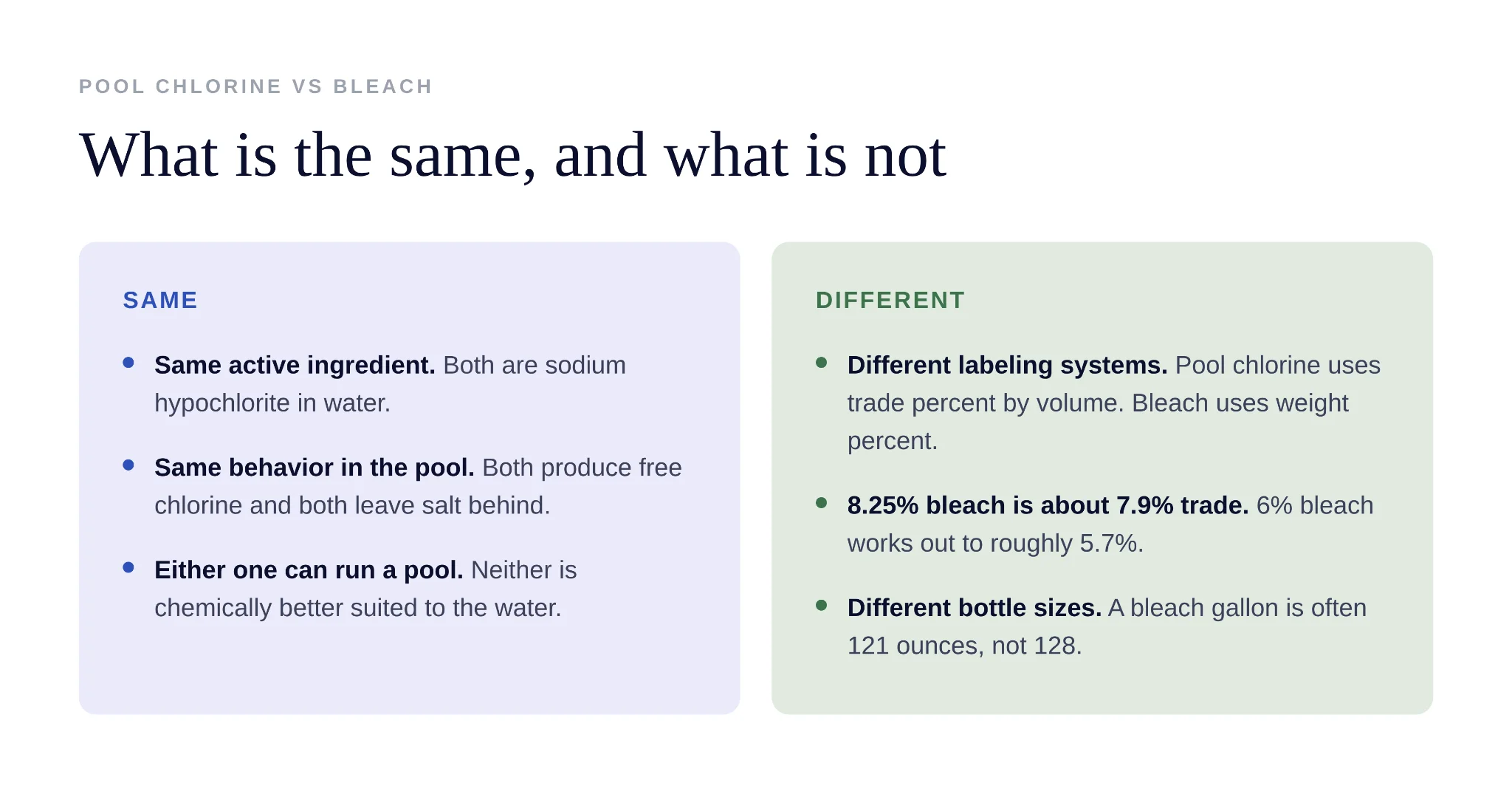
The active ingredient in liquid pool chlorine and household bleach is sodium hypochlorite. Same compound, same behavior in water, same free chlorine. What differs is the concentration, what else is in the bottle, how quickly it degrades, and how it’s labeled.
You can run a pool on either one. But you can’t switch between them using the same dose. Do that and you’ll either underchlorinate the pool or overshoot your target. The difference is mostly arithmetic.
Why Pool Chlorine and Bleach Have Different Concentrations
Liquid pool chlorine is sold by trade percent, also called available chlorine. It’s a volume-based measure: grams of available chlorine per 100 milliliters of product. A 12.5% jug means 12.5 grams of available chlorine in every 100 mL.
Household bleach is labeled by weight percent of sodium hypochlorite. An 8.25% jug means 8.25 grams of sodium hypochlorite per 100 grams of solution.
Those aren’t the same units. An 8.25% bleach works out to roughly 7.9% trade strength, while 6% bleach comes out near 5.7%. So compared with 12.5% pool chlorine, you need roughly sixty percent more 8.25% bleach by volume to deliver the same chlorine.
Bottle size matters too. A “gallon” jug of bleach is often 121 fluid ounces rather than 128, while pool chlorine commonly comes in a true gallon or 2.5-gallon carboy.
Put those differences together, and two containers labeled 12.5% and 8.25% don’t deliver chlorine in anything close to that ratio.
How to Calculate the Right Chlorine Dose
There’s one relationship worth remembering:
One gallon of liquid chlorine at X trade percent, added to 10,000 gallons of water, raises free chlorine by approximately X ppm.
So one gallon of 12.5% chlorine added to a 10,000-gallon pool raises free chlorine by about 12.5 ppm.
Scale that for normal dosing. In a 20,000-gallon pool, one gallon of 12.5% chlorine adds roughly 6 ppm. If you want a 2 ppm increase, you need about a third of a gallon, or 42 ounces.
Now use 8.25% bleach at its true strength of roughly 7.9% trade. One gallon adds about 3.9 ppm in the same 20,000-gallon pool. To raise free chlorine by 2 ppm, you need about 65 ounces.
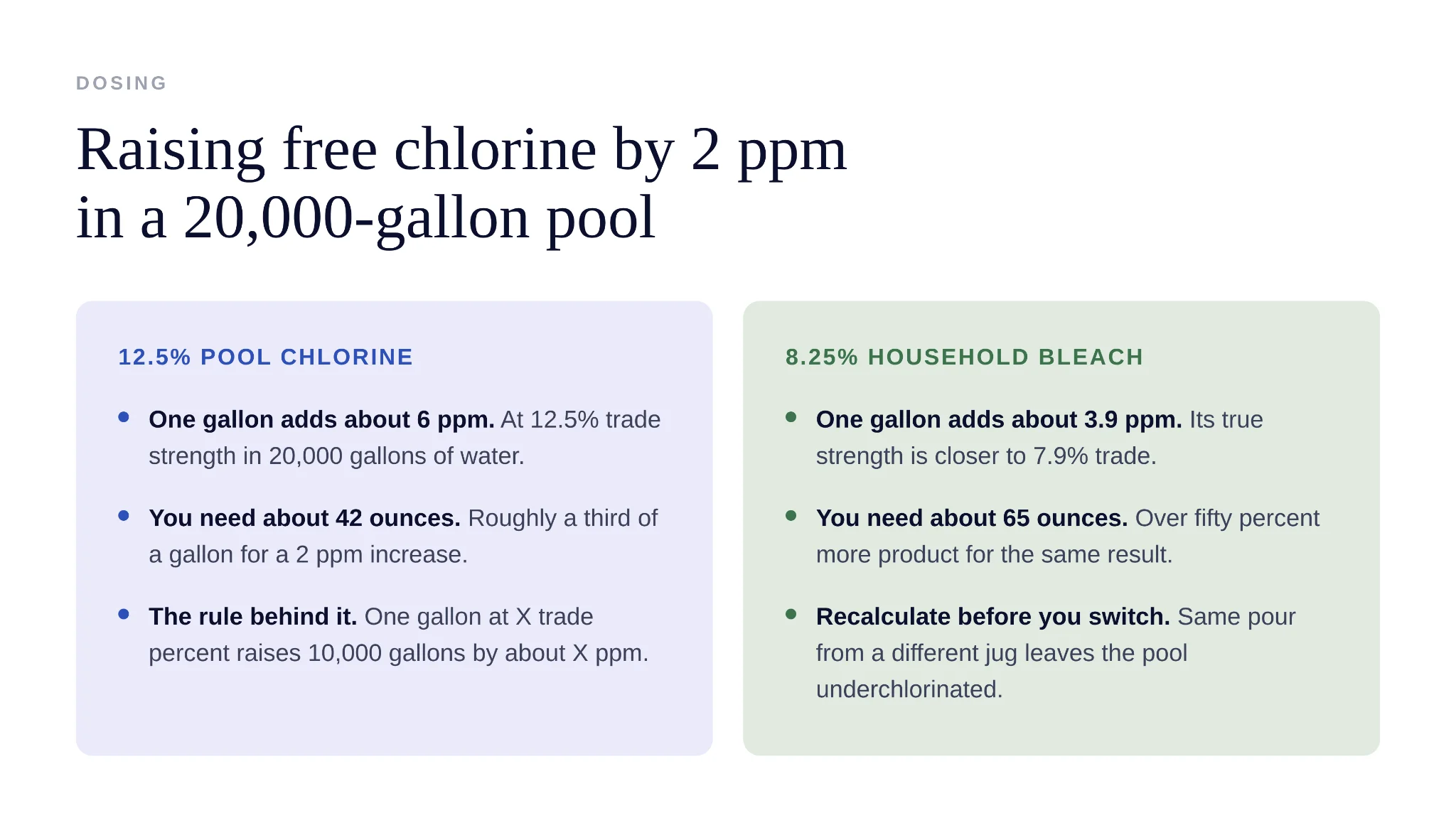
Forty-two ounces versus sixty-five. That’s the practical difference, and why switching products without recalculating can leave a pool underchlorinated.
How Long Pool Chlorine and Bleach Last
Sodium hypochlorite decomposes in the jug. The two biggest factors are temperature and concentration.
Heat speeds up degradation. Higher concentrations also degrade faster, which means a 12.5% solution loses strength more quickly than a 6% solution stored under the same conditions.
That 12.5% jug was 12.5% when it was made. A jug that spent weeks on a hot delivery pallet and another month in a 100-degree shed may be considerably weaker by the time you use it.
This is one practical advantage of household bleach, and the same reason it anchors what the BBB pool method actually is. Grocery-store bleach often turns over quickly, sits in climate-controlled retail, and starts at a lower concentration that degrades more slowly. Fresh 7.5% bleach may outperform an old jug of 12.5% pool chlorine.
Check the manufacture date when possible. Buy quantities you’ll use within a few weeks and store them upright in a cool, shaded place rather than a hot pool shed.
What Different Chlorine Products Leave in Your Pool
Once chlorine gets consumed, other parts of the product remain in the water. That’s where the longer-term differences between chlorine sources matter.
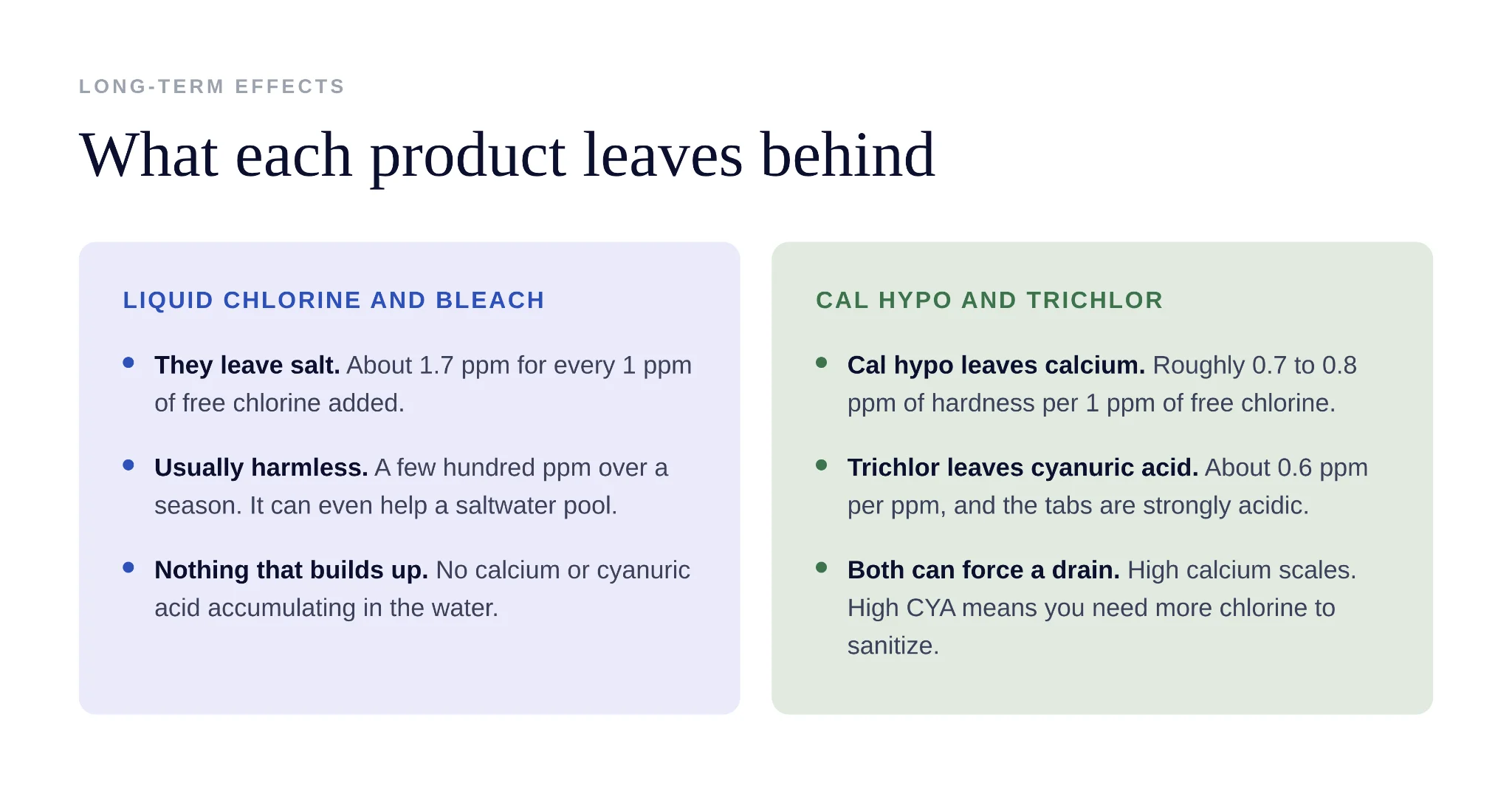
Liquid chlorine and bleach both leave salt, roughly 1.7 ppm for every 1 ppm of free chlorine added. Over a season, that can add a few hundred ppm. For most pools, it’s harmless, and in a saltwater pool it can actually contribute to the salt level.
Cal hypo, the granular shock, leaves calcium. It adds roughly 0.7 to 0.8 ppm of calcium hardness for every 1 ppm of free chlorine. That may be useful in soft water, but in areas with hard fill water, repeated use can contribute to scaling.
Trichlor tabs leave cyanuric acid, roughly 0.6 ppm per ppm of free chlorine, and they’re strongly acidic. Regular use can push CYA higher throughout the summer. As CYA rises, more free chlorine is needed to maintain the same sanitizing effect.
So the more useful comparison isn’t simply pool chlorine versus bleach. Both are liquid hypochlorite and primarily leave salt behind. Other chlorine products can add calcium or CYA that may eventually require water replacement to reduce.
What Kind of Bleach Is Safe for a Pool
Plain, unscented bleach is fine. Several products sitting beside it on the shelf aren’t.
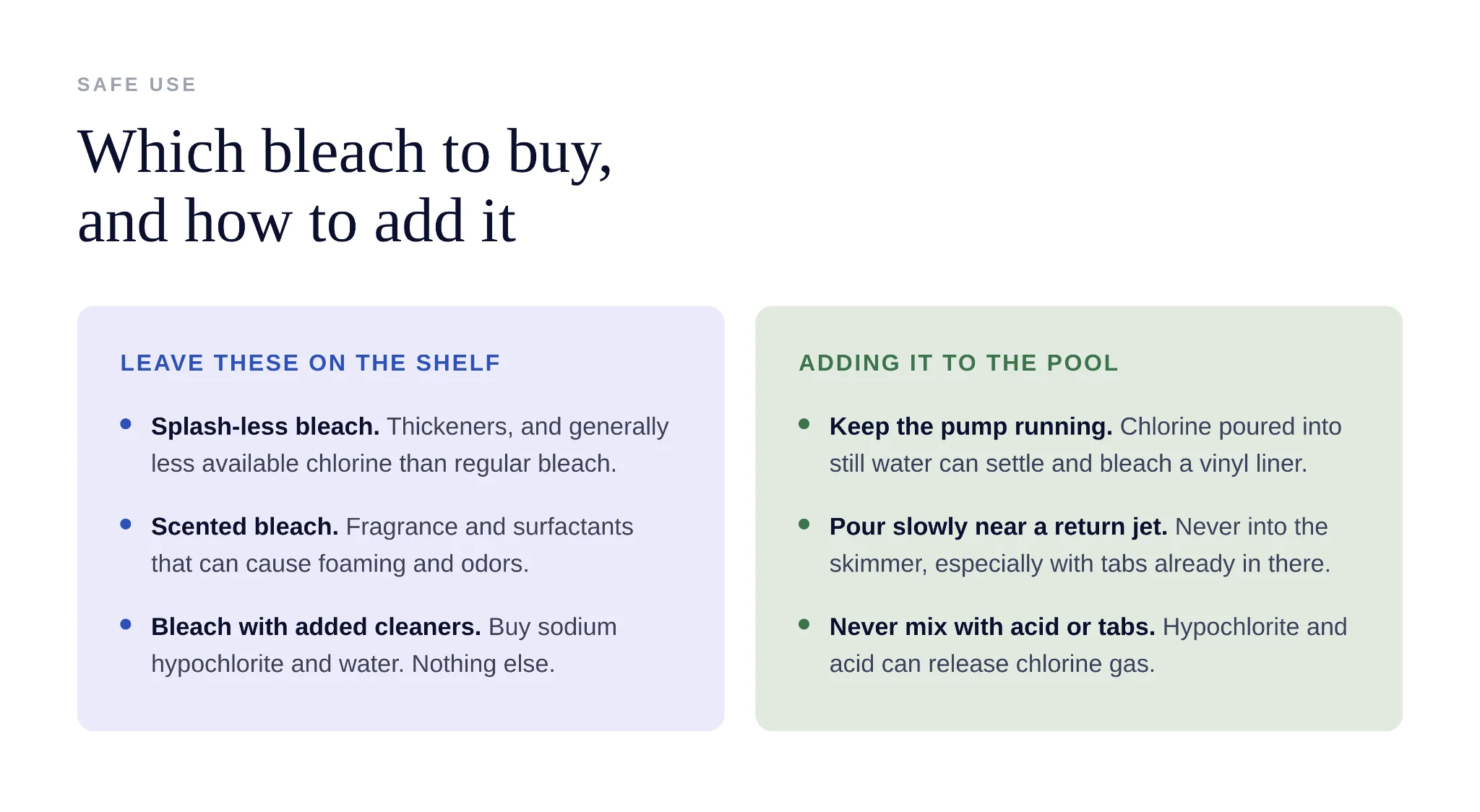
Splash-less bleach contains thickeners and generally has less available chlorine than regular bleach. Skip it.
Scented bleach contains fragrance compounds and sometimes surfactants that can cause foaming and unwanted odors.
Bleach with added cleaners shouldn’t go into a pool.
Look for a product containing sodium hypochlorite and water without added fragrances, thickeners, or cleaning agents.
And never mix hypochlorite with acid, trichlor, or cal hypo. Hypochlorite mixed with acid can release chlorine gas, while incompatible chlorine products can react violently. Don’t combine them in buckets, skimmers, or reused chemical containers.
How Pool Debris Increases Chlorine Use
Choosing the right chlorine is only half the equation. The other question is why the pool is consuming chlorine in the first place.
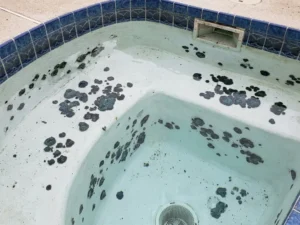
Free chlorine is lost mainly to UV exposure and organic material. Cyanuric acid helps manage UV loss. Organic demand comes from leaves, pollen, insects, sunscreen residue, algae, and biological material accumulating on pool surfaces.
Even a pile of leaves sitting on the bottom for several days creates additional chlorine demand. Remove that material, and there’s less for the chlorine to oxidize.
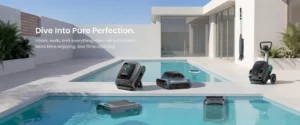
That’s why mechanical cleaning affects chemical use too. Running a robotic pool cleaner regularly removes organic material before chlorine has to deal with it.
A robotic pool cleaner cleans the floor, walls, and waterline. That last area matters because sunscreen oils and biological material can collect along the waterline.
Their fine filtration captures sand, pollen, and other small organic particles. Removing that fine organic material can reduce some of the demand being placed on the chlorine.
Running it regularly keeps the water clearer between chemical treatments.
A cleaner doesn’t replace chlorine. It reduces the amount of material you’re asking the chlorine to handle.
How to Add Liquid Chlorine or Bleach to a Pool
Keep the pump running while adding chlorine. Pouring concentrated chlorine into still water can allow it to settle, potentially bleaching a vinyl liner.
Pour slowly near a return jet so the chlorine disperses into moving water. Don’t pour it into the skimmer, particularly if chlorine tabs are already there.
Evening is generally better than the middle of the day. Chlorine added under strong midday sun immediately starts fighting UV loss, while an evening dose has overnight hours to work through the pool’s chlorine demand.
Rinse any splashes from the deck afterward. Hypochlorite can lighten stone, stain concrete, and bleach clothing.
Should You Buy Pool Chlorine or Household Bleach?
Compare the products based on how much usable chlorine you’re actually getting rather than the percentage printed on the front of the bottle.
Divide the price by the trade percentage and actual bottle volume to compare the cost per unit of available chlorine.
For example, a 128-ounce jug of 12.5% pool chlorine at $6 works out to about 48 cents per unit. A 121-ounce jug of 7.5% weight bleach at $5 provides roughly 6.7 comparable units, putting it around 75 cents per unit.
At those prices, pool chlorine is substantially cheaper. That’s often the case, especially if you have access to a refill station.
Bleach can still make sense for small pools, spas, people who use only small amounts at a time, or anyone without convenient access to fresh pool chlorine. Fresh bleach of a known strength can also be a better buy than old pool chlorine that has degraded in storage.
What you shouldn’t do is treat the two as interchangeable pours. Pick a product, calculate the correct dose for your pool volume, and keep that number somewhere near the equipment.
If you switch products, recalculate before the first pour rather than after the water tells you you got it wrong.
Get more pool and lawn care guides from Aiper on Google