How To Store Pool Chemicals Safely (And What Shouldn’t Sit Next To What)

Pool chemicals are the most dangerous thing most homeowners keep on the property, and they get stored like paint cans.
The failures are not subtle. A garage fire that starts on a shelf with nobody home. Chlorine gas filling a closed shed and putting someone in an ambulance. Ten years of corrosion on every tool within fifteen feet of an acid jug, found all at once when the garage door spring snaps.
None of it requires a handling mistake. It only requires two containers sitting closer together than they should have been.
The Two Chlorines That Can Start A Fire
Calcium hypochlorite and trichlor are both chlorine, and they are chemically incompatible. Mixing even small amounts of one into the other can produce fire and toxic gas.
That pairing sits behind a real share of the pool chemical fires that fire departments respond to every summer. It does not take a spill. Dust from a shock bag drifting into an open tab bucket on the shelf below is a starting point. Incident reports describe the same shape over and over: a bag stored above an open bucket, a small amount of powder somewhere nobody looked, and a fire hours after the last person left the building.
The rules for these two are absolute rather than advisory.
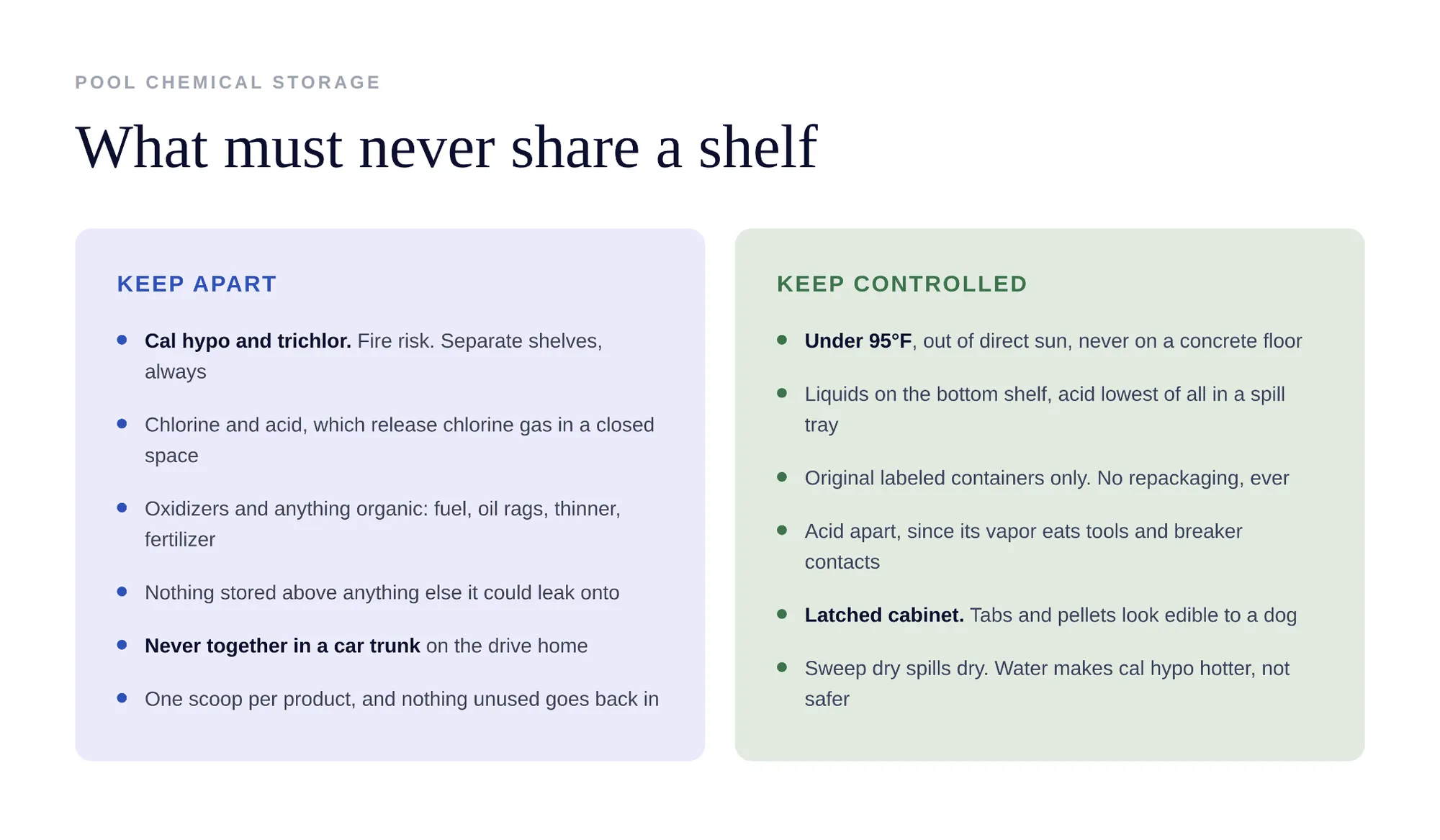
Different shelves, not different corners of the same shelf. Neither one above the other, ever. Separate scoops that never touch the other product, labeled, stored with the container they belong to. Lids closed the moment product comes out, not left open while the rest of the work happens. No leftover product poured back into a container.
Nothing goes in a car trunk together on the drive home from the pool store. Torn bag, bumpy road, and it starts somewhere between the parking lot and the driveway.
If a garage has room for one of the two, buy the one that gets used and leave the other at the store.
Acid Belongs By Itself
Muriatic acid does not need to spill to cause damage. It off-gasses through a closed cap, continuously, and hydrogen chloride vapor travels.
What that vapor does to a garage is slow and total. The tell is a garage where everything metal aged at once. Sockets that were clean last summer come out of the drawer with a dull film, a drill chuck binds, and the door opener starts straining against a spring that has been thinning for years.
Acid also cannot sit near chlorine. Together they release chlorine gas fast enough to make an enclosed space unsurvivable.
Separate it physically, ideally by a wall. A vented outdoor box, a detached shed, the far end of a covered patio.
Keep it in the container it came in. Acid-resistant HDPE and a random plastic jug are different things, and the label is what a responder reads at a glance. Store it low in a containment tray so a failed cap drips into a tub instead of across a floor.
Buy the diluted version where it is sold. It does the same job in the pool and fumes far less.
The Garage Is The Worst Place You Have
Pool chemicals are oxidizers. Oxidizers plus organics is what turns a small problem into a fire, and a garage holds every organic a household owns.
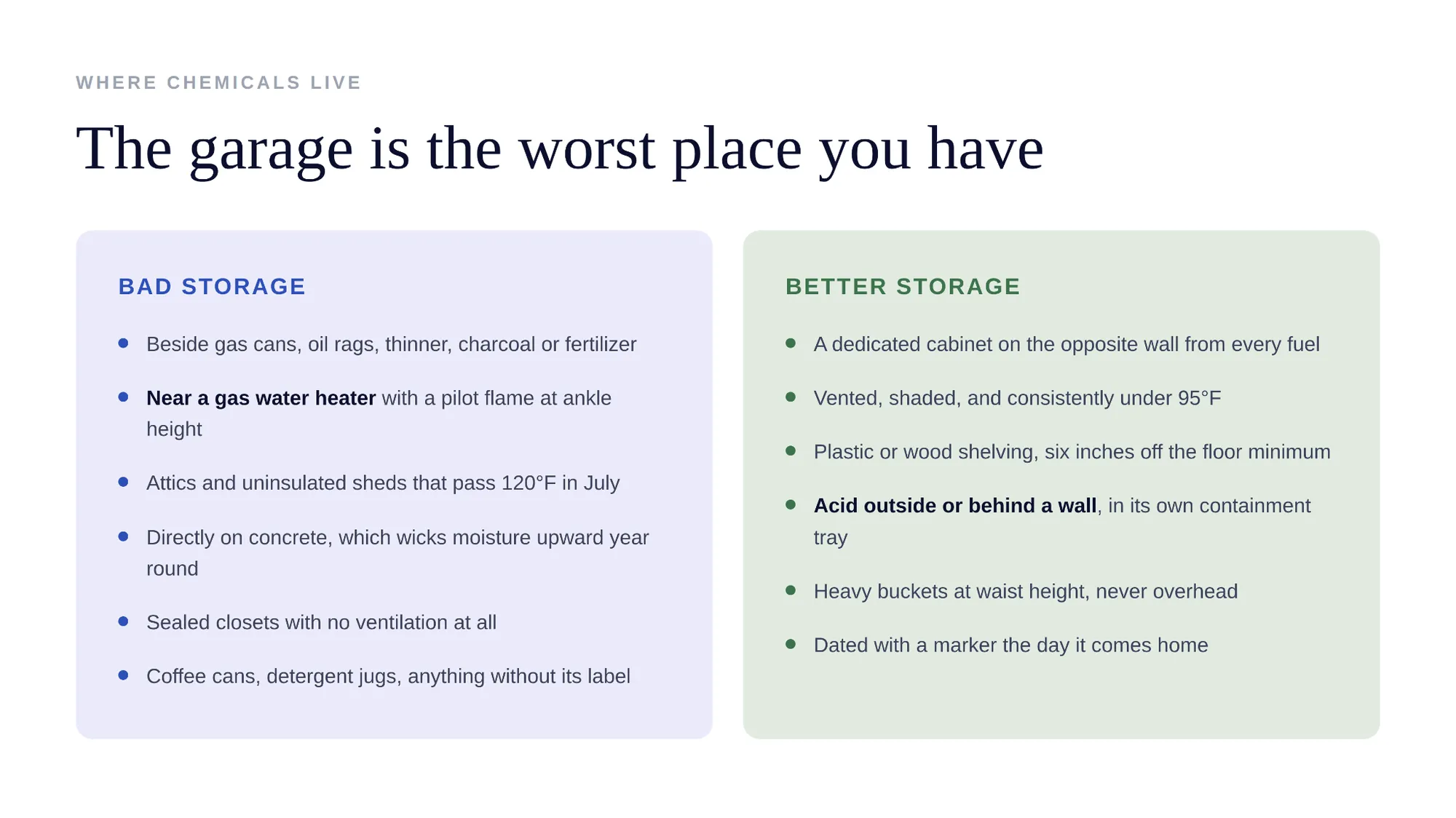
Gas cans. Two-stroke mix. Oil-stained rags in a bucket. Brake cleaner. Paint thinner. Charcoal and lighter fluid. Fertilizer. A mower with fuel in the tank. That inventory sitting eight feet from a bag of shock is the ordinary suburban setup, and it is why garage fires spread the way they do.
Ignition is the other half. A gas water heater or furnace in the garage runs a standing pilot flame at roughly ankle height, which is where heavier-than-air vapors settle.
When the garage is the only option: a dedicated cabinet, opposite wall from the fuel, off the floor, nothing combustible on the shelf below.
Shelf Life of Pool Chemicals
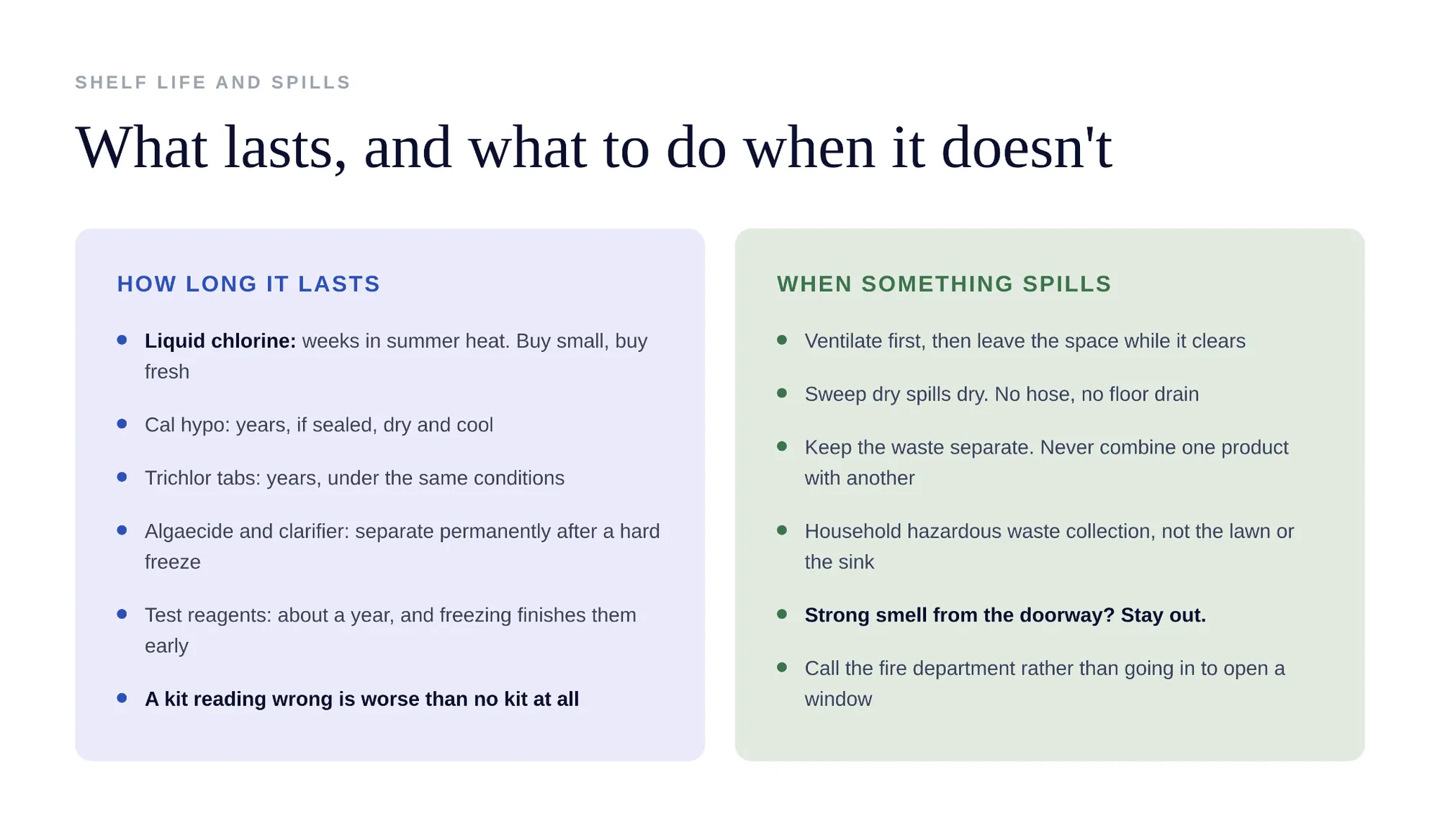
Liquid chlorine has a short life, and heat shortens it hard. A jug of twelve and a half percent that sat in a hot shed since June is closer to salt water than shock by August, and plenty of “the shock isn’t working” complaints trace back to degraded product rather than pool chemistry.
Twelve and a half percent stock loses roughly half its available chlorine over about six months at seventy degrees, and it gets there in a few weeks once storage temperatures sit above ninety.
Buy small, buy fresh, store it shaded.
Dry products hold up better. Cal hypo keeps for years sealed and dry, trichlor tabs the same, and heat combined with humidity is what ruins both. Most labels set the ceiling near ninety-five degrees.
That rules out an attic, and it rules out an uninsulated shed anywhere the interior passes a hundred and twenty in July. Attic air in a Phoenix or Dallas summer runs thirty to fifty degrees above outside, which puts a July attic near a hundred and fifty. Northern climates invert the problem in January, when the algaecide and the test reagents are the things at risk.
Moisture earns its own attention here, because cal hypo pulls water straight out of the air and wet cal hypo generates heat. Heat inside a container of oxidizer, surrounded by cardboard and dust, is how a shelf catches fire with nobody in the building.
Concrete wicks moisture continuously, including slabs that look bone dry. Nothing goes directly on concrete. Plastic or wood shelving, six inches up minimum.
Basements are humid. Sheds leak. A bag folded over at the top is not a closed container.
Cold ruins a narrower set. Algaecide and clarifier separate permanently after a hard freeze. Test reagents go further: DPD and phenol red degrade inside a year even in good conditions, and one freeze finishes them while the bottle still looks fine on the shelf. A kit that reads wrong is worse than no kit.
What Goes On Which Shelf
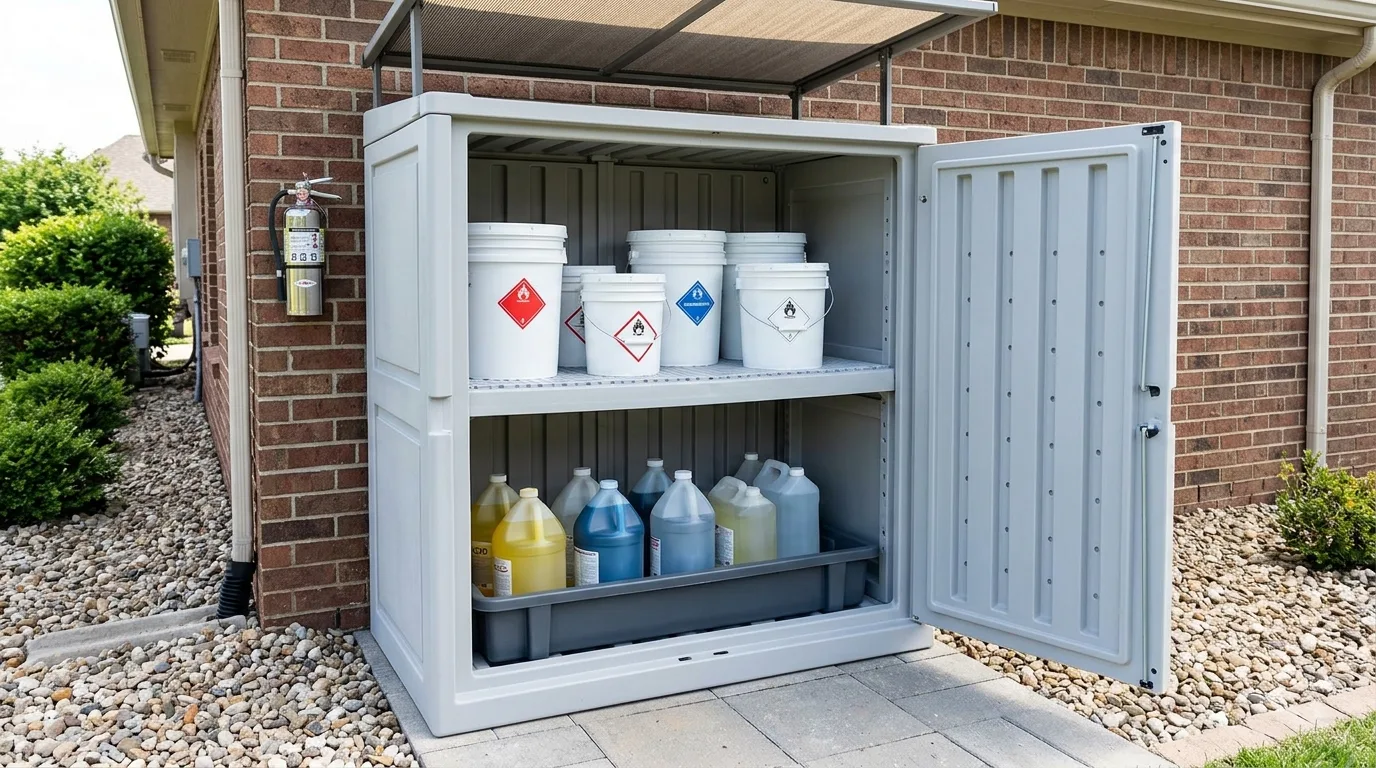
Shelving decides what happens when a container fails, and containers fail on their own schedule.
- Liquids on the bottom shelf, always
- Acid lowest of all, in its own tray, in its own space
- Heavy buckets at waist height, never overhead
- Nothing stored above anything it could leak onto
- A cabinet latch a four-year-old cannot work
A leaking jug dripping onto a bag of dry oxidizer is the combination that turns a bad afternoon into a fire, and gravity gets a vote no matter how careful the plan looked on paper. Cal hypo tabs and pellets look edible to a dog, and dogs eat them. Poison control calls for tab ingestion cluster in spring, when the season’s product comes home and sits in an open bag on the garage floor for a week before anyone puts it away.
Cross-contamination travels on tools more than through spills.
Every product gets its own scoop, and the scoop lives with that product. Nothing unused goes back in the container. That scoop has been in pool water, and it carries moisture into a sealed bag that sits until next month.
Every product stays in the container it arrived in. Repackaging into a coffee can or an old detergent jug destroys the label, the handling instructions, and any chance a paramedic identifies what they are dealing with.
Buy Less Than You Think
Bulk pricing pushes people into quantities that create a storage problem they did not have. A hundred pounds of shock sitting through a humid August is a worse deal than paying more per pound for twenty.
Demand is worth attacking from the other side. Leaves, silt, pollen, and algae pull the residual down faster than swimmers do, and removing debris mechanically cuts that load directly. A robot running on a schedule means less shock bought, less shock stored, and less sitting on a shelf in October waiting for next season.
Date every container with a marker the day it comes home. Nobody remembers when the algaecide was bought.
When Something Spills
Ventilate first. Open the door, open the far side, get air moving, then leave the space while it clears.
Dry spills get swept dry. No hose. Water on spilled cal hypo makes it hotter and larger, and rinsing it into a floor drain that took acid rinse last month puts the two together somewhere nobody can see.
Sweep it into its own container, away from all other waste, and take it to household hazardous waste collection. Never combine chemical waste. And never pour leftover product down a drain or onto grass.
One rule outranks everything else.
If a closed space smells strongly of chlorine or acid from the doorway, stay out and call the fire department. Chlorine gas takes very few breaths to do permanent lung damage, and the person who steps in to crack a window and see how bad it is has already made the choice that hospitalizes them.
Get more pool and lawn care guides from Aiper on Google