


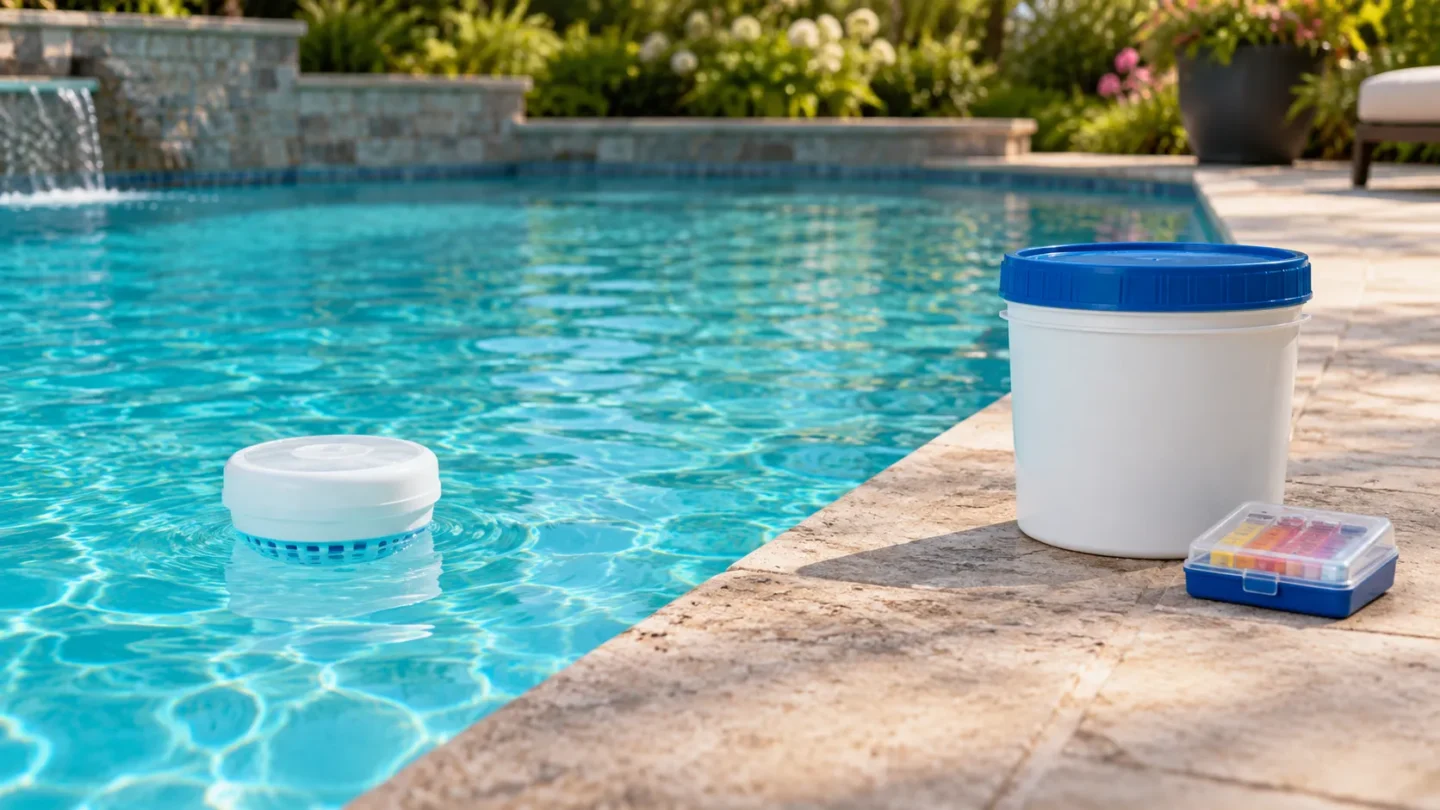
Ask ten pool owners what shock does, and a fair number will say it’s a bigger scoop of whatever sits in the chlorine floater.
Close enough to sound right, and it leads people wrong.
Someone empties a bag of shock when the water actually needed steady sanitizer, or rides one chlorine tablet for a week and then can’t work out why the pool turned cloudy and started to sting.
They’re two different products, built for two different jobs. Let’s find out where the differences lie.
What Sanitizer Does
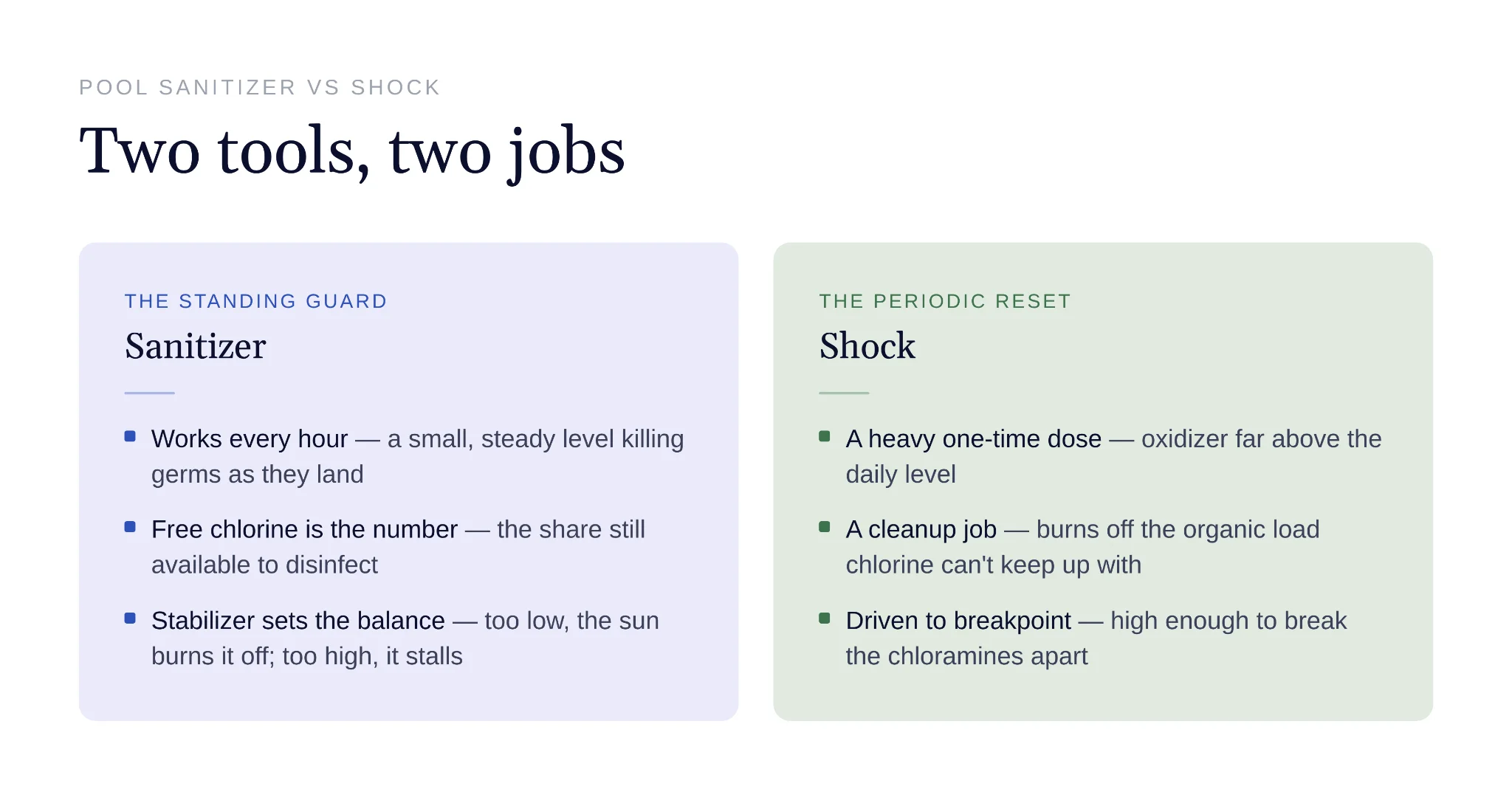
Whatever a pool runs on: chlorine tablets, a salt cell generating its own chlorine, or bromine in a spa, the goal is to keep a small, steady amount of disinfectant in the water every day, killing bacteria and other germs the moment they land.
The number that matters on a test is free chlorine, the share still available to do that work. Keep it in range, and the water stays safe between cleanings.
Focus on cyanuric acid, the stabilizer, which stops the sun from burning that chlorine off in an afternoon. Run it too low, and the chlorine is gone by midday; run it too high, and it keeps the chlorine from working. Either way the standing guard weakens, and that’s usually the point where shock gets called in to cover for it.
What Shock Is For
Shock is a one-time hit of oxidizer, much stronger than the daily dose, and its job is cleanup rather than patrol. Sweat, sunscreen, body oils, pollen, a week of leaf litter, land in the water and burn through chlorine faster than a maintenance level can keep up.
The heaviest part of that load is chloramines.
Chloramines show up as combined chlorine on a test kit, and they form when chlorine binds to the sweat, urine, and other body waste swimmers carry in. They’re behind that thick “chlorine” smell and the red eyes after a long session, and here’s the part that throws people: the smell means the water is short on working chlorine. The odor is the exhaust, the sign the sanitizer has been swamped.
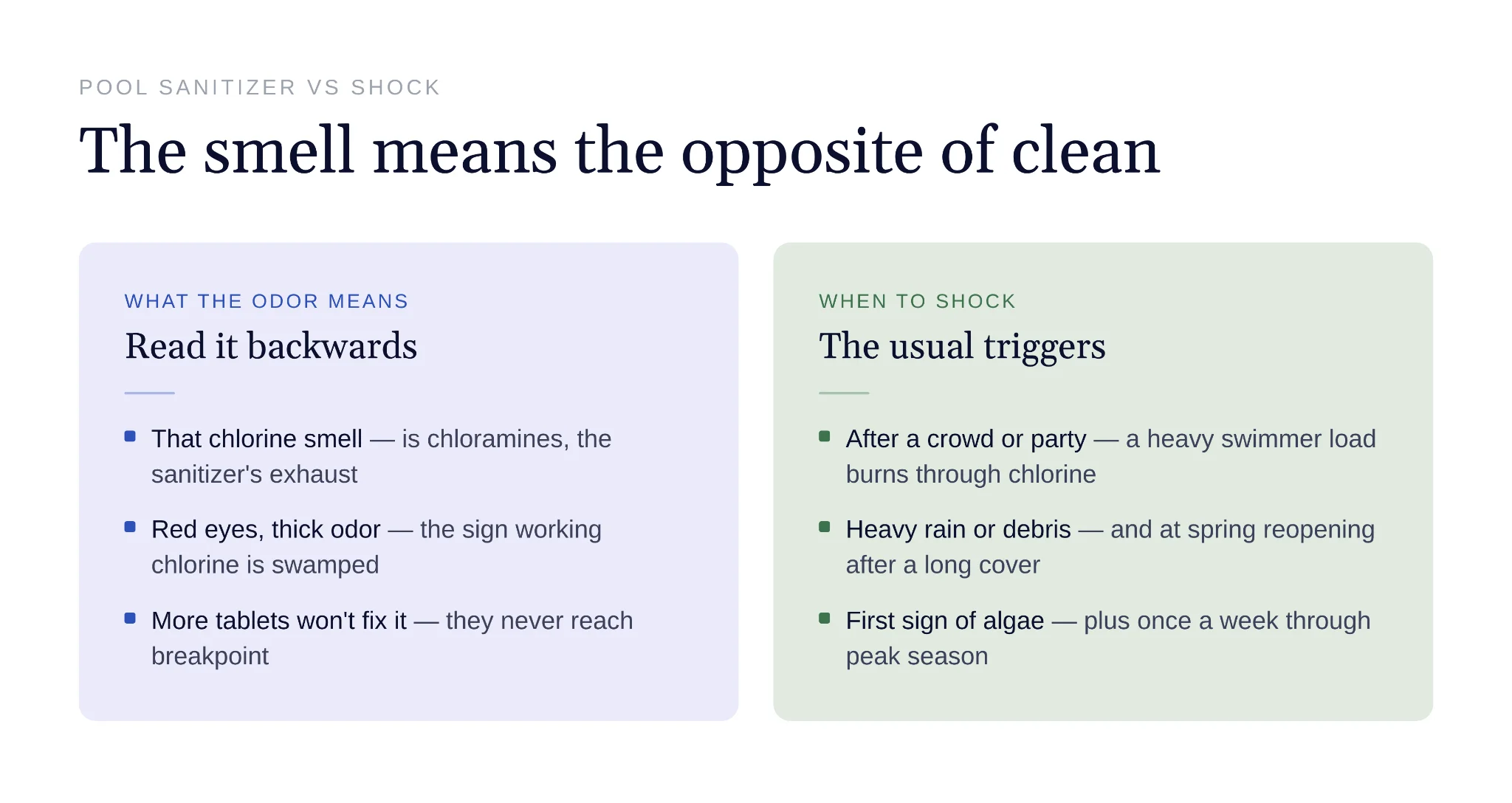
Clearing chloramines takes breakpoint chlorination, which means pushing free chlorine high enough in a single shot to break those compounds apart and burn them off. The working figure, per the CDC’s pool guidance, is about ten times the combined chlorine reading. Fall short of that and the shock half-works, which can leave the water worse off than before it went in. That’s the reason shock is a heavy, deliberate dose and not a casual top-up.
Chloramines aren’t the only trigger. A pool gets shocked after it’s been worked hard or knocked around:
- A crowded weekend or a pool party
- After heavy rain or a windstorm drops debris across the surface
- Spring reopening, and any long stretch the pool sat covered and unused
- The first sign of algae, caught before it spreads
- Once a week through peak season, as routine upkeep
Set next to day-to-day sanitizer, the split in labor is plain enough:
| Sanitizer | Shock | |
|---|---|---|
| Job | Continuous disinfection | Periodic oxidizing reset |
| How often | Present every hour, every day | Weekly, or after a heavy load |
| Targets | Germs as they arrive | Chloramines and organic buildup |
| Dose | Small and steady | Heavy, driven to breakpoint |
Where the Two Get Confused
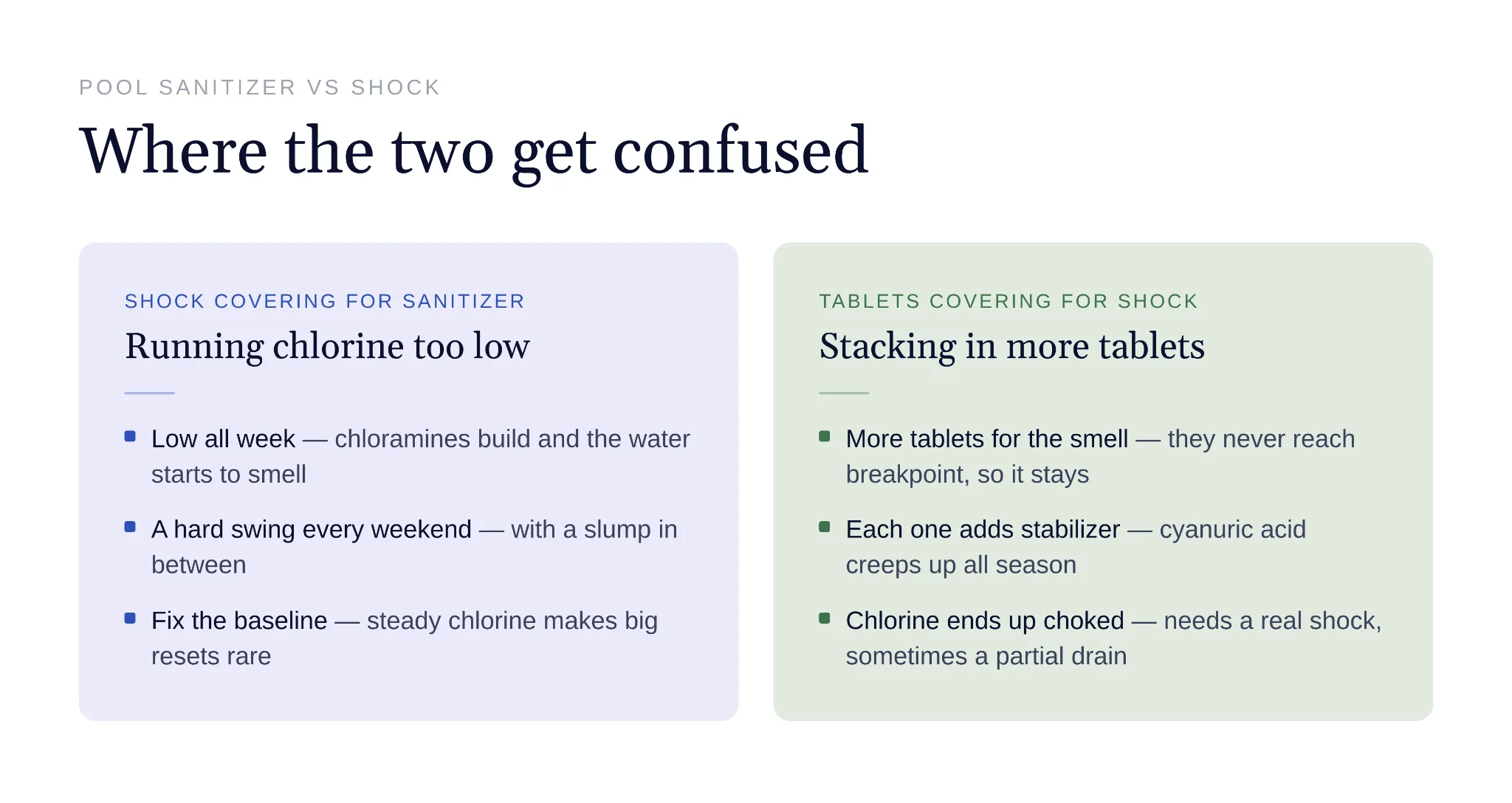
The usual pattern is leaning on shock to paper over a sanitizer that runs too low.
Free chlorine sits under where it should most of the week, chloramines build, the water starts to smell, and out comes the shock — a hard swing every weekend with a slump in between. The fix is in the baseline. Hold free chlorine steady and the big resets become rare.
The opposite mistake is just as common.
Combined chlorine climbs, the smell sets in, and the reflex is to screw in another tablet or two.
More tablets mean more sanitizer, but they never reach breakpoint, so the chloramines sit there and keep stinking. Worse, most tablets are stabilized, and every one adds cyanuric acid.
Over a season, that number creeps up until the chlorine already in the water is half-choked. The pool ends up reeking of chlorine while barely sanitizing, and no stack of tablets turns it around. That situation needs a proper shock, and sometimes a partial drain to pull the stabilizer back down.
Keeping the Load Down
Both tools get easier the less the water asks of them.
A pool carrying less organic junk needs smaller, rarer shocks, and a sanitizer that isn’t fighting a pile of debris holds its level with margin to spare. Much of that comes down to keeping contaminants and dead water from piling up and feeding the chlorine demand in the first place.
Circulation and physical cleanup pull more weight here than owners tend to credit. Moving water spreads sanitizer around instead of leaving thin pockets, and surfaces that get scrubbed on a regular basis give algae and biofilm nowhere to take hold.
A cordless robotic cleaner like the Aiper covers that side on its own, working the floor and walls on a set cycle, lifting out the debris that would otherwise break down into chloramine fuel, and stirring the slow corners a fixed return never reaches. It won’t dose the water. What it does is shrink the job both chemicals are there to handle.
Get more pool and lawn care guides from Aiper on Google