Pool Shock vs Chlorine: What’s Actually Different

Walk into any pool store, and you’ll find chlorine tablets on one shelf and bags labeled “shock” on another, priced differently, described differently, and in most cases containing the same active chemistry.
That shelf layout is responsible for a lot of confusion, and a fair amount of ruined water.
These two different chemicals have two different jobs.
One job is holding a low, steady sanitizer level in the water every hour of every day. The other is driving that level far above normal for a short period to burn through something the routine dose can’t handle.
Understanding which product does which job, and what each one leaves behind in your pool permanently, is most of pool chemistry in practice.
What Shock Actually Means
Shocking is a process of sharply raising free chlorine and holding it long enough to accomplish something specific.
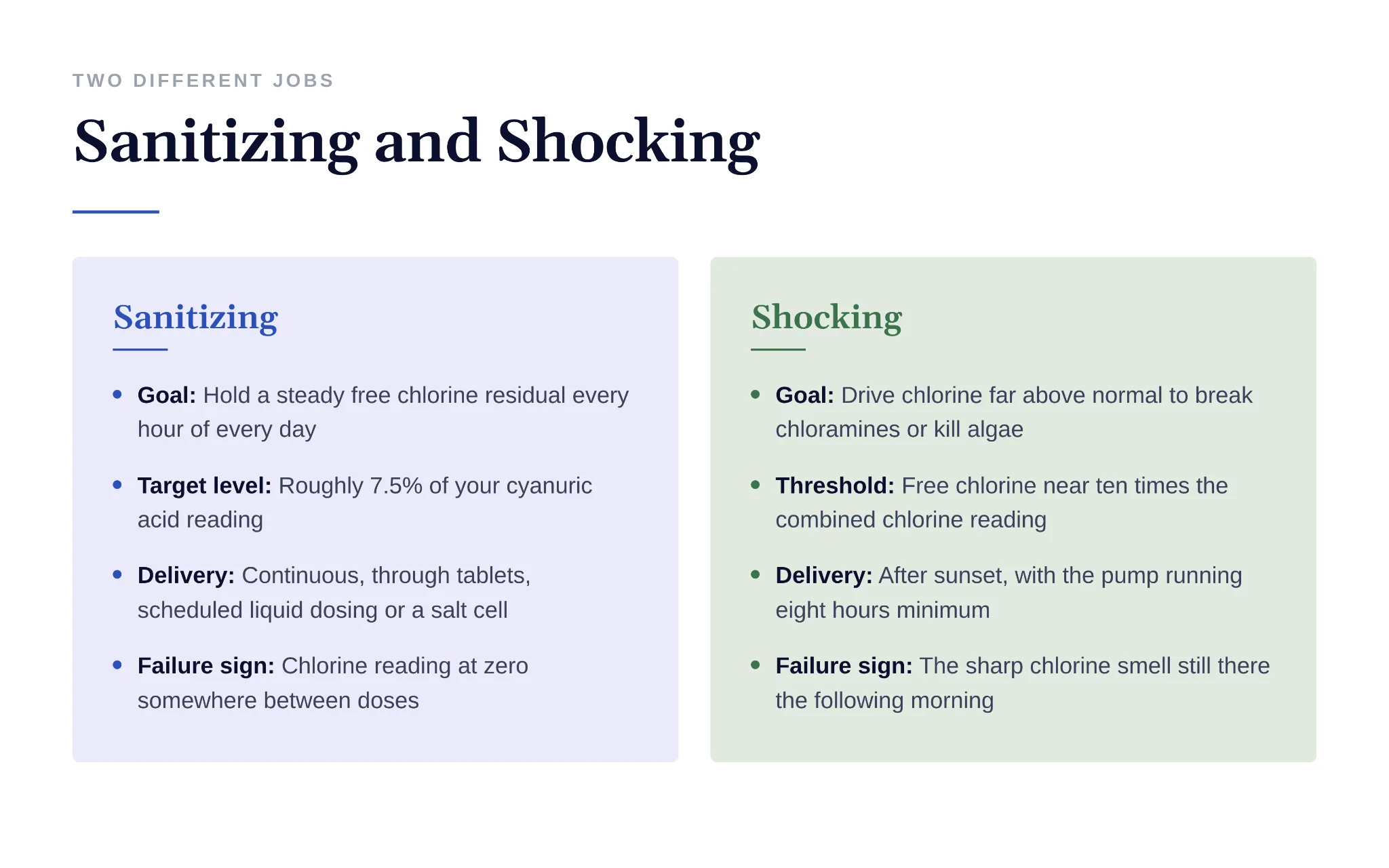
Two things justify it.
The first is destroying combined chlorine, which is chlorine that has already bonded with ammonia and nitrogen compounds from sweat, urine, sunscreen, and skin. Those bonded compounds are chloramines, and they sanitize poorly while irritating eyes and lungs.
Breaking that bond requires reaching a threshold, and the rough working number is free chlorine at about ten times the combined chlorine reading.
The second is killing algae, which requires holding elevated chlorine over hours or days rather than hitting a number once.
A product labeled shock is just chlorine packaged to deliver a large dose quickly. Nothing about the bag makes the process happen. Dumping a bag in without testing first is how people spend forty dollars and change nothing.
Shock vs. Chlorine at a Glance
Same active chemistry underneath in most cases. Different job, different dose, different rules.
| Pool Shock | Regular Chlorine | |
|---|---|---|
| Job | Resets the water — kills algae, burns off chloramines | Holds a steady sanitizer level day to day |
| Dose | Large, one-time spike, often 5-10x the normal level | Small, continuous |
| Dissolve speed | Fast — granular or liquid | Slow — tablets, or metered by a floater or salt cell |
| Stabilizer added | Depends on product: liquid and cal-hypo add none, dichlor adds it fast | Trichlor tabs add roughly 0.6 ppm CYA per 1 ppm chlorine |
| Wait before swimming | Until free chlorine drops back under 5 ppm — usually 8 hours, longer for a heavy dose | Safe once the level sits in the normal 1-4 ppm range |
| When to use it | Green or cloudy water, after a storm or a party, a chlorine smell that won’t clear | Every day, all season |
What’s In the Bucket
Four products cover almost everything sold for residential pools, and the differences between them are permanent in a way most people don’t realize until they’re draining water.
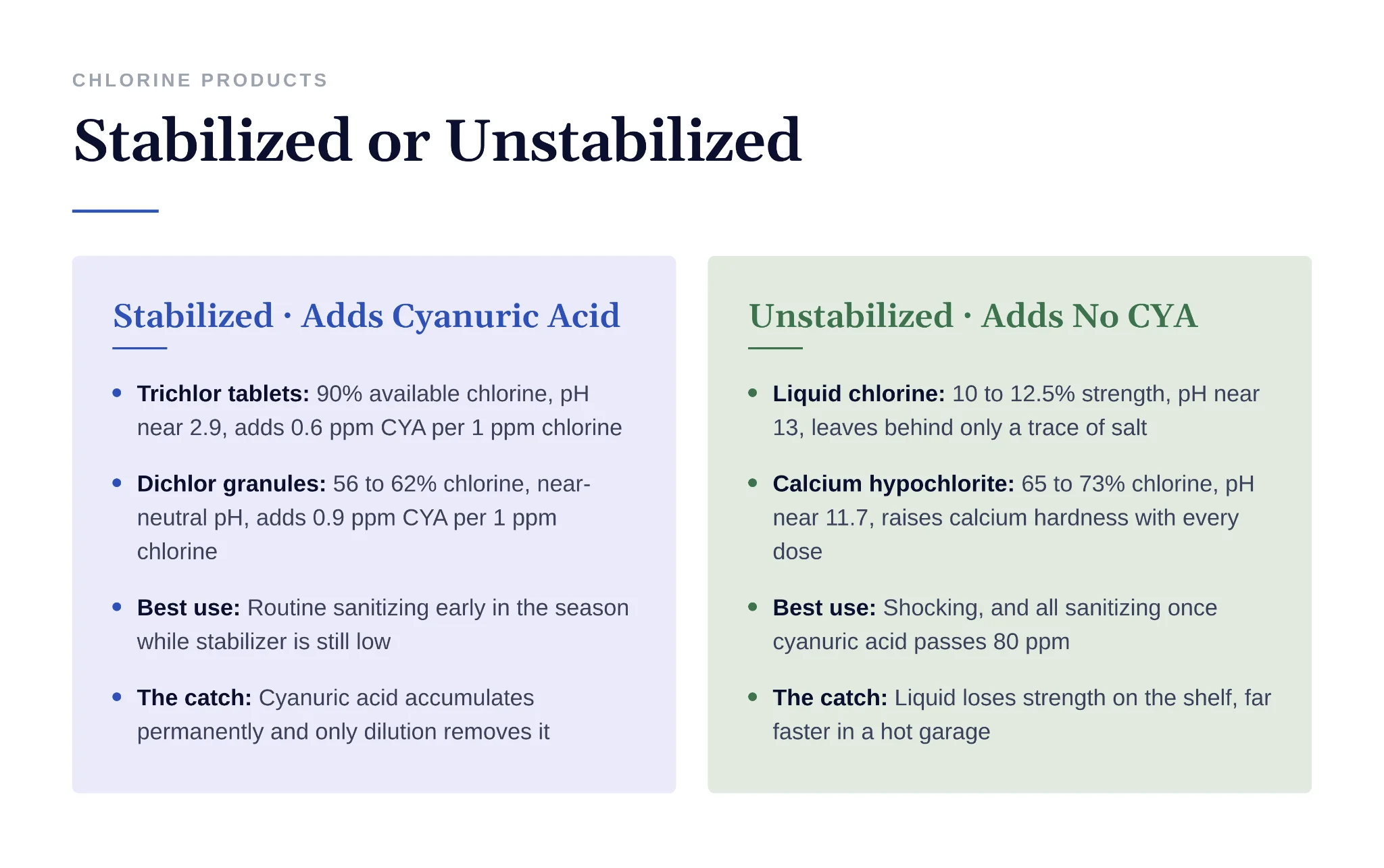
Trichlor is the slow-dissolving tablet, with around 90% available chlorine — the highest of the group. It’s stabilized, meaning it contains cyanuric acid. Every tablet you burn adds roughly 0.6 ppm of CYA to the pool for every 1 ppm of chlorine delivered. It’s also strongly acidic, around pH 2.9, so a pool running on tabs drifts down in pH continuously.
Dichlor is the fast-dissolving granular version, 56% to 62% available chlorine, near-neutral pH. Also stabilized, and it adds CYA faster than trichlor does relative to the chlorine delivered, close to 0.9 ppm per 1 ppm. Convenient. Dangerous to lean on.
Calcium hypochlorite is the classic shock bag. 65% to 73% available chlorine, unstabilized, and highly alkaline at around pH 11.7. It adds calcium hardness with every dose, roughly 0.7 ppm per 1 ppm of chlorine.
Liquid chlorine, sodium hypochlorite, runs 10% to 12.5%. Unstabilized, no calcium, no CYA. It adds a small amount of salt. It also degrades on the shelf, losing strength over weeks — much faster in a hot garage. Buy it fresh and buy it often.
That last one is the workhorse for most shocking, and the reason is what it doesn’t leave behind.
Check Your Stabilizer Before You Buy Anything
Cyanuric acid protects chlorine from ultraviolet light.
Without it, sunlight destroys free chlorine in a matter of hours, and an outdoor pool would need dosing three times a day. With it, chlorine persists.
There’s a ceiling to that benefit. As CYA climbs, more of your chlorine sits bound to it and unavailable for actual sanitizing, which means the free chlorine level you need to keep the water safe climbs along with it.
A workable rule is to hold free chlorine around 7.5% of your CYA reading. At 40 ppm CYA, that’s 3 ppm chlorine. At 100 ppm CYA, it’s 7.5 ppm, sustained, all season.
Here’s how pools end up there. Someone runs trichlor tabs in a floater all summer for sanitizing, then shocks with dichlor after every pool party because it dissolves fast. Both products add stabilizer.
By August, the CYA is at 120. The chlorine reads fine on the test strip, but the pool goes green anyway. Then the shock doesn’t work either, because the target free chlorine level for algae at that CYA is far higher than the bag instructions assume.
There is no chemical that removes cyanuric acid. Reverse osmosis service exists in some markets. Otherwise, you drain and refill, partially or fully, and you start over.
Test CYA before the season and again mid-summer. If it’s above 80, stop using stabilized products entirely and switch to liquid chlorine for both sanitizing and shocking.
The Chlorine Smell Means You Need More Chlorine
The sharp smell at an indoor pool comes from chloramines, and chloramines exist because free chlorine was insufficient to break them down.
People smell it, conclude the water is over-chlorinated, and back off. That’s the exact opposite of the correct response. Test for combined chlorine. If it reads above 0.5 ppm, the pool needs a shock, not a rest.
Match the Product to the Job
Shock isn’t something you run on a Sunday schedule. Pool stores sell it that way because a bag has a shelf price, and a weekly sale beats a one-time sale. But if your daily sanitizer level is actually holding where it should, there’s nothing left for a shock dose to fix. The signal to shock is a number, not a calendar: combined chlorine above 0.5 ppm, water that’s turned green or cloudy, or a pool that just took a storm or a party. Test first. If free chlorine and combined chlorine both come back clean, put the bag back on the shelf.
For routine sanitizing, trichlor tabs in a feeder or floater work well early in the season while CYA is low. A salt chlorine generator solves the problem structurally, producing unstabilized chlorine on demand. Liquid chlorine works too, and it never adds anything you’ll regret.
For shocking after heavy use, a storm, or high combined chlorine, liquid chlorine is usually correct. It dissolves instantly, adds no CYA, adds no calcium, and lets you hit a number without side effects.
For algae, liquid chlorine again, at elevated levels held over days rather than a single dose, with brushing between doses.
As a dosing reference: one pound of calcium hypochlorite shock raises free chlorine by roughly 7 ppm in 10,000 gallons of water. Visible green algae calls for two to three times that dose, held over several days rather than dumped in once and left alone, though white water mold hiding in pipes and filters needs a longer hold before it clears.
Calcium hypochlorite earns its place in two situations. Your calcium hardness is genuinely low and you want to raise it while shocking, or liquid isn’t practical to store. On a vinyl liner, pre-dissolve it in a bucket of pool water and pour the solution in. Undissolved granules that settle on vinyl will bleach a permanent white spot.
Test pH before any shock. Above 7.8, a large share of your chlorine converts to a much weaker form, and the dose underperforms. Bring pH to 7.2 to 7.4 first.
Non-Chlorine Shock Has One Real Use
Potassium monopersulfate oxidizes organic contaminants without adding chlorine. It clears the water of the material that causes chloramines and lets swimmers back in after about fifteen minutes.
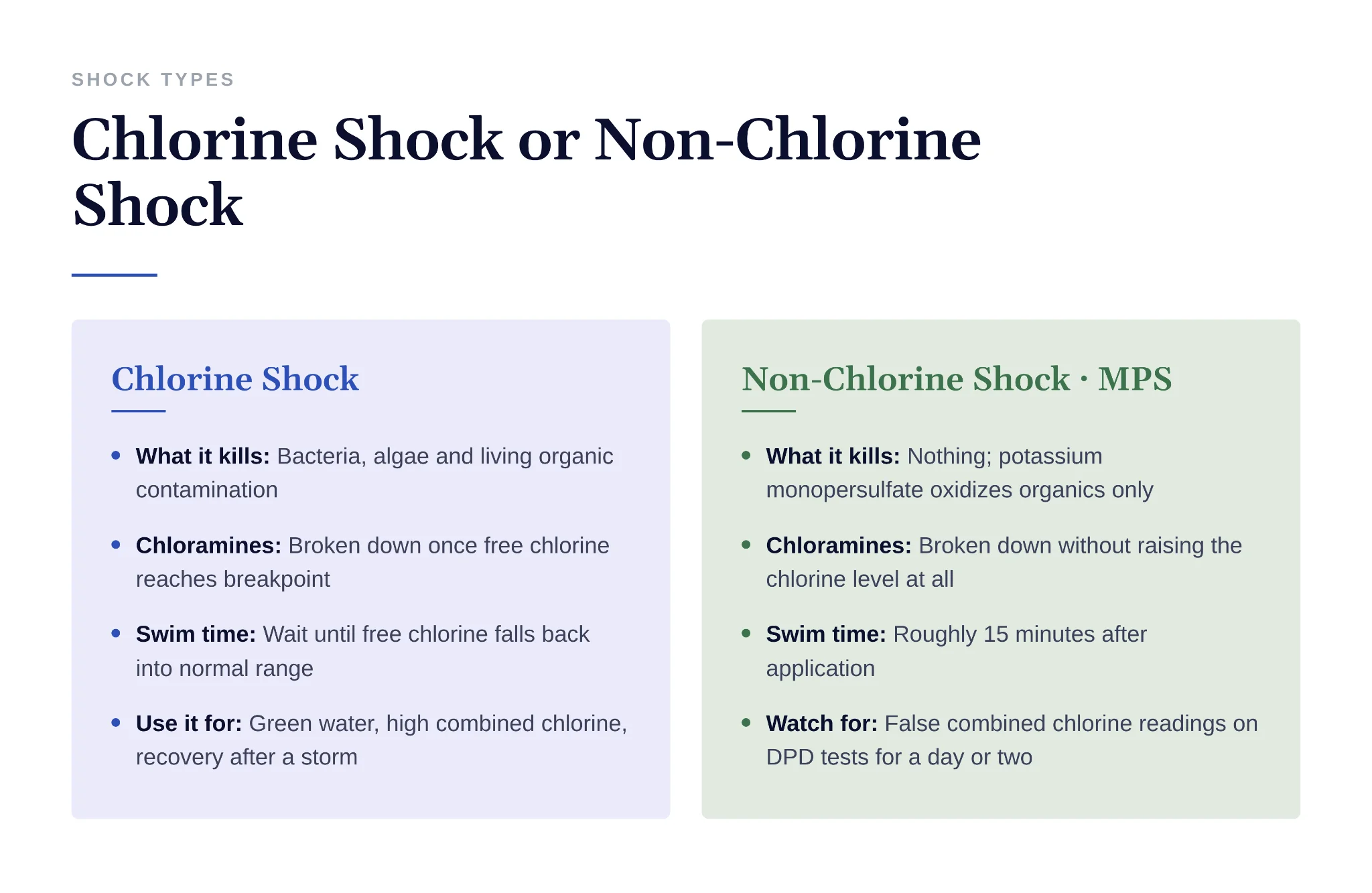
It does not sanitize. It does not kill algae. It will not save a green pool. It will also throw a false combined chlorine reading on a standard DPD test for a day or two afterward — that false reading has sent plenty of people chasing a problem that doesn’t exist.
Useful for an indoor pool or a spa with a heavy bather load. Not a substitute for chlorine.
Never Mix Two Types
Trichlor and calcium hypochlorite react violently with each other. This is not a caution about diminished effectiveness. It’s a fire hazard, documented repeatedly.
Never put one in a feeder that held the other. Never scoop them with the same wet cup. Never store them stacked. Keep the containers apart and closed.
Add chemical to water. Never water to chemical.
Shock After the Sun Goes Down
Ultraviolet light destroys unstabilized chlorine fast, and shock doses are typically unstabilized. Adding a large dose at two in the afternoon means burning a meaningful part of it off before it does any work.
Dose at dusk. Run the pump overnight, eight hours minimum, so the chlorine circulates instead of sitting in one part of the pool. Test again in the morning before anyone gets in.
There’s no fixed number of hours that applies to every dose. The rule is the number, not the clock: free chlorine needs to drop back under 5 ppm before anyone gets in. A standard liquid chlorine shock usually clears that in about 8 hours overnight. A heavy cal-hypo dose after a bad algae bloom can take closer to 24. Testing in the morning is what tells you it’s safe, not how long ago you poured it in.
Remove Dead Algae After Shocking
Shock kills algae, but the dead algae stays in the pool. That’s why a green pool often turns cloudy gray-blue after shocking and stays that way. You have to physically remove it.
Debris causes a smaller version of the same problem all season. Leaves, pollen, and dirt on the pool floor use up chlorine, so the pool needs shocking more often.
Brush the walls and steps when you shock. Algae clings to surfaces, and chlorine can’t reach it well until you break it loose. Then clean the floor to get the dead algae and debris out of the water.
Doing this by hand every few days is hard to keep up with. A cordless robotic cleaner from Aiper’s robotic pool cleaner range scrubs the floor and climbs the walls on a set schedule. That keeps debris from building up and using up chlorine between manual cleanings. After a shock, it pulls dead algae off the surfaces and out of the water, taking pressure off your filter. The models mainly differ in suction, waterline cleaning, and navigation, so pick one that fits your pool’s size and shape.
Clean surfaces use less chlorine. That means fewer shocks and less stabilizer and calcium building up in the water until you have to drain it.
Test Before You Shock
Before you shock, test four levels: free chlorine, combined chlorine, pH, and cyanuric acid (stabilizer). Test strips give rough readings. A drop-based kit with a FAS-DPD chlorine test gives numbers you can dose from. It’s the only option that stays accurate at high chlorine levels.
Skipping the test leads to the most common mistakes: shocking a pool that doesn’t need it, using the wrong chlorine target for your stabilizer level, or adding stabilized chlorine all season without noticing how much stabilizer has built up.
Get all four numbers, then decide what to add.
Get more pool and lawn care guides from Aiper on Google