White Water Mold vs White Algae: How to Tell Them Apart and Treat Each

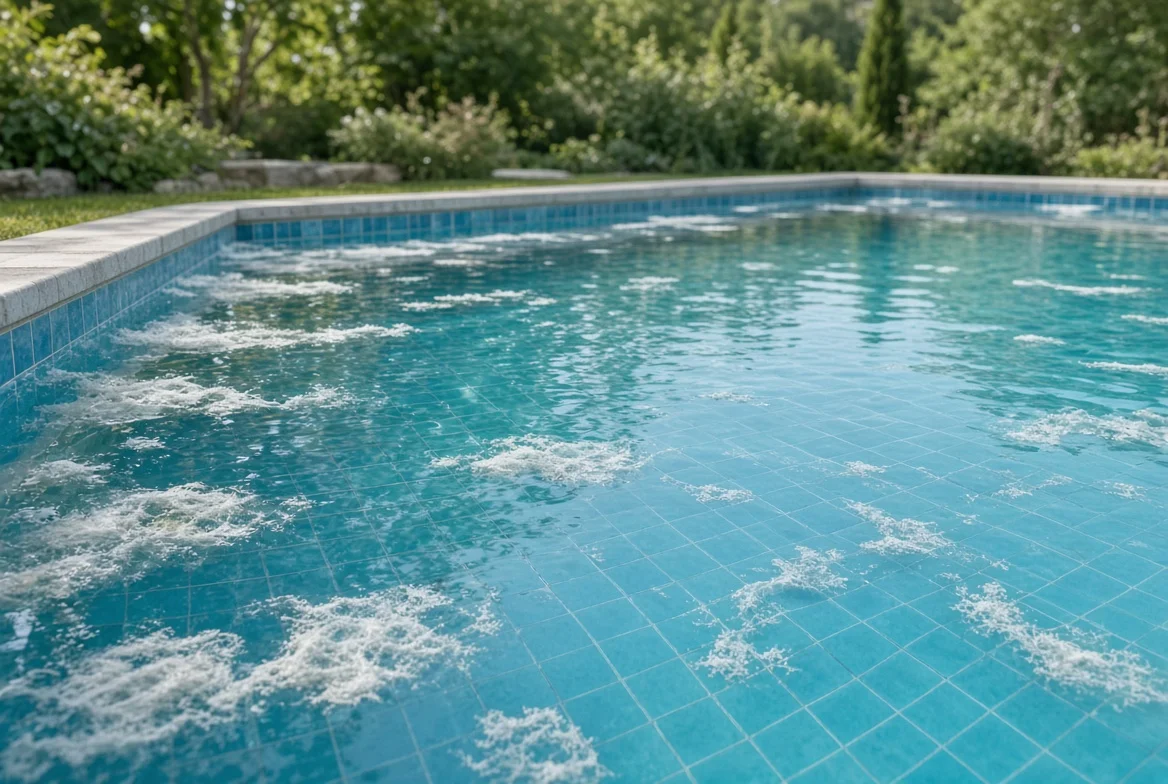
White water mold grows in places a shock doesn’t reach well: inside pipes, in the filter, in the skimmer, and behind the pool light.
That’s why a pool can clear up after a heavy dose of chlorine and fill with white slime again a week later. True white algae is rare. It stays on the walls and floor, and it responds to brushing and chlorine the way other algae does. If the growth leans green instead of white, see our guide on clearing green algae from a swimming pool.
Figure out which one you have before you buy anything.
Neither one is toxic, and a short swim while you figure out which one you have won’t hurt you. But once you start shocking the pool to clear it, keep everyone out of the water until free chlorine drops back under about 4 ppm. That’s well above a safe swimming level and far past what a normal daily chlorine dose ever reaches, which is the concentration needed to kill water mold.
Find Out Which One You Have
Start with a quick check around the pool:
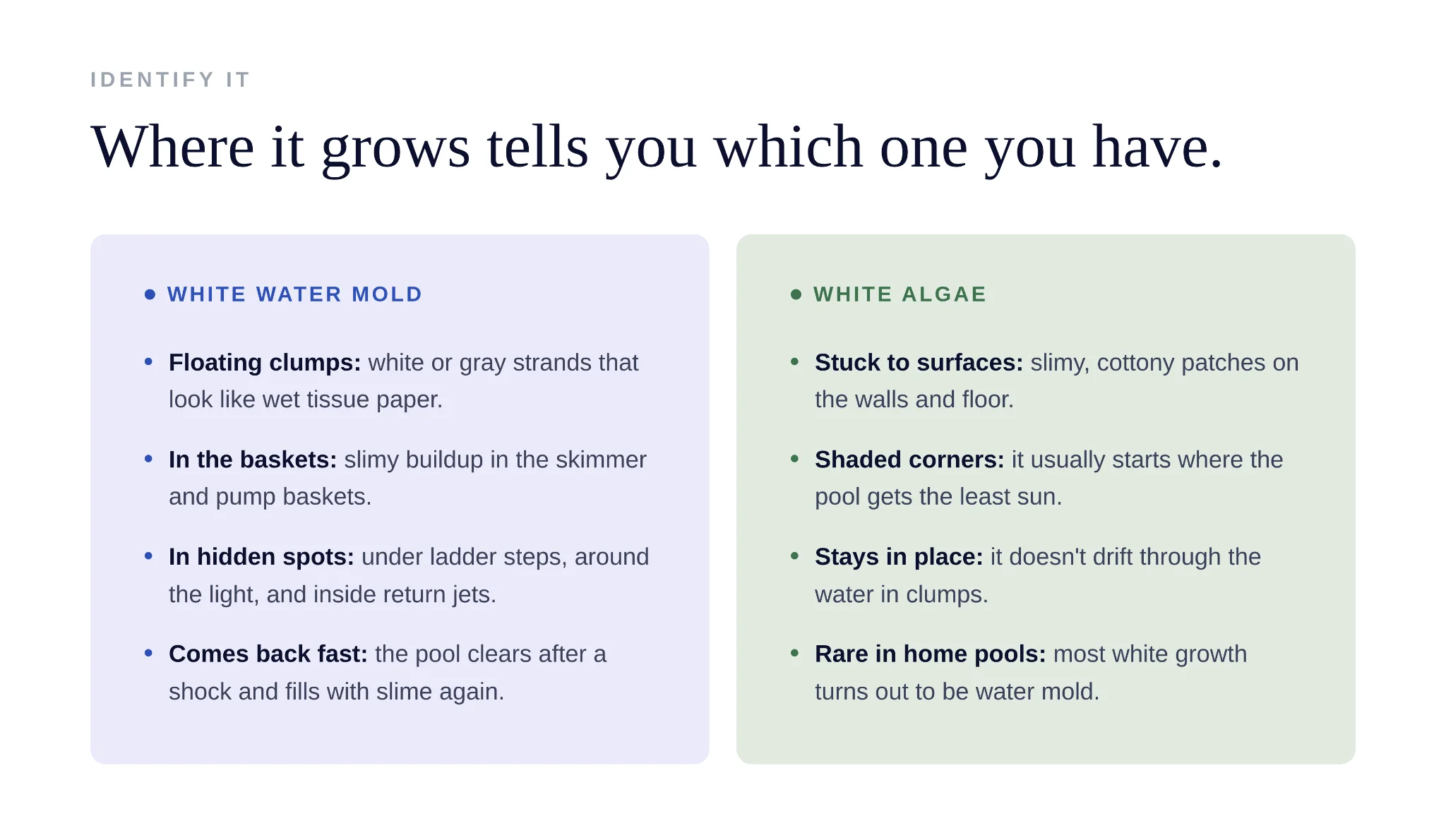
- Look at the water. Loose white or gray clumps and strands drifting around, like wet tissue paper, point to water mold.
- Pull the skimmer basket and the pump basket. Water mold collects there as slimy white gunk.
- Check the hidden spots. Look under the ladder steps, around the light, and inside the return jets. Turn over any floats or toys that have been sitting in the water.
- Rub some between your fingers. Slimy and soft means mold or algae. Hard and gritty means mineral scale.
Then match what you found:
- White water mold floats in clumps, builds up in baskets and plumbing, and comes back quickly after a shock.
- White algae forms slimy, cottony patches stuck to walls and floor, usually in shaded corners. It doesn’t float around in clumps.
- Calcium scale is crusty and hard, often at the waterline or on tile. It won’t smear or brush away.
If you also see pink or orange slime along the waterline or in the skimmer, that’s a bacteria that often grows alongside water mold. The water mold treatment below clears both.
What if it’s calcium scale?
Chlorine won’t do anything to scale. It forms when calcium and pH run high, so test both and bring them back into range. On a saltwater pool, flaky white deposits spitting from the return jets are usually calcium breaking off the salt cell, not algae or mold. The salt cell needs cleaning, not a shock.
Here’s our pool pH calculator to help you do this.
Use a scale remover or a pumice stone made for pool tile on the deposits you can reach.
Treat White Water Mold
Water mold protects itself with a slimy coating that chlorine has trouble getting through. Brushing breaks that coating, and holding chlorine high for days finishes the job. A single shock won’t clear it.
Plan on several days of work. In a bad case, it can take two weeks.
Prepare the pool
- Test free chlorine, combined chlorine, pH, and cyanuric acid (stabilizer). Use a drop-based test kit with a FAS-DPD chlorine test. Test strips can’t read the high chlorine levels this treatment needs.
- Bring pH to 7.2 to 7.4 and total alkalinity to 80 to 120 ppm. Chlorine works much better in that range. It also won’t swing pH all over the place mid-treatment.
- Take everything out of the pool. Remove toys, floats, thermometers, and removable ladders and handrails. Scrub hard items with a 1:10 bleach-to-water solution and rinse them. Throw out foam floats with slime in the seams.
- Brush every surface. Include under the ladder steps, the skimmer opening, around the light and return jets, and the corners of steps and benches.
Shock and hold
This process is what pool-hobbyist forums call a SLAM (Shock, Level, and Maintain) treatment:
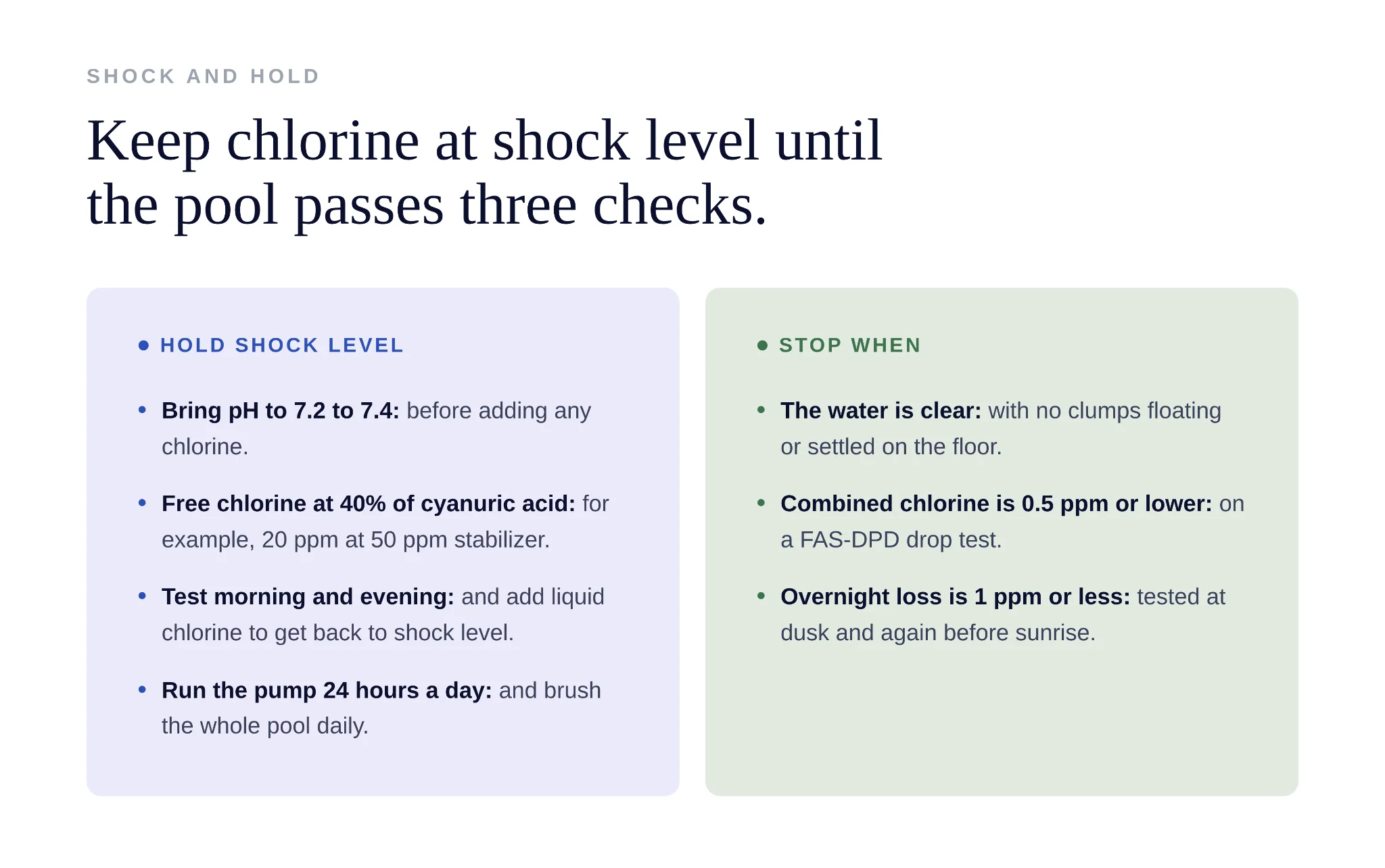
- Raise free chlorine to shock level. Shock level is about 40% of your cyanuric acid reading. At 30 ppm cyanuric acid, that’s 12 ppm free chlorine. At 50 ppm, it’s 20 ppm. Use liquid chlorine, which adds no stabilizer to the water.
- Run the pump 24 hours a day until treatment is done.
- Test every morning and evening. Add chlorine each time to bring it back up to shock level.
- Brush the whole pool every day.
- Stop once three things are true. The water is clear, combined chlorine reads 0.5 ppm or lower, and free chlorine drops 1 ppm or less overnight. To check overnight loss, test at dusk and again before sunrise.
If chlorine keeps dropping fast overnight, the mold is still growing somewhere, usually the filter or the plumbing.
If you have a vinyl-lined pool, stay at the low end of the shock-level range above. Chlorine that high can bleach or weaken vinyl if it sits in contact with the liner for the full multi-day hold.
Use our pool shock calculator to know how much chlorine you need.
Clean the filter and plumbing
Clean the filter at least twice: once a couple of days into the treatment and again at the end.
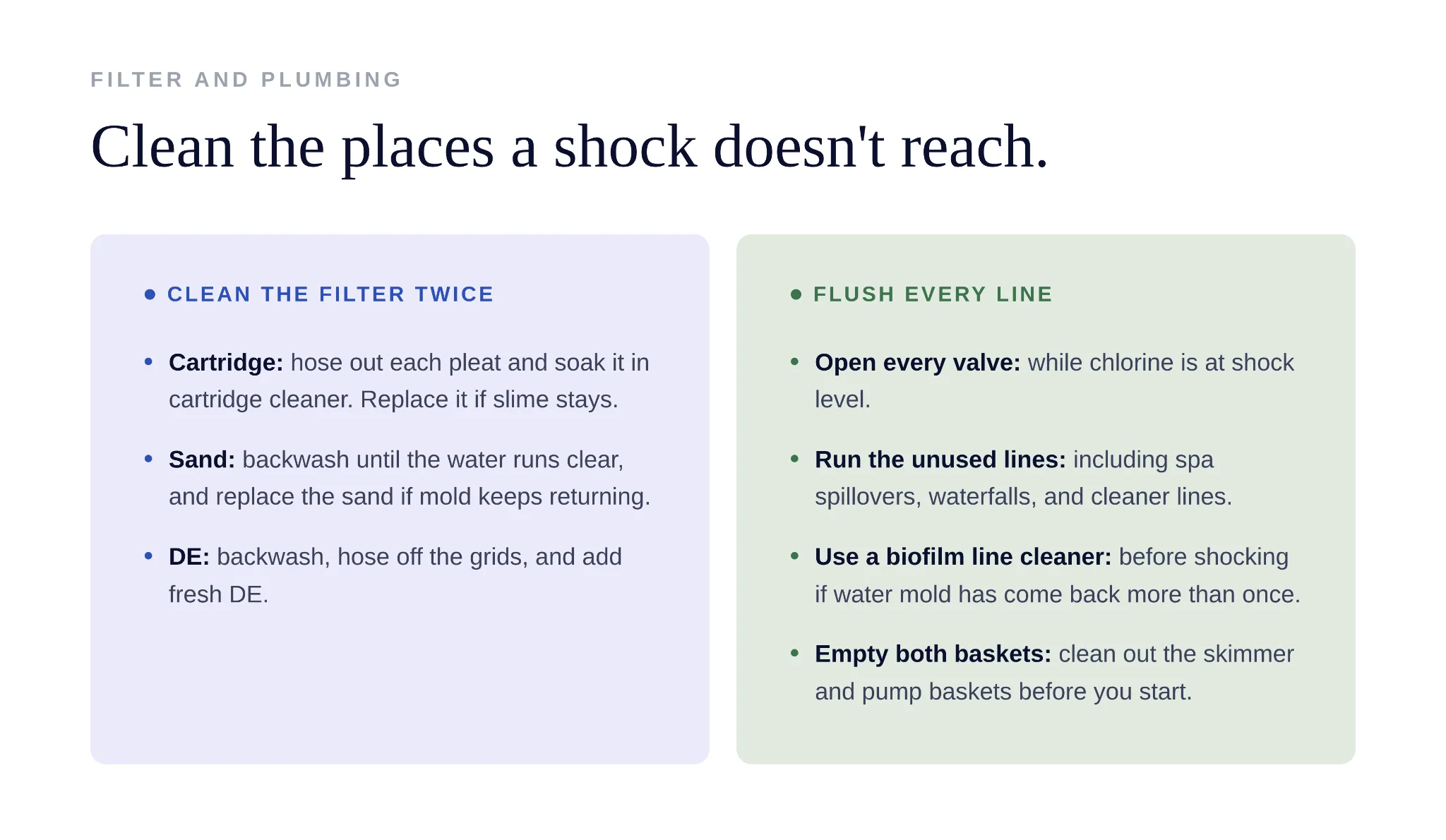
- Cartridge filter: Remove the cartridge, hose out each pleat, and soak it in cartridge cleaner. Replace it if slime stays in the pleats after cleaning or the cartridge is already old.
- Sand filter: Backwash until the water runs clear, and repeat several times during treatment. If water mold keeps coming back, replace the sand.
- DE filter: Backwash, take out and hose off the grids, and add fresh DE.
While chlorine is at shock level, open every valve and run every line. That includes spa spillovers, waterfalls, cleaner lines, and any line that usually sits closed. Water mold left in one unused pipe will seed the pool again.
If water mold has come back more than once, use a line cleaner made for biofilm before you shock. Follow the label, since most need to circulate for a set time before the chlorine goes in. Check the pool light too. With the power off, pull the fixture out of its niche and brush and rinse it in a bleach solution. That recess barely gets any water flow, and it’s one of the most common places water mold restarts from.
What if you have a Biguanide pool?
Pools that use biguanide sanitizer (PHMB) get water mold more often than chlorine pools. Don’t add chlorine to a biguanide pool.
The two react and leave a sticky brown residue that’s hard to remove. Use the oxidizer and mold treatment made for your biguanide system. Clean the filter and plumbing the same way.
Treat White Algae
True white algae gets the same shock and hold process, with more brushing. It anchors to plaster and grout, and chlorine kills it faster once the surface has been scrubbed.
Brush the patches twice a day while you hold shock level. Clean the filter at the end of treatment, since dead algae clogs it.
Suppose the patches keep returning in the same spots, even after you’ve held shock level until the water passes the overnight test. Go back and check the skimmer, baskets, and plumbing — it was likely water mold from the start.
Clear Out the Dead Mold and Algae
Chlorine kills water mold and algae, but the dead material stays in the pool. It settles on the floor, clouds the water, and clogs the filter. Vacuum it up daily on the “waste” or “drain” setting. That sends the dead debris straight out of the pool instead of back through your filter.
A cordless robot handles this well. A cleaner from Aiper’s robotic pool cleaner range runs on its own battery with no hoses connected to the skimmer or plumbing. Suction cleaner hoses are one of the places water mold likes to hide. The robot’s filter basket also catches dead clumps before they reach your main filter. Models that climb walls also scrub the surfaces where mold and algae cling.
During treatment:
- Empty and rinse the robot’s filter basket after every run. Leaving dead mold in the basket gives it a place to grow back.
- Soak the basket and rinse the brushes in the same bleach solution used for the pool toys at the end of treatment.
- Choose a model that cleans walls as well as the floor. Water mold and algae both grow on walls, and match the model to your pool’s size and shape.
Keep It From Coming Back
Water mold gets started when chlorine runs low for a few days. Keep free chlorine at about 7.5% of your cyanuric acid reading. Run the pump at least 8 hours a day too, so water doesn’t sit still in corners and behind steps.
A few weekly habits help:
- Take toys and floats out of the pool after swimming.
- Brush the walls, floor, and steps once a week.
- Clean the filter on a regular schedule, even when the water looks clear.
When you open the pool in spring, check the skimmer and filter first. Water that sits under a cover all winter is a common starting point for water mold.
Get more pool and lawn care guides from Aiper on Google