How to Get Rid of Bahia Grass in a Lawn

Bahiagrass throws up tall, V-shaped seed stalks three or four days after the lawn is mowed. It is a warm-season perennial that spreads by seed and by rhizomes, so cutting off the seedheads leaves the plant and its underground runners intact.
Removing it from an established lawn comes down to three decisions: which herbicide your lawn grass can tolerate, when to spray, and whether the infestation is small enough to treat selectively. Plan on at least two applications and a full season of follow-up.
How to Identify Bahiagrass
Bahiagrass looks like several other coarse grassy weeds until it sets seed. Check these four features before you buy anything.
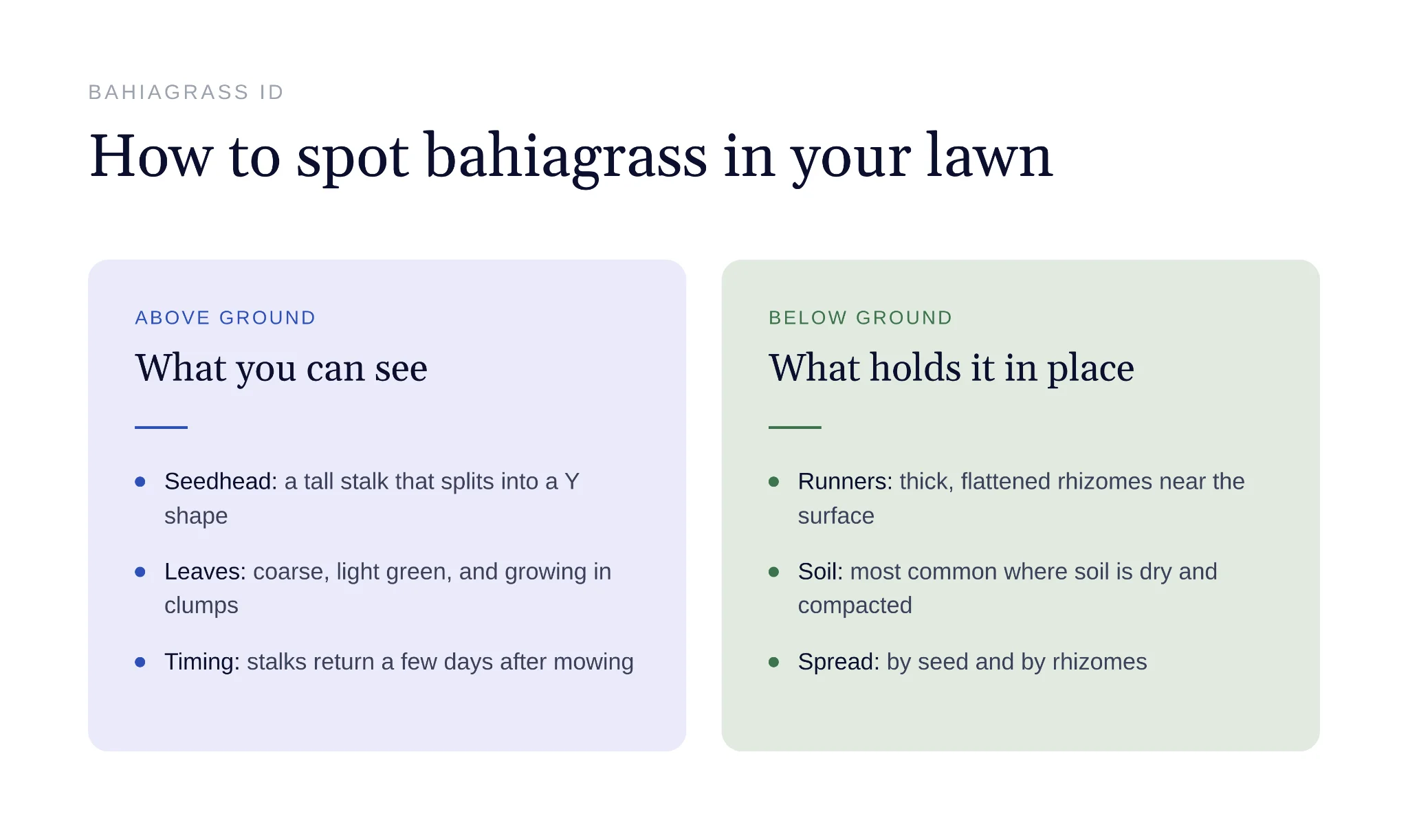
Seedhead. The stalk ends in spikes that split into a Y shape, usually two branches.
Leaves. The blades are coarse and light green, and they grow in clumps that stand out against St. Augustine, centipede, or zoysia.
Runners. Pull up a clump, and you will find thick, flattened rhizomes running just under the soil surface.
Location. It is most common in parts of the lawn with dry, compacted soil, such as along driveways, sidewalks, and sunny slopes.
Why It Takes Over Thin Lawns
Bahiagrass grows on millions of acres of Florida pasture because of its drought tolerance and low fertility requirements. Those same traits let it outlast lawn grass that is underfed or underwatered.
In University of Florida work on bermudagrass stands, bahiagrass moved in as the turf thinned and nitrogen became limiting. Some of its seed also stays in the soil for several years, so new seedlings can appear long after the original plants are gone.
Choose a Herbicide Your Lawn Can Tolerate
No single product is safe on every lawn. The right choice depends on the grass you want to keep, and the table below shows how common turf species tolerate the three selective herbicides extension services recommend for Bahia grass.
| Lawn grass | Metsulfuron | Imazaquin | Sethoxydim |
|---|---|---|---|
| Bermudagrass | Safe | Safe to reduced rate | Not labeled |
| Centipedegrass | Safe | Reduced rate | Safe |
| St. Augustinegrass | Safe to reduced rate | Reduced rate | Not labeled |
| Zoysiagrass | Safe | Safe | Not labeled |
| Tall fescue | Not labeled | Not labeled | Not labeled |
Tolerance ratings from Clemson University Extension HGIC 2316. “Reduced rate” means the turf may be injured at full label rates.
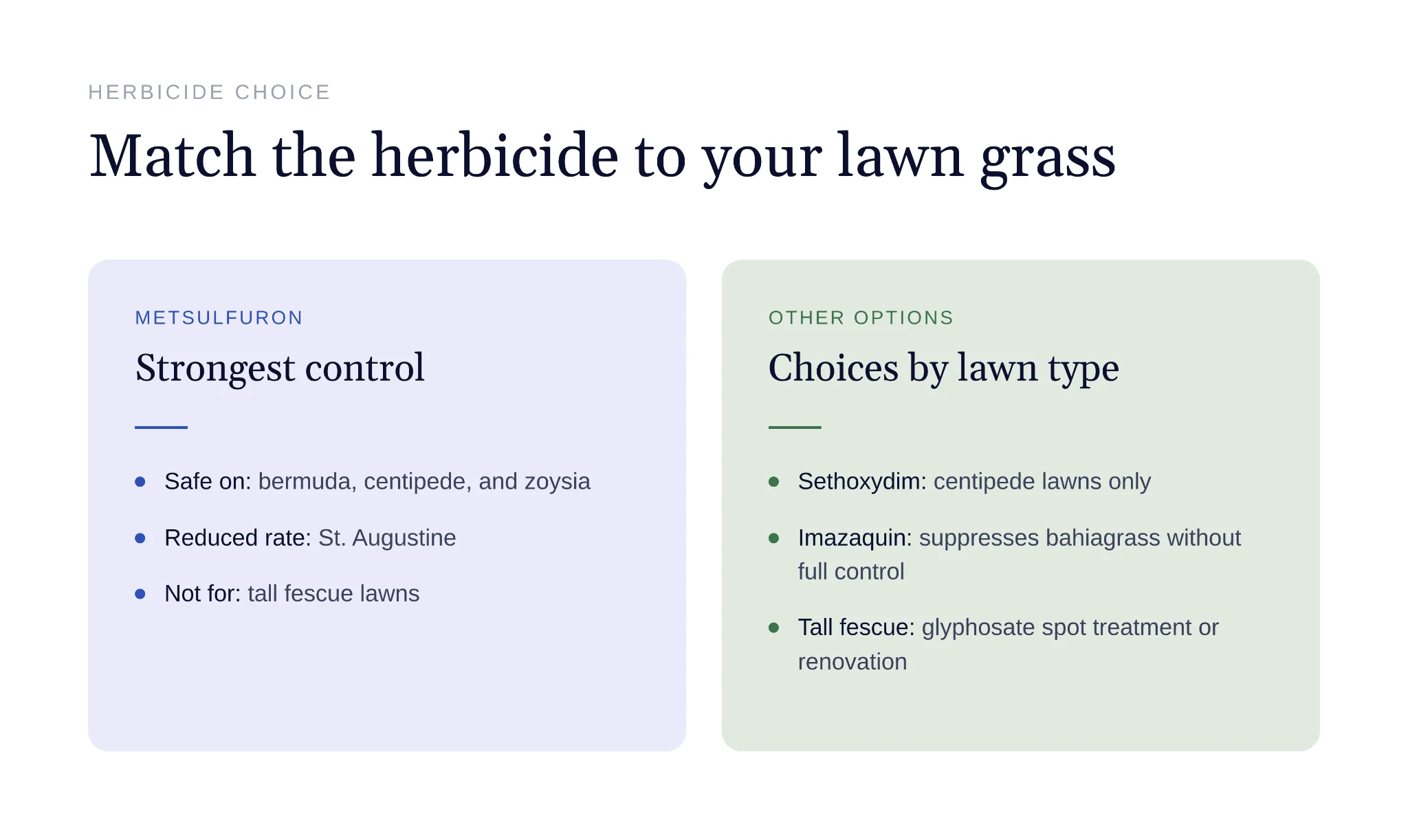
Metsulfuron gives the strongest control. Products such as Quali-Pro MSM Turf, Fahrenheit, and Blindside are professional-use herbicides that also control many broadleaf weeds.
It works best on Pensacola bahiagrass, the most common type in lawns. It gives very little suppression of Argentine, Paraguayan, and common bahiagrass.
Imazaquin is sold to homeowners as Image Kills Nutsedge. Clemson describes it as a product that aids in control and reduces competition from bahiagrass, and it should not be applied just before or during spring green-up.
Sethoxydim, sold as Segment, is limited to centipede lawns and also takes out crabgrass and other grassy weeds.
Tall fescue lawns have no selective option. Spot-treat with glyphosate and replant, or renovate the whole lawn as described further down.
When to Spray
Timing decides whether a treatment holds or the bahiagrass recovers within a few weeks. Wait until all of these conditions line up:
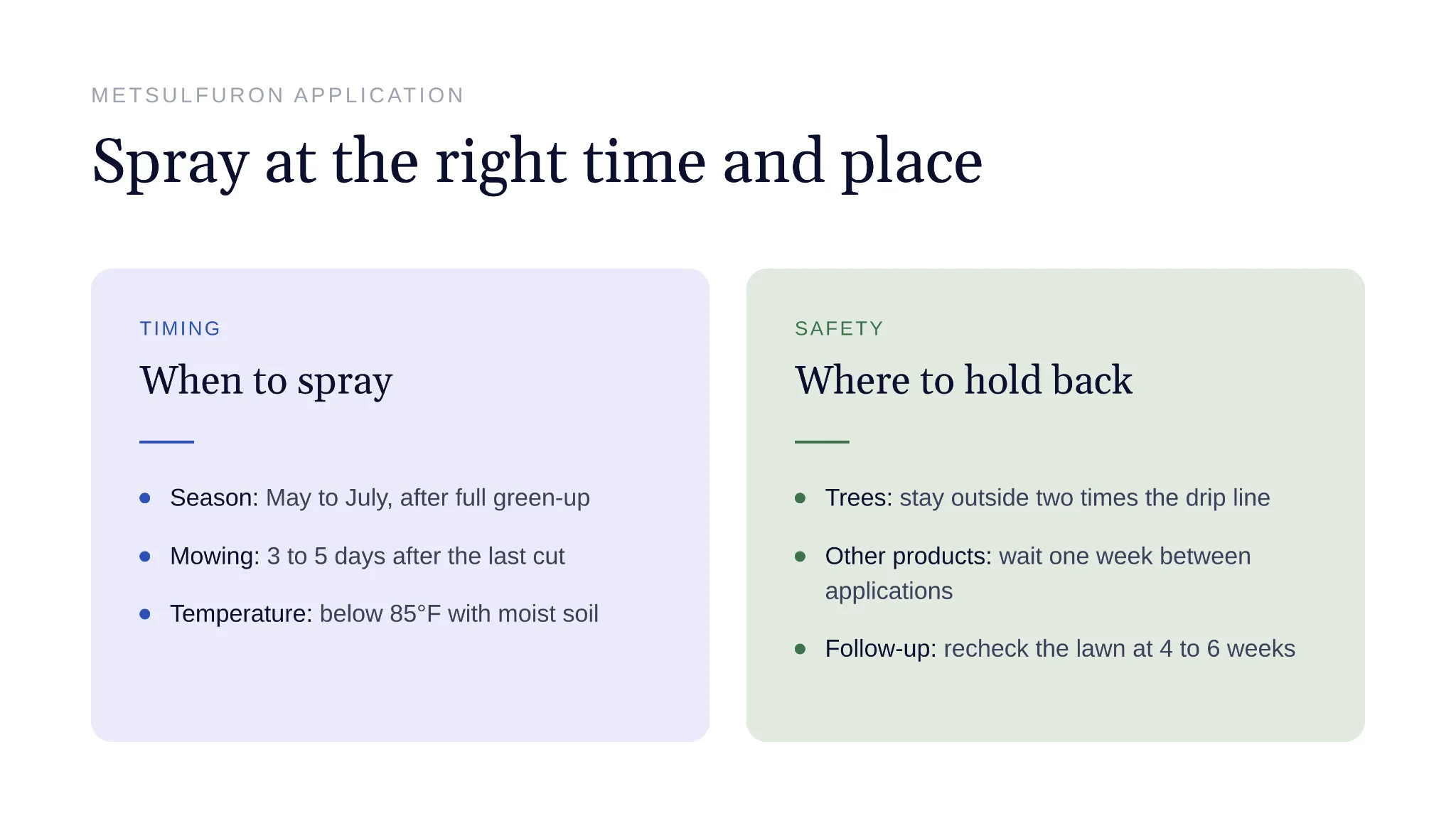
- The lawn has fully greened up, and the bahiagrass is actively growing. North Carolina extension agents recommend May through July, starting early while the plants are still small.
- The bahiagrass has had 3 to 5 days to regrow after mowing. Treatments are most effective before seedheads form.
- Air temperature is below 85°F. Heat increases drift onto nearby plants.
- The soil has moisture in it. Metsulfuron works less well under dry conditions, so water the lawn a day or two ahead if there has been no rain.
Find out how to measure your soil moisture.
How to Apply Metsulfuron
Metsulfuron rates are very low, and most turf damage comes from mixing by guesswork. Measure the lawn and calibrate the sprayer before you open the product.
Extension guidance for bahiagrass in centipede lawns puts the rate at 0.25 to 0.5 ounces of product per acre, with 1/3 ounce as a good middle rate, plus nonionic surfactant at 0.25%. That works out to roughly 0.16 to 0.33 grams per 1,000 square feet, which is below what most kitchen scales can measure accurately. Always follow the rate on the specific product label for your turf type.
- Measure the area. Mark the lawn off in 1,000-square-foot sections, so you know exactly how much mix each block needs.
- Calibrate the sprayer. Use a pump-up sprayer, which UF/IFAS considers more accurate than hose-end sprayers, and set it to deliver 1/2 to 1 gallon per 1,000 square feet. Spray plain water over one measured section at a steady walking pace and check how much is left.
- Mix the product. Add metsulfuron at the label rate, and use the reduced rate the label lists for centipede. Add nonionic surfactant at about 2 teaspoons per gallon of water.
- Keep 2,4-D out of the tank. Combining it with metsulfuron results in less bahiagrass control.
- Spray away from trees and shrubs. Do not apply within two times the width of the drip line of hardwood trees. Ornamentals can absorb metsulfuron through their roots, and UF/IFAS has documented damage to trees such as live oaks from turf applications.
- Hold off on other lawn products. Leave one week between metsulfuron and any other pesticide.
- Check the lawn at 4 to 6 weeks. Bahiagrass often needs a second application in that window.
What to Expect After Treatment
The lawn usually looks worse for a few weeks before it improves. Metsulfuron can discolor the turf, and adding surfactant increases yellowing and stunting.
Treated bahiagrass stops growing and fades over several weeks. University of Florida researchers measured up to 90% control, followed by regrowth over time, so budget for one application every growing season until the turf fills in.
Metsulfuron also limits what you can do in the treated area:
- Do not overseed or lay new sod for 8 weeks after application.
- Do not plant trees or shrubs in treated areas for one year.
- If you used imazaquin, do not use the clippings as mulch around vegetables, fruit trees, or small fruit plants.
Dig Out Small Patches
A few clumps in an otherwise clean lawn are faster to dig up than to spray. Cut off any seedheads first so seed does not drop into the hole.
Dig 4 to 6 inches deep and a few inches past the edge of the clump to get the rhizomes. Fill the hole with soil and a plug of your lawn grass, then check the spot every two weeks for new shoots.
Start Over When Bahiagrass Dominates
Once bahiagrass covers most of the lawn, spraying selectively leaves more bare ground than turf. Rutgers uses loss of 70% or more of the desirable grass as the point where renovation makes more sense.
Glyphosate kills all turfgrass it contacts, including your lawn, so use it only for spot treatment or a full renovation.
- Water for several days first. Glyphosate only works on actively growing plants.
- Spray the whole area. Follow the label rate and let the spray dry for one day before watering again.
- Respray after 10 days. Treat any spots that still show green.
- Clear the dead growth. Once everything is brown, mow as low as possible and rake off the debris. Strip off the dead mat and thatch before laying sod.
- Replant. Wait at least seven days after the last glyphosate application before seeding.
- Wait before spot-treating new turf. Young grass is sensitive to herbicides, so hold off until three mowings or about 60 days before spraying any bahiagrass seedlings.
Keep Bahiagrass From Coming Back
Herbicides clear the existing plants, and dense turf keeps new ones from establishing. Clemson lists mowing height, irrigation, and fertilization as the best defense against weeds.
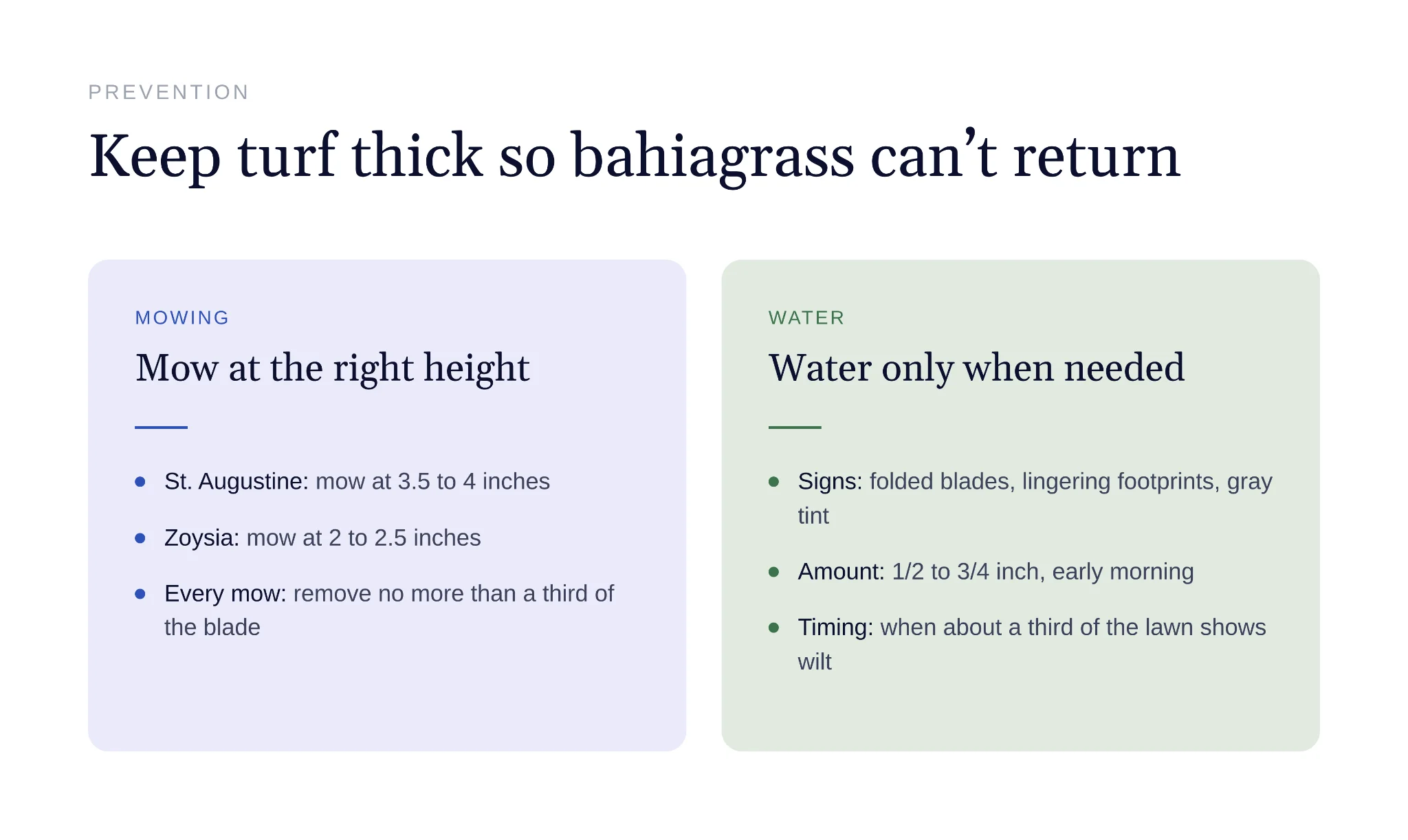
Mow at the right height. UF/IFAS recommends 3.5 to 4 inches for St. Augustine and 2 to 2.5 inches for Empire zoysia, and never removing more than a third of the blade at once. Centipede does best at 1.5 to 2 inches, and bermudagrass at 1 to 2 inches.
Fertilize to your grass type. Annual nitrogen targets in North Florida are 3 to 5 pounds per 1,000 square feet for bermudagrass, 2 to 4 for St. Augustine, 2 to 3 for zoysia, and 1 to 2 for centipede. Apply no more than half a pound of nitrogen at a time with quick-release fertilizer, or 1 pound if at least 30% is slow-release.
Water deeply and only when the lawn needs it. Look for folded leaf blades, footprints that stay visible, and a grayish tint. When about a third of the lawn shows those signs, apply 1/2 to 3/4 inch of water in the early morning.
Watering on a fixed schedule two or more times a week trains roots to stay shallow. A shallow-rooted lawn thins out first in a dry spell, and those thin spots are where bahiagrass spreads.
Hitting the 1/2 to 3/4 inch target means knowing what each sprinkler zone actually puts down, which usually requires a can test for every zone. The Aiper IrriSense 2 tracks watering depth and water use by zone in its app and pauses watering when rain is in the forecast, so each watering lands closer to the amount the lawn needs.
When to Hire a Licensed Applicator
The most effective metsulfuron products are labeled for professional use, and a licensed lawn care company can buy and apply them safely. Hiring one makes sense when the lawn sits under or near hardwood trees, when bahiagrass covers large areas, or when you do not want to calibrate a sprayer for rates measured in fractions of a gram.
Get more pool and lawn care guides from Aiper on Google