How to Get Rid of Tree Saplings in a Lawn

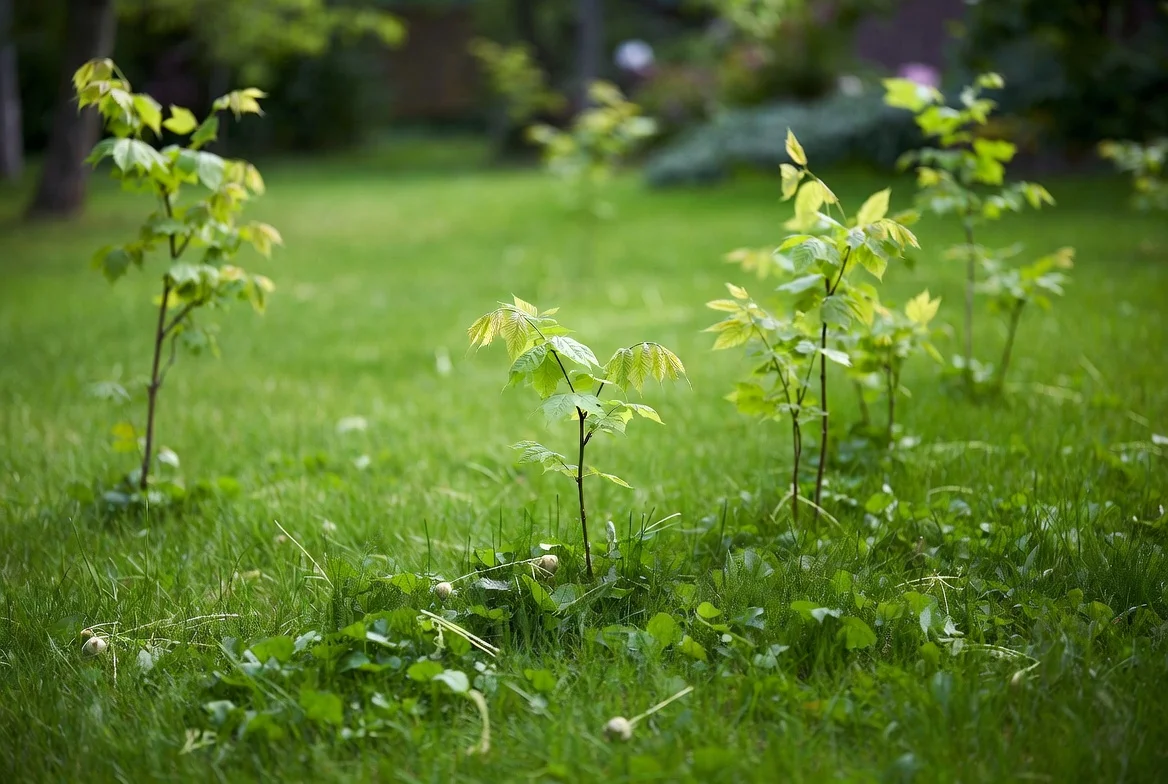
The first mistake almost everyone makes with tree saplings is treating them like a mowing problem.
You see little trees coming up in the grass, you run the mower over them, they disappear, and three weeks later they’re back, in the same spots, sometimes thicker.
Then people escalate to broadleaf weed killer, watch the leaves curl, and declare victory right before the whole patch flushes out again in June.
Saplings in a lawn are a source problem. Something is feeding them, and until you know what, everything you do is guesswork. The good news is that figuring it out takes about two minutes and one gentle tug. For the triangle-stemmed invader, see how to get rid of nutsedge in lawns — its tubers make it a different fight. Wild onion spreads by bulbs instead, so removing onion grass and its bulbs from lawns is the only way it actually stops.
The rest of this is just doing the right thing for the right sapling, in the right season, and not sabotaging the mature trees you actually want to keep. Knowing when a job crosses from routine lawn care into landscaping work also affects who you call for it — our comparison of landscaping versus lawn care breaks down that difference.
Figure Out What’s Feeding Them First
Grab one of the saplings low on the stem and pull slowly. What happens next tells you almost everything.
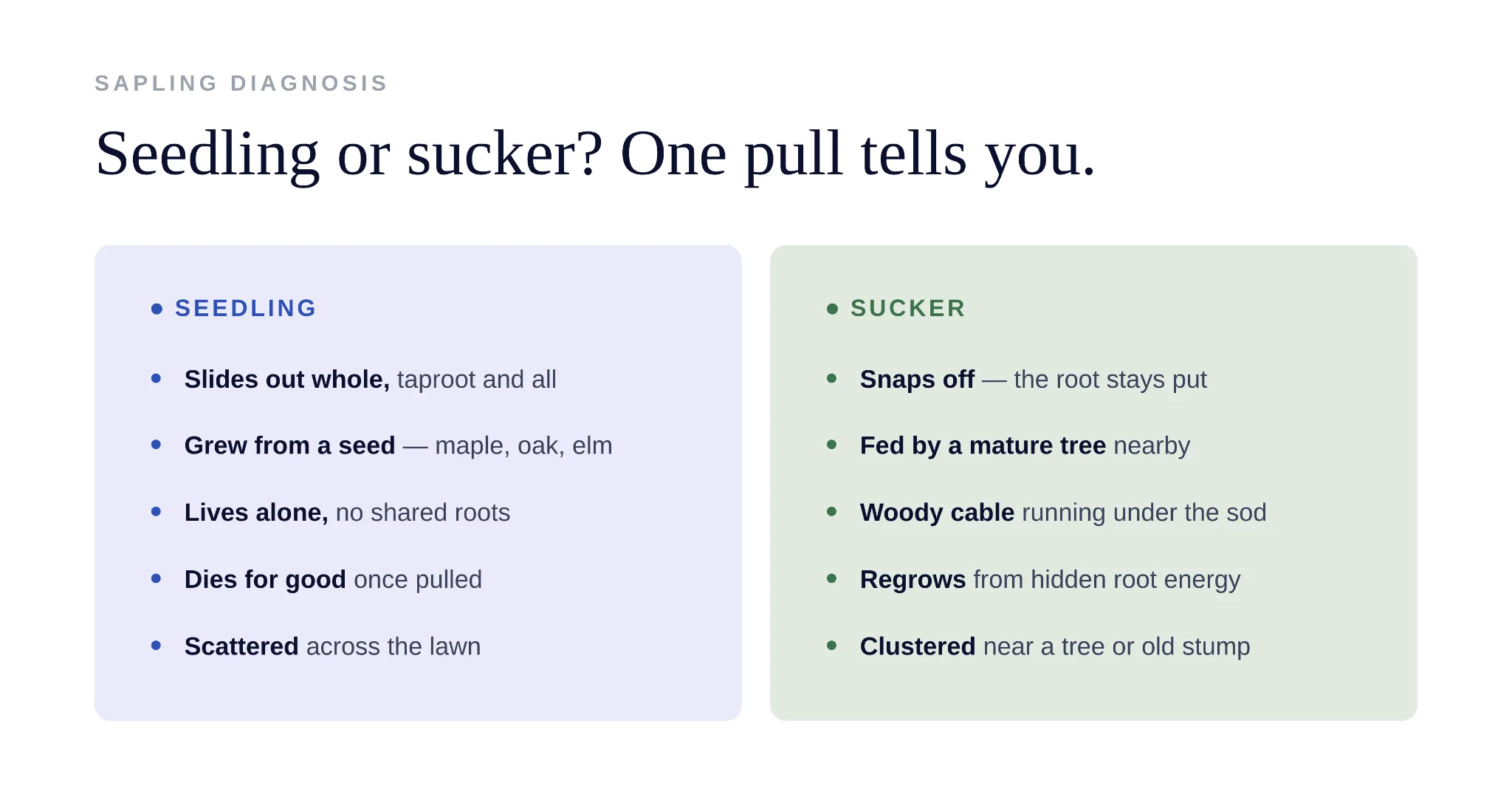
If it slides out with a small taproot and a few fine hairs attached, you have a seedling.
It grew from a seed, a maple helicopter, an oak acorn a squirrel buried and forgot, an elm or mulberry seed dropped by a bird sitting on your fence. Seedlings are individuals. Each one lives and dies alone, and once the root is out, that plant is finished forever.
If the stem snaps off and the root stays put, or if the root turns out to be a thick woody cable running horizontally just under the sod, you have a sucker.
That’s not a baby tree. That’s a mature tree’s root system sending up new shoots, and it might be coming from your silver maple thirty feet away, your neighbor’s tree of heaven, or the stump of something that was cut down two owners ago.
Cottonwood, black locust, wild cherry, sumac, and crabapple are notorious for it. Suckers regenerate from root energy you can’t see, which is why pulling the top off does nothing.
There’s a third category worth naming: stump sprouts. If a tree was removed but the stump was left in, or the roots weren’t ground out, those roots can keep pushing shoots for years. Five years, sometimes longer, depending on the species and how much stored carbohydrate the root system had when the tree came down.
Seedling, sucker, stump sprout. Everything else in this article depends on which one you’ve got.
Pulling Seedlings: Timing Does Most of the Work
Seedlings under a year old come out by hand, and the difference between an easy pull and a snapped stem is soil moisture:
Wait for a day or two after a good rain, or water the area deeply the evening before. Dry, compacted clay will hold a taproot like concrete. The same root slides out of damp soil with barely any resistance.
Grip low, pull straight up, no twisting. If it fights you, use a dandelion fork or a hori-hori knife to loosen alongside the root before pulling again.
What you’re after is the whole taproot, a maple seedling that loses its top but keeps two inches of root will often resprout once, though usually weaker.
The window matters more than the technique.
Silver and red maples dump their samaras in late spring, and the seeds germinate almost immediately. That means four to six weeks after helicopter season, your lawn can have hundreds of seedlings at the perfect pulling stage: two to four inches tall, roots still shallow, soil still holding spring moisture.
Miss that window and by August the same seedlings have taproots six inches deep and stems that are starting to lignify.
Norway maples and oaks work differently, their seeds overwinter and germinate the following spring, so those show up as a spring flush a year after the seed fell.
Either way, the pattern holds: one dedicated hour of pulling at the right moment beats ten scattered hours later in the season.
Mowing Is Your Weapon
Here’s the thing people get backwards. Mowing over saplings doesn’t just hide them, done consistently, it kills them. But the mechanism is starvation, not decapitation, and starvation takes time.
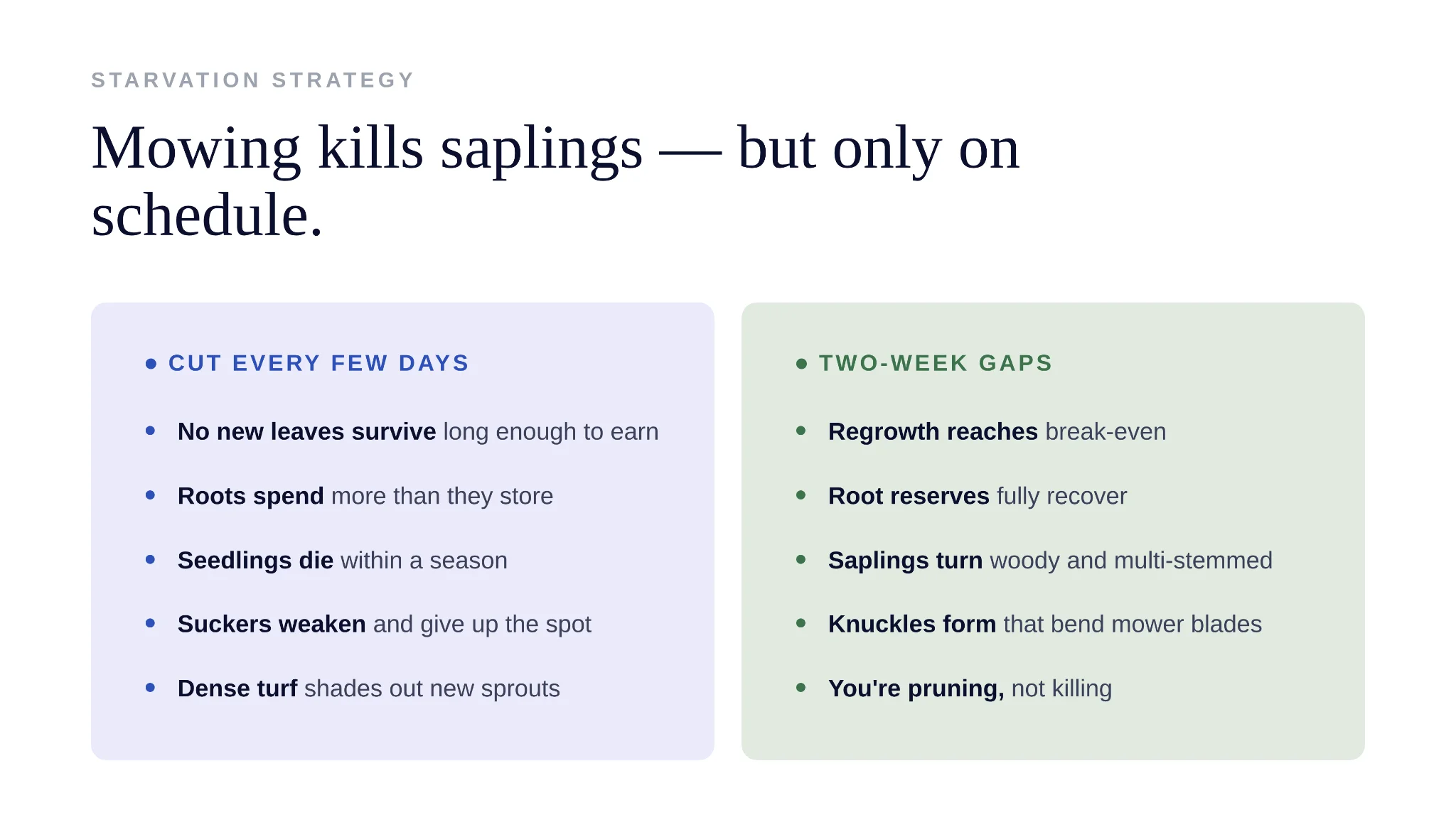
Every time a woody shoot regrows its leaves, it spends stored carbohydrate from its roots.
Cut it before those new leaves have paid back the energy debt, and the root reserve drops. Cut it again, and it drops further.
A seedling has a tiny reserve and dies within a season of regular mowing. A sucker connected to a mature tree has an enormous reserve, but even suckers weaken and eventually give up on a spot where they get sheared every few days.
The word doing all the work in that paragraph is regular.
Mowing every ten or fourteen days doesn’t starve anything. That gap gives the regrowth enough time to photosynthesize its way back to break-even, and now you’re just pruning your saplings into stubby, multi-stemmed shrubs with thickening root collars. This is exactly how people end up with those woody knuckles in the lawn that bend mower blades. Infrequent mowing trains saplings to survive mowing.
Frequent, consistent cutting flips the math. The shoots never get ahead. They spend and spend and never earn. It’s the least dramatic method on this list and, for whole-lawn seedling pressure, the most effective one.
When You Need Herbicide
Some situations earn a chemical answer. A stump that keeps sprouting. A thicket of tree-of-heaven suckers along a fence line. A sapling that’s gotten thick enough that pulling and mowing aren’t realistic.
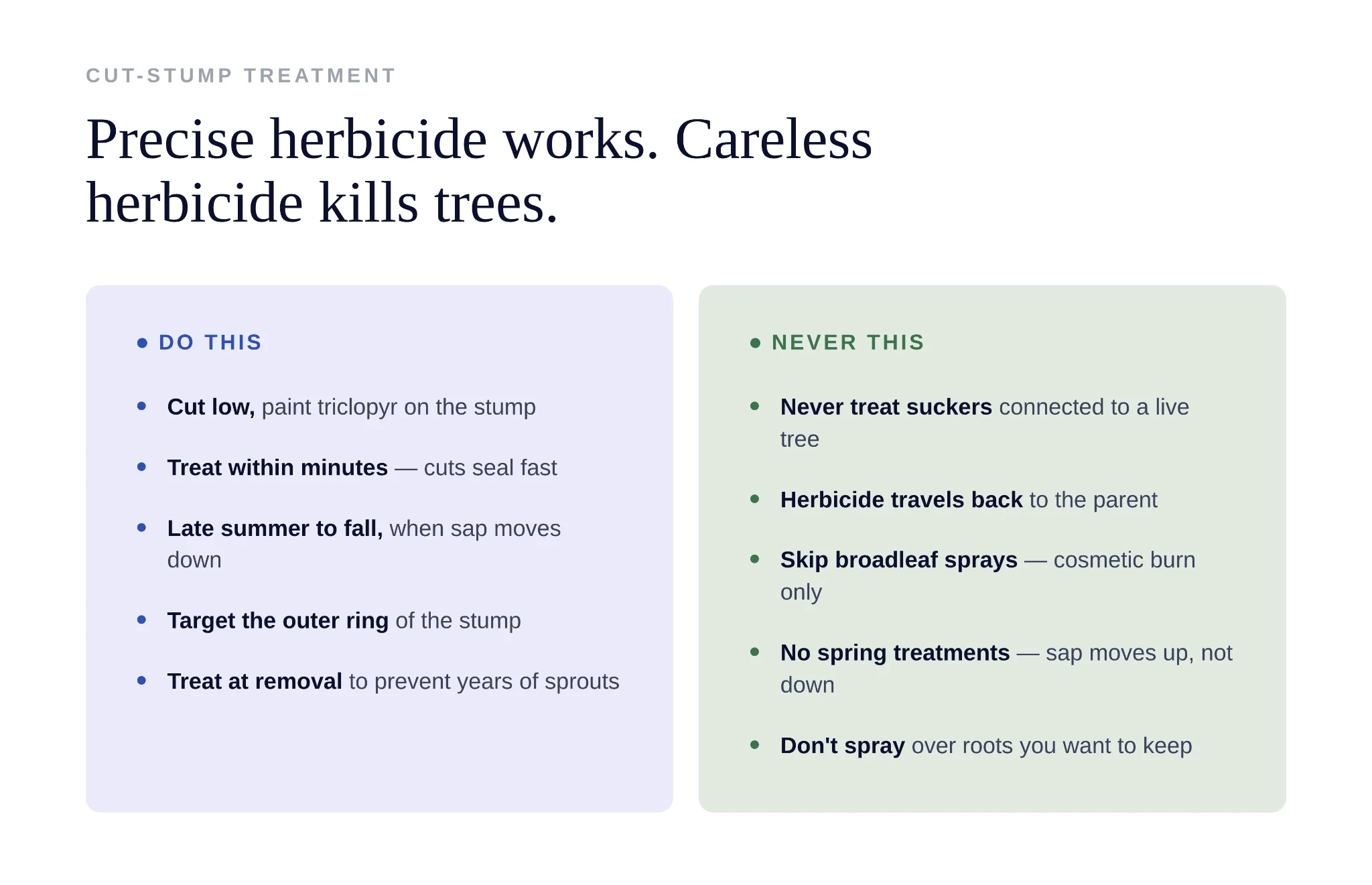
The method that actually works is cut-stump treatment.
Cut the stem as close to the ground as you can, then paint concentrated triclopyr onto the fresh cut within a few minutes. The cut surface starts sealing fast, and the outer ring of the stump (the cambium and sapwood) is what carries the herbicide down into the roots.
Late summer through fall is the best timing, because that’s when the plant is actively moving sugars down to the roots and will carry the herbicide with them. Spring treatment often fails for the same reason in reverse, as everything is moving up, not down.
Skip broadleaf lawn herbicides sprayed on sapling foliage. Products built for dandelions and clover will burn sapling leaves and accomplish little else on anything woody past its first year. You get cosmetic damage and full regrowth. Thorny invaders like blackberry and thistle need a different approach — learn how to remove prickly weeds in lawns without shredding your hands.
And one warning that matters more than everything else in this section: never apply systemic herbicide to a sucker that’s still connected to a tree you want to keep.
The connection runs both ways. Triclopyr or glyphosate painted onto a cut sucker travels back through that shared root and into the parent tree.
People have damaged or killed forty-year-old maples this way, treating what they thought were independent saplings in the lawn. If the sucker traces back to a living tree you like, herbicide is off the table for that shoot. Full stop.
For those, cut the sucker below grade with a sharp spade, sever it where it meets the parent root if you can find the junction, and then rely on mowing to keep the spot suppressed. The parent tree will keep trying.
Your job is to make every attempt too expensive to sustain, and to accept that suckering trees sucker. It’s a management relationship, not a one-time fix.
Stumps and the Roots Nobody Ground Out
If your sapling problem traces back to a removed tree, the shoots are running on the stored energy of the old root system, and you have two honest options.
Grind or dig out what’s feeding them. Stump grinding that goes eight to twelve inches down and chases the major lateral roots removes most of the reserve. Sprouting usually collapses within a season or two afterward.
Or wage the exhaustion campaign: cut every sprout the moment it appears, all season, every season, until the roots run dry. This genuinely works. Dead roots can’t sprout, but with a vigorous species you’re committing to two or three years of vigilance, and one lazy summer resets a chunk of your progress.
Cut-stump herbicide at the time of removal shortcuts all of this, which is why it’s worth insisting on when a tree comes down. Ten minutes with a brush during the removal saves three years of whack-a-mole after it.
The Lawn Itself Is Your Best Defense
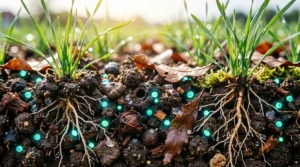
A thin lawn is a seedbed. Bare soil, sparse turf, and scalped patches are where samaras and acorns win, because tree seeds need soil contact and light at the surface to establish.
A dense stand of grass mowed at three to three and a half inches shades the soil surface enough that most tree seedlings never make it past germination. They sprout, stretch, find no light, and die before you ever see them.
So the boring fundamentals carry real weight here:
Overseed thin areas in fall.
Don’t mow below three inches, especially under the drip line of seed-heavy trees where the pressure is highest.
Rake or mulch-mow the helicopters and acorns when they drop instead of letting them sit, a maple can put tens of thousands of seeds onto a lawn in one spring, and every one you shred or remove is one you never pull.
Consistency Wins This
Everything above shares one dependency. Pulling works if you catch the window. Starvation works if the cutting never lapses. Suppression of suckers works if the shoots never get a week to breathe.
The homeowners who lose to saplings are applying the right ones at intervals long enough for the trees to recover in between.
That same consistency problem shows up underground. A lawn watered unevenly, too much in one spot and too little in the next, ends up with the thin, stressed patches where windblown seeds actually get a foothold, since bare or sparse turf is what lets a seedling germinate in the first place. Our smart irrigation pillar covers what actually separates a system that manages that zone-by-zone from one that’s just watering on a timer.
This is where a multi-zone system like Aiper IrriSense 2 earns its place in the plan. It reads soil moisture zone by zone and waters accordingly, so the dense, even turf that shades out germinating seeds holds across the whole yard instead of just the corners you remember to water.
You still pull the spring flush when the soil is damp. You still treat the stubborn stump properly. But keeping the lawn itself too thick and healthy for new seedlings to get started is the part that can run quietly in the background.
Get more pool and lawn care guides from Aiper on Google