How to Get Rid of Hairy Bittercress in a Lawn

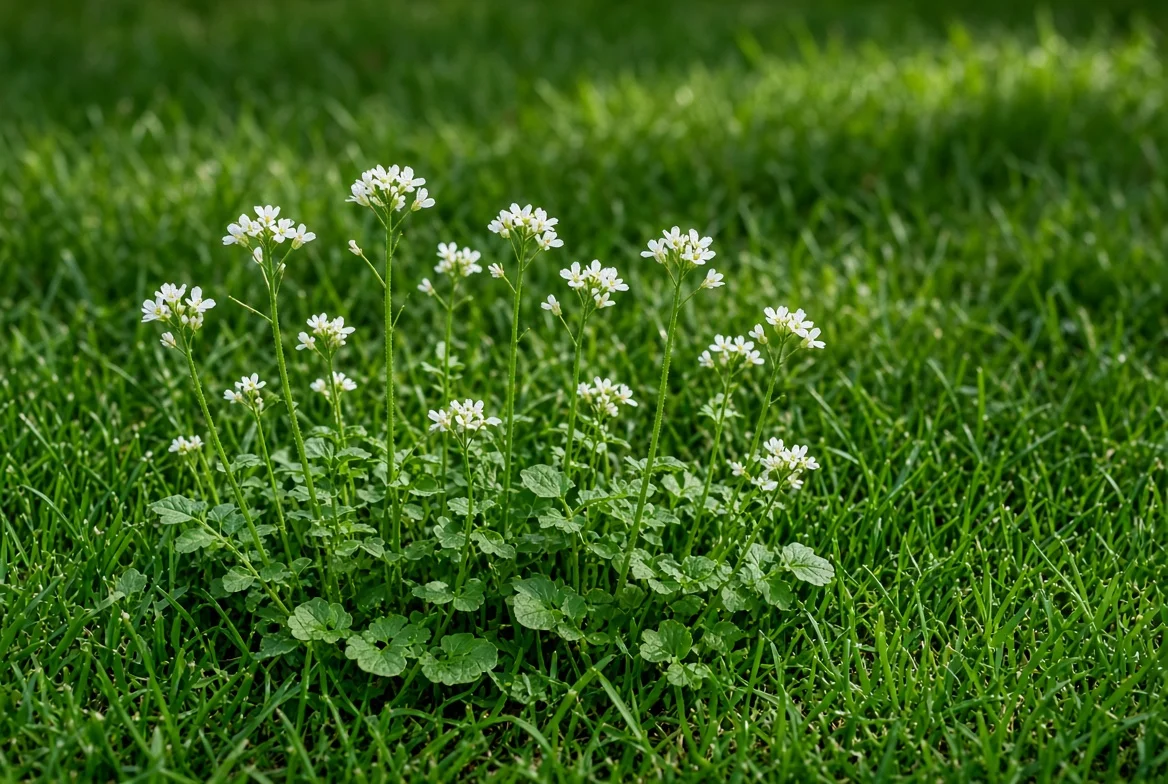
Most people meet hairy bittercress in March, when the lawn is still half dormant, and something green has already thrown up a mat of little white flowers along the driveway edge and through the thin patch under the maple. It looks small. It looks like something a mower will handle.
By the time it’s flowering, the fight is mostly over, and you lost it in October.
Bittercress is a winter annual, which means its calendar runs opposite to almost every other weed people think about. It germinates in fall, sits through winter as a low rosette that nothing seems to touch, flowers before the turf wakes up, fires its seed in every direction, and dies on its own in early summer heat.
Kill it in April, and you’ve killed a plant that was going to die anyway, after it had already reseeded the yard. Everything that actually works happens earlier than feels natural.
How to Identify Hairy Bittercress
Start with a flat rosette pressed against the soil, three to five inches across. The leaves are compound, a row of small rounded leaflets running up a stalk, with a larger rounded leaflet at the tip. The hairs the name promises are sparse and sit mostly on the leaf stems, so don’t expect anything fuzzy.
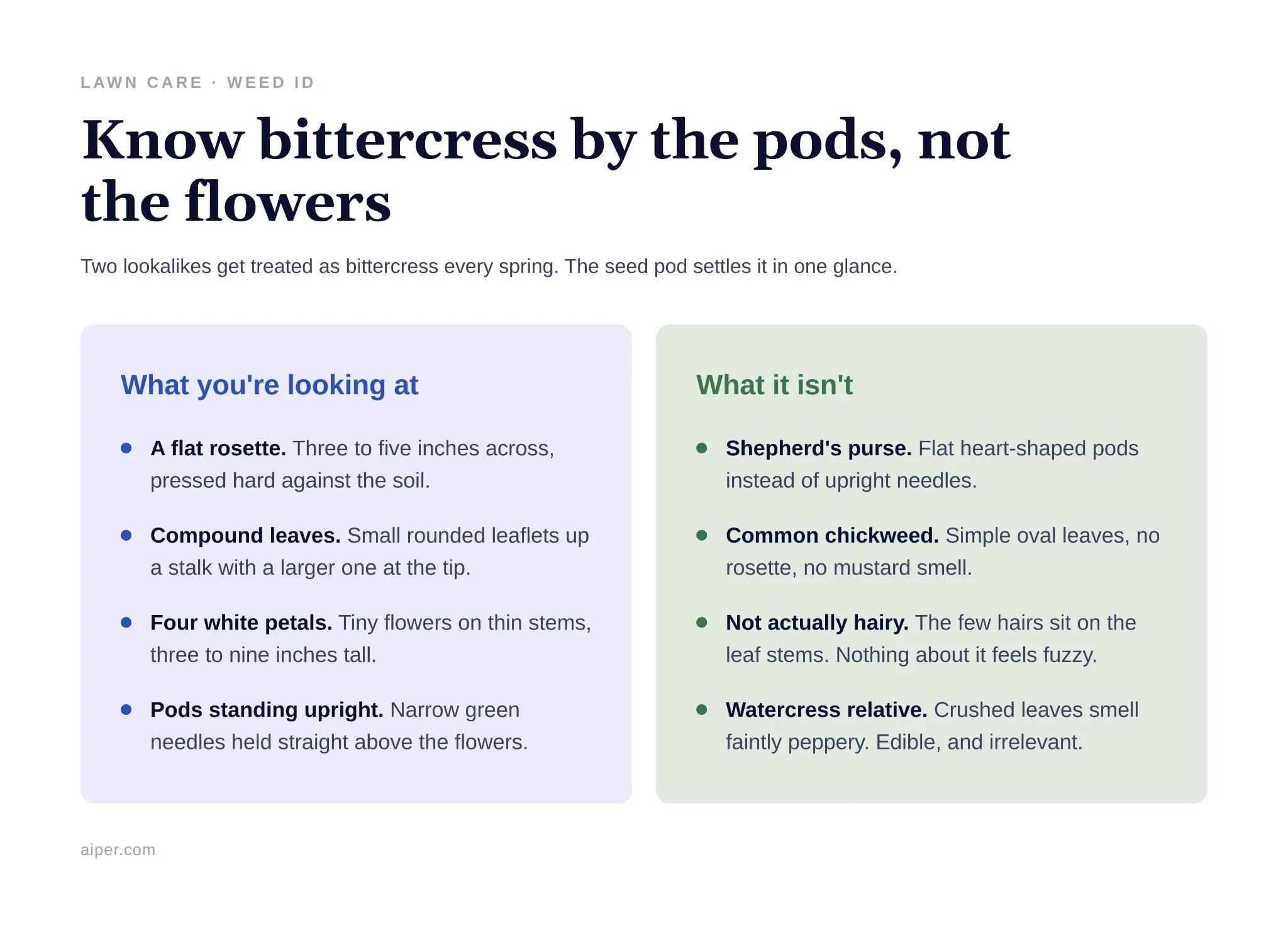
From the center of that rosette, thin stems rise three to nine inches, carrying clusters of tiny white flowers with four petals each. Mustard family. Crush a leaf, and it smells faintly like watercress, because it’s a close relative and it’s edible, which is worth exactly nothing when it’s covering your lawn.
Then come the seed pods, and those are the part that matters. Narrow green needles, half an inch to an inch long, standing straight up past the flowers. A single plant carries dozens.
Confused with it most often: shepherd’s purse, which has heart-shaped flat pods, and common chickweed, which has simple oval leaves and no rosette structure.
Understand the Timeline Before Doing Anything
Seed germinates from September through November, when soil cools and moisture returns. The plants stay low and unremarkable through winter, still growing whenever temperatures climb above the mid-40s.
Flowering starts as early as late January in the South and February to March across most of the country. Seed set follows within a couple of weeks of flowering.
In a mild, wet year, the whole cycle can run in five or six weeks, which means a stand that germinates in a spring rain can flower, seed, and start a second generation before June.
Seed needs light to germinate and does so at the soil surface. That single detail is the lever behind half the control methods below.
Pull It Before the Pods Stand Up
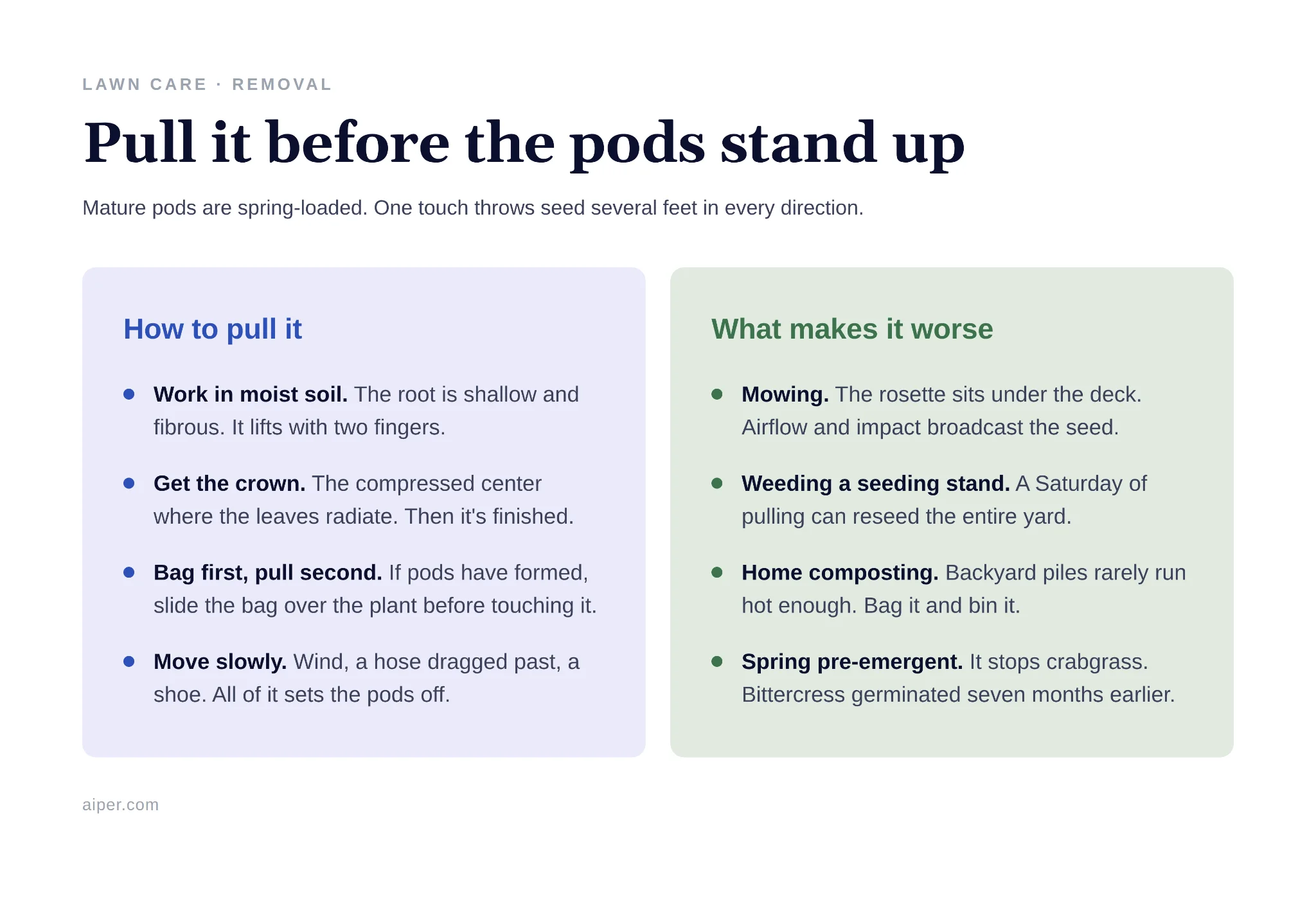
The root system is shallow and fibrous, and in moist soil the whole plant lifts with two fingers and a small tug. Get the crown, the compressed center where the leaves radiate from, and it will not come back.
The window is the problem, not the effort.
Once those pods have formed and dried slightly, hairy bittercress becomes ballistic.
The pods are spring-loaded, and contact of any kind (a hand, a shoe, a hose dragged across the bed, wind against a stiff stem) splits them open and throws seed several feet in every direction.
So: pull in late fall, or in a warm break in January and February, while the rosettes are small and the stems haven’t bolted. If you’re pulling plants that already have pods, slide a bag over the top of the plant first, then pull.
Bag it and bin it. Home compost piles rarely run hot enough to kill the seed, and a pile that never heats up is a nursery.
Stop Trying to Mow It Out
The rosette sits below the mower deck. Cut the flower stalks off, and the plant simply pushes new ones, shorter, under the blade height, and flowers there instead.
Worse, a mower run across a stand in full pod does the same job as a leaf blower pointed at a dandelion. Deck airflow plus impact is close to ideal for dispersal.
Mowing manages the look of the problem for about four days.
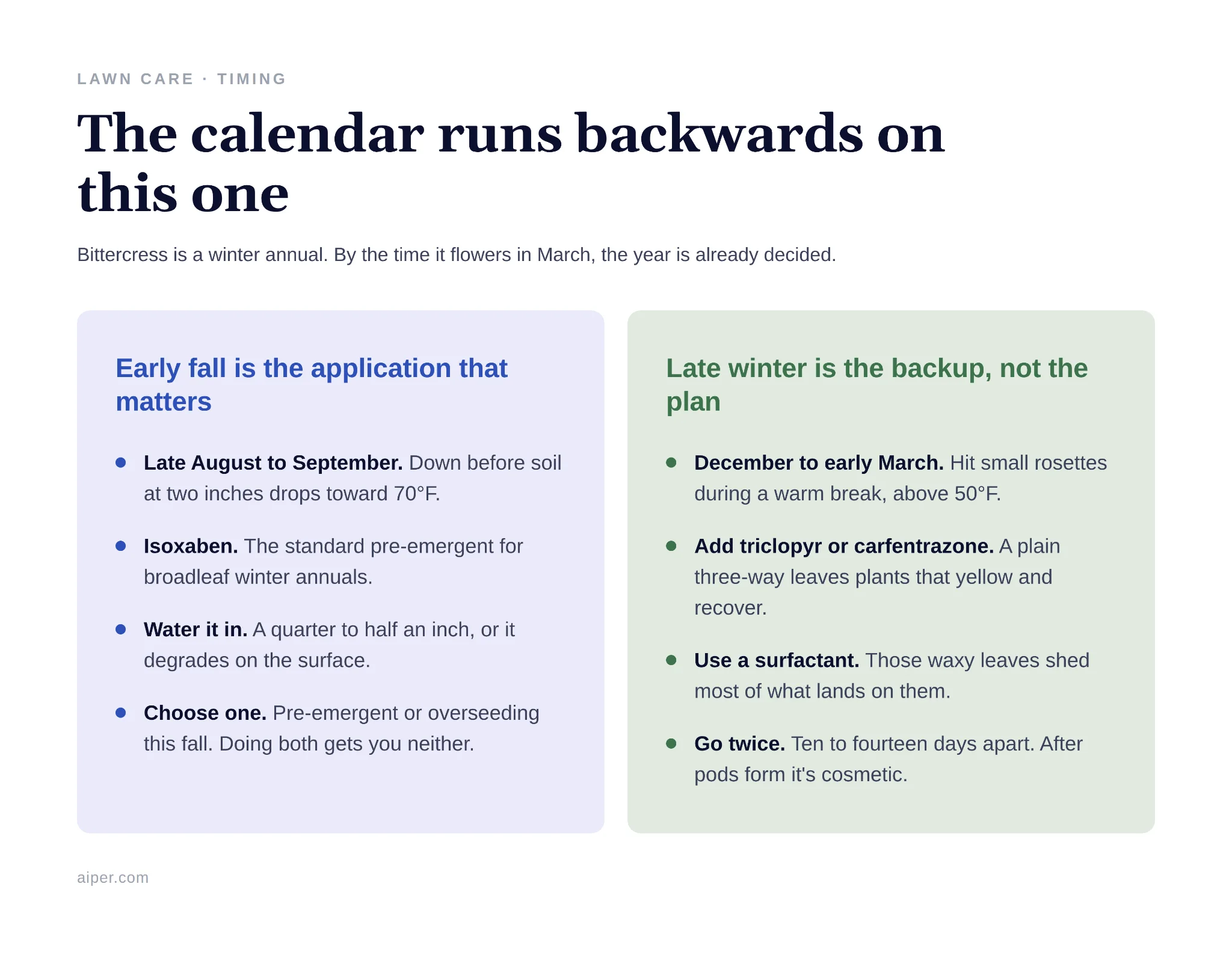
Apply a Pre-Emergent in Early Fall
This is the highest-value thing on the list, and almost nobody times it right, because the whole culture of lawn care points at spring.
Spring pre-emergent stops crabgrass. It does nothing for bittercress, which germinated seven months earlier and is already a plant.
The application that matters goes down in late August through September, when soil temperature at two inches falls toward 70°F and before fall rains trigger germination.
Isoxaben is the standard active ingredient for broadleaf winter annuals, and it holds bittercress well. Prodiamine, pendimethalin, and dithiopyr all give some suppression and are worth using if that’s what’s already in the shed for other reasons, but isoxaben is the one built for this job.
Water it in after application, a quarter to a half inch, or it sits on the surface and degrades without ever forming a barrier.
Hold off on overseeding for the interval the label specifies, which is usually several weeks and sometimes longer. That forces a choice: seed the lawn this fall, or lay the barrier this fall. Doing both in the same six weeks gets you neither.
Spray Broadleaf Herbicide in Late Winter, Not Spring
If bittercress is already up, the target is a small rosette in a warm spell, not a flowering plant in April.
Standard three-way lawn products built on 2,4-D, dicamba, and mecoprop will take it, though bittercress shows more tolerance than most broadleaf weeds, and thin coverage tends to produce a plant that yellows, sulks, and recovers. Formulations that add triclopyr or carfentrazone work noticeably harder on it. A surfactant matters here, because those waxy little leaves shed a lot of what lands on them.
Spray when daytime temperatures are above 50°F and the plant is actively growing: a February thaw, a mild stretch in early March. Cold plants don’t move herbicide.
Expect to go twice, ten to fourteen days apart.
Anything sprayed after the pods are up is cosmetic. The seed is already viable.
Bury the Seed in Beds Under Real Mulch
Since the seed germinates at the surface and needs light to do it, two to three inches of mulch is a physical answer rather than a chemical one.
The mistake is depth and timing. An inch of shredded bark, half broken down by August, blocks nothing. Refresh beds in early fall so the barrier is at full depth before germination starts, and top up bare patches around the base of shrubs where mulch always thins first.
Bittercress in a bed also spits seed straight out into adjacent turf, so a clean bed edge is worth more than it looks.
Check Nursery Containers Before Planting
Hairy bittercress is the most common weed in container nursery production in the country, and a large share of infestations arrive by car, in a pot, from a garden center.
Look at the soil surface of anything you buy. If there’s a rosette in there, or the fine green flush of seedlings, scrape off the top half inch of media and bin it before the plant goes in the ground. Two minutes at planting saves several seasons.
Thicken the Turf So There’s Nowhere to Land
Bittercress doesn’t invade dense, healthy lawn. It fills gaps.
Look at where it actually is in the yard, and the pattern is always the same: the compacted strip along the walk, the shaded thin area under the tree canopy, the low spot that stays wet, the ground that got scalped in July and never recovered.
Mow at three to three and a half inches so the canopy shades the soil surface. Core aerate compacted ground. Overseed thin areas in early fall, before bittercress seed has a chance at the same bare soil. Fix the drainage that keeps one corner damp all winter, and thin overhanging limbs where shade is the limiting factor.
None of this is fast. It’s also the only version of control that doesn’t need repeating every year.
Vinegar Burns the Leaves and Leaves the Crown
Horticultural acetic acid and household vinegar both scorch bittercress foliage within hours, which looks like success.
The crown survives. New leaves push within a week or two, and the plant flowers slightly later than it would have.
On a driveway crack or a gravel path, boiling water or a flame weeder does finish the job, and both are reasonable where there’s no turf to protect. In a lawn, neither is usable, they kill grass on contact, and every bare spot they create becomes germination ground in the fall.
Clearing an Established Stand
A yard that’s been running unchecked for two or three years has a seed bank, and one clean season won’t empty it. Bittercress seed doesn’t persist for decades the way some weeds do, but it holds for a few years, which sets the realistic horizon at two to three seasons of consistent work.
Overwatering is what keeps the shaded corner damp enough for bittercress to germinate, and most controllers run on a fixed schedule regardless of what the soil is actually holding.
A moisture-aware system like the Aiper IrriSense 2 waters by what the ground needs rather than by the calendar, which dries out the marginal zones without starving the rest of the lawn.
Get more pool and lawn care guides from Aiper on Google