How to Reseed a Lawn: Timing, Prep, and Germination

Most reseeding jobs fail before the seed leaves the bag. Seed is cheap. The window is not.
You get one good shot a year at this, maybe two if you’re lucky with spring weather, and blowing it means looking at the same thin, patchy turf for another twelve months.
So the job deserves to be done in the right order, at the right time, with the one thing most people can’t seem to manage: three weeks of consistent water.
Here’s the whole process, in the order it actually matters.
Timing Is Half the Job
For cool-season grasses, fescue, ryegrass, bluegrass, which are most lawns in the northern half of the country, fall is the window. Not spring. Fall.
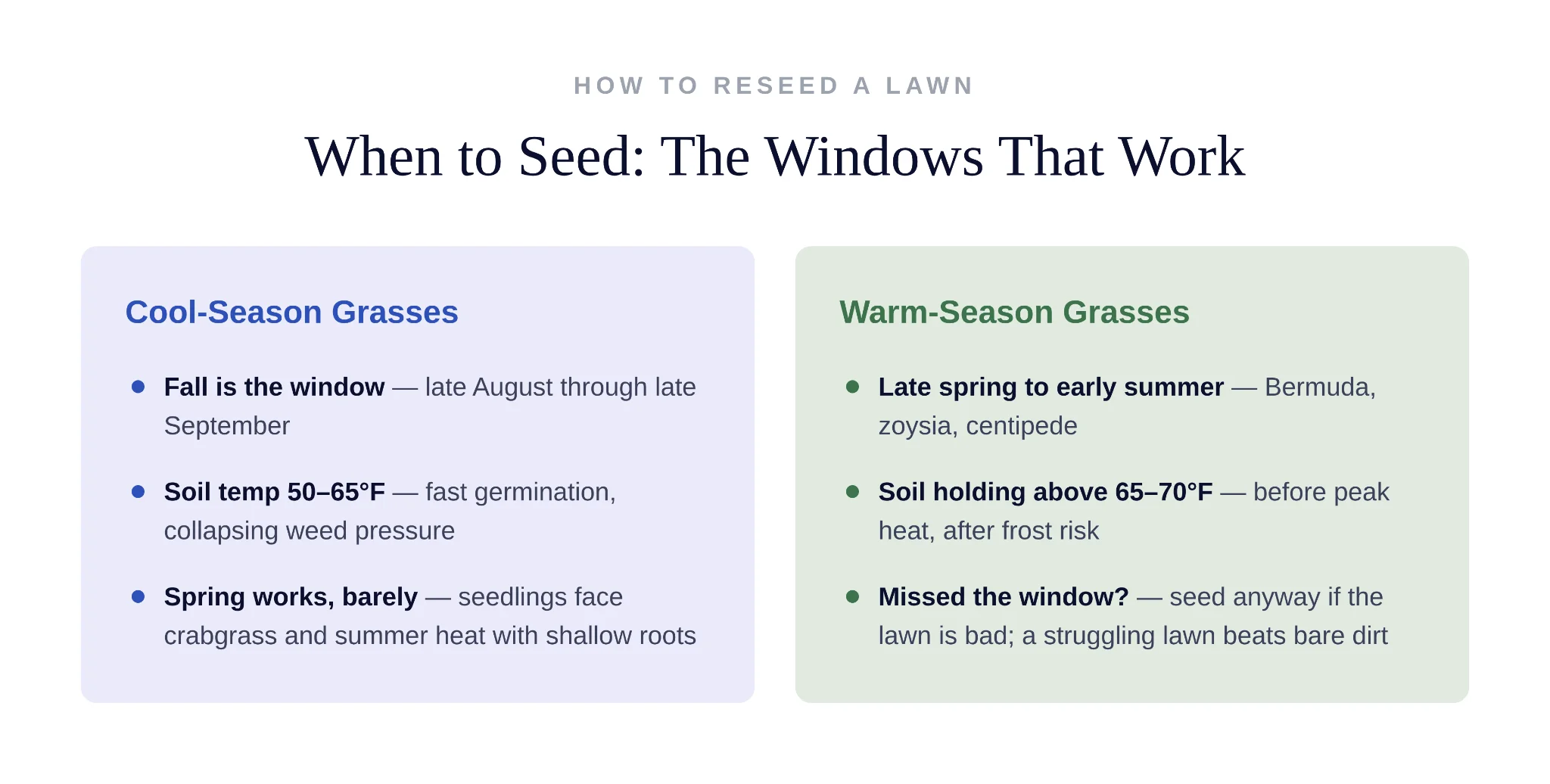
Late August through late September, depending on how far north you are. What you’re looking for is soil temperature in the 50–65°F range with daytime air temps cooling off.
Seed germinates fast in warm soil. The young grass establishes through fall while weed pressure collapses, goes dormant over winter, and comes back in spring with a root system already in place.
Spring seeding works, technically. But spring seed germinates right into crabgrass season, summer heat arrives before the roots are deep enough to handle it, and you can’t use pre-emergent on a newly seeded lawn, the same chemistry that blocks crabgrass blocks your grass seed. Spring reseeders spend the whole summer babying shallow-rooted grass through heat it wasn’t ready for.
Warm-season grasses flip the calendar. Bermuda, zoysia, centipede, seed those in late spring through early summer, once soil holds above 65–70°F.
If you missed the fall window and the lawn is genuinely bad, seed in spring anyway. A struggling lawn in June beats bare dirt in June. Before you buy seed, it helps to know the difference between turf and a lawn, since the two words get mixed up in lawn advice. Just know you’re playing the harder version.
Prep Decides Whether Seed Becomes Grass
This is the section people skip, and it’s the section that decides the outcome. Grass seed has one non-negotiable demand: seed-to-soil contact. Seed sitting on top of thatch, dead grass, or crusted soil will germinate and then die, because the root never reached dirt.
Cut it short first
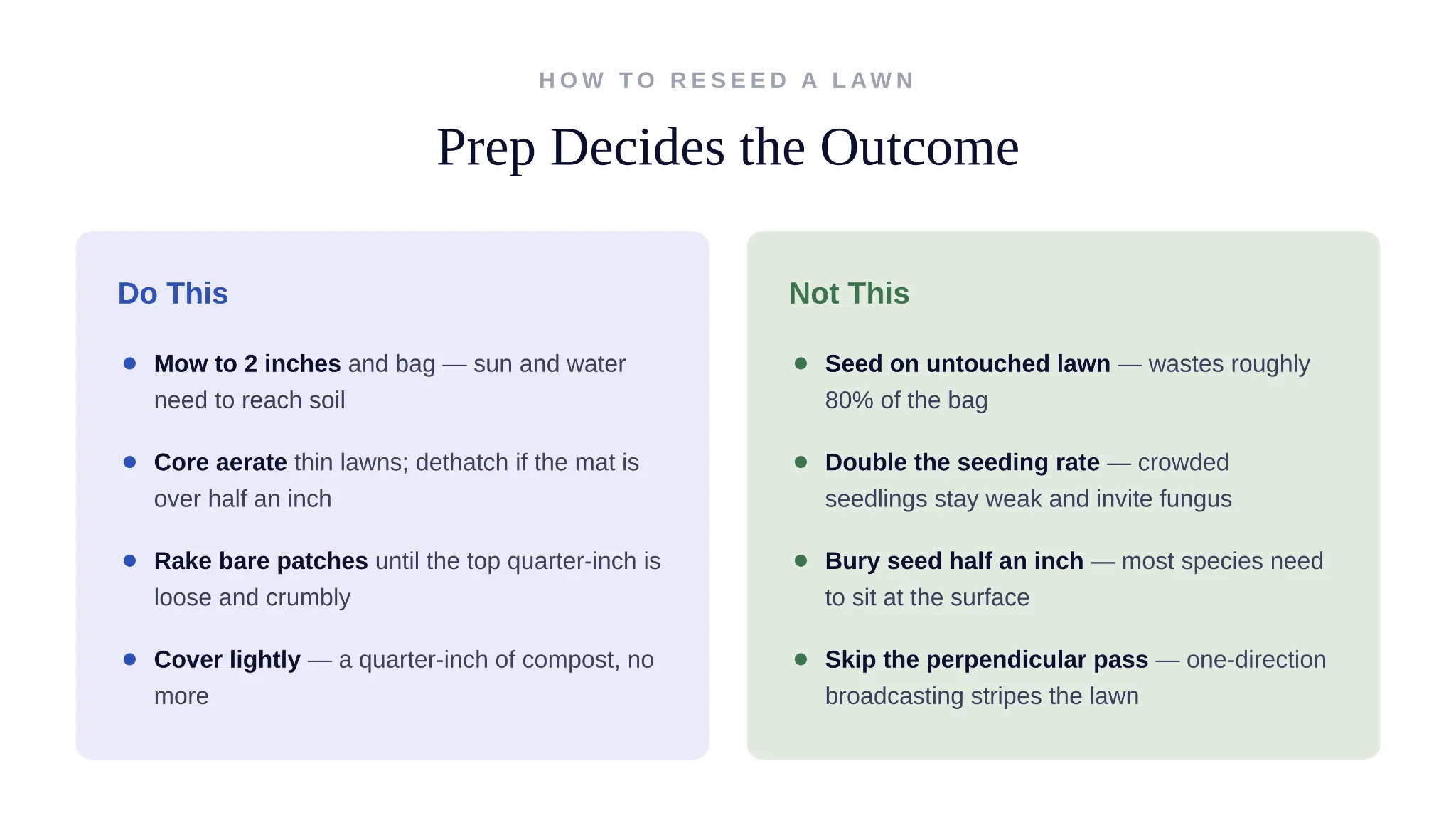
Mow down to about 2 inches, shorter than your normal cut, and bag the clippings. You want sunlight and water reaching the soil surface, and you want the new seedlings not competing with tall existing grass for light.
Break the surface
Pick based on how bad the lawn is:
Thin but decent lawn: Core aerate. The plugs open thousands of seed-catching holes and fix compaction at the same time. This is the best single prep step for most overseeding jobs.
Thatch layer over half an inch: Dethatch or power rake first. Seed cannot fight through a thatch mat. Rake up the debris; there will be far more than you expect.
Bare patches: Rough up the top quarter-inch with a garden rake until the surface is loose and crumbly. Seed on smooth, hard-packed dirt washes away in the first rain.
Skipping this step and broadcasting seed over an untouched lawn wastes roughly 80% of the bag. The birds do well. You don’t.
Seed at the right rate
The bag has two rates on it, new lawn and overseeding. Use the right one. Doubling the rate doesn’t double the grass; overcrowded seedlings compete with each other, stay weak, and invite damping-off fungus. For tall fescue, overseeding runs around 4–5 lbs per 1,000 sq ft. Bluegrass is far less, the seed is tiny.
Broadcast half the seed walking one direction, half walking perpendicular. It’s the only reliable way to avoid stripes.
Cover lightly
A quarter-inch of screened compost or a light rake-in. That’s it. Grass seed buried half an inch deep is gone, most species need to be at or barely below the surface. On slopes or bare areas, a thin straw covering holds moisture and stops washout. Thin means you can still see soil through it.
Germination: The Three Weeks That Decide Everything
The seed has one job: absorb water and stay wet until the root takes over. If it dries out after it starts, even once, even for an afternoon, that seed is dead. It doesn’t pause. It dies.
This is where nearly every failed reseeding actually failed.
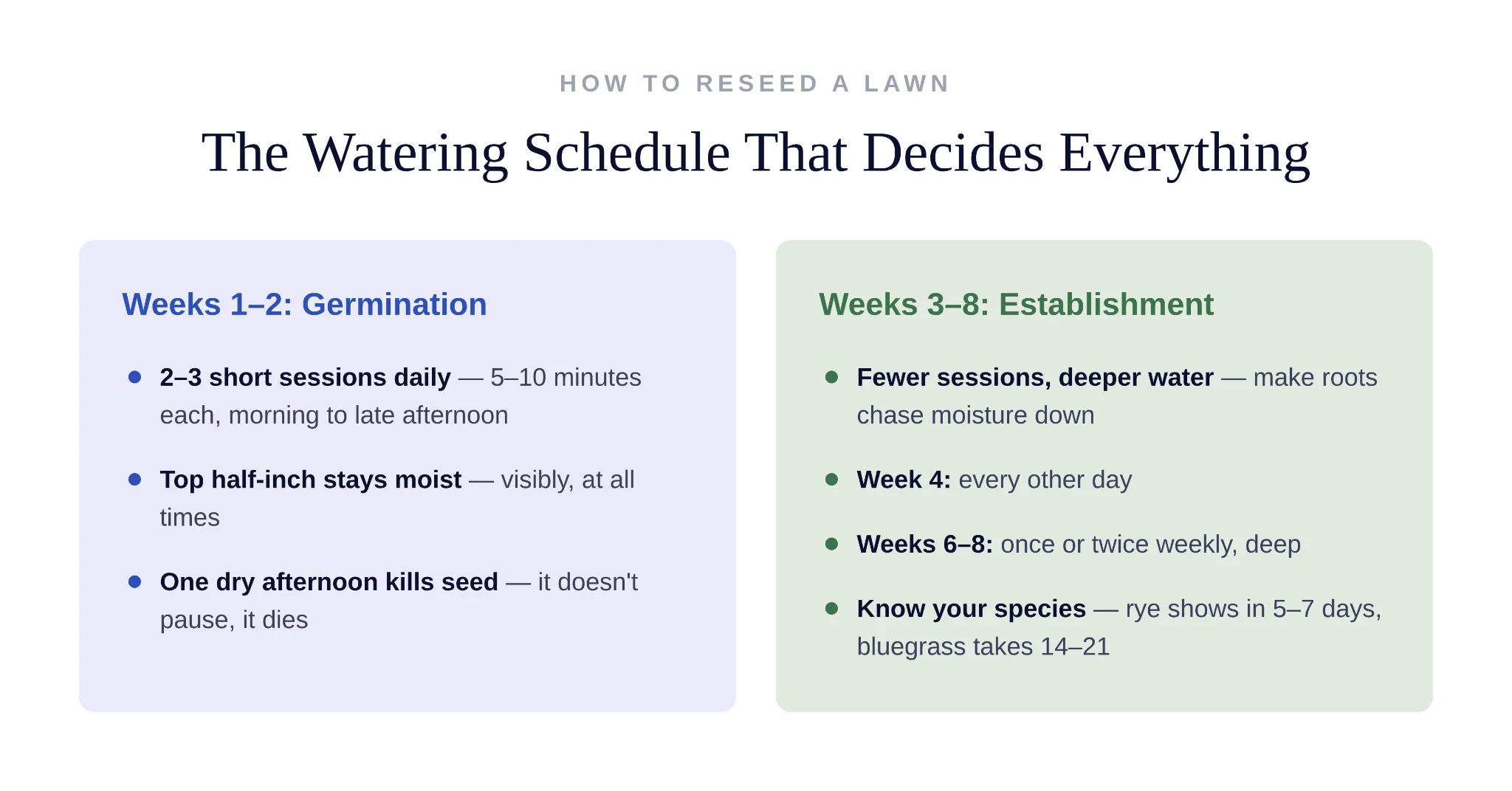
Weeks 1–2: light and frequent. The top half-inch of soil stays visibly moist at all times. In fall weather that means 2–3 short watering sessions a day, 5–10 minutes each — morning, midday, late afternoon. You are not soaking anything. You’re keeping a thin layer damp. Puddling and runoff mean you’re carrying seed away.
Once seedlings are up (7–21 days depending on species): shift gradually. Fewer sessions, more water per session, so moisture reaches deeper and roots chase it down. By week four, you should be at every other day. By week six or eight, once or twice a week, deep.
Ryegrass shows in 5–7 days. Fescue takes 7–14. Bluegrass takes 14–21 and will test your faith. Most bluegrass failures are people who gave up in week two of a three-week germination.
The brutal part is the schedule. Miss two days of watering in week one because work got busy, and the job is over. This is the single most common failure point, and it’s why irrigation on a timer beats a homeowner with a hose every single time.
The First Eight Weeks After Germination
New grass is not lawn yet. Treat it accordingly.
First mow. When it hits about 3.5–4 inches, never remove more than a third of the blade. Sharp blade, dry grass, gentle turns, new roots pull out of the ground easily.
Stay off it. Foot traffic on seedlings is worse than most people assume. Reroute kids, dogs, wheelbarrows for a month.
Starter fertilizer at seeding or just after germination helps, specifically the phosphorus. Skip weed-and-feed entirely, the herbicide component kills seedlings.
Weeds will come up with the grass. Leave them alone until you’ve mowed three or four times. Young turf can’t take broadleaf herbicide, and a thickening lawn will crowd out most of the interlopers on its own by spring.
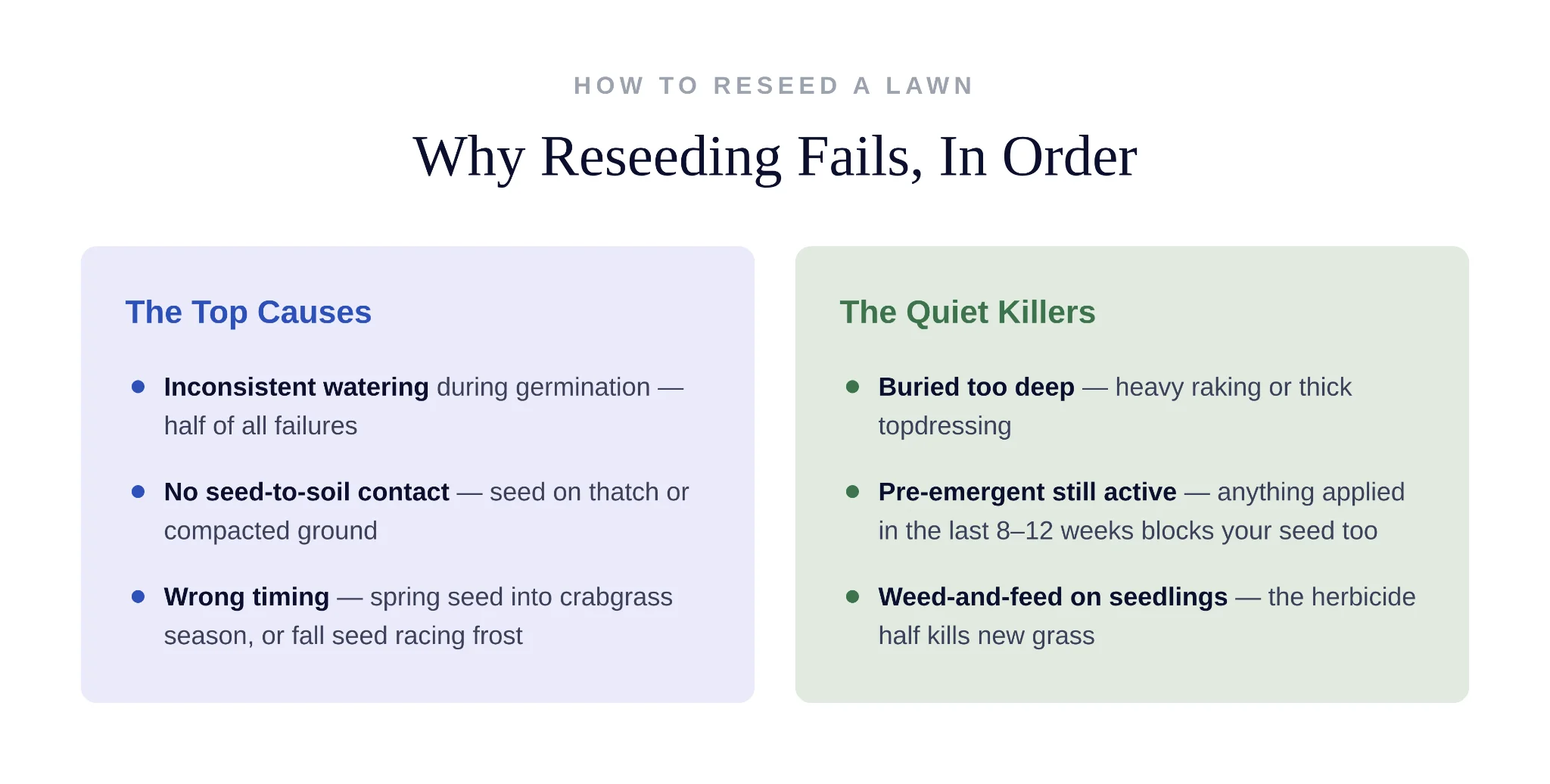
Why Reseeding Fails, In Order
Inconsistent watering during germination: Half of all failures, easily.
No soil contact: Seed thrown on thatch or compacted ground.
Wrong timing: Spring seeding into crabgrass season, or seeding so late in fall that frost beats establishment.
Buried too deep: Usually from enthusiastic raking or heavy topdressing.
Pre-emergent in the soil: Applied in the last 8–12 weeks, it’s still active, and it doesn’t distinguish your seed from crabgrass.
Notice what’s not on the list. Seed brand barely matters compared to any of these. People agonize over the bag and then lose the job with a hose.
Reseeding is a short list of steps that punish shortcuts, on a schedule that punishes inattention.
If the watering schedule is the part you already know you’ll blow, automate it out of your hands. The Aiper IrriSense 2 smart irrigation system covers up to 4,800 sq ft across ten independent zones, so the reseeded section can run its own light, frequent germination schedule while the rest of the lawn stays on a normal one.
Weather-Sense scheduling adjusts for rain and heat automatically, which means the seed stays moist through week three whether or not you remembered. That’s the single failure point removed from the job.
Get more pool and lawn care guides from Aiper on Google