Mustard Algae (Yellow Algae): The Chlorine-Resistant Look-Alike

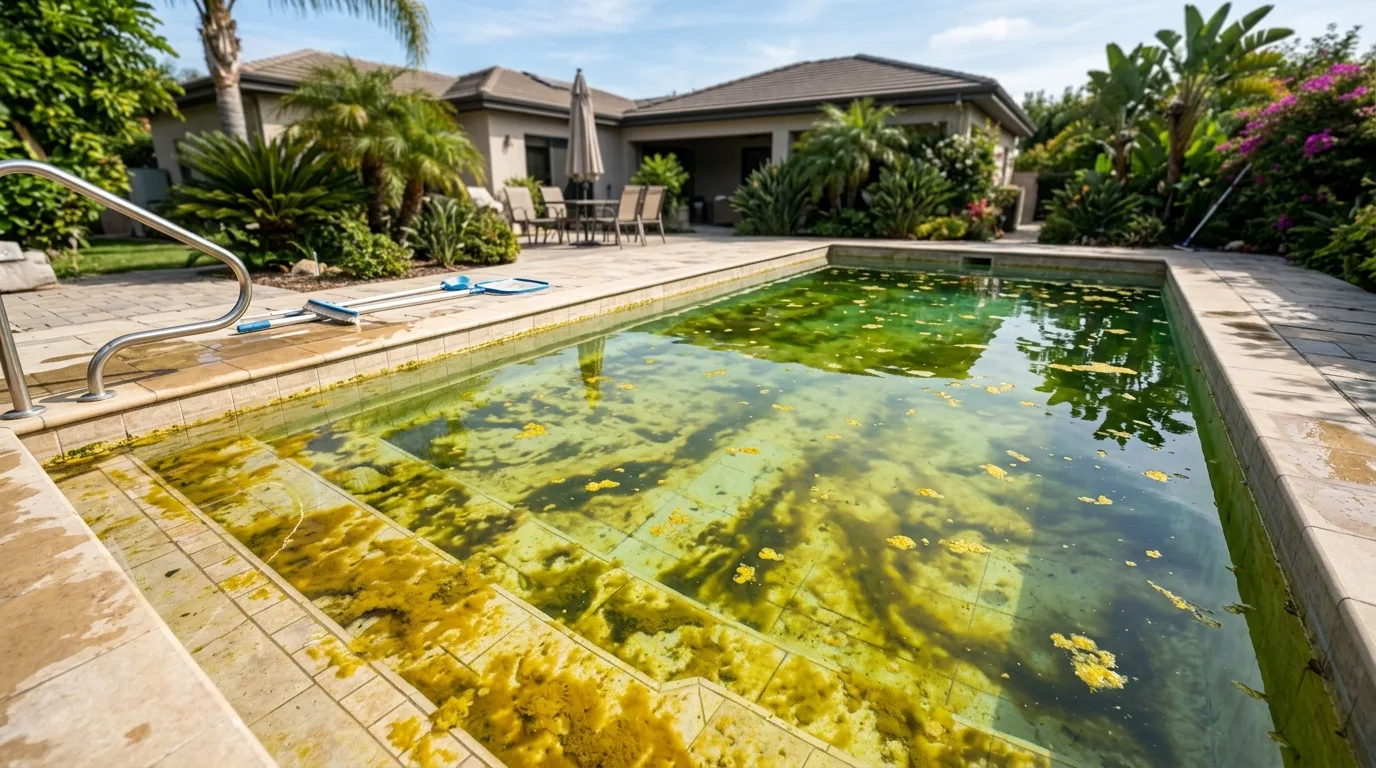
Mustard algae is easy to mistake for dirt. Your pool stays clear, chlorine reads around 2 ppm, and a brownish-yellow film appears along the shady wall or in the corner behind the ladder.
Brush it away, and it disappears. By morning, it’s back in the same spot.
That cycle is the giveaway.
What Mustard Algae Looks Like
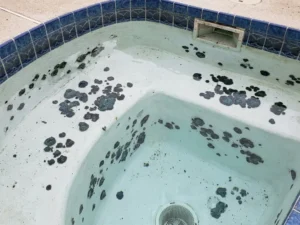
Mustard algae shows up as a yellow-brown film on the wall, flat and powdery, sitting in patches rather than spreading evenly.
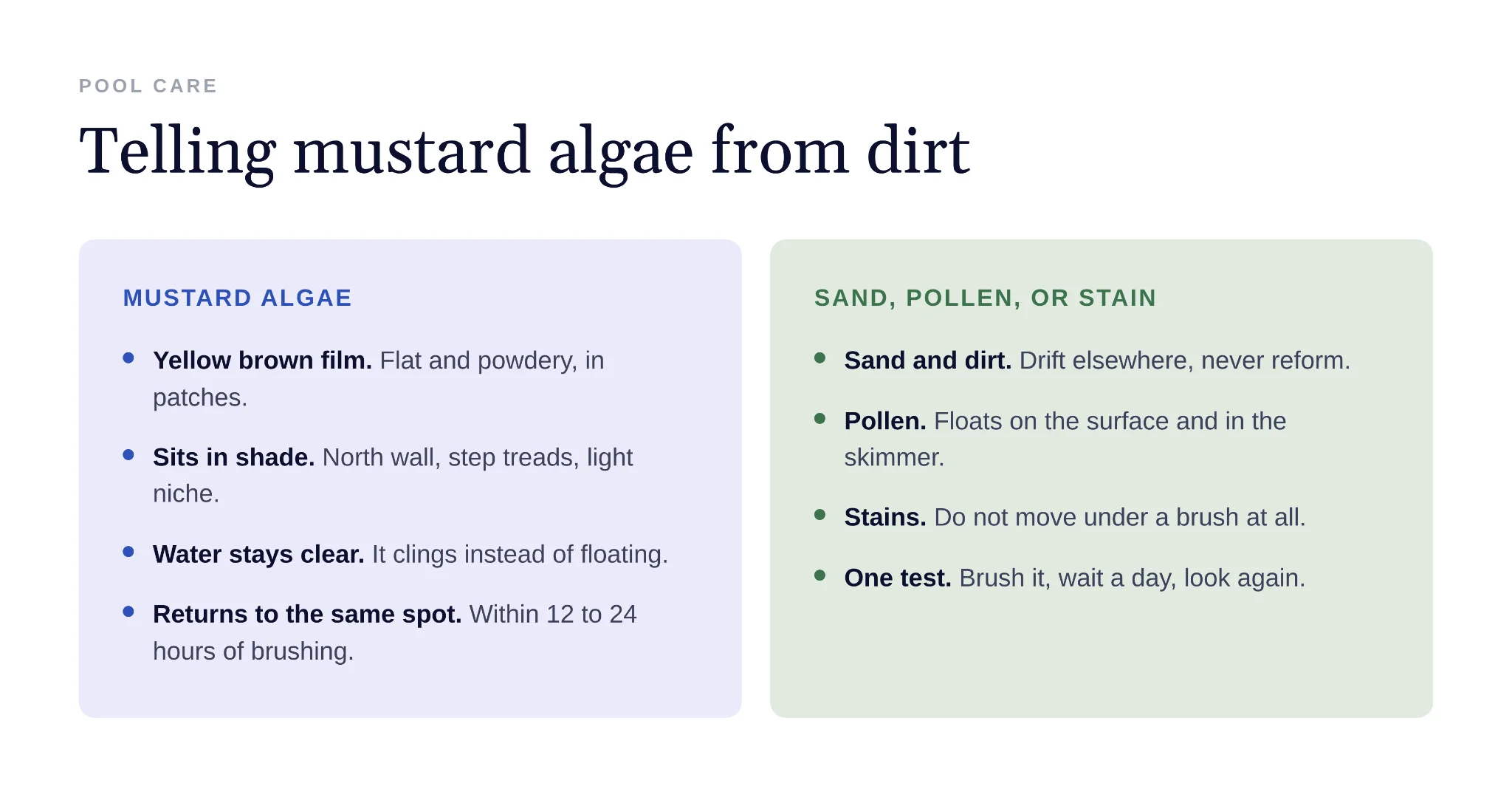
The film collects in shade. You’ll find it on the north wall, the step treads, under the diving board, behind the light niche, and in whichever corner the sun never reaches for long. It clings to surfaces rather than floating, so the water above it stays clear.
Despite the name, this is a green algae, and the color comes from pigment. The reason it survives normal chlorine is a protective outer sheath that ordinary sanitizer levels don’t get through, combined with the fact that it lives on surfaces instead of in the water column, so the chlorine you’re measuring is mostly nowhere near it.
Test for Mustard Algae
Three things get mistaken for mustard algae, and one test separates them.
Sand and dirt brush up and drift down somewhere else. They don’t reappear in the same footprint. Pollen floats and collects on the surface and in the skimmer, not on the walls in a defined patch. Stains don’t move at all under a brush.
Mustard algae disperses in a faint cloud, clears, and then reforms on the same section of wall within roughly twelve to twenty-four hours. Nothing else does that.
Check CYA Before Shocking
This is where most shock treatments fail before they begin, and it has almost nothing to do with the algae.
Cyanuric acid accumulates all season because it doesn’t evaporate, doesn’t burn off, and doesn’t get consumed. It only leaves when water leaves.
CYA protects chlorine from UV, but it does so by binding most of your free chlorine into a reserve that isn’t actively sanitizing at any given moment. The higher the CYA, the higher your free chlorine has to be to deliver the same killing power.
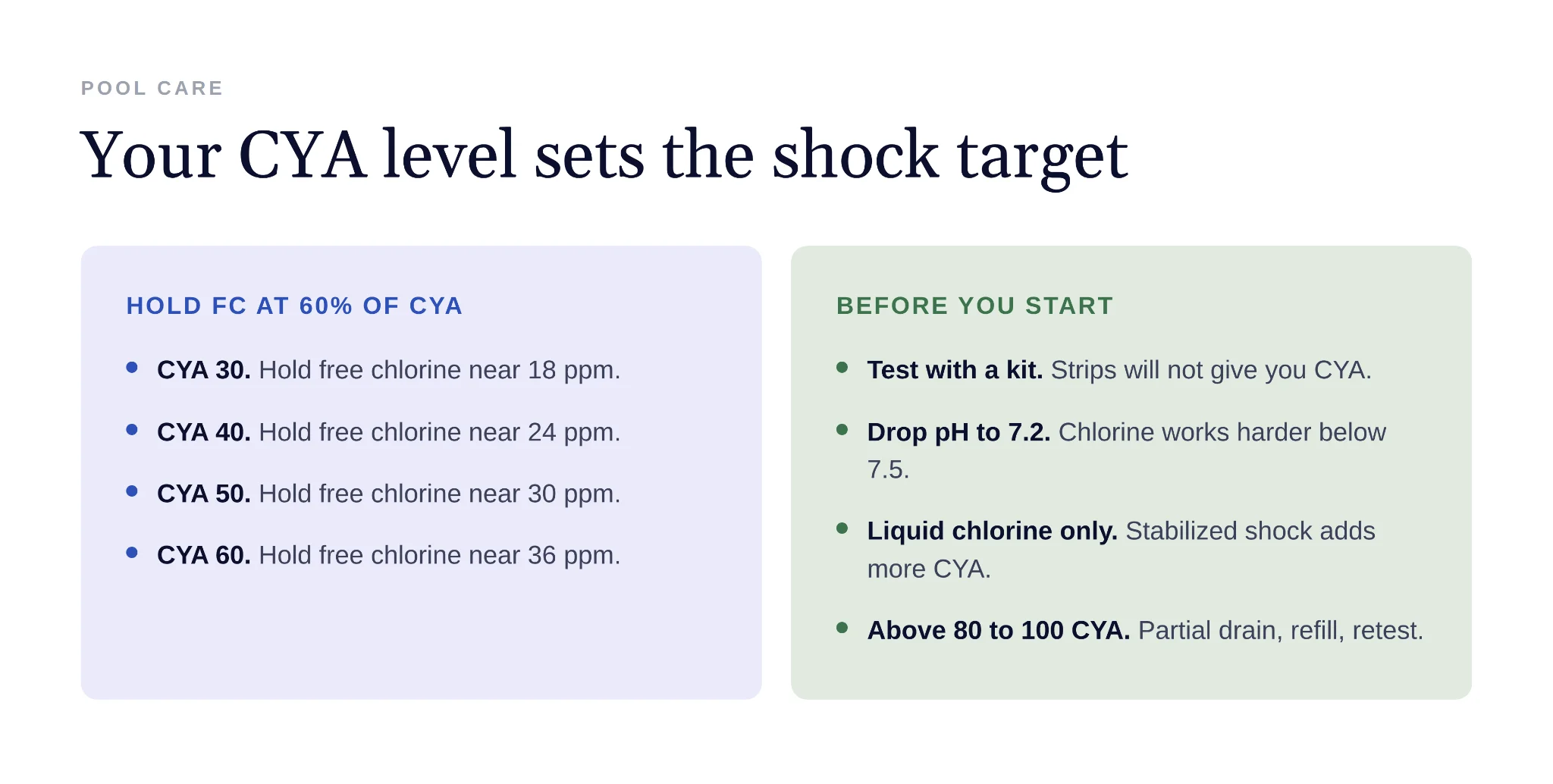
For a normal algae kill, the working target is roughly 40% of your CYA level held as free chlorine. Mustard algae needs more. Push it to about 60% and hold it there.
A one-pound bag of shock in a 20,000-gallon pool moves you maybe 5 ppm. That’s not a treatment, that’s a gesture.
Above roughly 80 to 100 CYA, the required chlorine level gets impractical and expensive enough that you should stop buying chemicals and start draining. Partial drain, refill, retest.
Test with a proper kit, not a strip.
Bring pH down to about 7.2 before you shock. Chlorine’s actual disinfecting form is hypochlorous acid, and the fraction of your chlorine sitting in that form falls off sharply as pH climbs.
Hold Chlorine at Shock Level
A single dose that peaks at 25 ppm and falls to 6 ppm by the next afternoon has bought you almost nothing.
Mustard algae survives the dip, and the sheath means a lot survives. What kills it is sustained exposure across days, and that means testing every few hours and adding chlorine back every time the level drops below target.
Liquid chlorine or plain bleach for this. Nothing stabilized. Every scoop of dichlor and every trichlor tab you add during a shock cycle is raising the CYA that created the problem. Cal-hypo doesn’t add CYA, but it does add calcium, and in a hard-water region, that bill comes later.
Brush the affected surfaces at least twice a day, and brush hard. You’re breaking the film open so the chlorine can reach what’s underneath. The pump runs the entire time continuously.
Most pools take three to five days. Some take a week.
Clean Everything That Touched the Water
If mustard algae keeps coming back to a pool that’s been shocked correctly, this is why, and it’s the part almost nobody does completely.
Pool equipment
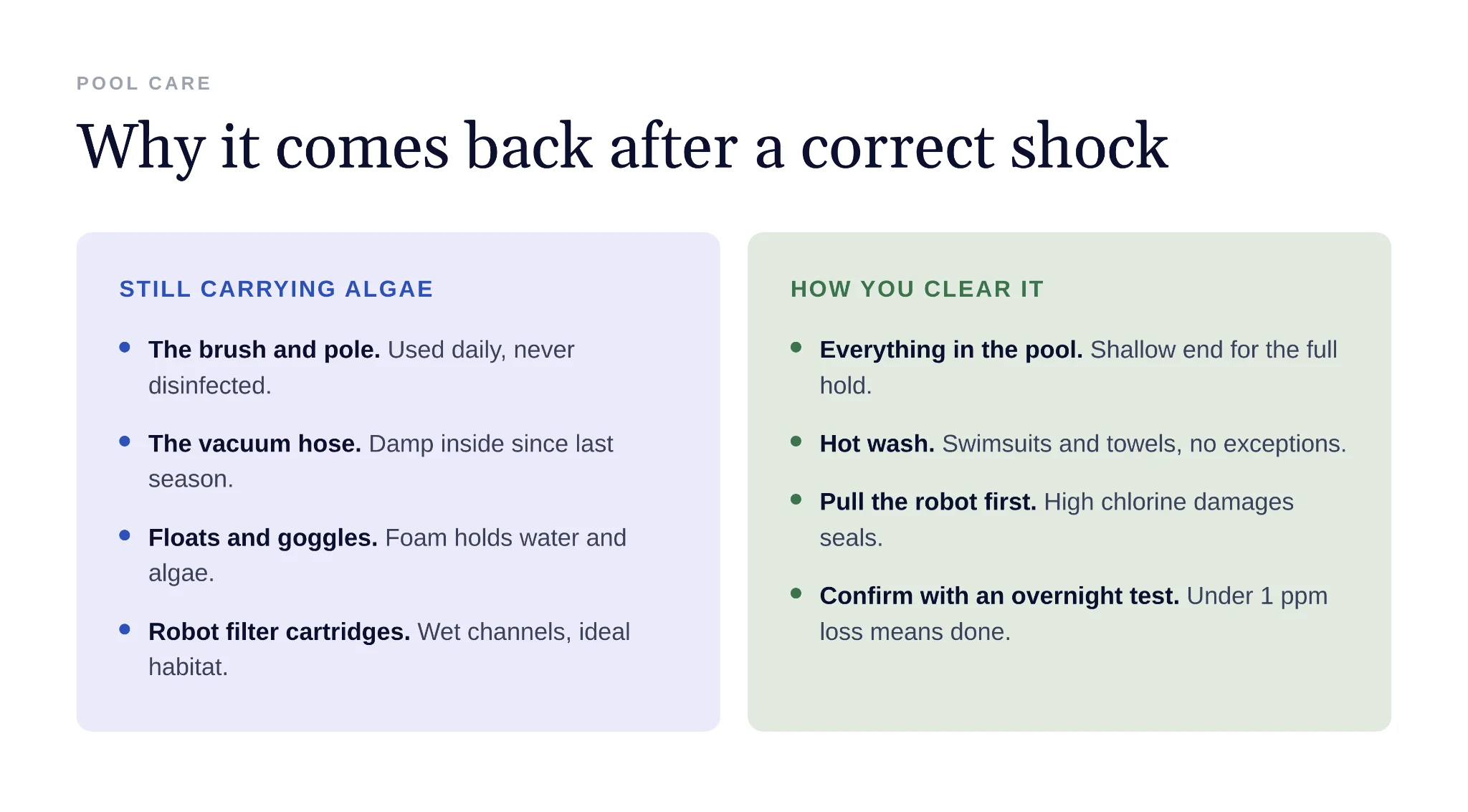
It doesn’t just live on the plaster. It lives on the brush you used. On the pole. Inside the vacuum hose, which stayed damp in the shed all winter. On the floats, the goggles, the skimmer basket, the seams of everybody’s swimsuits, and the dog that swims every afternoon.
During the high-chlorine hold, everything goes in. Toys, floats, brushes, hoses, baskets, ladders if they come out, are tossed into the shallow end and left there for the duration. Swimsuits and towels go through a hot wash. Anything with foam that holds water gets squeezed out and soaked properly rather than dunked.
Automatic cleaners
Pressure and suction cleaners get disconnected and their hoses flushed and soaked. Robotic units are different: most manufacturers don’t want the unit sitting in water at 25 or 30 ppm free chlorine, because that’s rough on brushes, seals, and gaskets over time.
Pull the robot out before you shock, take the filter cartridges out and clean them thoroughly, hose the brushes and the housing, let everything dry fully in direct sun, and put it back in once the pool’s free chlorine has fallen back into the normal range.
After the pool is clear, a unit that scrubs the waterline and the shaded wall on a regular schedule is doing more to prevent a repeat than any chemical you can buy. If you’re replacing an older cleaner, Aiper’s robotic pool cleaners cover the wall and waterline coverage that matters here.
Use Sodium Bromide Carefully
The yellow-algae-specific products sold at every pool store are usually sodium bromide. It works fast because your free chlorine converts it to hypobromous acid, and bromine handles mustard algae far more efficiently than chlorine does.
Once you add sodium bromide, you have a bromine pool. Not for an afternoon. Until enough water has been replaced through splash-out, backwashing, and rain to dilute it, which can run weeks or a full season.
Bromine isn’t protected by cyanuric acid, so your sanitizer burns off in sunlight much faster, and your consumption goes up noticeably. You also can’t use it in a pool with a salt chlorine generator without creating a bromine system you didn’t plan for.
For a stubborn recurrence in a pool that’s already been through a proper hold and lost, it’s a reasonable call. As a first move because it’s faster than doing the chlorine work correctly, it’s a trade most people regret in September.
Skip Copper Algaecides
Copper-based algaecides do kill it.
They also stain plaster, particularly when pH swings, and the stain is permanent enough to require acid washing. Copper plus high chlorine turns blonde hair green. Polyquat 60 is a good maintenance algaecide and a weak mustard algae treatment.
Clean the Filter
Whatever you brushed off the walls went somewhere.
Cartridge filters get a chemical soak rather than a hose-down, since spraying a cartridge pushes debris deeper into the pleats. If the cartridges are already at the end of their life, replace them now instead of at the end of the treatment.
DE grids get backwashed and recharged during the process, and a full teardown afterward is worth the hour.
Sand beds hold organic material, and a bed that’s eight years old is doing about half the filtering it thinks it is. Backwash long, consider a filter cleaner, and if you’ve been meaning to change the media, this is the season.
Confirm the Algae Is Gone
Clear water and clean walls are not the endpoint. They show up on day two, well before the algae is dead.
The endpoint is the overnight chlorine loss test. Take a free chlorine reading after sunset, once UV is out of the equation. Take another before sunrise. If you’ve lost more than about 1 ppm across the night, something in the pool is still consuming chlorine, and it isn’t the sun.
One ppm or less overnight, with clean walls and a clear pool, means you’re done. Then you let the chlorine drift back down to normal on its own, rather than dumping anything in to speed it up.
Prevent a Repeat
Water above 85°F, a heavy weekend of swimmers, a pump timer that only runs six hours, and it has everything it needs to start over in the same shaded corner it liked the first time.
Which is why the useful habit after a mustard algae summer isn’t a product. It’s checking that one wall.
Get more pool and lawn care guides from Aiper on Google