Robotic, Suction, and Pressure Pool Cleaners: How Each Category Actually Works

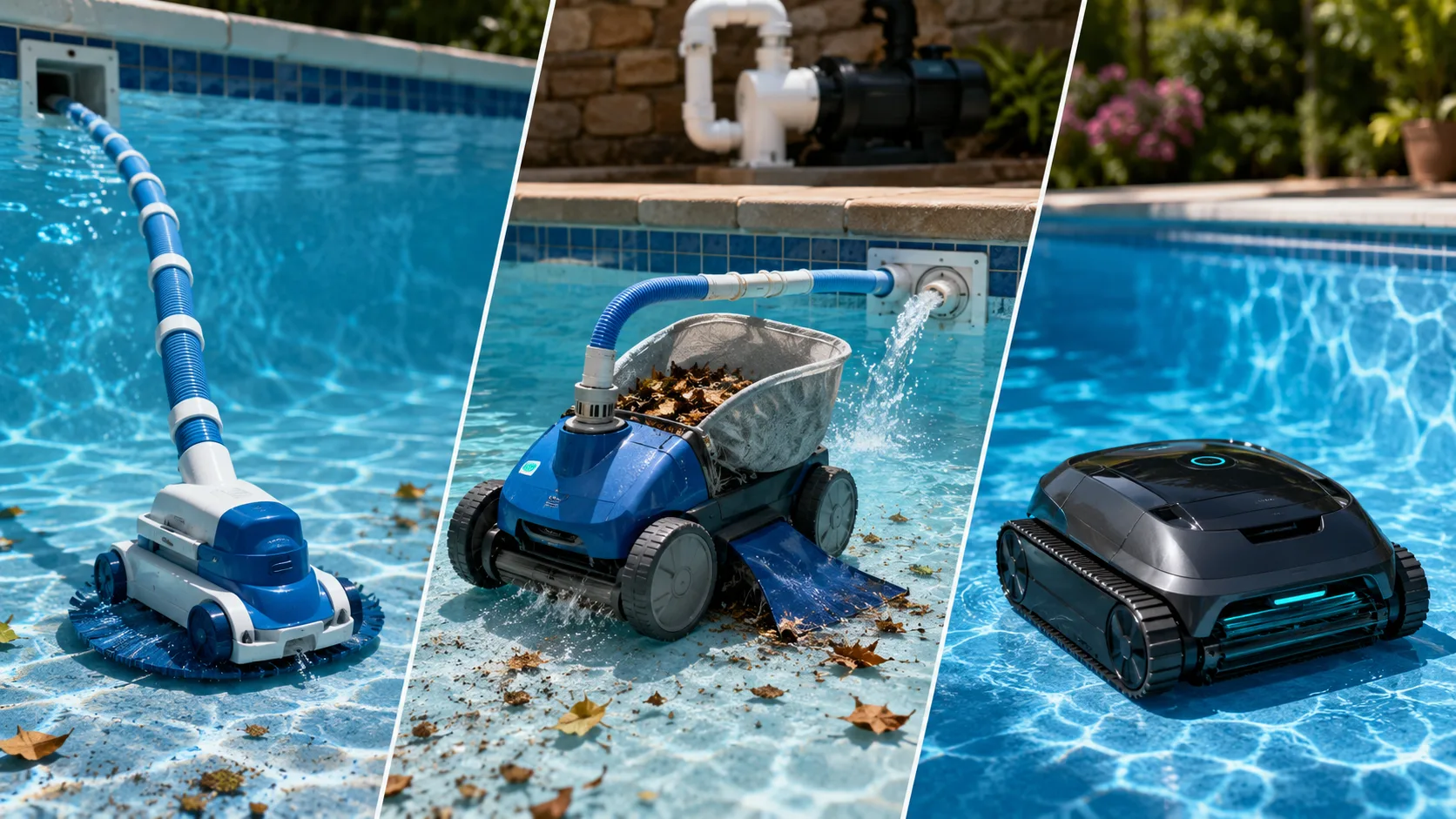
Walk into a pool store, and the three cleaner categories get presented as price tiers: suction is the cheap one, pressure is the middle, robotic is the splurge.
That framing hides the thing that actually matters: these are three completely different machines that get their power from three completely different places, and where a cleaner gets its power decides what it does to the rest of your equipment.
One of them borrows your pump’s suction — and everything that can go wrong with that setup, from air leaks to a pool vacuum that keeps flipping over, traces back to the hose. One borrows your pump’s pressure, usually with a second pump bolted on to help. And one brings its own everything and touches your plumbing not at all.
That’s the whole comparison, really. Everything else is detail. But the detail is where people buy the wrong machine.
Suction-Side Cleaners
A suction cleaner is the simplest machine of the three. It plugs into your skimmer or a dedicated suction port via a long segmented hose, and your pool pump does all the work. The cleaner is just a moving vacuum head that your pump drags water through.
How it moves
Most move by pulses. A diaphragm or hammer mechanism inside flexes with the flow and inches the cleaner along in a more or less random walk across the floor. Geared versions steer a little better. None of them navigate. They wander, and coverage is a matter of hours and luck.
The appeal is obvious. No motor to fail, few moving parts, and you can buy one for what a robotic cleaner’s filter set costs.
What the price tag doesn’t mention
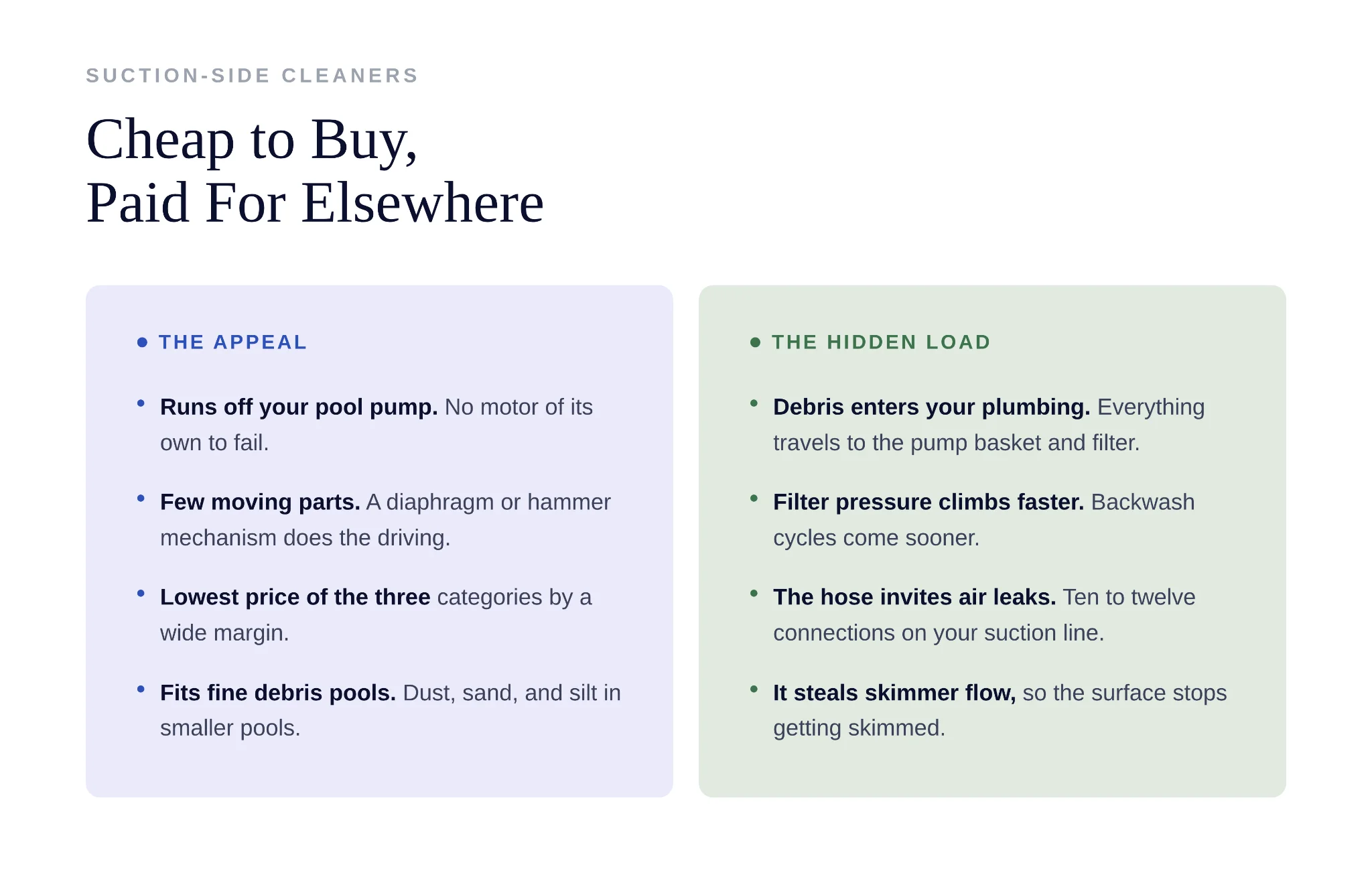
Every leaf, every acorn, every dead beetle that cleaner picks up travels down the hose, through your suction line, and into your pump basket. Whatever gets past the basket lands in your filter. You haven’t removed debris from your system. You’ve fed it into your system.
Pump baskets fill faster.
Filter pressure climbs faster.
Backwash cycles come sooner.
And there’s another cost.
That hose is ten or twelve segments long, each connection a place where air can sneak into your suction line.
If you’ve fought a pump that keeps losing prime, and there’s a suction cleaner hanging off the skimmer, disconnect it before you troubleshoot anything else. It’s the first suspect for a reason.
While the cleaner runs, it’s also stealing flow from your skimmer.
The surface stops getting skimmed properly, which in a leafy yard means the debris you’re cleaning off the floor keeps arriving.
Where it makes sense
Small pools with fine debris, dust, sand, silt, and owners who don’t mind emptying the pump basket more often. In a pool under trees, they clog, and they clog at the throat where you can’t see it.
Pressure-Side Cleaners
A pressure cleaner works from the other side of the pump. It connects to a return line, the pipe pushing filtered water back to the pool, and uses that pressurized water three ways:
Jets drive the wheels.
A venturi throat creates suction to lift debris.
A tail whips around behind it, stirring fine silt up toward the skimmer.
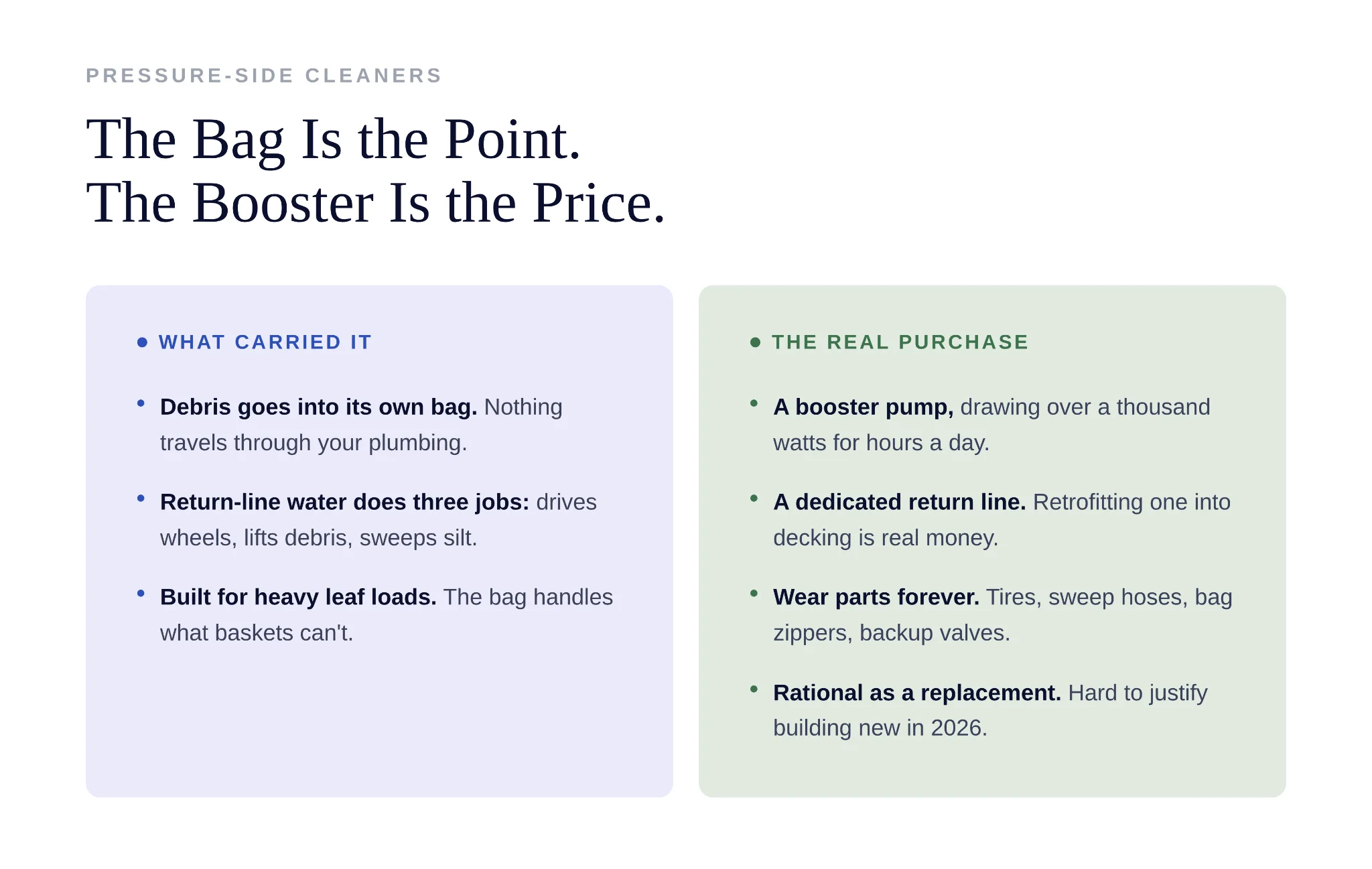
The critical detail: debris goes into the cleaner’s own bag, riding on top. Nothing travels through your plumbing.
Your pump basket and filter never see what the cleaner catches. For heavy leaf-load pools, that one fact carried this category for thirty years.
The booster pump problem
Most pressure cleaners need more pressure than your return line naturally provides. That means a booster pump, a second, dedicated pump plumbed in just to run the cleaner, typically three-quarter horsepower, drawing serious wattage for two or three hours a day.
Some low-pressure models run off the main pump alone, and they work, but with noticeably less pickup.
So a pressure cleaner isn’t really one purchase. It’s a cleaner, plus a booster pump, plus a dedicated return line if your pool wasn’t plumbed with one, and retrofitting that line into existing decking is real money.
On a pool already plumbed for it, with a booster in place, replacing a worn pressure cleaner with another is often the path of least resistance. Building that infrastructure from scratch in 2026 is hard to justify.
What ownership looks like
Wear parts are the reality: tires, sweep hoses, bag zippers, backup valves. All replaceable, none expensive individually. They just never stop needing replacement.
Robotic Cleaners
A robotic cleaner shares nothing with your pool plumbing. It has its own drive motors, its own internal pump pulling water through its own filter, and its own power, either a low-voltage transformer with a floating cord, or a battery in the cordless models.
Drop it in, and it operates as a self-contained system inside your pool.
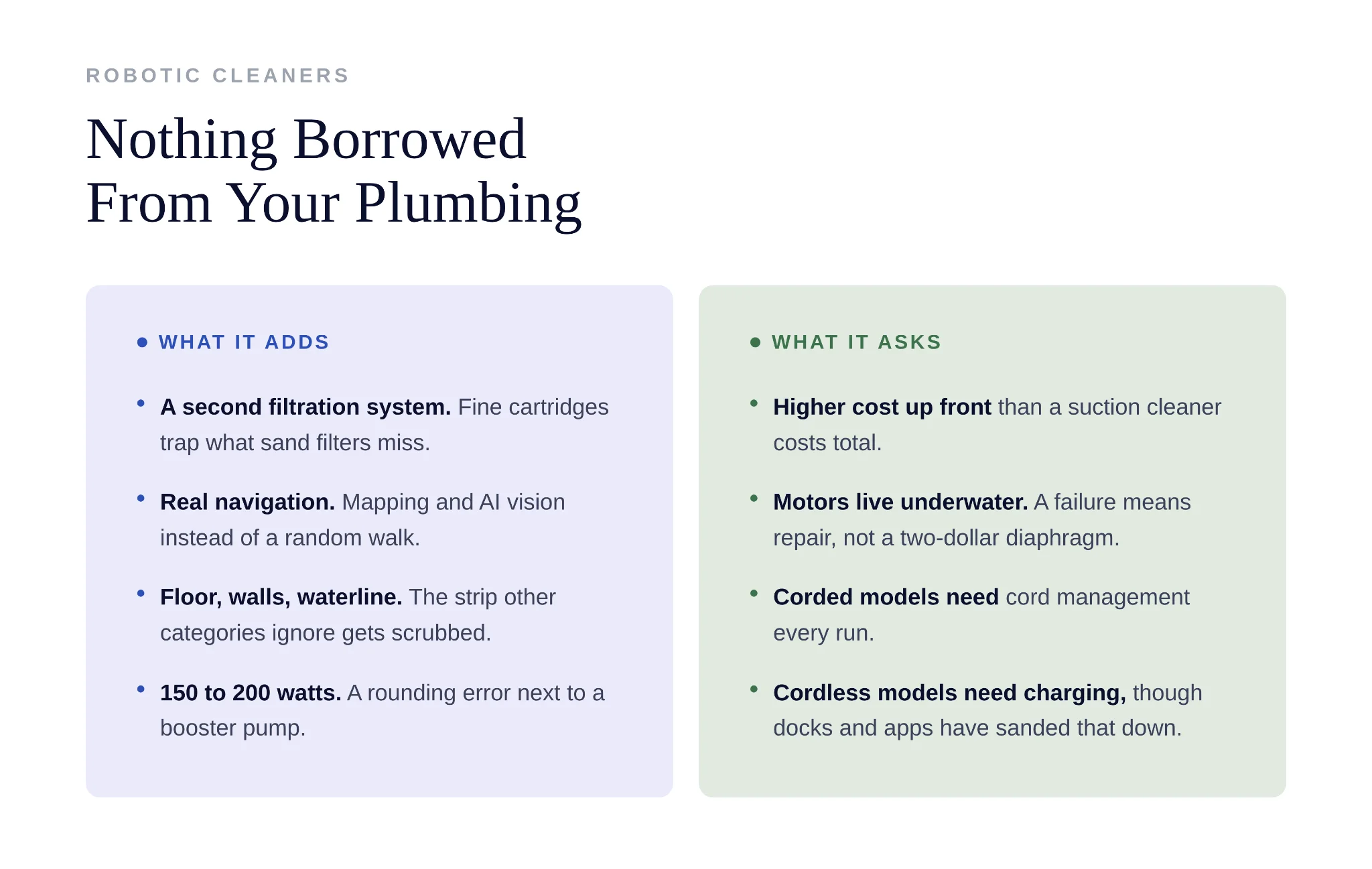
That independence changes three things at once.
Filtration
A robotic cleaner pulls water through fine mesh or pleated cartridges, many down to particle sizes your sand filter can’t touch, and traps everything onboard. Your pump and filter see none of it. In effect, you’ve added a second filtration system to the pool, one that scrubs while it filters.
Owners switching from suction cleaners routinely notice their filter pressure stops creeping and their water clarity improves. It’s not the cleaning pattern doing that. It’s the water passing through the robot’s cartridges.
Coverage
Robots actually navigate.
Entry-level units run structured patterns.
Better ones use gyroscopes and mapping.
The current generation uses AI vision and time-of-flight sensors to identify debris and plan routes around obstacles.
They climb walls. Good ones scrub the waterline where sunscreen and oils band up, the strip every other category ignores.
Energy
This is the number that decides it for a lot of people. A robotic cleaner draws somewhere around 150 to 200 watts.
A booster pump for a pressure cleaner draws over a thousand. Run daily across a swim season, the robot’s operating cost is a rounding error, and the booster pump shows up on the electric bill.
The honest downsides
You’re buying a machine with motors and electronics that live underwater, so a failure means a repair or a warranty claim, not a two-dollar diaphragm.
Corded models need cord management. Cordless models need retrieval and charging, though docks, scheduling, and app control have sanded most of that friction down. And a good one costs more up front than a suction cleaner costs total.
Front-loaded cost, lowest cost to run, and it’s the only category that adds capability to your pool instead of borrowing capacity from it.
Matching the Machine to the Pool
Fine debris, small pool, tight budget, and a pump you don’t mind loading up, a suction cleaner does the job, as long as you accept the hose on the suction line and the baskets you’ll be emptying.
A pool already plumbed with a booster and a dedicated cleaner line under heavy leaf fall, that’s when a pressure cleaner remains a rational replacement. Just don’t build that setup new.
Everything else points robotic, and it’s why the category has eaten the market.
If you’re going that way, explore the cordless robotic pool cleaner series to see what independence from your plumbing actually buys: cordless, AI vision navigation that maps the pool instead of wandering it, floor-wall-waterline coverage, and every bit of debris ending up in its own basket, not your pump’s.
Get more pool and lawn care guides from Aiper on Google