How to Get Rid of Prickly Weeds in a Lawn

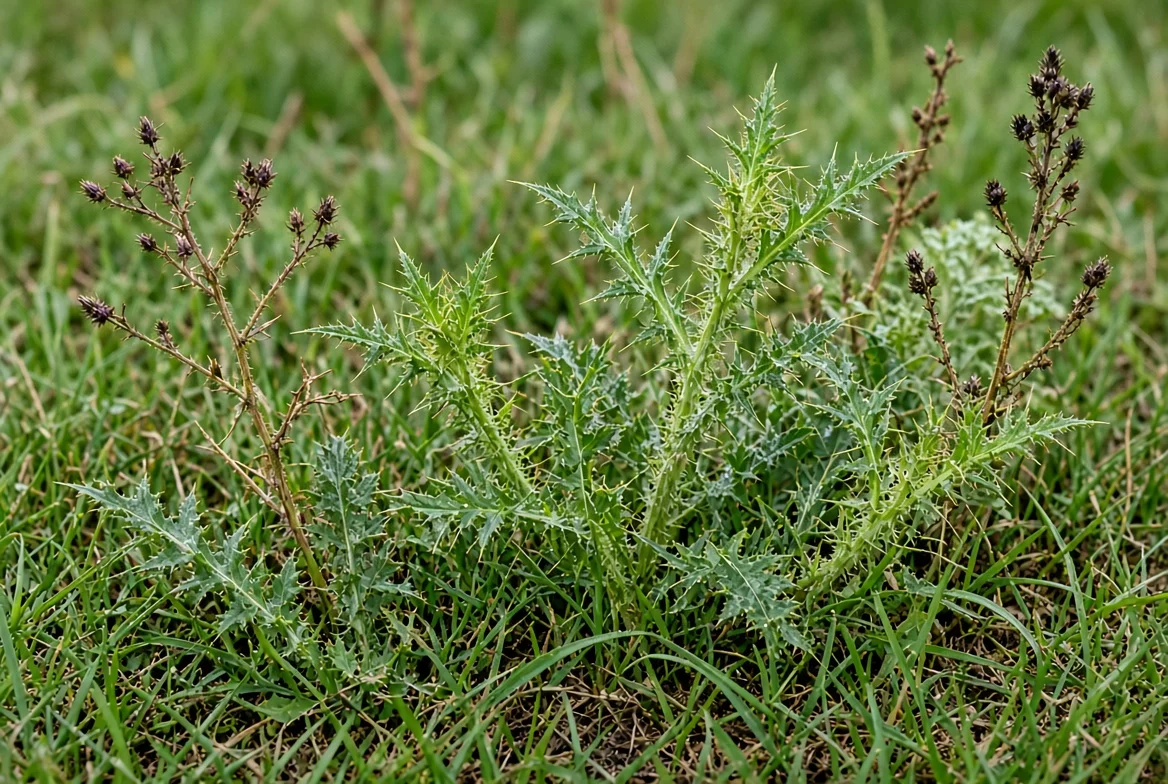
The complaint always arrives the same way. Somebody walks across the yard barefoot in April, or a dog comes up the steps holding one back paw off the ground, and suddenly a lawn that looked fine all winter has become unusable.
By then the useful window has closed.
Prickly weeds share a trait that makes them different from every other weed problem: the part that hurts is the seed, and killing the plant after the seed has hardened changes nothing. The burs stay in the turf. Some of them stay for months. A dead sticker still goes through a heel.
The other thing worth knowing before spending money at a garden center is that “prickly weed” describes at least four unrelated plants with four different life cycles and four incompatible treatments. Buying the wrong product isn’t a small waste. It’s a lost year.
Identify the Plant Before Buying Anything
Get down and look at the foliage rather than the bur.
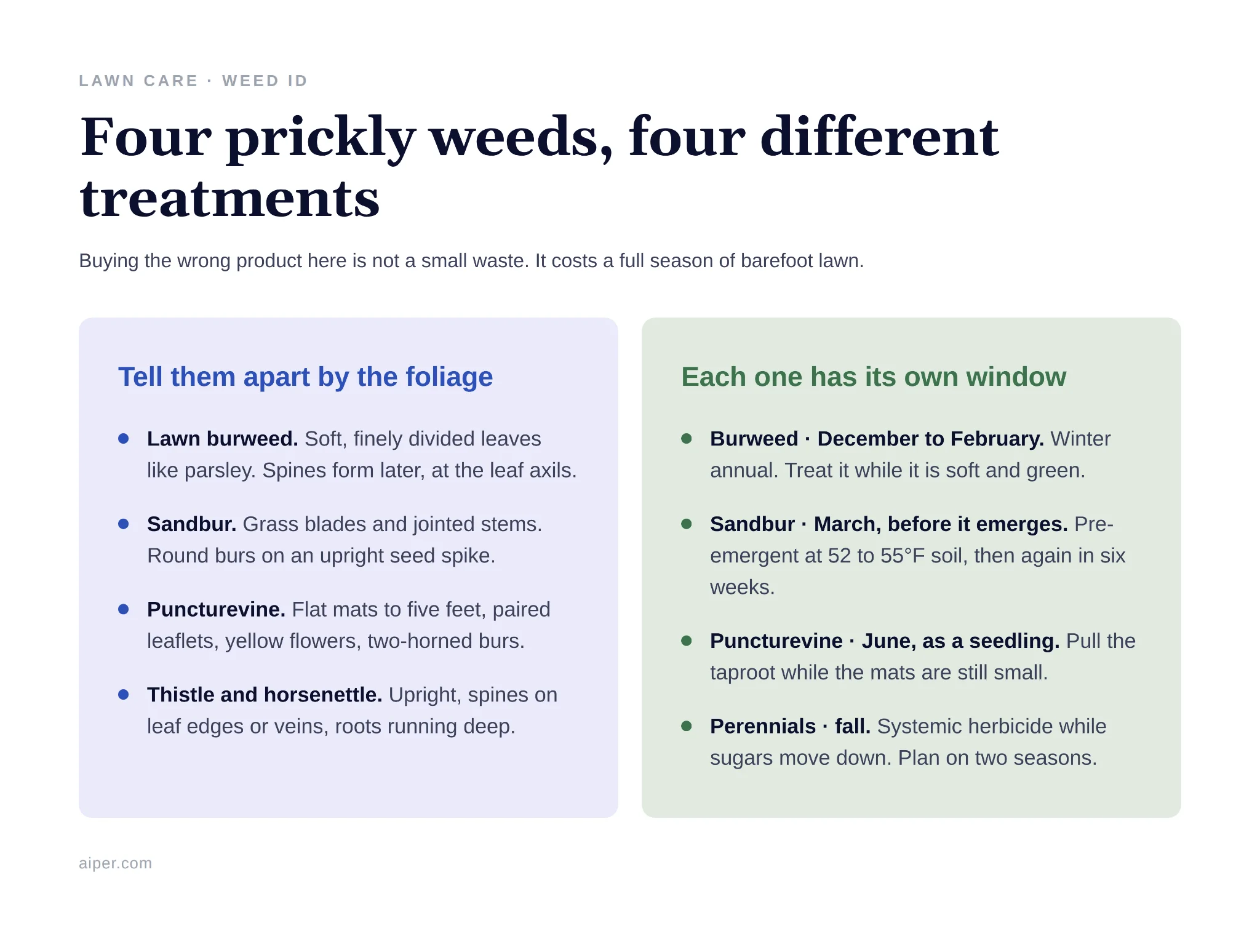
- Lawn burweed has soft, finely divided leaves that look like parsley or a small fern, growing in a low sprawl. It’s green and completely harmless to touch through the winter. The spines form later, tucked in where the leaves meet the stem.
- Sandbur looks like grass, because it is grass. Coarse, light green, slightly flattened stems, and a seedhead spike carrying round burs covered in short spines. If the plant has grass blades and a jointed stem, this is what you have, and it matters more than anything else on this page.
- Puncturevine runs flat along the ground in long mats, sometimes five feet across, with small paired leaflets on either side of a stem, tiny yellow flowers, and hard woody burs with two upward-pointing horns. Those are the ones that flatten bike tires.
- Thistles and horsenettle are the tall, obvious ones. Spines on the leaf edges or along the veins, upright growth, and roots that go far deeper than the others.
Four plants. Fall treatment, spring treatment, summer treatment, and multi-year treatment, respectively.
Lawn Burweed Gets Treated in Winter
Burweed is a winter annual. Seed germinates in September and October as soil temperatures drop below about 70°F. The plant spends the entire winter as a small, soft, unremarkable green patch that nobody notices because nobody is walking on the lawn.
In late February and March, it flowers and forms burs, the spines harden through April, and the plant dies with the first real heat in May.
The burs stay behind in the thatch through summer.
So the treatment calendar looks wrong to most people. Spray in December, January, or early February, while the plants are small and soft and the spines don’t exist yet.
A three-way broadleaf product handles it easily at that stage:
- Atrazine works well on centipede and St. Augustine and is the common choice across the Gulf states.
- Metsulfuron is another option on warm-season turf.
Check the label against the grass type. Products containing 2,4-D can injure St. Augustine and centipede, especially in warm weather.
A spray in April kills a plant that was already finished, and leaves every sticker exactly where it was.
Better still is a pre-emergent in early fall — isoxaben, atrazine, or simazine, applied late September to early October before germination, watered in. That’s the application that removes the problem instead of managing it.
Sandburs Are a Grass, So Broadleaf Herbicide Does Nothing
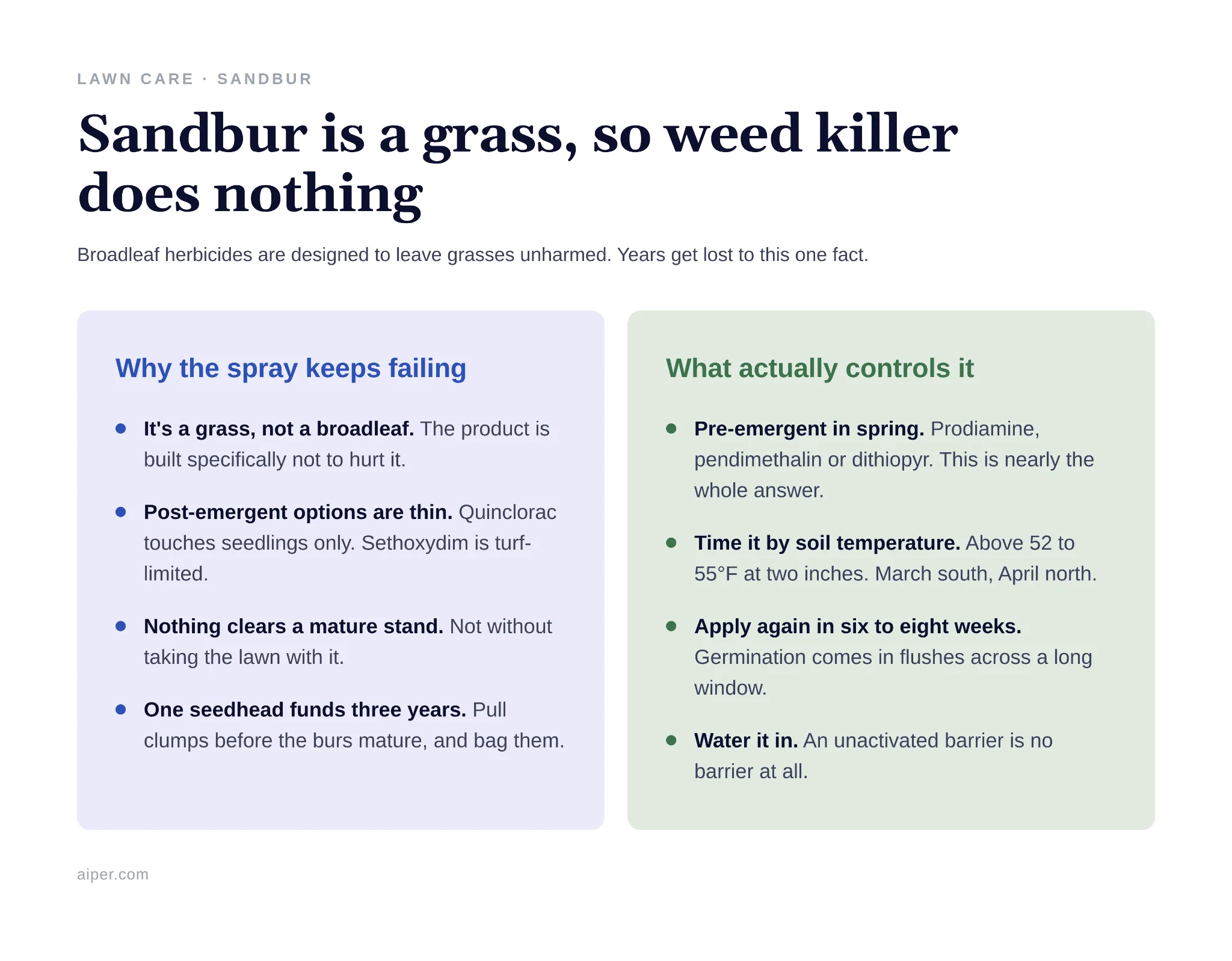
People spray sandburs with weed killer for years. It never works, and the reason is simple: broadleaf herbicides are designed to leave grasses alone, and sandbur is a grass.
It’s a summer annual. Seed germinates once soil temperatures reach the mid-50s in spring and keeps germinating in flushes through the season, which is why one application of anything rarely covers it.
Pre-emergent is close to the entire answer. Prodiamine, pendimethalin, or dithiopyr, applied when soil temperature at two inches holds above 52 to 55°F. That’s usually March in the South, April further north. Then apply again six to eight weeks later, because the germination window is long and a single barrier breaks down partway through it.
Post-emergent options in established turf are thin and always have been. Quinclorac has some effect on very young seedlings and almost none on mature plants. Sethoxydim is only usable on certain warm-season grasses. No product clears a mature sandbur stand out of a lawn without damaging the lawn.
Which means the practical approach on an existing infestation is to dig or pull the visible clumps before the seedheads mature, bag them, and get the pre-emergent right the following spring.
Pull them early. A sandbur plant that has already dropped seed has provided for the next three years.
Pull Puncturevine While It’s Still Soft
Puncturevine is a summer annual with a taproot, and a young plant lifts out of moist soil with almost no resistance. That’s the whole opportunity.
Look for the flat mats in the hottest, driest, most compacted parts of the property: driveway edges, the strip along the sidewalk, gravel, anywhere the turf is already failing. It rarely establishes in a stand of healthy grass.
Pull before the yellow flowers set fruit. Once burs form and go woody, they detach at a touch, and the plant you’re carrying to the trash is dropping seed the entire way.
Wear gloves. Bag it, don’t compost it, and don’t leave the pulled plants sitting on the driveway to dry, because the burs survive that fine.
Seed stays viable in the soil for four or five years, so a spot that’s been producing puncturevine for a while will keep producing it after the visible plants are gone. Broadleaf herbicides do work on it if the mats are large, but hand removal on a small area is faster than a spray program, and there’s no regrowth from the root.
Thistles and Horsenettle Take More Than One Season
These are perennials with root systems built to survive exactly what people do to them.
Canada thistle spreads by creeping roots that can run several feet horizontally, and every fragment left in the ground after digging becomes a new shoot. Horsenettle does the same thing from deep rhizomes and shrugs off most standard lawn herbicides.
Treat them in fall, while the plant is moving sugars down into the root system, and the herbicide moves with it. Clopyralid is the strongest common option for Canada thistle. For horsenettle, repeated applications of a triclopyr or 2,4-D and dicamba combination are the realistic route.
Plan on two seasons. Cutting or digging alone reliably makes both of these worse.
Drag the Burs Out of the Turf
Killing the plants doesn’t remove what’s already there, and this step gets skipped constantly.
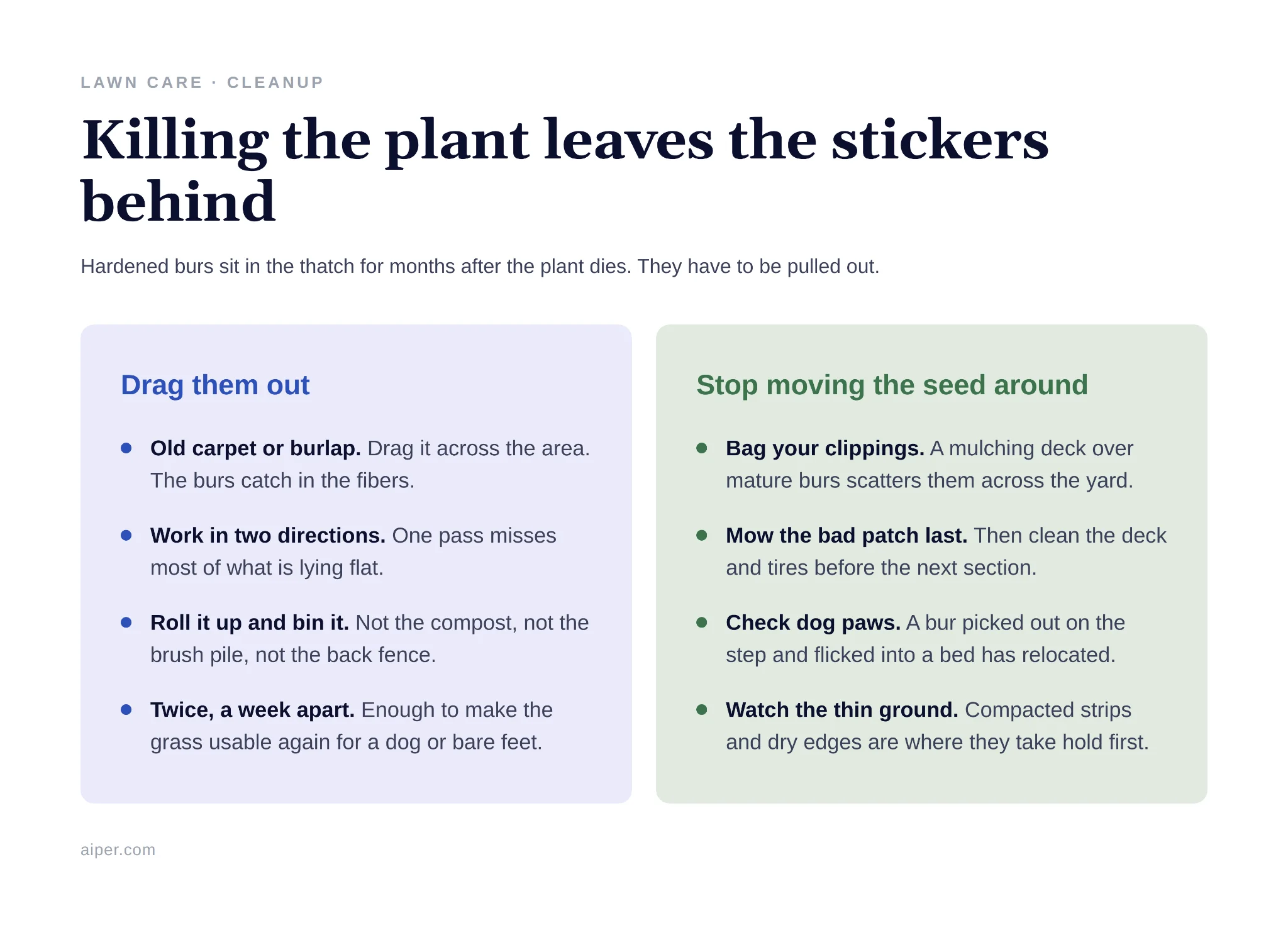
Take a piece of old carpet, a burlap sack, or a heavy flannel blanket and drag it across the affected areas. The burs catch in the fibers. Work in two directions, then roll the whole thing up carefully, bag it, and put it in the trash, not the compost, not the brush pile, not shaken out at the back fence.
A mower with the bag attached, run over the area before burs fully mature, pulls a meaningful share out too. Running a mulching mower over a mature stand does the opposite, scattering seed across everything in range.
For a small yard with young children or a dog, doing the carpet drag twice, a week apart, makes a genuine difference in how usable the grass is that season.
Stop Carrying the Seed Around the Property
Burs evolved to hitchhike, and most of the spread in a typical yard is being provided by the homeowner.
Mower tires and deck undersides move seed from the infested strip along the fence to the middle of the lawn. So do shoes, dog paws, and anything dragged across the ground. Clean the deck after mowing an infested section, and mow the clean parts of the yard first and the bad patch last.
Check dogs after they’ve been in it. A bur that gets picked out of a paw on the back step and flicked into the flower bed has just relocated.
Thicken the Turf Where They Keep Coming Back
Every one of these weeds is opportunistic, and the map of where they show up is a map of where the lawn is thin.
Compacted ground along walkways. The dry strip by the driveway that irrigation never reaches. The area under the trampoline. Ground that got scalped in August and never filled back in.
Core aerate compacted areas, mow high enough to shade the soil surface, overseed thin ground in the correct season for your grass type, and get water to the dry edges. None of this kills anything currently growing, and it’s the reason some yards need a pre-emergent every year while the yard next door doesn’t.
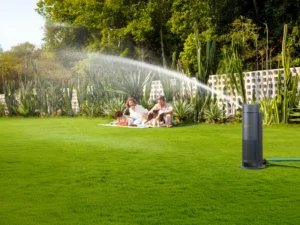
That dry strip by the driveway is almost always a coverage problem rather than a runtime problem, and the usual fix is running the whole system longer. But this waterlogs the shaded half of the yard to get water to the edge that needs it. Zone-level moisture control is what closes the gap.
A system like the Aiper IrriSense 2 waters each zone against what the soil is actually holding, so the compacted strip along the walk and the baked ground by the sidewalk get enough to carry turf through August instead of thinning out and handing the space to sandbur.
The Season to Deal With It Is the One Where Nothing Hurts
Every prickly weed on this list has a stretch of the calendar where it’s soft, small, easy to kill, and completely invisible to anyone not looking for it.
Burweed in December. Sandbur in March, before it emerges at all. Puncturevine as a two-inch seedling in June.
Nobody walks the lawn in December looking for a weed that isn’t bothering them yet. That’s precisely the problem, and the fix is a note on a calendar rather than anything you buy.
Get more pool and lawn care guides from Aiper on Google