How to Get Leaves Off Your Lawn (Why Mulching Beats Bagging)

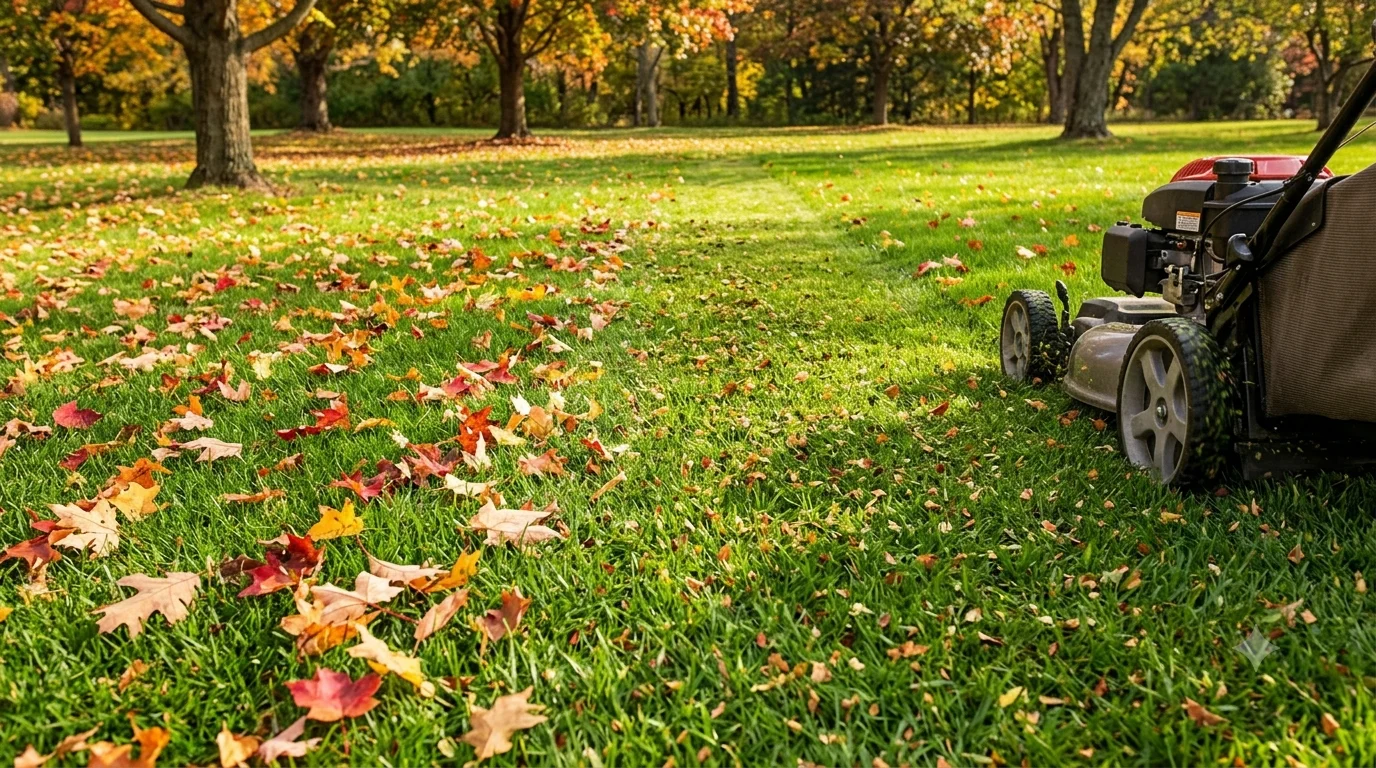
Every fall, the same ritual. Rake, pile, stuff, drag.
Forty bags at the curb and a sore back, and the whole operation repeats in ten days because the maple wasn’t finished. Most of that work is optional.
A lawn can absorb an astonishing amount of shredded leaf material and be better for it. What it can’t survive is a wet mat sitting on it for five months.
What a Leaf Layer Actually Does to Grass
Cool-season grass does its most important work of the year in fall. Air cools, soil stays warm, and the plant shifts energy underground, root mass, carbohydrate storage, the reserves it will spend next summer.
To do that, it needs light, and it needs it during exactly the weeks the trees are burying it.
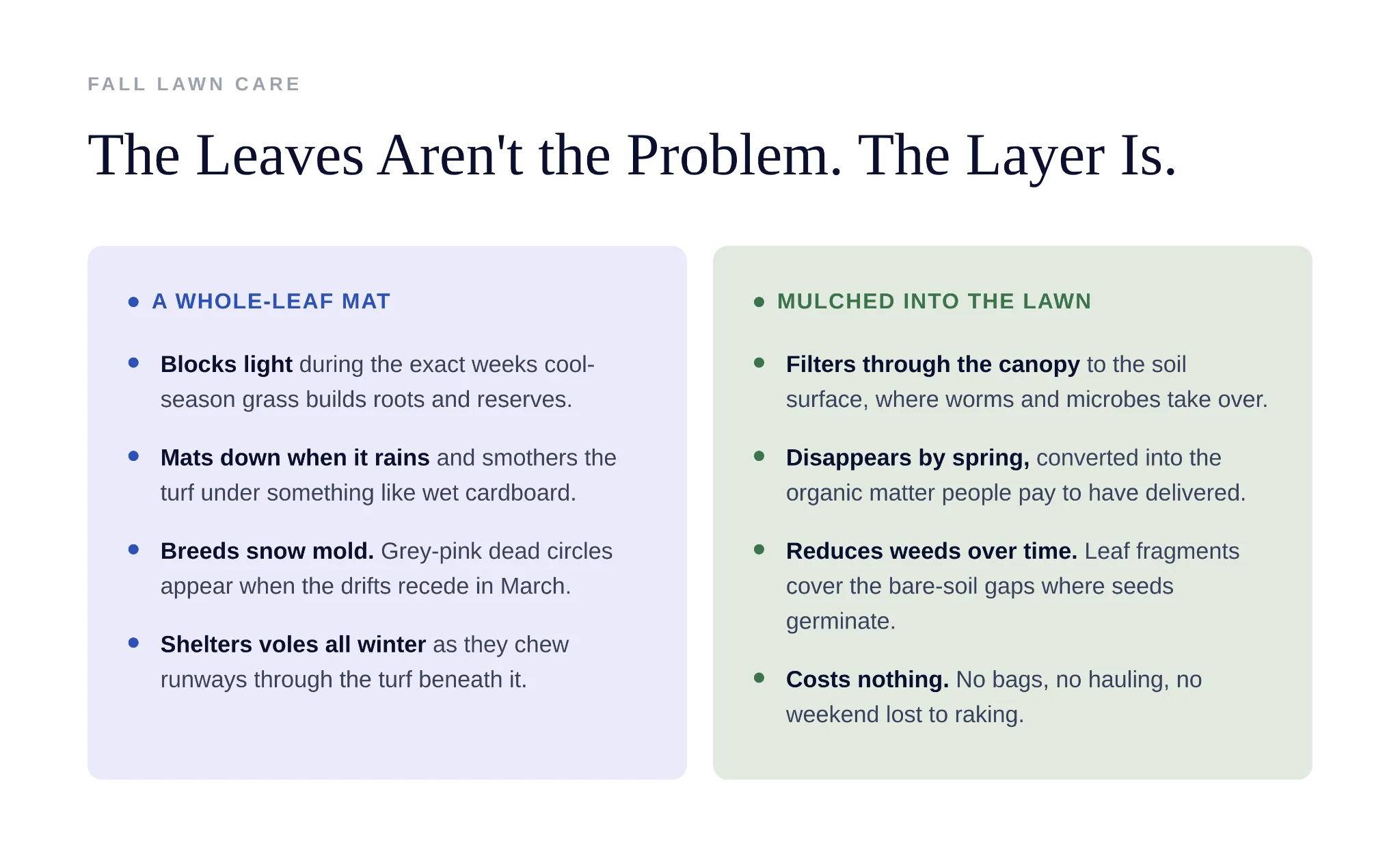
A whole-leaf layer blocks that light. Then it rains, the layer mats down into something like wet cardboard, and now you’ve got a smothered lawn that also can’t breathe or dry out.
Snow falls on top of that mat, and you’ve built ideal habitat for snow mold, those grey-pink dead circles that show up when the drifts recede in March.
Voles love a leaf mat too. They tunnel under it all winter, safe from hawks, chewing runways through your turf that you won’t discover until spring.
None of this happens because leaves are toxic to grass. It happens because of the physical layer. Break the layer into confetti and every one of those problems disappears.
The Case for Mulching, With Numbers
Michigan State ran the study most of us in this trade cite. They mulched enormous quantities of leaves, up to six inches deep, directly into turf plots, season after season, and measured the results.
The grass wasn’t harmed. Spring green-up was fine.
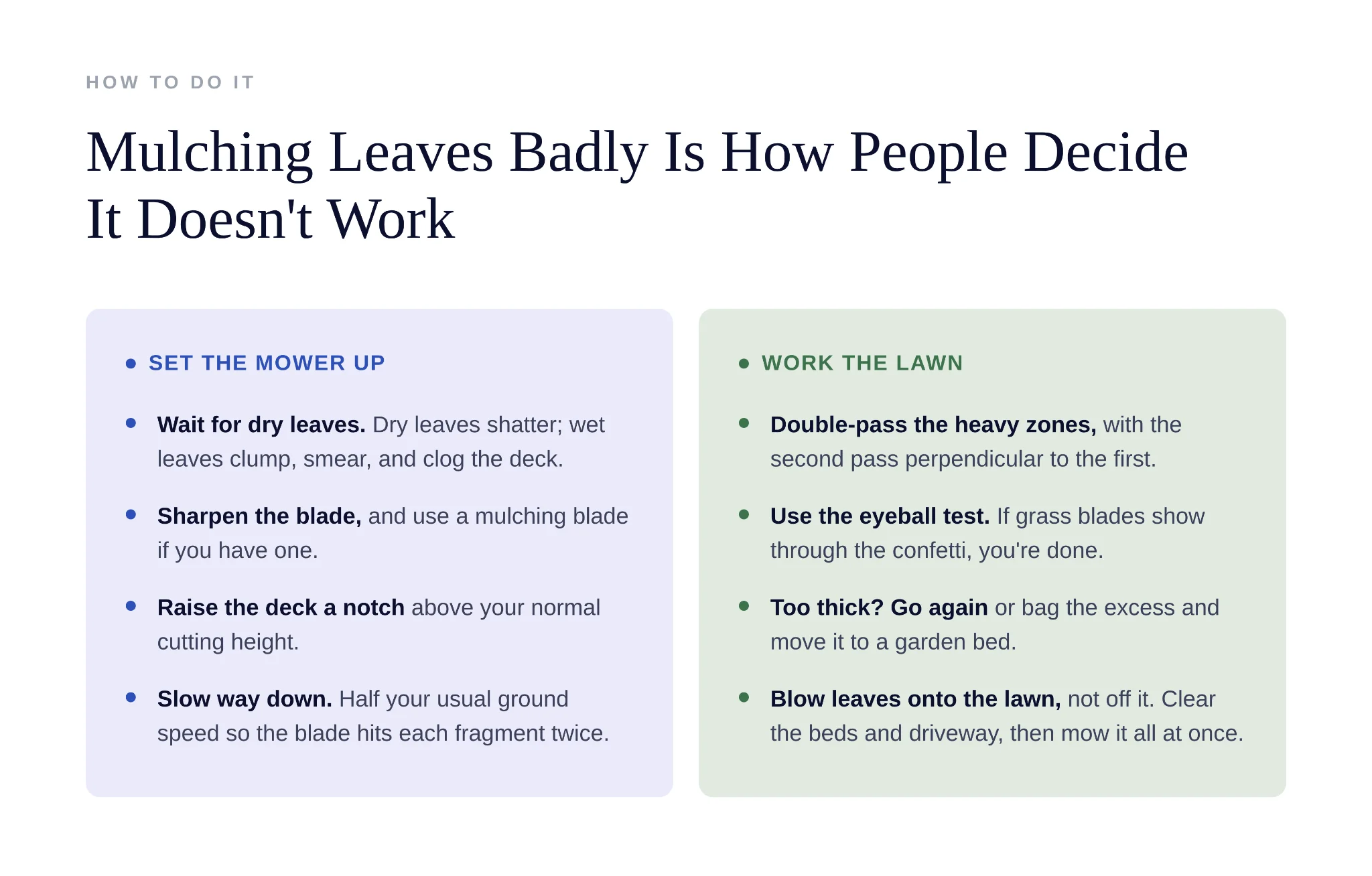
And over several years the mulched plots showed measurably fewer dandelions and less crabgrass, because a lawn constantly topdressed with decomposing leaf fragments covers the bare-soil gaps where weed seeds germinate.
Read that again. Mulching improved the lawn while eliminating the disposal problem.
The mechanism isn’t mysterious. Shredded leaves filter down through the grass canopy to the soil surface, where earthworms and soil microbes take over.
By spring, the fragments are gone, pulled down, digested, converted into the organic matter people pay to have delivered by the yard. It’s free fertilizer and free soil conditioning, dropped on your property annually, and the standard response is to pay someone to haul it away.
The nitrogen worry comes up every year. Leaves are carbon-heavy, and the theory says decomposing carbon ties up nitrogen. At the surface, mulched into turf, this effect is trivial, the decomposition happens on top of the soil, not in the root zone.
If it nags at you, a normal fall nitrogen application covers it with room to spare, and you were probably doing that anyway.
Doing It Right
Mulching leaves badly is how people convince themselves it doesn’t work.
Mow dry leaves. This is the rule that matters most. Dry leaves shatter; wet leaves shred into clumps, smear, and clog the deck. If it rained, wait a day. The afternoon of a dry, breezy day is the window.
Mulching blade if you have one. Deck up a notch from your normal cutting height. Then slow down, half your normal ground speed, maybe less through the deep spots. The blade needs time to hit each fragment more than once. Heavy drop zones get a second pass, perpendicular to the first.
Then look down. The test is simple:
If you can see grass blades standing up through the scattered leaf bits, you’re done.
If you’re looking at a carpet of shredded leaves with no green showing, it’s too thick, make another pass, or collect the excess with the bagger and move it to a garden bed.
That eyeball test is the entire quality control system. There is no other measurement worth taking.
Little and often beats the marathon. A weekly mulching pass during peak drop is twenty minutes. Waiting for the trees to finish and facing eight inches of matted maple in one November weekend is how the whole idea fails.
One more habit worth stealing: use the blower backwards from how most people use it. Instead of blowing leaves off the lawn into piles, blow them out of the beds and off the driveway onto the lawn, then mow everything at once. The lawn is the disposal system. Feed it.
When Bagging Actually Wins
Mulching has limits, and pretending otherwise is its own mistake.
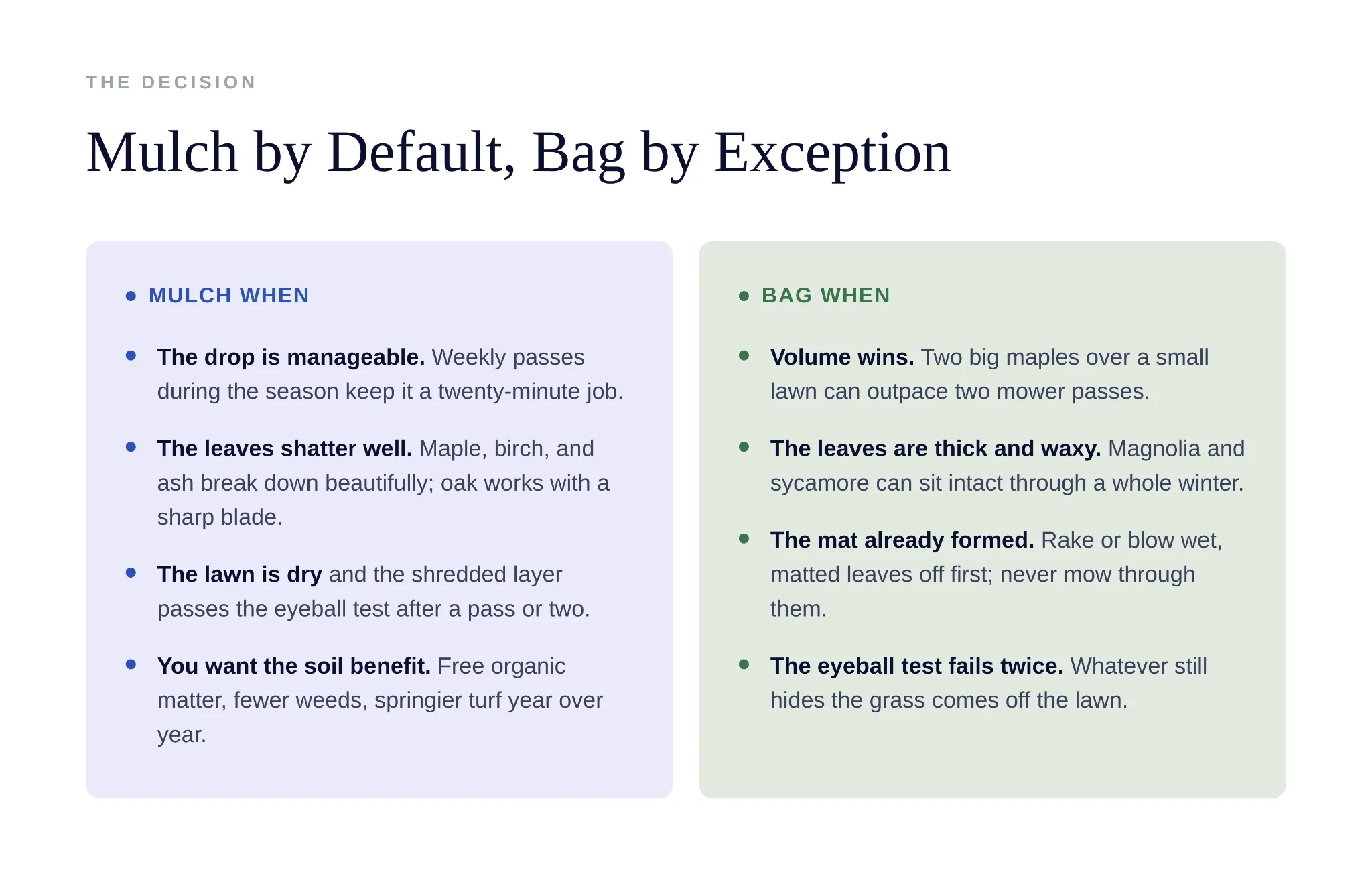
Volume is the main one. Two big silver maples over a small lawn can drop more material in one week than two mower passes can make disappear.
When the shredded layer fails the eyeball test even after a second pass, the excess has to come off. That’s not a failure of the method. That’s just arithmetic.
Leaf type matters more than people expect:
Maple, birch, and ash shatter beautifully.
Oak leaves are leathery and slower to break down but still mulch fine with a sharp blade.
The genuinely stubborn ones are the thick waxy leaves: magnolia, and especially sycamore, which can sit nearly intact through an entire winter. Those, bag.
And if the season got away from you, the leaves are already wet, matted, half-composted into the turf, don’t run a mower through that. You’ll smear it.
Rake or blow the mat off first, on a dry day, with a leaf rake rather than anything aggressive, because raking hard on soft wet ground tears grass out by the crown.
Bagged Doesn’t Mean Landfilled
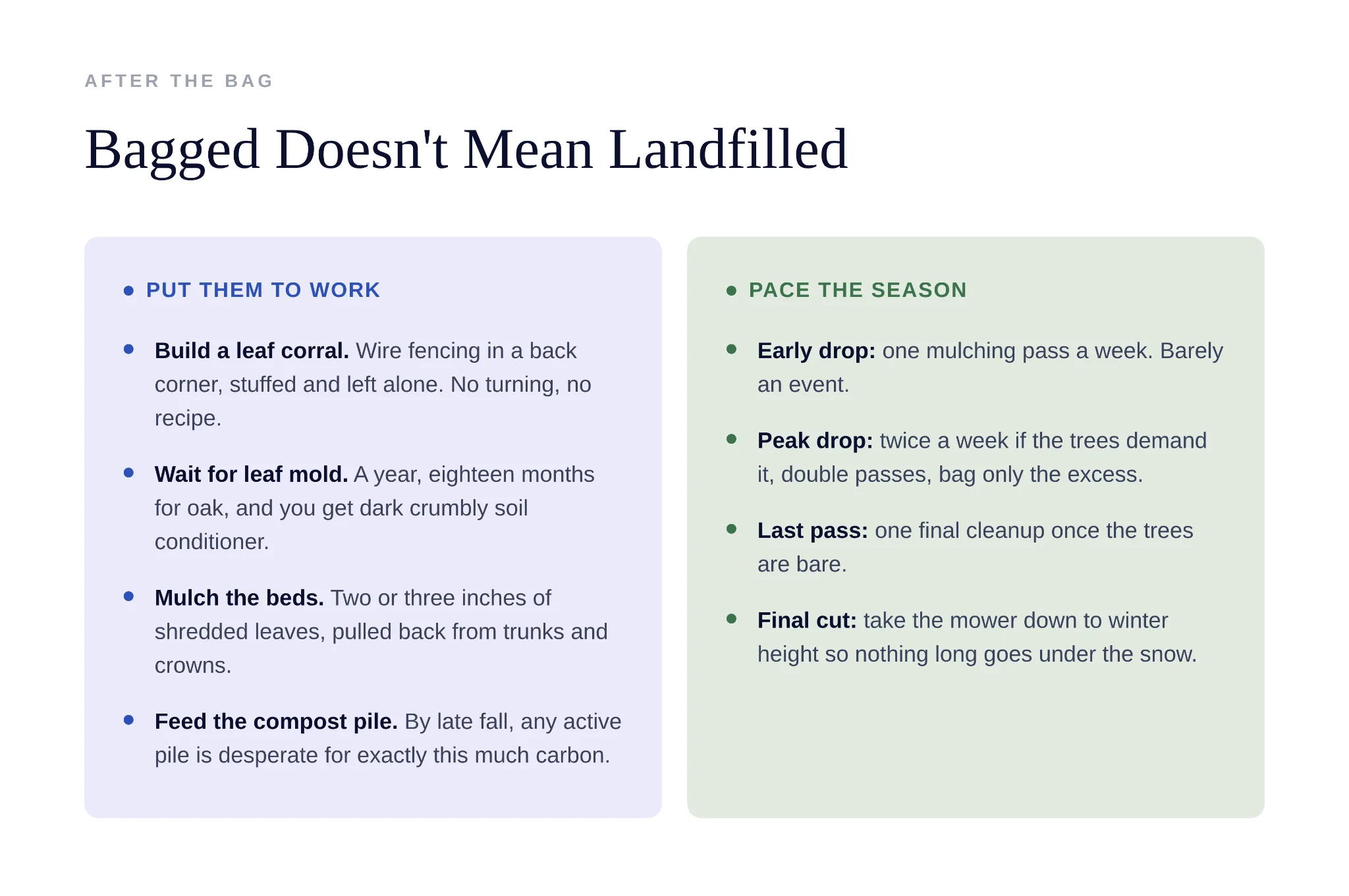
Whatever does come off the lawn is still too valuable to send away in plastic.
The laziest good option is a leaf corral in a back corner, wire fencing, four feet across, stuffed with leaves and left alone.
In a year, eighteen months for oak, you get leaf mold: dark, crumbly, and better at holding soil moisture than almost anything you can buy. No turning, no recipe, no management. It’s the crockpot of composting.
Shredded leaves also make legitimate winter mulch, two or three inches over garden beds and around shrubs, pulled back from direct contact with trunks and crowns. And any active compost pile is desperate for exactly this much carbon by late fall.
The curb is the last resort, not the default. Municipal leaf collection in most places means your organic matter gets trucked, burned, or buried. You paid a tree twenty years of growth for that material.
The Season, Paced
Early drop: mulch weekly, single pass, barely an event. Peak drop: mulch twice a week if the trees demand it, double passes, bag only what fails the eyeball test.
End of season: one final cleanup pass once the trees are bare, and take the mower down to its normal winter height on that last cut so nothing long and floppy goes under the snow.
A lawn that gets this treatment year after year is noticeably different to walk on because it’s been fed the way forest soil gets fed, just chopped finer. Dense turf like that still needs water doing its share, and uneven watering is the thing that undoes everything else you got right. For the mechanics of how modern systems actually decide when to run, our smart irrigation pillar breaks down what’s changed.
A smart irrigation system like the Aiper IrriSense 2 maps your lawn into zones, adjusts to the weather on its own, and keeps the moisture consistent across up to 4,800 square feet, so the lawn you spent all fall feeding actually holds its density through the seasons when you’re not thinking about it at all.
Get more pool and lawn care guides from Aiper on Google