Clover Lawn vs Grass: The Real Tradeoffs

Ask ten people why they want clover, and you get three answers.
Fertilizer costs money. A patch by the back gate keeps dying no matter what goes down on it. Or there’s a dog, and spraying 2,4-D on the ground where the dog sleeps has stopped sitting right.
All fine reasons.
What doesn’t come up until about eighteen months later is that clover rewrites the maintenance rules for the whole lawn, and one of those rewrites only runs one direction.
What The Nitrogen Actually Does
Sometime in July, dig up a single clover plant to check whether the fixation is happening at all. Take the whole thing, roots included, and knock the soil off gently.
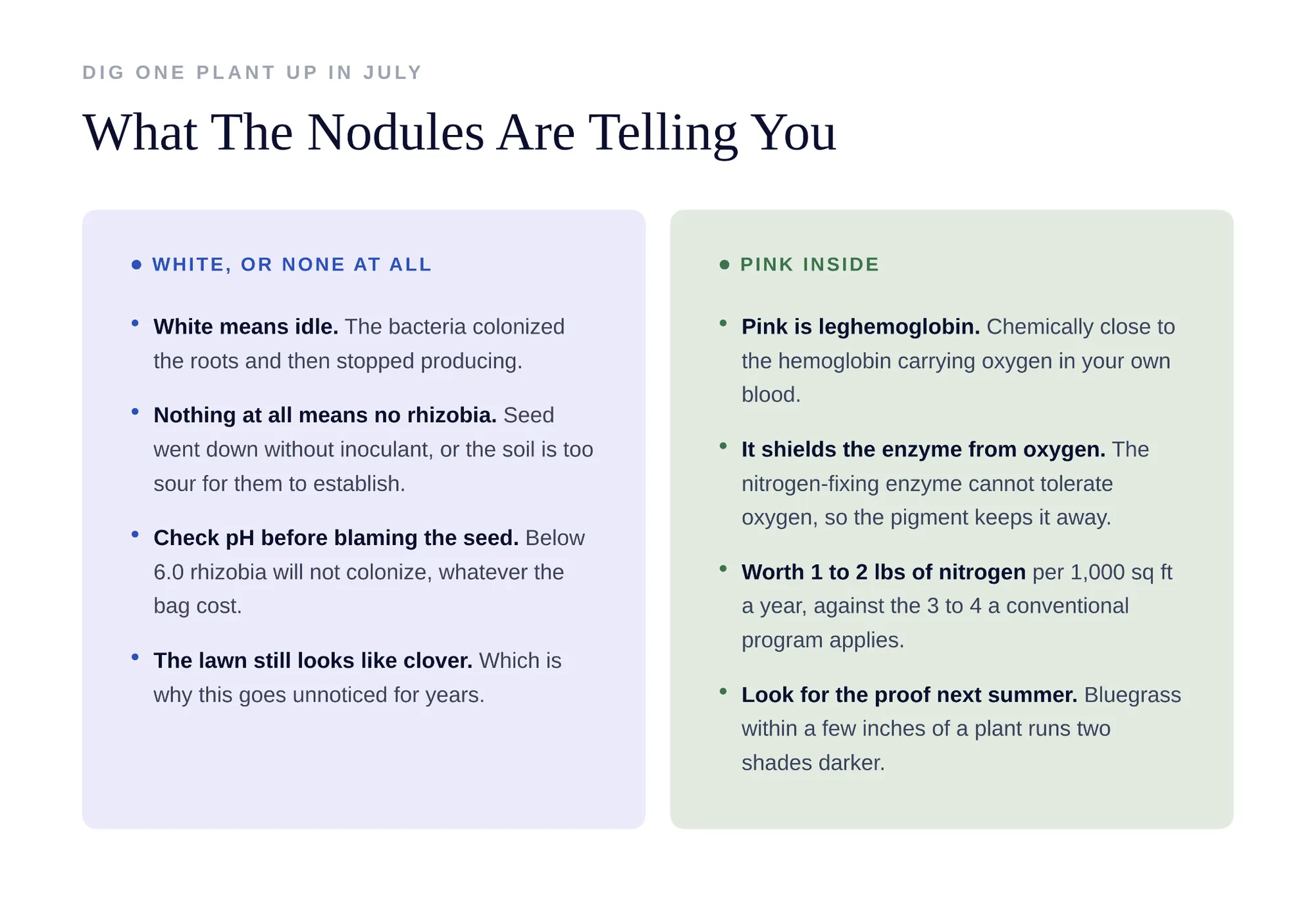
Along those roots you’re looking for bumps about the size of a pinhead. Pale. Sometimes strung out along the root, sometimes bunched at a junction. Nick one open with a thumbnail.
Pink inside is what you want.
That’s leghemoglobin, chemically not far off the hemoglobin doing oxygen work in your own blood, and it’s there to keep oxygen away from the nitrogen-fixing enzyme, which the enzyme cannot tolerate.
Pink means the bacteria are producing. White means they’ve colonized and gone idle. Nothing at all means the seed went down without inoculant, or the soil’s too sour for rhizobia to establish, and what’s growing out there looks like clover while doing none of the job clover was bought for.
A stand full of pink nodules is worth 1 to 2 pounds of nitrogen per 1,000 square feet a year. A conventional cool-season program applies 3 to 4. Offsets, in other words. Doesn’t replace.
The part you’ll actually see isn’t in the clover, though. It’s in the grass next to it, second summer onward, where bluegrass within a few inches of an established plant runs two shades darker than the same bluegrass six feet away. From an upstairs window in July you can map the clover by color.
Two other things a mixed stand does, neither of them related to nitrogen:
- Grub damage fills instead of showing. Grubs feed on grass roots and ignore clover. Do the pull-back test and the turf lifts like carpet right until it hits clover, where it stops.
- Dog urine stops leaving rings. That nitrogen slug scorches bluegrass. Clover just uses it.
Settle The Herbicide Question Before You Seed
Herbicides sort plants into two groups: grasses and broadleaf weeds. Clover falls in the second group, alongside dandelion, plantain, chickweed, thistle, and ground ivy.
Every jug on the hardware store shelf works on that one distinction: the 2,4-D and dicamba and MCPP blends, the weed-and-feed bags, the hose-end concentrates. Kill broadleaf, spare grass.
Nothing in the chemistry knows which broadleaf was paid for. So seeding clover means retiring those products permanently, and anything you were counting on them for has to be dealt with first.
Do this before any seed goes down
- Walk the lawn and identify what’s actually in it. Dandelions and plantain are a different problem from ground ivy, and the answer changes depending on which you have.
- Clear any creeping charlie now. It’s the one weed density won’t beat, so it needs triclopyr, usually two applications a season apart.
- Stop the spring pre-emergent, including corn gluten meal. Skip the application the season before you seed and every season after.
- Then seed. Not before.
That order gets reversed constantly, because seeding is the enjoyable part and spraying isn’t. Reverse it, and you spend the next two years watching ground ivy take the lawn while there’s a jug in the shed nobody can use.
Why the damage doesn’t show up right away
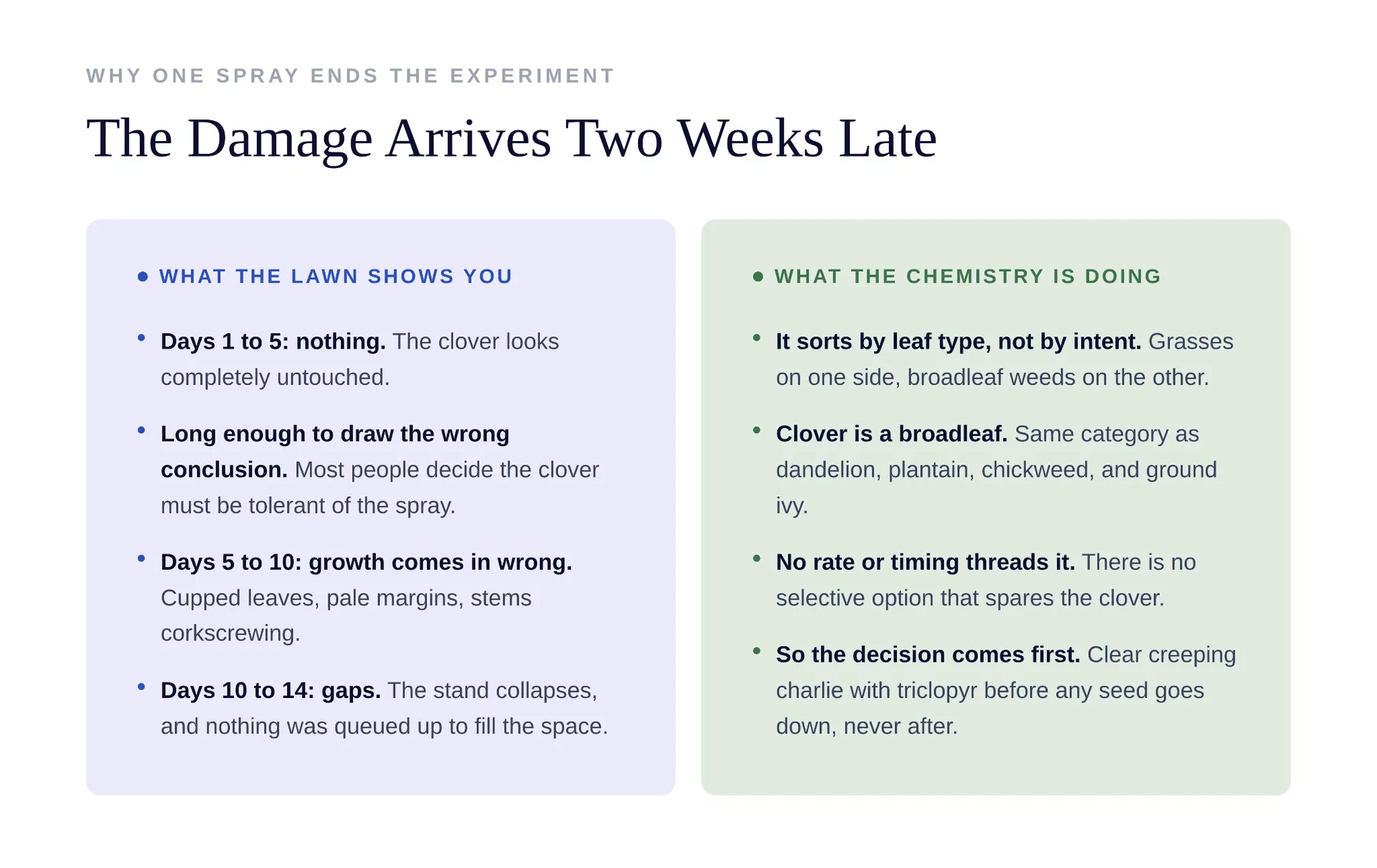
If you do spray a mixed stand, the delay is what fools people. An April application runs roughly like this:
- Days 1 to 5. Clover looks untouched, which is long enough for whoever sprayed to conclude it must be tolerant.
- Days 5 to 10. New growth comes in cupped, margins pale, stems corkscrewing.
- Days 10 to 14. The stand collapses into gaps, and nothing was queued up to occupy them.
No product threads this needle. There’s no selective option, no rate low enough, no application window that spares clover while killing everything else in its category.
What you use instead
Three tools, none of them chemical:
- Hand weeding, slow but the only thing that works on an established weed inside a stand you want to keep.
- Mowing height, since taller grass shades out germinating weed seed.
- Density, which carries most of the load once a mixed stand knits together.
For a lawn whose worst problem is dandelions, density alone is enough. Creeping charlie is where it runs out. Ground ivy spreads by stolons exactly the way clover does, occupies the same layer, and beats it. That’s why it comes out before seeding rather than after.
Why pre-emergents have to go too
Pre-emergents stop germination. Any germination. Crabgrass seed, clover seed, no distinction available, because indiscriminate is how the mechanism works.
Corn gluten meal is the one that catches people, marketed as the organic choice to precisely the audience buying clover. White clover holds its density partly by reseeding itself each summer.
Shut that off every spring and the stand thins across two or three seasons, gradually enough that nobody traces it back to the bag.
How Much Clover Seed You Actually Need
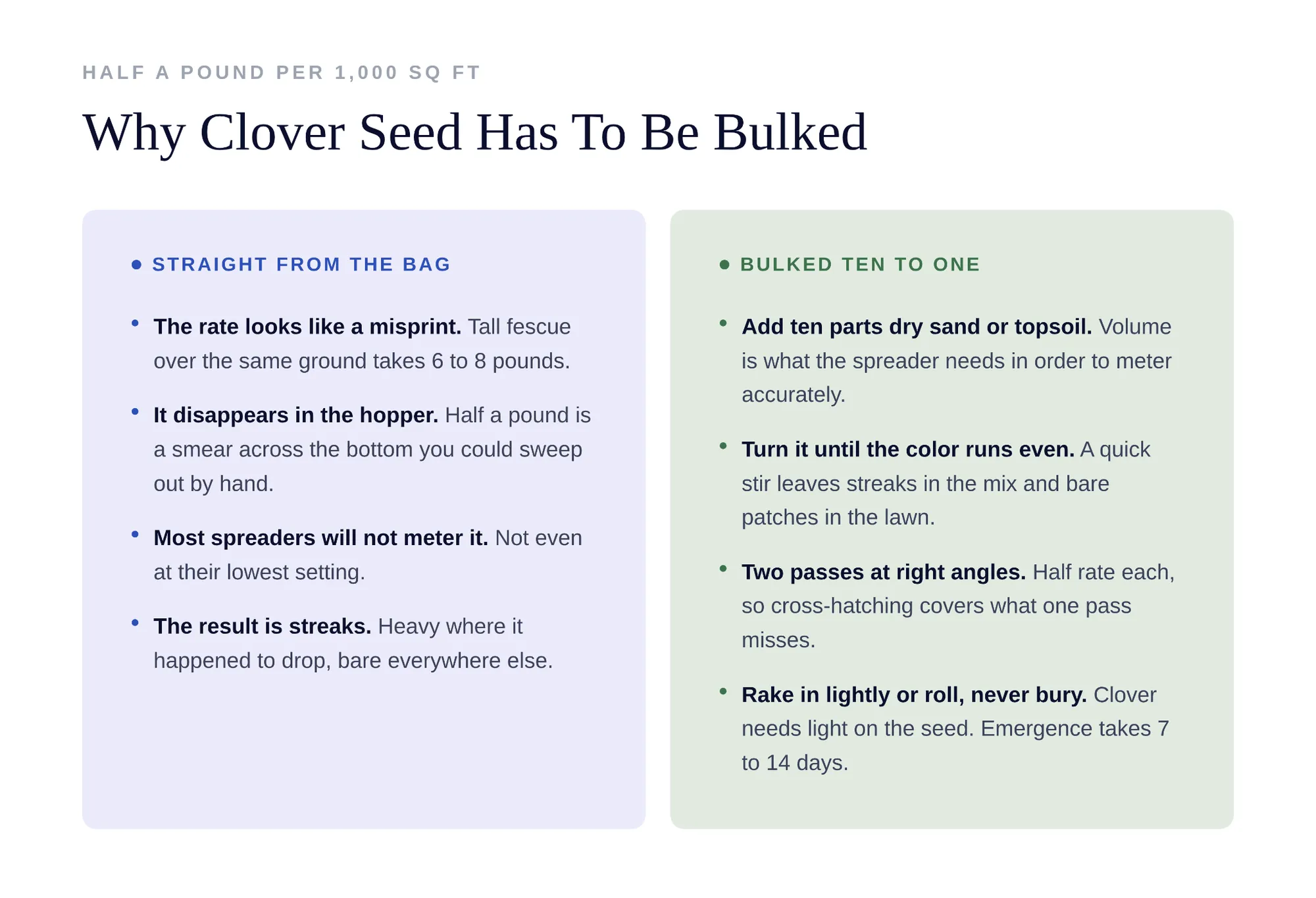
Clover goes down at a fraction of what grass seed does. A quarter to a half pound per 1,000 square feet for a pure stand, two to four ounces when overseeding into existing turf. Tall fescue over that same ground takes 6 to 8 pounds. The rates look like a misprint the first time you read them.
That gap creates a practical problem before you get anywhere near the lawn. Coated seed looks like dyed sand, pink or purple depending who packaged the inoculant, and half a pound of it sits in a broadcast hopper as a smear across the bottom you could sweep out by hand. Most spreaders won’t meter it at their lowest setting at all.
Read our extensive guide on planting clover before you choose.
Bulking and sowing
The fix is to give the spreader more volume to work with:
- Mix ten parts carrier to one part seed: Dry sand or screened topsoil both work. Turn it until the color runs even.
- Run two passes at right angles, half rate each: Cross-hatching covers what a single pass misses at these volumes.
- Surface sow and don’t bury it: Clover needs light on the seed to germinate, so rake in lightly or roll. Emergence takes 7 to 14 days.
Frost seeding beats spring seeding
Frost seeding means broadcasting in late February or early March onto ground that freezes overnight and thaws by afternoon. The freeze-thaw cycle works the seed in at exactly the depth it wants.
No equipment, no watering schedule, and in northern yards it produces better stands than an April sowing does.
Two things to check before you buy seed:
- Soil pH: This matters more for clover than for grass. Below 6.0, rhizobia won’t colonize properly, nodules don’t form, and you get clover that grows and fixes nothing. A test kit is twenty dollars.
- Sun: Four hours is the floor. Under that, plant fine fescue instead.
Here’s how to run tests on your lawn for pH and other factors.
Two Reasons To Keep Some Grass
Clover handles most of a lawn well. Two situations where it doesn’t.
Bees
A clover lawn will have bees in it, at ankle height, where people walk barefoot. Mowing won’t solve this. It clears the flowers for four or five days, and white clover reflowers faster than a 10- to 14-day mowing schedule can keep up with.
The only real fix is microclover, which barely flowers under regular mowing. It costs $40 to $80 a pound against $8 to $15 for common Dutch white, and it doesn’t stay small forever: mow it low or stress it through a dry August and the leaves creep back to ordinary size over two or three seasons.
Traffic
Clover can’t recover from a worn path. Its stolons run along the surface where feet crush them, and unlike bluegrass, which regrows into worn lines from underground rhizomes, clover has nothing to push recovery back in.
Keep grass on the soccer patch, the dog’s route along the fence, and the strip to the gate.
How Much Water A Clover Lawn Needs
Clover roots deeper than bluegrass early on and holds color through short dry spells that push bluegrass into dormancy. Through a genuinely dry August with nothing applied, it wilts, thins, then recovers on rain. If drought tolerance is the main reason you’re considering it, tall fescue beats clover and it isn’t close.
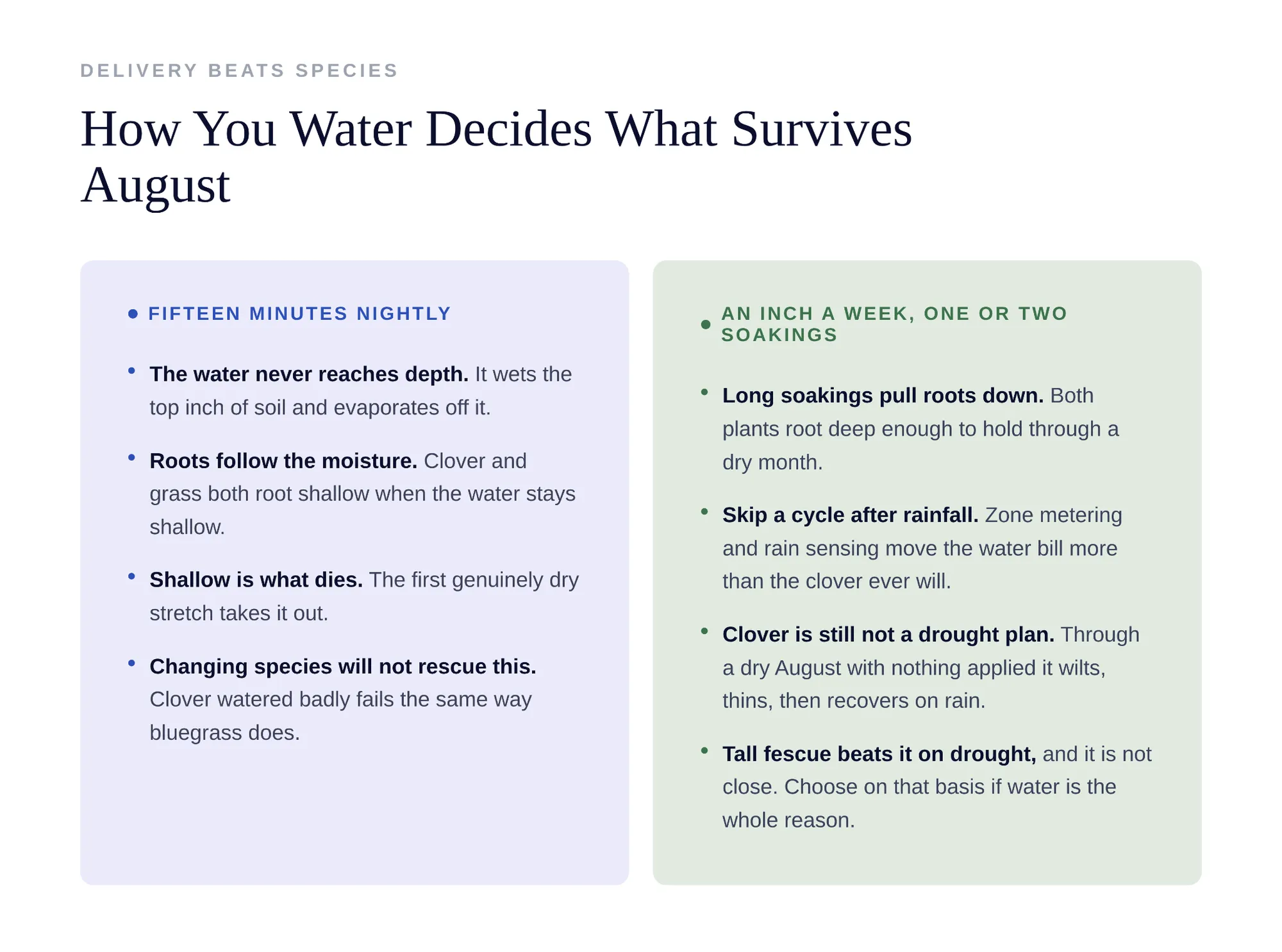
The water savings are thinner than the marketing suggests, because how you water matters more than what you plant:
- An inch a week, in one or two long soakings. This roots clover and grass deep enough to survive August.
- Not fifteen minutes nightly. Frequent shallow watering roots both plants shallow, and shallow is what dies.
- Skip a cycle after rain. A smart irrigation system that meters by zone and reads rainfall moves your water bill considerably more than the clover ever will.
Plan To Overseed Every Second Or Third Autumn
Individual white clover plants live 2 to 3 years. The stand carries on through runners and self-seeding, but density drifts down regardless.
Budget 2 to 4 ounces per 1,000 square feet every second or third September. It’s a small job, but it doesn’t stop. A clover lawn is maintained, not installed once.
Clover or grass is a false binary, and it pushes people toward a purity nobody needed. The same confusion surrounds turf and lawn, so before you plan anything, read what turf means compared to a lawn. For most lawns, the answer is a mixed stand:
- Overseed at 5 to 10 percent clover by seed weight into the turf you already have.
- Expect nitrogen, grub resistance, fewer dog spots, and a lighter fertilizer program out of that fraction.
- Leave the grass to handle traffic and texture, which it does better.
- Settle the herbicide question first. Five percent clover or ninety percent, nobody sprays that lawn. So clear out any creeping charlie before seeding, not after.
This is roughly what commercial low-input blends are built around already. Not a novel idea, just an unadvertised one.
Get more pool and lawn care guides from Aiper on Google