What Makes an Irrigation Controller Smart: Sensors, Weather Data, and ET

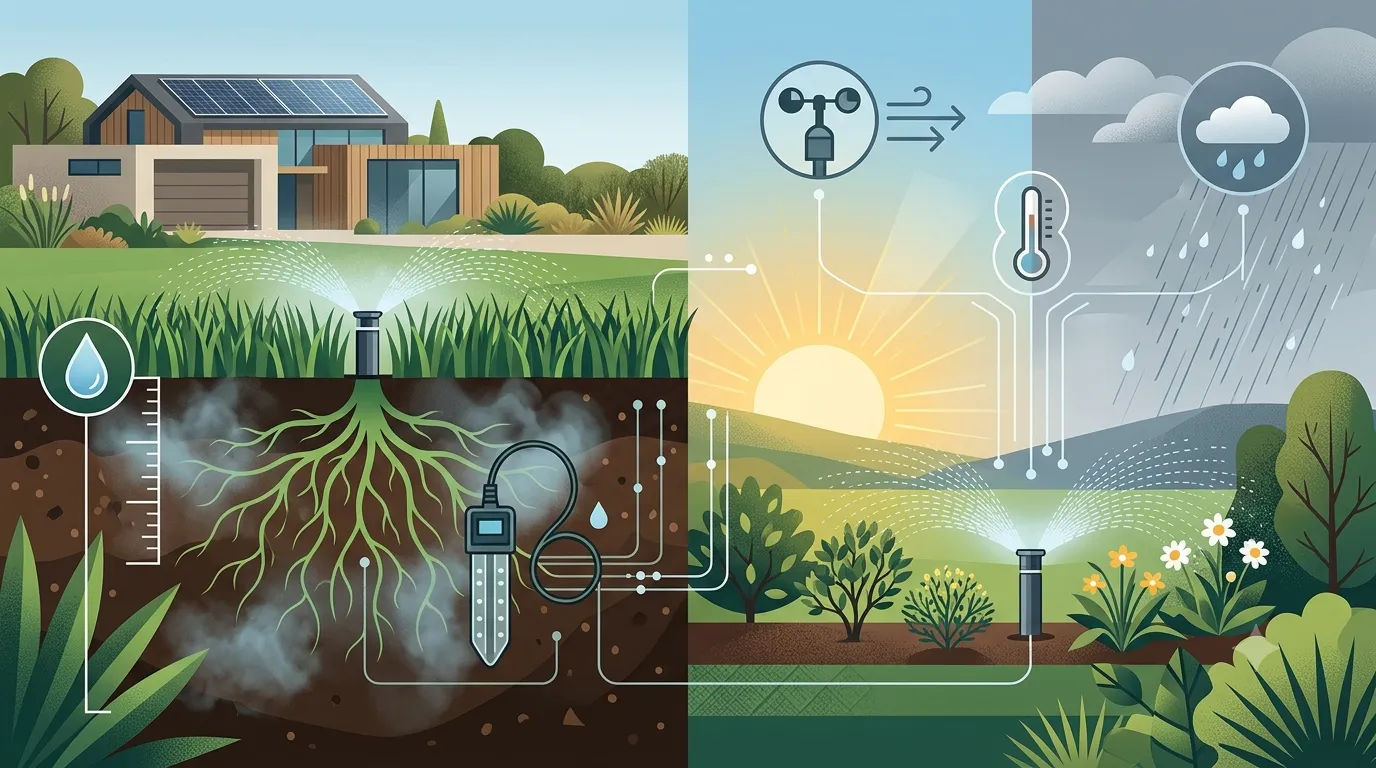
The word gets used loosely enough that it’s nearly meaningless on a box.
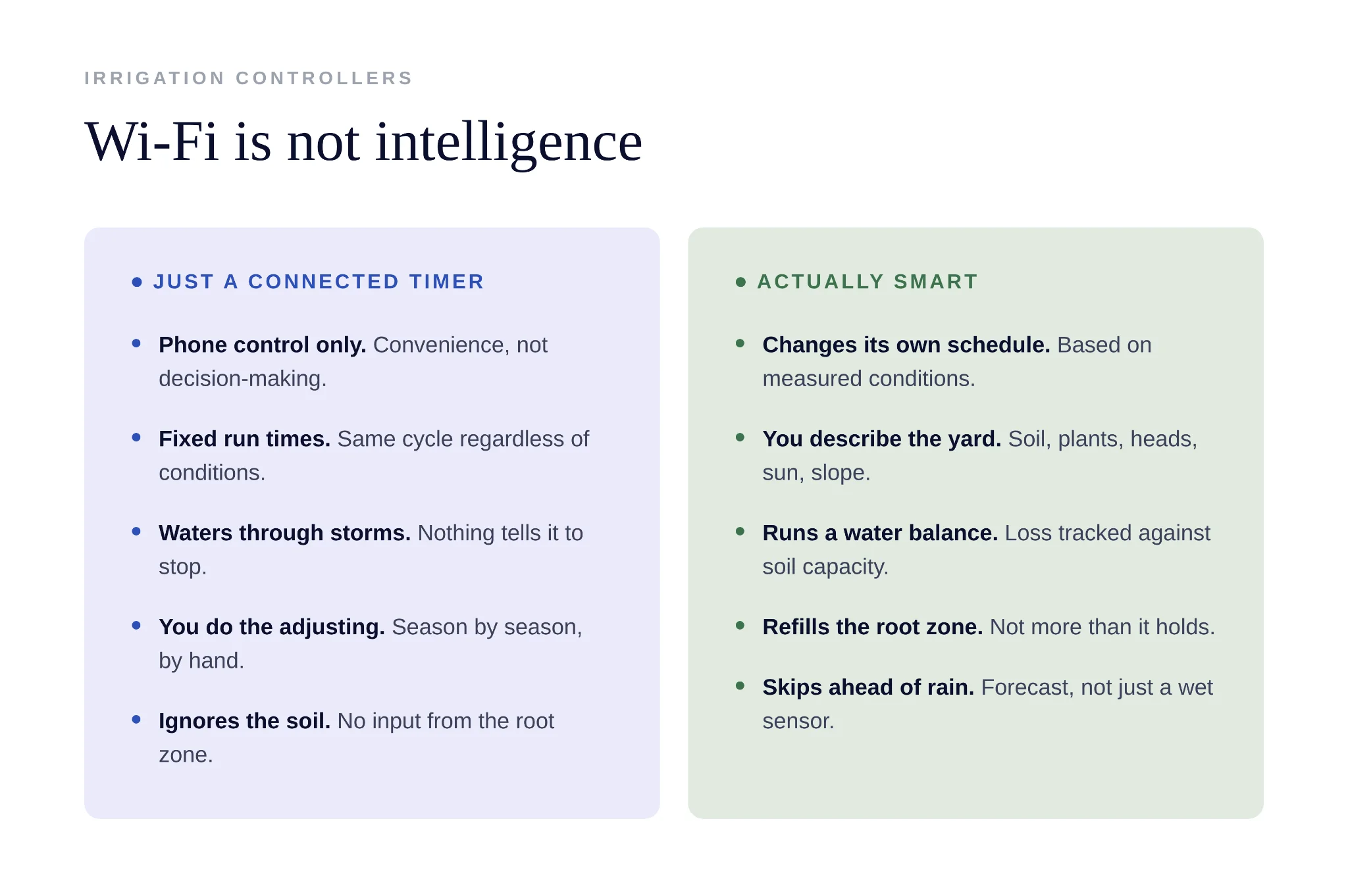
A controller you can turn on from your phone is not a smart controller — a real one pays for itself, and our guide shows how much smart irrigation saves on water bills. That’s a timer with Wi-Fi, and it will happily run a full 20-minute cycle on every zone during a thunderstorm while you’re at work, same as the mechanical dial it replaced.
The convenience is real. The intelligence is not.
What separates an actually smart controller is that it changes its own schedule based on conditions it either measures or receives.
You set the parameters once and from then on the controller decides how long and how often, adjusting continuously as the season moves. You stop programming run times. You start describing your yard and letting the controller do the arithmetic.
That’s the whole distinction. Everything below is about the three mechanisms that make it possible, and they’re not equally good.
Sensors: The Blunt Instrument, and the Precise One
There are two categories here, and lumping them together does a disservice to one of them.
Rain sensors
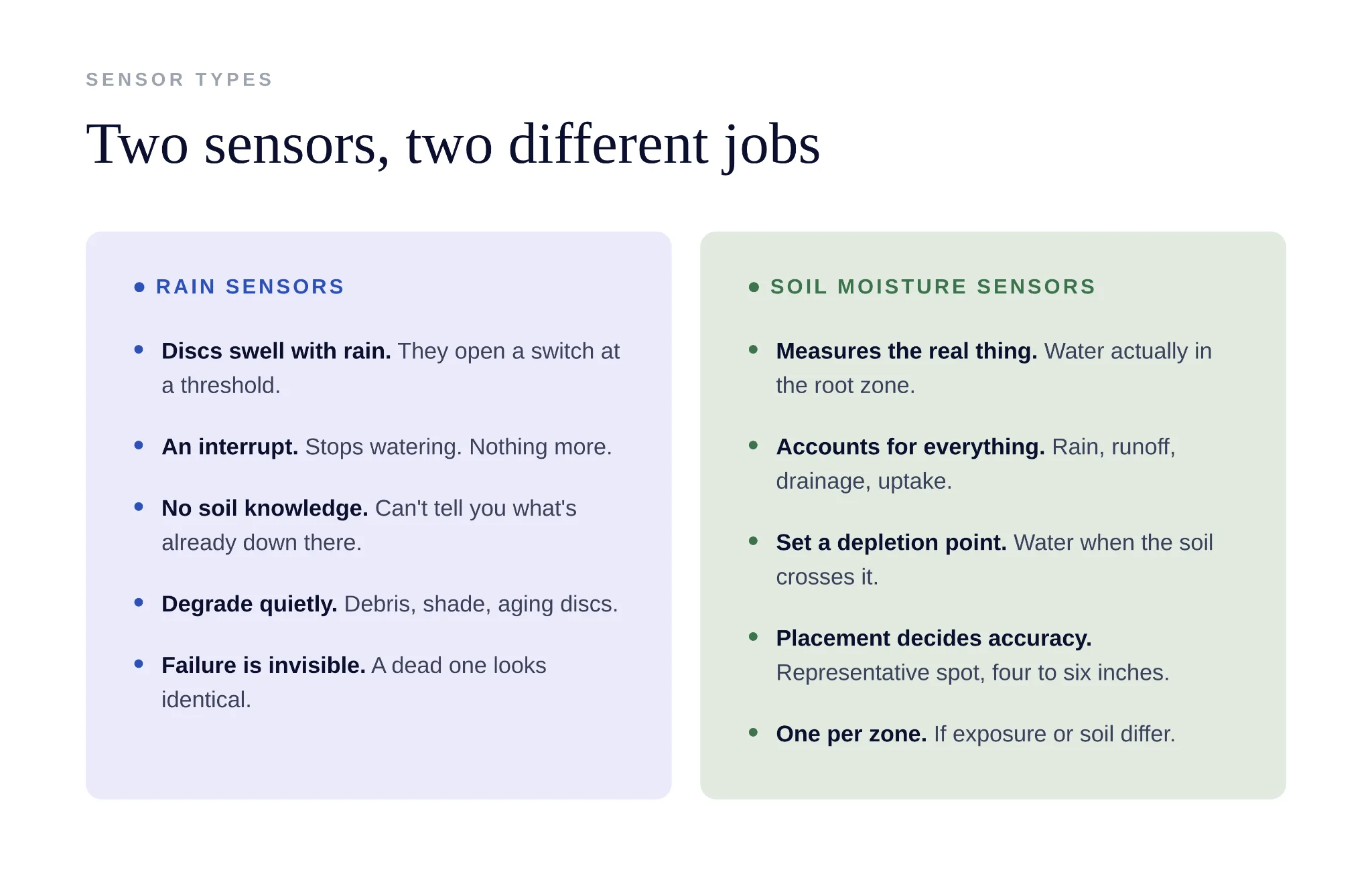
A small device mounted somewhere with open sky exposure, containing hygroscopic discs that swell as they absorb rainfall.
Once they swell past a threshold you set, typically an eighth, quarter, or half inch, they open a switch and interrupt the controller’s signal to the valves. Rain stops, discs dry out, switch closes, irrigation resumes.
They’re cheap, they’re required by code in a lot of municipalities, and they work. But understand what they do: they tell your system not to water right now. They don’t tell it anything about how much water is already in the soil, how much the plants have used since the last rain, or what tomorrow looks like. A rain sensor is an interrupt, not intelligence.
Also, they fail quietly. The discs degrade over a few seasons, the vent gap gets packed with debris or spiderwebs, the mounting position ends up shaded by a tree that’s grown since installation. A rain sensor that stopped working looks identical to one that’s working. Nobody checks them until the water bill arrives.
Soil moisture sensors
These go in the ground, in the root zone, in the zone that actually matters, and they measure the one variable everything else is trying to estimate. Volumetric water content. How much water is physically present in the soil right now.
A soil moisture sensor accounts for rainfall, prior irrigation, runoff, drainage, root uptake, soil composition, and shade, all at once, because all of those things are already expressed in the number it reads.
You set a depletion threshold. The controller waters when the soil crosses it, and skips when it hasn’t.
The catch is placement, and this is where most soil moisture installations go wrong. One sensor represents one spot. Put it in a low corner that collects runoff and your whole zone gets under-watered because the sensor thinks everything is fine.
Put it in the driest, most sun-exposed patch and you’ll over-water everything else. Correct practice is to place it in a representative area of the zone at root depth, roughly four to six inches for turf, deeper for shrubs, and to use one sensor per zone if the zones differ meaningfully in exposure or soil.
Done right, soil moisture is the most accurate input available to a residential controller. Done carelessly, it’s worse than no sensor at all, because you’ll trust it.
Weather Data: Useful, But It’s Coming From Somewhere Else
Weather-based controllers pull forecast and observed conditions from an internet source and adjust run times accordingly.
This is where smart gets marketed hardest and where the actual performance varies most, because everything depends on the distance between the reporting station and your yard.
If the nearest station is fifteen miles away across a ridge, you are irrigating based on someone else’s weather. Convection storms in summer are notoriously local; the station gets a half inch, you get nothing, and your controller skips a cycle you needed. Or the reverse. Coastal areas, valleys, and anywhere with real elevation change make this worse.
Some controllers let you connect a personal weather station or pull from a nearby PWS network. If that option exists and there’s a station within a mile or two of you, use it. The improvement is substantial, and it’s the single highest-value configuration change most people never make.
Weather data does one thing sensors can’t, though, and it’s worth the tradeoff on its own: it looks forward. A soil moisture sensor can only tell you the soil is dry. A forecast can tell you it’s about to rain two inches tomorrow, so don’t bother watering tonight. That predictive skip is where a lot of the real savings come from.
ET: The Part That Actually Does the Work
Evapotranspiration is the number underneath every credible smart controller, and it’s worth understanding because it explains why these systems behave the way they do.
ET is the combined water loss from two processes happening at once: evaporation directly off the soil surface, and transpiration, water pulled up through plant roots and released through leaf stomata. Add them together, and you get a single figure, expressed in inches per day, describing how much water left your landscape.
Four things drive it:
- Temperature
- Solar radiation
- Humidity
- Wind
Wind is the one people underestimate. A dry, breezy 75-degree day can pull more water out of a lawn than a still, humid 90-degree one, because wind constantly strips the saturated boundary layer off the leaf surface and lets transpiration run unchecked.
Anyone who’s watched a lawn go from fine to stressed during a week that never got particularly hot has seen ET in action without naming it.
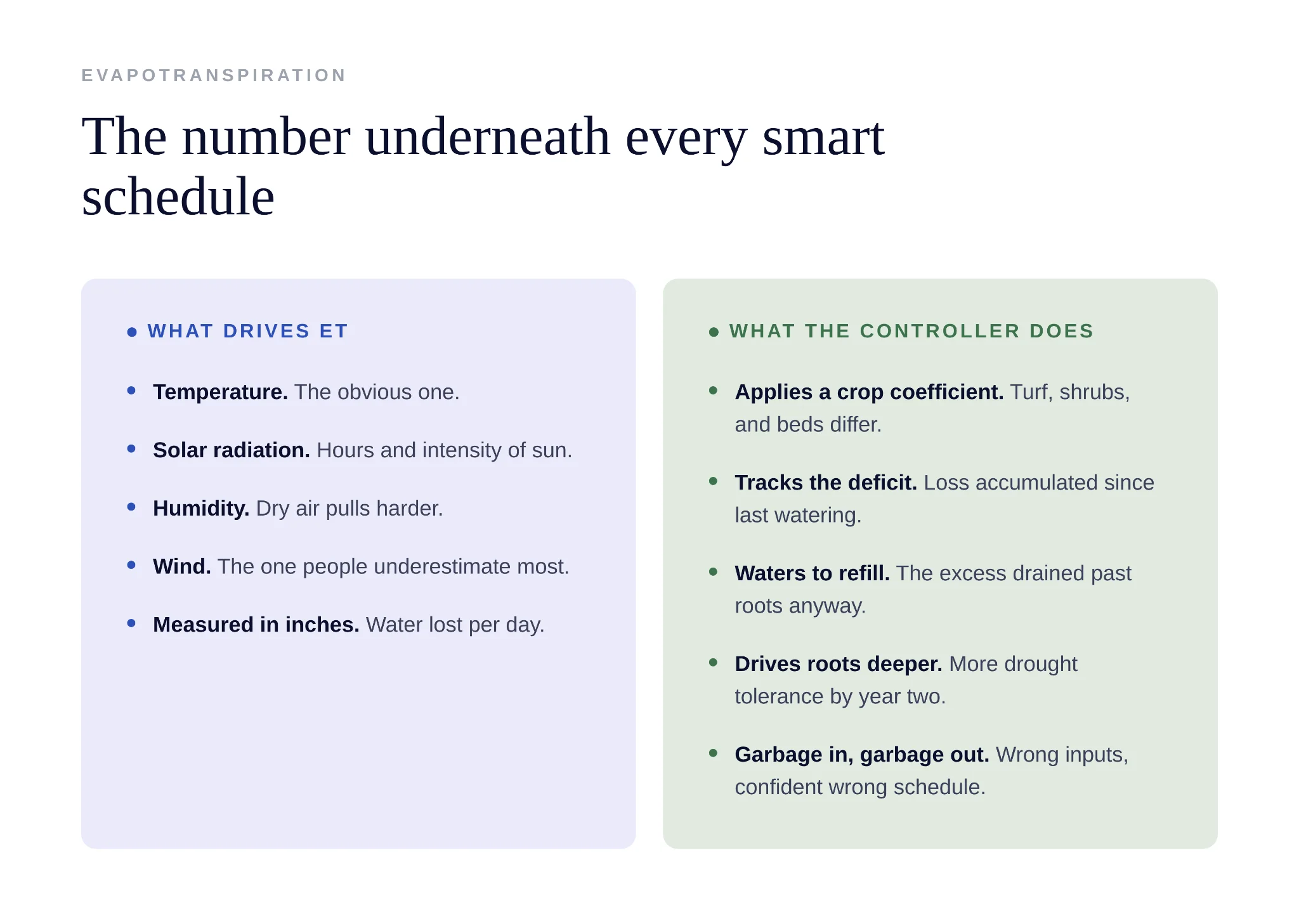
The controller takes daily ET, applies a crop coefficient for what’s actually planted in each zone, turf uses water differently than established shrubs, which use it differently than annual beds, and runs a water balance. It knows how much water your zone holds, how much has been lost, how much your heads deliver per minute. When the accumulated deficit reaches the threshold, it waters, and it waters exactly enough to refill the root zone. Not more.
That last part is where the savings live. Most residential irrigation isn’t wasteful because it runs too often. It’s wasteful because each cycle applies far more water than the soil can hold, and the excess drains straight past the roots into the subsoil where nothing can reach it. You paid for it, the grass never saw it. An ET-driven controller with correct zone setup simply stops doing that, and the reduction in a typical over-watered yard is not marginal.
There’s a second-order effect too.
Deeper, less frequent watering (which is what ET scheduling naturally produces) drives roots down. Shallow daily watering trains roots to stay near the surface, where they’re the first thing to fail in a heat wave. Turf on an ET schedule is measurably more drought-tolerant by the second season, and that has nothing to do with the water bill.
Where ET falls is garbage input. The controller’s math is only as good as what you told it about your yard. Wrong soil type, wrong sprinkler type, wrong sun exposure, and it will confidently calculate a precise schedule that’s wrong. It won’t tell you it’s wrong. It’ll just run.
The Setup Is the Product
This is the part nobody wants to hear about a device sold on the promise of automation.
Every zone needs to be entered accurately: soil texture, plant type, head type and precipitation rate, sun exposure, slope. Most people click through this in four minutes because the interface makes it easy to click through, accept the defaults, and then wonder why their “smart” controller isn’t saving anything.
Do a catch cup test on at least your most important zones.
Set out identical straight-sided containers across the zone, run it for fifteen minutes, measure what collected in each.
You’ll learn two things:
- Your actual precipitation rate in inches per hour, which is the number the controller needs
- Your distribution uniformity, which tells you whether your heads are even covering the zone evenly in the first place.
If distribution uniformity is bad, no controller can fix it. Smart scheduling on a badly designed zone means the system waters long enough to satisfy the driest spot, which means the rest of the zone is over-watered by definition. That’s a head spacing and nozzle problem, and it needs fixing before the controller can do anything useful.
Best controller on the market, wrong precipitation rate entered, and you’ve built an expensive timer.
Which Approach Belongs in Your Yard
Weather and ET together handle most residential situations well, especially where the yard is reasonably uniform, and there’s a good data source nearby.
Setup is lighter, there’s nothing buried to fail, and the forward-looking rain skip is genuinely valuable.
Soil moisture earns its place where the yard is complicated. Heavy clay that drains slowly. Deep shade against full sun in the same property. Slopes that shed water. Anywhere the general regional conditions don’t describe what’s actually happening in your soil.
If you’d rather not choose between the two approaches, the Aiper IrriSense 2 runs both.
ET-based scheduling handles the baseline, soil moisture readings from the root zone act as the override, and the system flags a sensor that has stopped reporting instead of quietly ignoring it.
Zone setup walks you through soil texture, head type, and precipitation rate rather than letting you click past them, which is the step that determines whether any of the rest works.
Get more pool and lawn care guides from Aiper on Google