How to Test Your Lawn Soil (and Read the Results)

Most lawn fertility programs are guesses.
Somebody’s grass looks pale, they throw lime at it because a neighbor said lime, and half the time they’ve just pushed a perfectly fine pH in the wrong direction.
Lime on soil that didn’t need it is not neutral, it’s a problem you paid to create, and it takes years to walk back.
A soil test costs about as much as one bag of fertilizer and replaces every guess with a number. That’s the whole pitch. The test isn’t the hard part, either.
The hard parts are pulling a sample that actually represents your lawn, and knowing what the report is telling you when it comes back. Both are learnable in an afternoon.
Skip the Kits, Use the Lab
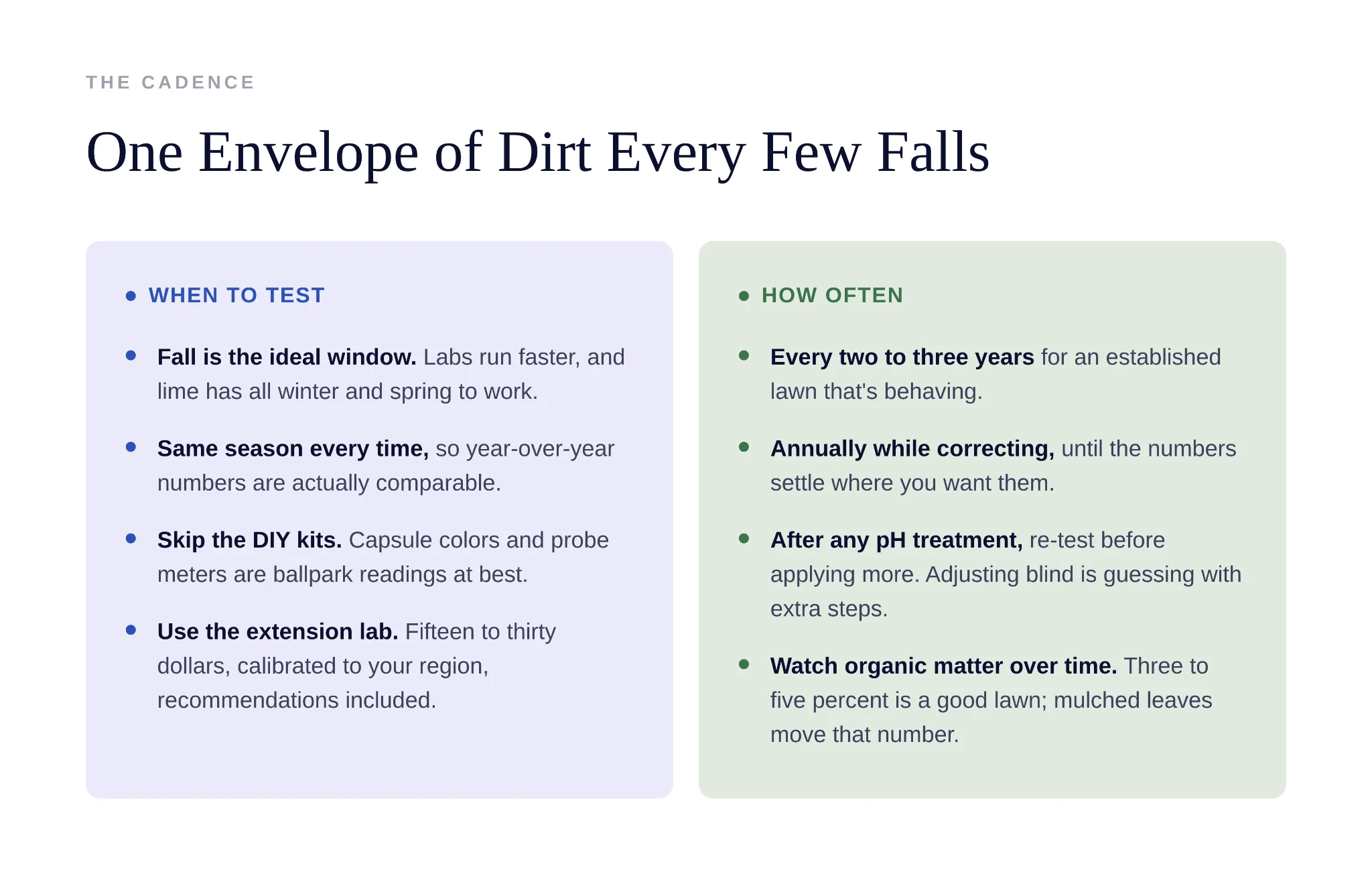
Get this out of the way first: the $12 color-capsule kits and the two-dollar pH meters with the metal probe are not soil tests.
The probe meters respond to moisture and salts as much as pH. You can get three different readings from three insertions in the same hole. The capsule kits give you a color you’ll squint at against a chart in bad light. Ballpark at best.
Your county extension service, or the state university lab it partners with, runs a real test for fifteen to thirty dollars. Actual lab equipment, results calibrated to your region’s soils, and, this is the part people miss, recommendations attached. Not just “your pH is 5.4” but “apply this much lime per thousand square feet for turf.” The interpretation comes with the number.
Commercial labs are fine too. But the extension lab is cheap, local, and has seen ten thousand samples from soil exactly like yours.
And once the recommendations come back, a tool like the Aiper garden soil calculator converts them from rates per thousand square feet into the actual volume of material to buy for your lawn’s size.
Pulling a Sample That Means Something
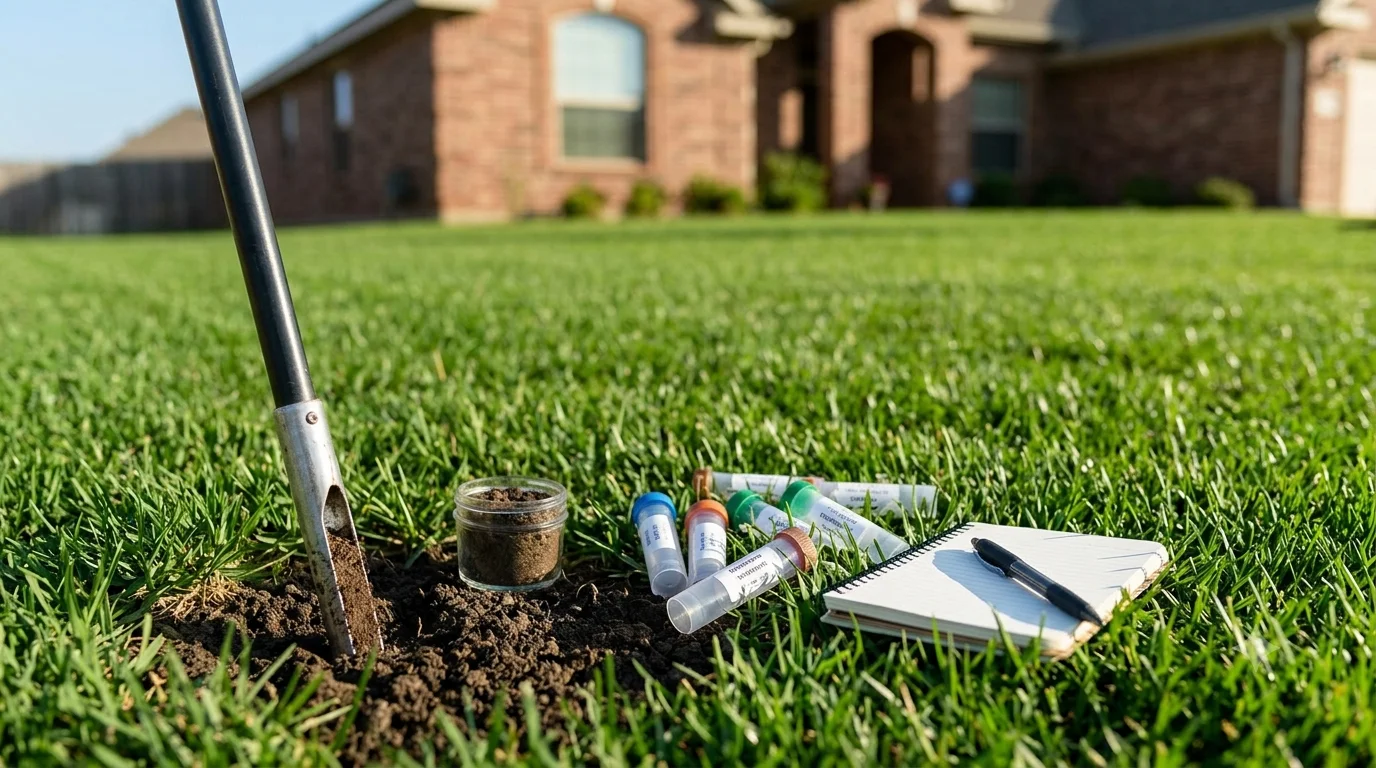
The lab result is only as good as the cup of dirt you send, and one scoop from beside the driveway is not a soil test. It’s a test of that scoop.
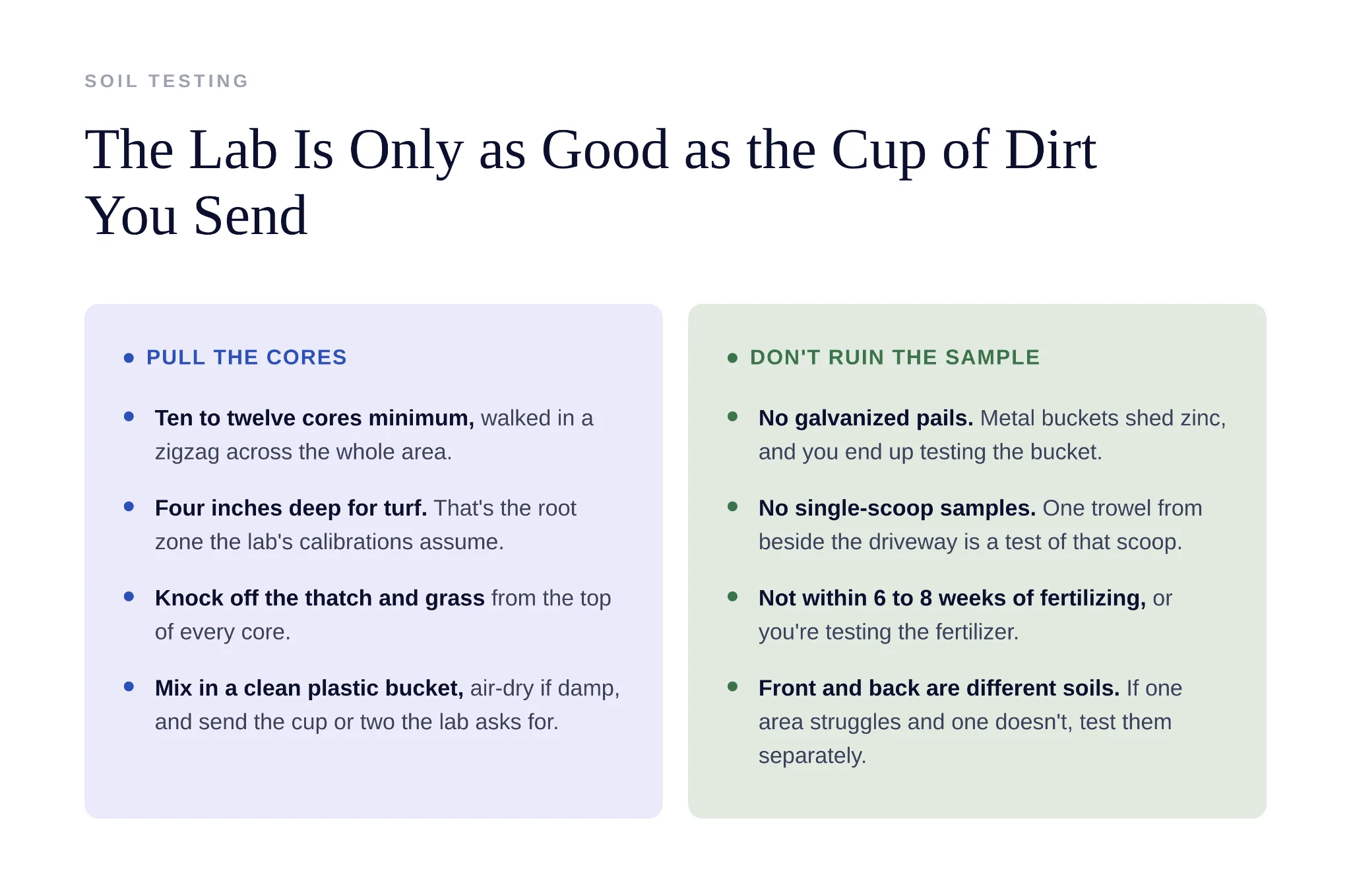
Ten to twelve cores, minimum, walked in a zigzag across the whole area you’re testing. Four inches deep for turf.
That’s the root zone, and it’s what the lab’s turf calibrations assume. A soil probe makes this pleasant; a trowel works if you cut a consistent slice each time. Knock off the thatch and grass from the top of each core.
Everything goes into a clean plastic bucket. Plastic, specifically, a galvanized pail sheds zinc into the sample, and you’ll get a micronutrient reading for your bucket. Mix it all thoroughly, spread it to air-dry on newspaper if it’s damp, and send in the cup or two the lab asks for.
Front yard and back yard are different soils more often than not. Different construction fill, different sun, different history. If one area struggles and another doesn’t, test them separately. Two tests that tell you something beat one blended test that averages the story away.
Timing: fall is ideal. Labs are slower, and you have all winter and spring to act on lime recommendations before the growing season. But the rule that actually matters is consistency. Same season, every time, so year-over-year numbers are comparable. And never sample within six to eight weeks of fertilizing, or you’re testing the fertilizer.
Reading the Report
The envelope comes back, and it’s a wall of abbreviations. Here’s what carries weight.
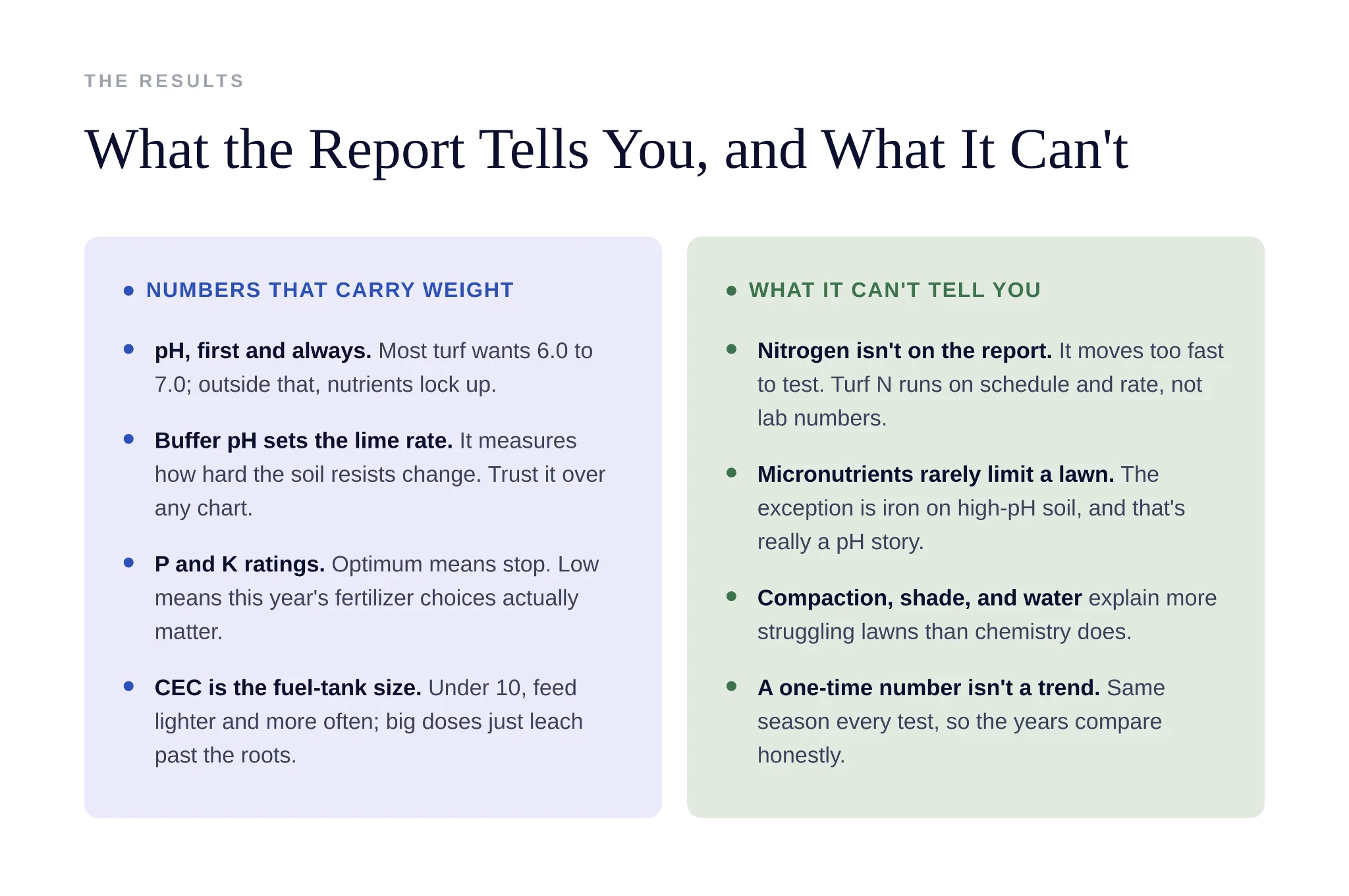
pH first, always. Most turf grasses want 6.0 to 7.0, slightly acid. Below 6.0, phosphorus starts locking up, and the grass can’t access nutrients that are physically present in the soil, which is why fertilizing a low-pH lawn often does nothing.
Above 7.5, iron becomes the problem, and you’ll see it as yellowing grass that stays yellow no matter how much nitrogen you feed it.
Next to pH, many reports list something called buffer pH, and this is the number people skip that they shouldn’t. Regular pH tells you where the soil is; buffer pH tells you how hard the soil will resist being moved.
Two lawns can both read 5.5 and need wildly different lime rates, because one is sandy and one is clay. The lab’s lime recommendation is computed from buffer pH. Trust it over any generic chart.
Phosphorus and potassium are reported in ppm with ratings: low, medium, optimum, high. Optimum means stop; more is waste at best. Low P or K means the starter or fall fertilizer choices actually matter this year.
Worth knowing: several states now restrict phosphorus on lawns unless a soil test documents a deficiency. Your test result is literally the legal permission slip.
Nitrogen is not on the report, and that absence confuses everyone. It’s deliberate. Nitrogen moves through soil so fast that a lab number would be obsolete before the envelope arrived. Turf nitrogen is managed by schedule and rate — pounds per thousand square feet per season for your grass type — not by testing. If your report shows an N value, it’s an estimate, not a prescription.
CEC (cation exchange capacity) is the soil’s fuel-tank size. Low numbers, under 10 or so, mean sandy soil that can’t hold nutrients: feed lighter and more often, because a big application just leaches past the roots. High CEC means clay or organic soil that stores well: fewer, fuller feedings work fine.
Organic matter as a percentage. Three to five percent is a good lawn. Under two percent explains a lot of struggling turf all by itself, and it’s the number that mulched leaves and grass clippings slowly move, which is the long game.
Micronutrients, like iron, manganese, zinc, seldom limit a home lawn. The exception is iron on high-pH soil, and even then the fix is usually managing the pH story, not chasing the iron.
Fixing pH Without Making It Worse
Lime for acid soil. Calcitic lime if your magnesium reading is adequate or high; dolomitic if magnesium is low, dolomitic on already-high-Mg soil stacks a problem you didn’t have.
Whatever the total recommendation, cap single applications around 50 pounds per thousand square feet and split the rest across seasons. Lime is slow. Months, not weeks. Pelletized is easier to spread than pulverized and worth the small premium.
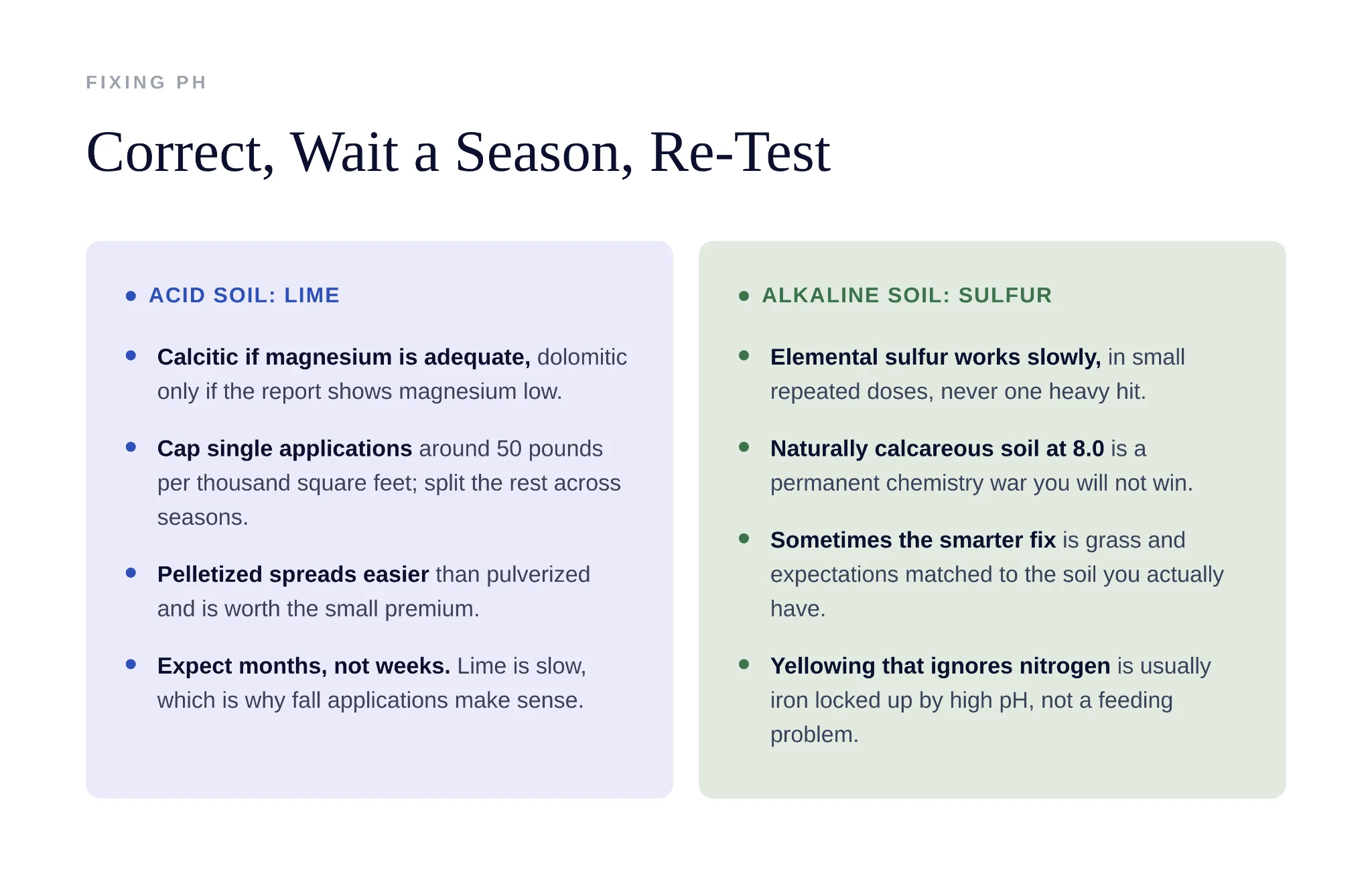
Alkaline soil is the harder direction. Elemental sulfur works, slowly, in small repeated doses. But if your soil sits at 8.0 because it’s naturally calcareous, you are signing up for a permanent chemistry war you will not win. At some point the smarter move is grass and expectations matched to the soil you actually have.
Either way: correct, wait a season, re-test — and if the test came back low, start with how to fix acidic soil in your lawn. pH adjustment without a follow-up test is just guessing with extra steps. Start instead by learning whether your lawn actually needs lime added before you buy or spread anything.
The Cadence
Every two to three years for an established lawn that’s behaving. Annually if you’re actively correcting something, until the numbers settle. That’s the entire maintenance load: one envelope of dirt every few falls, and every fertilizer decision in between is made on evidence rather than folklore.
One caveat the report can’t give you. Soil chemistry explains fewer lawn problems than people want it to. Thin grass under a maple is a light problem.
A hard, bouncy lawn that sheds water is compaction. And a lawn watered unevenly, soaked near the heads, parched at the edges, will look deficient on any chemistry, because roots can’t drink numbers off a report. Consistent moisture is the layer under everything the test measures.
A smart irrigation system like the Aiper IrriSense 2 maps up to 4,800 square feet into zones and adjusts watering to the weather on its own, so the soil you finally understand gets the one input no lab can prescribe: water, evenly, on time.
Get more pool and lawn care guides from Aiper on Google