How to Get Rid of Clover in a Lawn (If You Want To)

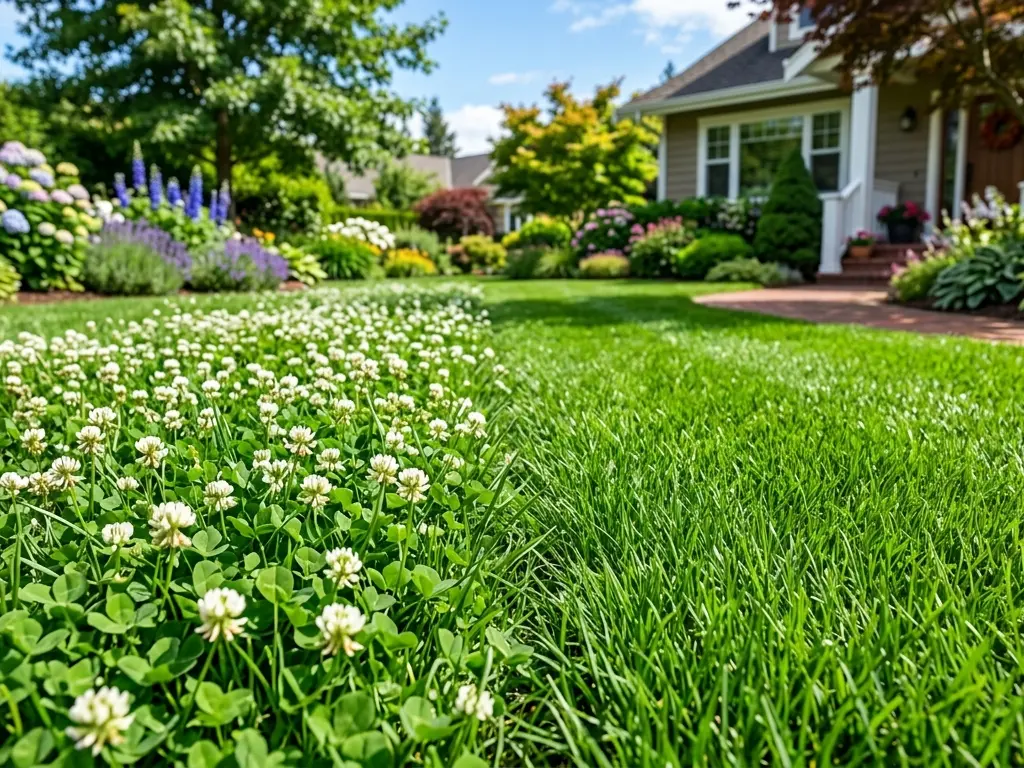
A lot of clover problems are really just thin, nutrient-starved lawns filling space. Quackgrass exploits that same thin turf, though it calls for a different removal approach — our guide to getting rid of quackgrass in a lawn walks through it.
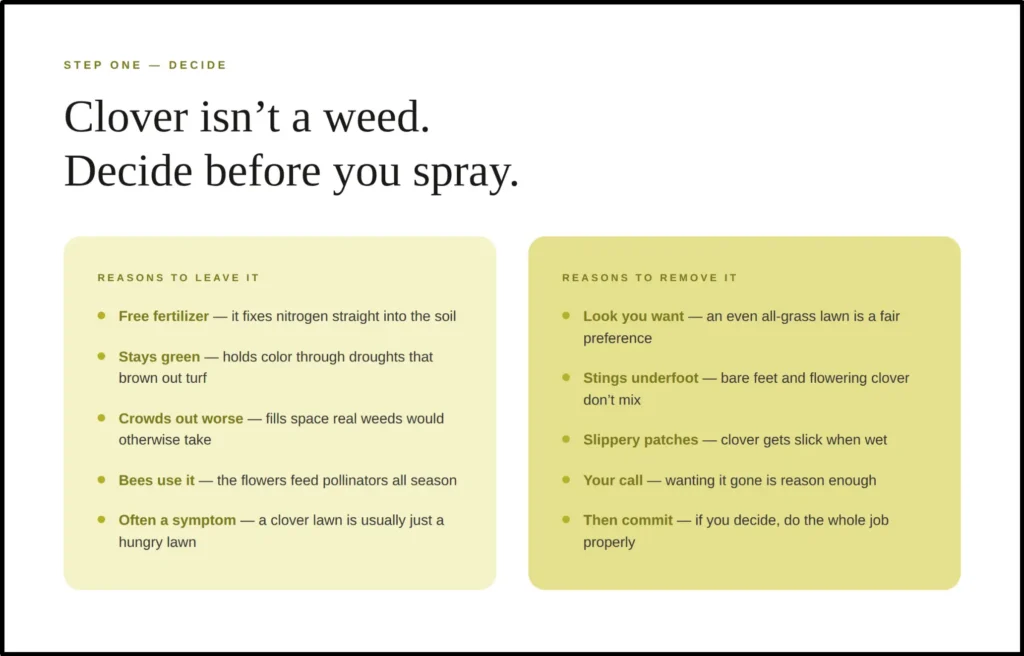
Clover isn’t crabgrass. It fixes nitrogen into the soil, stays green during dry stretches that burn regular turf brown, and often prevents more aggressive weeds from taking over. Bees like it too.
So the real first step usually isn’t buying a herbicide. It’s deciding what kind of lawn you actually want. Deciding whether to keep or remove clover is a lawn-care call, not a landscaping one, a line our guide to landscaping vs lawn care draws clearly.
If you’ve made that decision and you still want the clover gone, the process matters. Below: how to tell clover from the things that look like it, which selective products actually work on it, how and when to apply them, and what to do afterward so it doesn’t simply return.
Should You Actually Get Rid of Clover?
Worth sitting with for a minute, because a growing number of homeowners are deliberately planting clover lawns instead of removing them. The clover lawn pros and cons split fairly cleanly, and knowing which side you land on determines everything that follows. Johnsongrass is a far more aggressive invader than clover, and getting rid of johnsongrass in a lawn usually needs a targeted grass herbicide rather than spot-pulling.
The case for keeping it
Clover pulls nitrogen out of the air and puts it into your soil, which means it feeds the grass around it instead of competing with it for fertilizer. It holds color through drought that turns cool-season turf brown. It needs less water, less feeding, and less mowing than grass does. It supports pollinators, and because white clover flowers over a long season, it feeds them during stretches when little else is blooming.
And microclover, a dwarf cultivar bred for lawns, blends into turf far more evenly than the wild stuff, with smaller leaves and fewer flowers.
The case against
Clover grows in patches rather than evenly, so a mixed lawn reads as blotchy rather than uniform. The flowers attract bees, which is a real problem if anyone in the house is allergic or if small children play barefoot.
Clover gets slick underfoot when it’s wet. It doesn’t take foot traffic the way turfgrass does, and it bruises where grass would spring back. In colder zones it dies back over winter and leaves gaps.
Neither answer is wrong. But the worst outcome is the middle: half-heartedly spraying a lawn you were never that bothered about, every spring, forever.
How to Identify Clover in Your Lawn
Before you treat anything, confirm what you’re treating. A lot of failed clover treatments are actually successful treatments applied to a different plant.
| Weed | How to tell | Notes |
|---|---|---|
| White clover | Round leaflets in threes, often with a faint white V-mark; white or pale pink puffball flowers | The most common lawn clover, spreads by creeping stems (stolons) |
| Red clover | Slightly larger, upright growth; pink-purple flowers | Less common in mowed lawns, more common in unmown edges and pastures |
| Microclover | Smaller leaflets than white clover, lower growth habit | Usually intentionally seeded, not a volunteer weed |
| Oxalis (yellow wood sorrel) | Heart-shaped leaflets (not round), yellow flowers, seed pods that shoot seeds when touched | Commonly confused with clover but needs a different herbicide mix |
| Black medic | Small yellow flower clusters, center leaflet sits on its own tiny stalk | Also nitrogen-fixing, also thrives in thin/dry lawns, similar treatment to clover |
Penn State Extension calls white clover the most common weed of home lawns, and the LSU AgCenter flags oxalis as the plant most often mistaken for it. This matters because oxalis in particular is tougher to kill with a straight three-way herbicide and usually needs a product that lists it on the label specifically. If your “clover” doesn’t respond after a couple of applications, check the leaf shape again before assuming the product failed.
Why Do I Have So Much Clover in My Lawn?
Clover is an opportunist, not an invader. It spreads into thin turf, bare patches, and soil that’s low on nitrogen, because those are the spots grass can’t defend. Wild violets exploit the same weak turf, so how to get rid of violets in grass really means closing those gaps.
Thin lawns also sometimes have underlying stress happening below the surface, including shallow roots, compacted soil, or even lawn grubs damaging the root system underneath.
If the soil feels hard and water sits on top instead of soaking in, aerating your lawn can help more than another round of weed treatment, because it gives air, water, and nutrients a way back into the root zone.
A soil test is worth the twenty dollars here. It tells you your nitrogen level and your pH, and it turns “the lawn is thin” into something you can act on. Turfgrass wants a pH of roughly 6.0 to 7.0, with the mid-6s ideal, and clover tolerates poorer fertility than grass does. If both numbers are off, the clover isn’t the problem — it’s the symptom. If a low pH is part of it, a lime application raises it back toward that range.
The scale of the fix is worth knowing. Michigan State University Extension reported trials in which raising annual nitrogen to 3 lb per 1,000 square feet cut clover by roughly three-quarters over six years. Slow, but it holds in a way that spraying doesn’t.
Which means the lawns that fight clover hardest with sprays are usually the same lawns that never fix why the clover showed up. They spray, it comes back, they spray again. You can lose years that way.
How to Get Rid of Clover in a Lawn Naturally
The non-chemical route is slower and less dramatic, and on a lawn that isn’t badly overrun it works.
Feed the lawn. Clover thrives in low-nitrogen soil precisely because it makes its own nitrogen and doesn’t need yours. When you fertilize, you tilt the ground in favor of the grass and against the clover, which is roughly the opposite of what most people expect from a nitrogen feed.
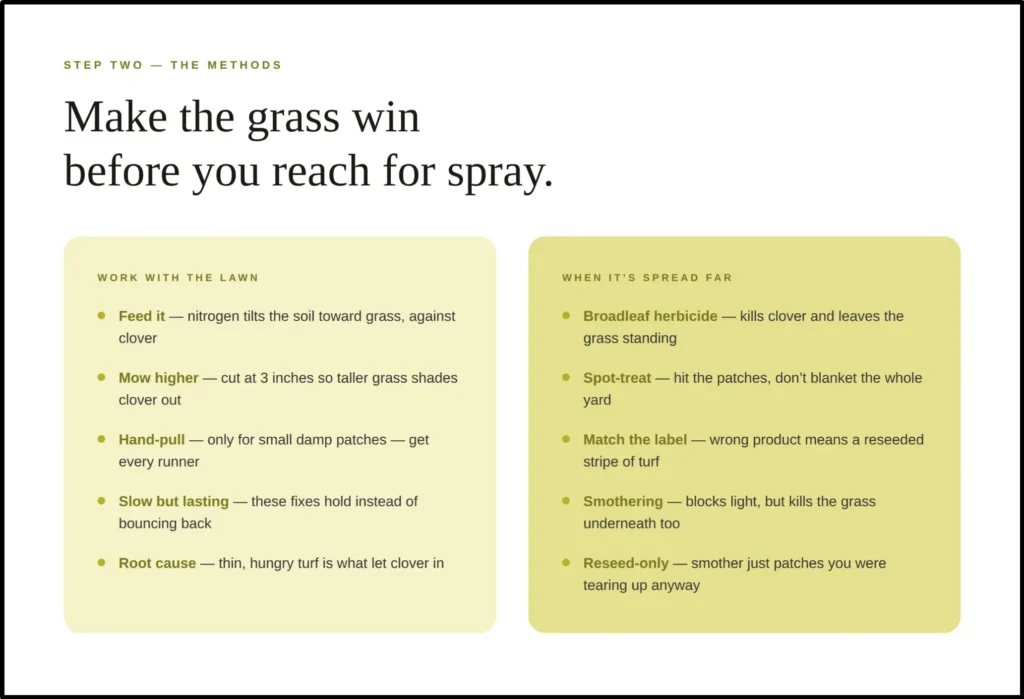
Mow higher. Cut at three inches or above. Taller grass shades the soil, and clover, which sits low and needs light, gets starved out slowly.
Pull it, but be honest about scale. Hand-pulling works on a few isolated patches, in damp soil, with a free afternoon. Get the roots and the runners, because a snapped-off piece of stolon will just root again. If clover has run through half the yard, hand-pulling is a way to spend a weekend and accomplish almost nothing.
Chelated iron (FeHEDTA) is the one natural product that acts selectively. Broadleaf plants absorb iron faster and in greater quantity than grass does, and the overload causes oxidative damage that blackens and shrivels the foliage within hours, while the turf around it tolerates the same dose and often greens up. Products like Fiesta and Iron-X are the common store options, and the EPA registered it as a biopesticide in 2009.
The honest caveat: it’s a contact product, not a systemic one, so it kills what it touches and leaves the lower plant to regrow. University of Maryland Extension ran three years of trials on it and found that on weeds like white clover, higher rates and applications spaced closer than four weeks apart worked better than a single treatment. Plan on three or four passes, and weigh the cost and labor against spot-spraying rather than treating the whole lawn.
Corn gluten meal is a pre-emergent. It suppresses seed germination and does nothing at all to established clover, which is perennial and already rooted, so treat it as prevention rather than removal. It’s also roughly ten percent nitrogen, so it doubles as a feed. Iowa State Extension notes that timing is what determines whether it does anything at all. The same seed-bank logic is why getting rid of spurge in your lawn starts with stopping the seed bank before it germinates — a fall pre-emergent (chemical or corn gluten) does that job.
Vinegar doesn’t work here. Household and horticultural vinegar burn whatever they touch, including grass, and they burn foliage without reaching the root, so the clover regrows. You’ll trade a clover patch for a dead patch, and a dead patch is how clover got in.
How to Get Rid of Clover in a Lawn: Pet-Friendly Options
Iron-based products are the usual pick for households with pets or children, and several are OMRI-listed for organic use. FeHEDTA is well studied on this front: the EPA’s registration review found no adverse effects for mammals, birds, fish, or honeybees at label rates.
The more useful rule, though, applies to everything you spray: keep pets and children off the treated area until the product has fully dried, and read the specific re-entry interval on the label rather than trusting the word “safe” on the front of the bottle. Drying time governs transfer to paws and skin, and it varies with humidity more than with the product.
One more thing people miss. If you’ve treated with triclopyr, atrazine, metsulfuron, or 2,4-D, Clemson Extension advises against using the clippings as mulch or compost afterward.
What Will Kill Clover but Not Grass
For larger spreads, a selective herbicide for clover is the practical answer. Selective means it targets growth pathways that broadleaf plants have and grasses don’t, so the clover dies, and the turf around it doesn’t.
Start with the thing most homeowners get wrong: 2,4-D on its own is a poor choice for clover. It’s the most widely used broadleaf herbicide in the world, and it appears on almost every bottle, but Purdue Turfgrass Science is clear that 2,4-D alone will not control clover effectively. It needs partners.
The actives that do the work:
MCPP (mecoprop). Notably strong on clover, and one of the three ingredients white clover is most susceptible to.
Dicamba. Consistently named across extension recommendations. It can be taken up through roots, so University of Maryland Extension advises keeping it off the root zone of trees and shrubs.
Triclopyr. Effective on tougher broadleaf weeds and stubborn clover patches, and the one most likely to damage certain warm-season grasses.
Fluroxypyr. Named by Penn State as one of the most effective actives on white clover, and increasingly common in consumer three-way and four-way mixes.
Quinclorac. Best known for crabgrass, but it controls clover too, which makes it useful when you have both.
You may also see clopyralid described as the single most effective active on clover. It is, but Penn State notes it isn’t for residential lawns, so it’s not a homeowner option.
Most consumer bottles are “three-way” mixes, typically 2,4-D plus MCPP plus dicamba. For clover, a combination product beats any single active, and the ones adding fluroxypyr or quinclorac do better still.
Best Herbicide for Clover, by Grass Type
The decision that matters isn’t the brand on the bottle. It’s your turf.
| Grass type | Use | Avoid |
|---|---|---|
| Cool-season (Kentucky bluegrass, tall fescue, ryegrass) | A three-way mix of 2,4-D + dicamba + MCPP, or a straight triclopyr product, at the labeled rate | — |
| Bermuda, zoysia | Same three-way mixes, or quinclorac-based combo products (these also handle crabgrass) | Check the label for seasonal timing — some actives can thin warm-season turf if applied during green-up |
| St. Augustine, centipede | A three-way product specifically labeled “safe for southern lawns,” typically at a reduced rate, or chelated iron | Straight triclopyr and full-rate three-way mixes — both can injure these grasses |
| Not sure / mixed lawn | Chelated iron (see the organic section below) as the lowest-risk first pass | Any selective herbicide until you’ve confirmed your grass type |
Cool-season lawns (tall fescue, Kentucky bluegrass, perennial ryegrass) tolerate standard three-way products well. Most off-the-shelf clover killers for lawns — like Ortho Weed B-Gon Chickweed, Clover & Oxalis Killer (triclopyr-based) or T-Zone — are formulated with these grasses in mind.
Warm-season lawns are the caution zone. St. Augustine and centipede in particular can be damaged by triclopyr, dicamba, and full rates of 2,4-D, and the LSU AgCenter recommends reduced rates where 2,4-D is used on them at all. Clemson points to metsulfuron-containing products for good clover control across bermuda, centipede, St. Augustine, and zoysia. Atrazine-based products are the other common route, with the caveat that atrazine should be kept away from tree bases, water, and light sandy soils that leach.
Newly seeded lawns need to wait. Don’t apply broadleaf herbicide until the new grass has been mowed three or four times.
Read the label and match it to your grass type. That’s the difference between killing the clover and killing a stripe of turf you’ll be reseeding in a month.
How to Apply It
Conditions do more for your results than product choice does.
Mow two to three days before spraying, not after. You want leaf surface area for the herbicide to land on and be absorbed through.
Apply between 60 and 80°F, on clover that’s actively growing. Purdue advises against spraying above 80°F because turf burn becomes likely and control drops off. Amine formulations suit those moderate temperatures; ester formulations work better in cool weather below about 50°F.
Add a surfactant, or a small splash of liquid dish soap (about 1/4 teaspoon per gallon), to your sprayer. Clover leaves have a waxy coating that makes the spray bead up and roll off; a surfactant breaks that layer so the herbicide sticks and gets absorbed.
Make sure the lawn isn’t drought-stressed. Colorado State’s PlantTalk stresses that both the clover and the grass should be well watered before you treat. Stressed plants absorb poorly.
Wait for calm. Under roughly 10 mph. Drift damages plants you didn’t intend to treat.
Check for a four-hour dry window at minimum. Some labels want 24 hours. Rain inside the window washes off the application.
Spot-treat the patches rather than blanketing the lawn, and spray to runoff. Spot treatment is preferable to broadcast spraying for exactly this reason: less product reaching plants you never meant to hit.
Expect two to four weeks for full effect, and plan on a second application 14 to 21 days later on established patches. Clover’s spreading stolons make it hard for herbicide to translocate through the whole plant, so one pass rarely finishes it.
Wait three to four weeks after treatment before overseeding. Herbicide residue interferes with germination.
There’s also the slow option: smothering. Cover a clover patch so it gets no light with cardboard or a tarp, and after a few weeks the clover underneath dies. The catch is obvious, which is that the grass dies too. This only makes sense for a patch you were going to tear up and reseed anyway.
Best Time to Get Rid of Clover
Autumn is the answer, and it isn’t close. Clover is moving carbohydrates down into its roots ahead of winter, and a systemic herbicide travels down with them. Penn State, Purdue, and the University of Minnesota all name fall as the most effective window, and UMN Extension goes further, describing spring applications as frequently ineffective.
Spring will do something, particularly on young growth, but expect the roots to push new leaves back up within weeks and plan on a follow-up in autumn.
Summer is the one to avoid. Heat-stressed clover absorbs poorly, heat-stressed turf takes collateral damage more readily, and above 80°F you’re increasing the chance of burning the lawn while decreasing the chance of killing the weed.
Don’t be surprised if full control takes two seasons. That’s normal for this plant, not a sign you did it wrong.
Make Sure Your Lawn Recovers
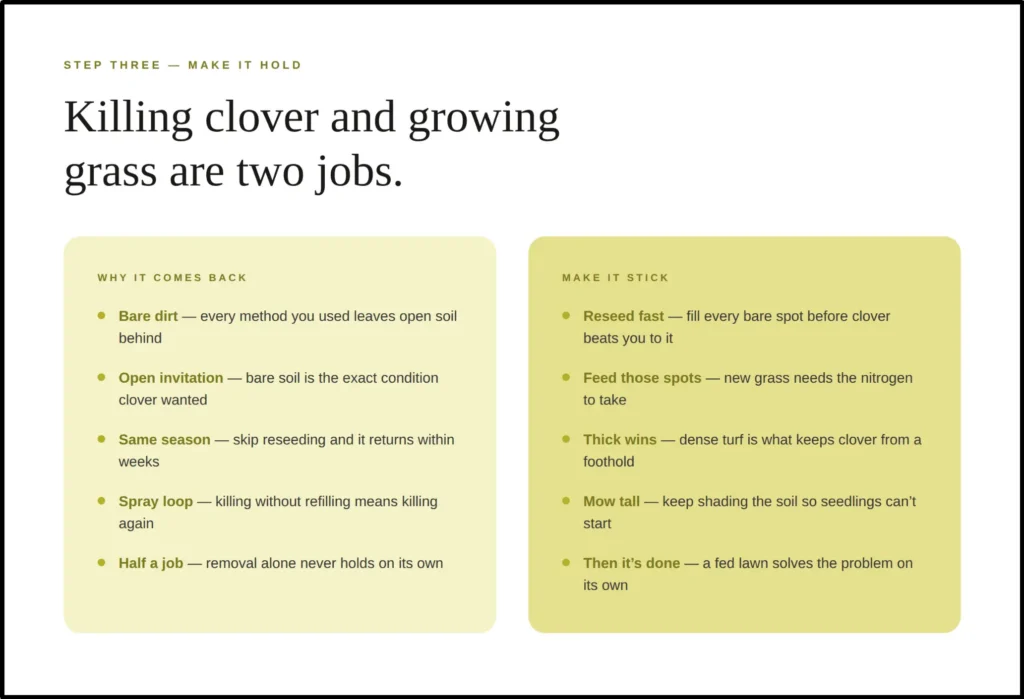
Whatever you do (pull, spray, or smother) you’ve created bare dirt, and bare dirt is exactly the condition clover was waiting for in the first place. Annuals exploit openings even faster, which is why getting rid of hairy bittercress in lawns means acting before it sets seed.
If you don’t reseed and feed those spots, clover comes straight back, often within the same season, and you’re back where you started. Killing clover and growing grass are two different jobs — exactly the split you need for killing bindis in the lawn without killing grass. Skip the second one, and the first one doesn’t hold.
Watering is the variable most people get wrong during this window. New seed needs consistent light moisture rather than the deep, infrequent soaking that suits established turf, and getting that wrong produces exactly the thin patches you were trying to eliminate. The Aiper IrriSense 2 maps zones, adjusts for weather conditions, and waters more precisely than a standard sprinkler setup, which matters when you’re trying to encourage stronger grass growth instead of creating more patchy areas or runoff.
Frequently Asked Questions
Not reliably on its own. 2,4-D is the most common broadleaf herbicide on the shelf, but Purdue Turfgrass Science states plainly that it won’t control clover effectively by itself. It works as part of a mix, and the ingredients doing the real work alongside it are MCPP, dicamba, fluroxypyr, and triclopyr. Check the full active-ingredient list, not the front label.
Selective broadleaf herbicides combining MCPP, dicamba, fluroxypyr, triclopyr, or quinclorac. For a non-chemical option, chelated iron (FeHEDTA) burns broadleaf foliage while turfgrass tolerates it. Match either to your grass type before applying, particularly on St. Augustine and centipede.
Visible wilting usually starts within a few days, with dieback over two to four weeks. Because clover spreads by stolons, herbicide struggles to travel through the whole plant, so a second application 14 to 21 days later is normal. Full control often takes two seasons.
No. Vinegar is non-selective and damages any foliage it contacts, including turfgrass. It also burns the top growth without reaching the root, so the clover regrows and you’re left with bare soil, which is the precise condition that invites more clover.
Yes, unless you address the conditions that let it in. Reseed bare spots, feed the lawn, and mow at three inches or higher. MSU trials found that sustained nitrogen at 3 lb per 1,000 square feet a year cut clover by about three-quarters over six years, which is the version of this that actually lasts.
Not inherently. It fixes nitrogen, tolerates drought, and supports pollinators through a long flowering season. It’s a problem when you want uniform turf, when bees near bare feet are a concern, or when it’s spreading because the lawn underneath is failing.
It’s strongly recommended. Clover leaves have a waxy coating that makes the spray bead up and roll off. Adding a surfactant, or about 1/4 teaspoon of liquid dish soap per gallon, breaks that layer so the herbicide sticks and gets absorbed — without it, you can lose most of the product.
For a chemical-free approach, chelated iron (FeHEDTA) is the one natural product that works selectively, blackening clover leaves within hours while turf tolerates it — expect to need three or four passes. Feeding the lawn nitrogen, mowing at three inches or higher, and hand-pulling small patches are the other low-cost levers, but they work slowly.
Get more pool and lawn care guides from Aiper on Google