How to Get Rid of Chickweed in a Lawn

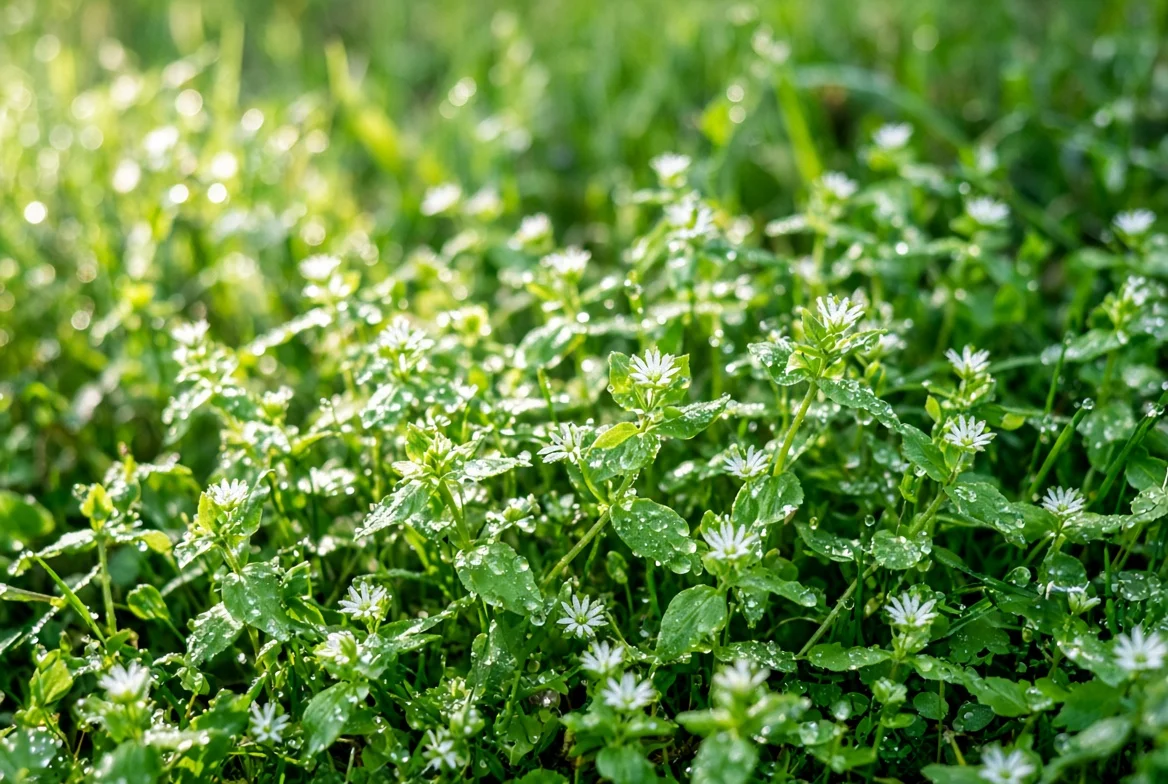
Chickweed takes advantage of thin, damp, or stressed areas of lawn, the same weak spots that let foxtail seed heads spread through a lawn and Bermuda grass creep past a lawn’s borders. By the time you notice it in spring, it may already have spread into a mat across the soil.
The plant itself is easy to kill. Keeping it from coming back is the harder part, and most of that work happens before chickweed appears.
This guide covers how to get rid of chickweed and what to do to keep it from returning.
Know Which Chickweed You Have
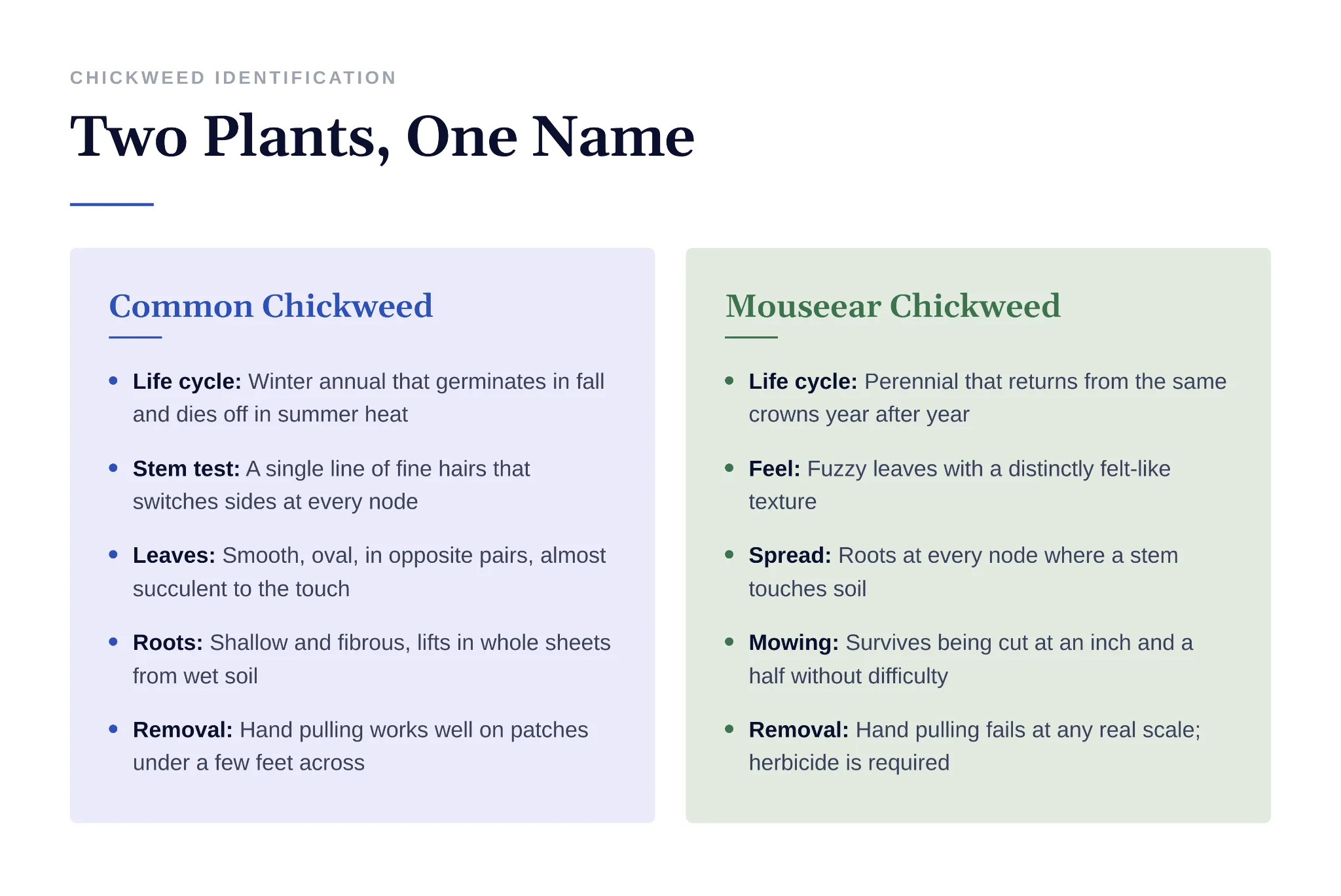
Common chickweed is the winter annual. Smooth, tender, almost succulent-looking. Small oval leaves in opposite pairs. Tiny white flowers with five petals so deeply split they look like ten.
Here’s the identifier that settles it: run your fingers along the stem. You’ll feel a single line of fine hairs running down one side, and that line switches sides at every node. Nothing else in a lawn does that. Common chickweed has shallow, fibrous roots and pulls up in sheets.
Mouseear chickweed is the perennial, and it’s the harder one. It’s fuzzy, and its leaves feel like felt.
It grows tighter to the ground and roots at the nodes wherever a stem touches soil. It will happily survive being mowed at an inch and a half. When someone tells you they’ve pulled the same chickweed patch four springs running, it’s mouseear.
Check before you do anything else. It takes thirty seconds.
One quick exclusion: if the flowers are yellow instead of white, it isn’t chickweed. That’s almost always yellow woodsorrel (oxalis), a different weed with a different herbicide response.
Pull It While the Ground Is Soft
For common chickweed in a small patch, hand removal genuinely works, and it works best the morning after rain or a deep watering.
Get low. Slide your fingers under the mat near the crown and lift slowly rather than yanking at the leaves. The root system is shallow and wide. Go slow, and the whole thing comes up as one piece. Pull it fast, and you’ll strip the top growth off and leave the crown sitting there. That sets you back nothing, but it wastes the afternoon.
Bag what you pull. Do not put flowering chickweed in a compost pile you plan to spread on your own beds.
Mouseear is a different experience. Every node that has rooted has to come out. If the patch is bigger than a dinner plate, you’re going to miss some. For mouseear at any real scale, skip the hand pulling and go to a herbicide.
Spray in Fall, Not Spring
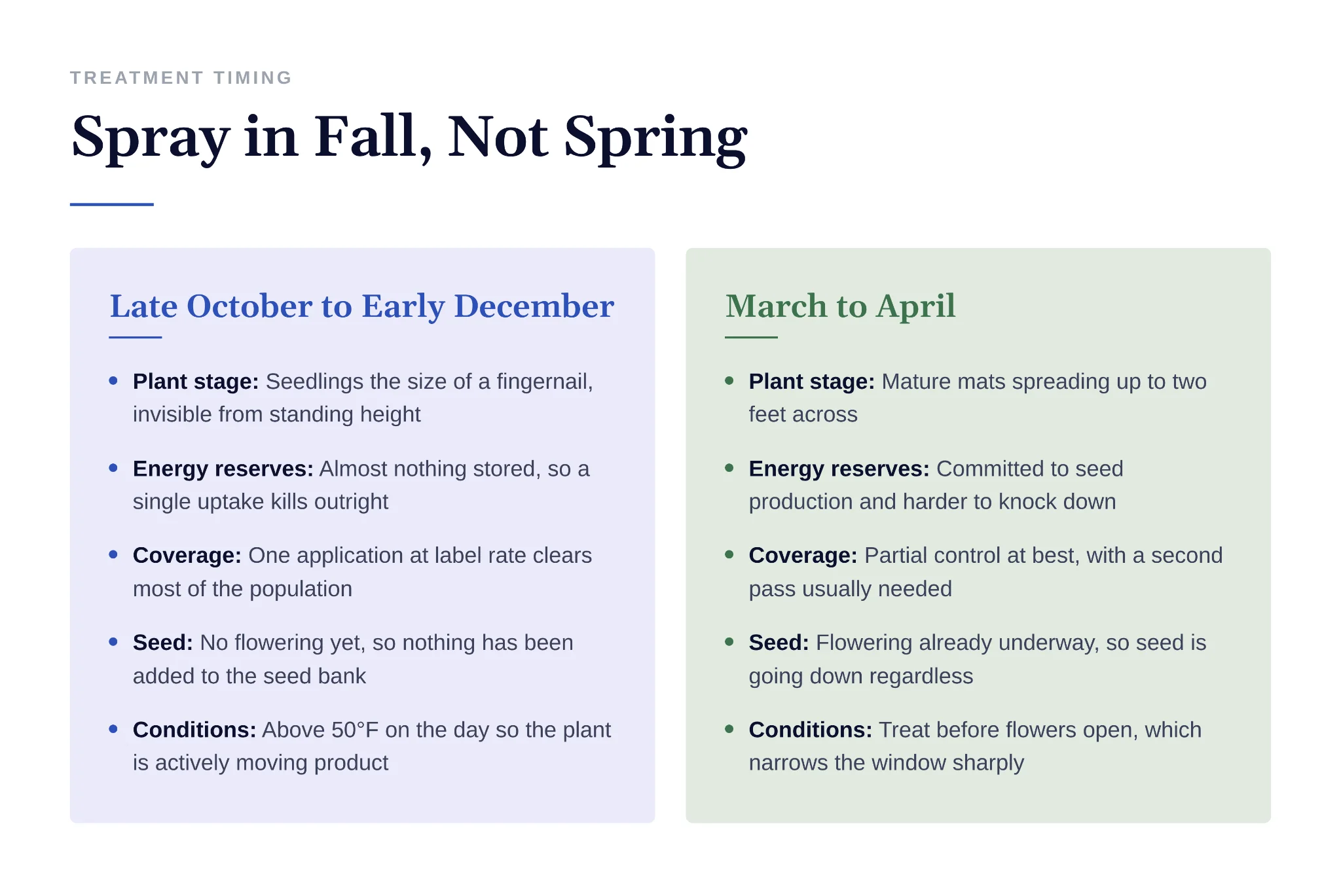
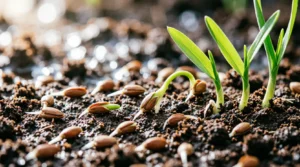
Chickweed germinates in autumn. Soil temperatures drop into the low fifties, and seed that has been sitting in the top half inch of soil all summer wakes up. By early November there are hundreds of seedlings the size of a fingernail scattered through the lawn. Nobody sees them.
The grass is still growing, the leaves are coming down, and a two-week-old chickweed seedling is invisible from standing height.
Those seedlings sit through winter. They barely grow. Then the first stretch of mild March weather arrives, and they explode, and what was invisible in November is a mat two feet across in April.
Spray them in November, and the job is close to trivial. The plants are small and actively growing, with almost no stored energy. A single application at label rate will take out nearly everything. Spray the same population in April, and you’re dealing with a mature, flowering, waxy-leaved plant that has already committed most of its energy to seed production.
You’ll get partial control, you’ll need a second pass, and the seed is already in the ground regardless.
Late October through early December is the window. If you miss it, go early spring, and go before flowers open, which usually means late February to mid-March depending on where you are.
Temperature matters on the day. Stay above 50°F so the plant is actually moving product around, and below 85°F so you don’t stress the turf. Spray on a calm morning with no rain expected. Don’t mow for a couple of days on either side of the application — the herbicide goes in through the leaves, so leave the leaves alone.
Don’t judge the spray by what you see in the first two weeks. Chickweed hit with a broadleaf herbicide often looks more alive right after treatment — leaves curl, growth surges, sometimes it even throws out a last round of flowers. That’s the plant’s hormone system misfiring before it dies, not the herbicide failing. Full die-back takes four to six weeks. Respraying at week two just wastes product and stresses the surrounding turf.
What Actually Works on the Label
Read the active ingredients, not the front of the bottle.
The thing to know: chickweed shrugs off 2,4-D. Plenty of cheap broadleaf products are heavy on 2,4-D and light on everything else, and people spray them, watch the chickweed yellow slightly and then recover, and conclude that chickweed is unkillable.
What you want is one of these doing the heavy lifting:
- Fluroxypyr: The strongest performer on chickweed and reliable on mouseear too
- Dicamba: Effective, but keep it away from tree and shrub root zones
- Mecoprop (MCPP): The reason three-way products work at all on chickweed
- Triclopyr: Good on both types
- Carfentrazone: Fast visible burn-down, usually blended in for speed
Most good three-way and four-way lawn products combine two or three of these. If the label lists 2,4-D and nothing else recognizable from that list, put it back.
For a few scattered patches, use a spot sprayer instead of treating the whole lawn. There is no reason to put herbicide on nine thousand square feet to handle four patches.
Check the label against your grass type before you spray, not after. Dicamba and fluroxypyr can stress warm-season lawns like St. Augustine at full label rate, while cool-season lawns tolerate them fine. If your bottle doesn’t list your turf by name, call the manufacturer or drop down to a milder blend. Adding a few drops of surfactant to the tank mix helps the herbicide stick to chickweed’s smooth, almost waxy leaves instead of beading off. Most spot-spray failures come down to product running off the leaf, not the wrong active ingredient.
Stop Watering the Way You’ve Been Watering
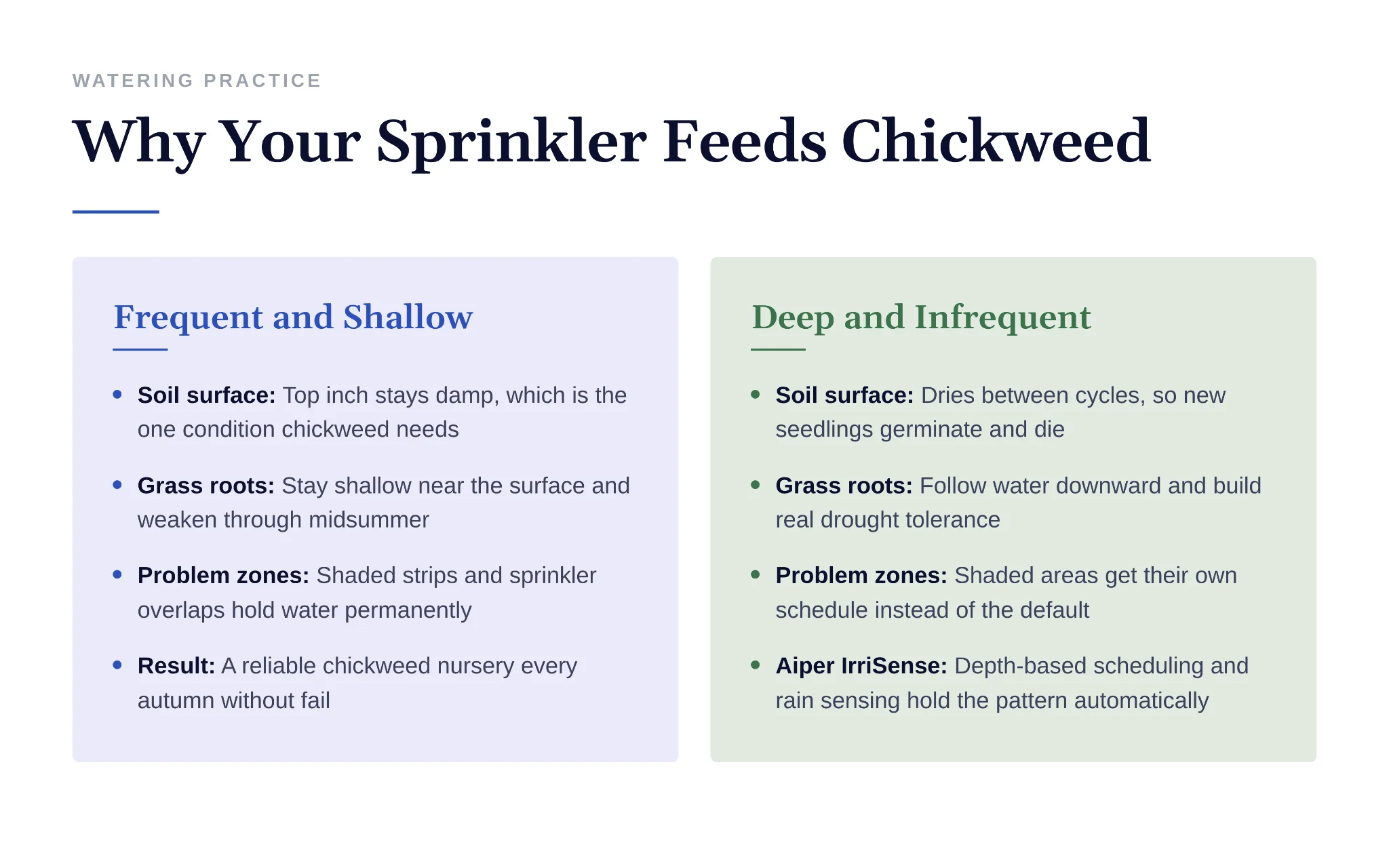
Chickweed grows best where the top inch of soil stays damp. Short daily watering keeps the surface that wet. So does sprinkler overlap on one strip of lawn, and watering shaded areas on the same schedule as sunny ones. All three give chickweed the moisture it needs to spread.
Frequent shallow watering also keeps grass roots shallow, which leaves the lawn weaker by midsummer.
Here’s how to change your watering:
- Water deeply. Run each cycle long enough to wet the soil several inches down. Grass roots grow deeper to follow the water.
- Let the surface dry between waterings. Chickweed seeds near the surface have a hard time sprouting and surviving in dry soil.
- Water shaded areas separately. Shaded, slow-drying spots need less water than parts of the lawn in full sun.
- Skip watering when rain is coming. Watering on top of a wet week keeps the surface soaked, and that’s how most spring chickweed gets started.
- Fix overlapping sprinklers. Spots hit by two sprinkler heads stay soggy and are often where chickweed shows up first.
Sticking to this by hand is difficult. You have to track rainfall, how each part of the yard drains, and how long your sprinkler needs to run. The Aiper IrriSense makes it easier. It combines a controller, valve, and rotor sprinkler in one unit, and covers up to 4,800 square feet with a 39-foot reach. It connects to a standard garden hose in about 15 minutes with four ground stakes and no trenching.
Better watering stops new chickweed from sprouting, so you’ll still need to remove the plants already growing. Over two seasons, it does more to keep chickweed out of your lawn than herbicide alone.
Fill Bare Spots in Early Fall
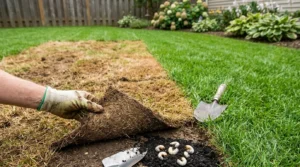
Bare soil in fall gives chickweed room to spread. Early fall is also the best time to establish cool-season grass, so use it to thicken the lawn.
- Aerate compacted soil. Chickweed handles compacted soil better than grass does, so core aerate before you seed.
- Don’t till chickweed under to get rid of it. Chickweed seed can sit dormant in soil for decades, and tilling drags buried seed up where light can trigger it — you’ll trade this spring’s patch for a much bigger one next fall. Pull or spray what’s on the surface, then aerate without turning the soil over.
- Fix drainage problems. If a spot stays wet after every rain, fix the drainage first. Grass seed alone won’t fill that spot.
- Overseed thin areas. Spread seed over thin or bare patches in early fall.
- Wait before spraying new grass. Hold off on post-emergent herbicide until the new grass has been mowed two or three times.
Pre-emergent herbicide and grass seed shouldn’t go down at the same time. Isoxaben is the pre-emergent that controls chickweed, and it can also keep new grass seed from sprouting. Choose one for the fall:
- If your lawn is thin, overseed and skip the pre-emergent.
- If your lawn is thick, apply isoxaben once soil temperatures drop to around 70°F.
Plan for Several Seasons
One chickweed plant can drop thousands of seeds, and those seeds can survive in the soil for years. Clearing a patch this spring won’t stop older seeds from sprouting next fall, when the soil cools and gaps open up in the lawn.
The goal is to keep the lawn thick enough that those seeds have nowhere to grow. Each year:
- Mow high so the grass shades the soil surface.
- Water deeply and less often so the top of the soil dries out between waterings.
- Overseed bare spots before the end of September.
- Apply herbicide in late October to any chickweed that still comes up.
Follow this plan for three years in a row, and chickweed should become a minor problem in your lawn.
Get more pool and lawn care guides from Aiper on Google