How to Get Rid of Foxtails in a Lawn

Foxtail is a grass growing in a lawn, so most broadleaf weed killers that handle low-growing winter weeds like chickweed will not get rid of it, and neither will treatments aimed at warm-season runners such as Bermuda grass. Some can even damage the turf around it and leave more bare ground for next year’s seed.
The problem is more serious if you have dogs. Foxtail seed heads are barbed and can get caught in paws, ears, and noses.
This guide covers how to get rid of foxtail, when to treat it, and what to do to prevent it from coming back. The schedule starts in March, so if it’s already August, most of what you can do this year is damage limitation. Quackgrass forms a similarly aggressive, spreading clump, and the identification tips for clearing quackgrass out of a home lawn apply just as well here.
Find Out Which Foxtail You Have
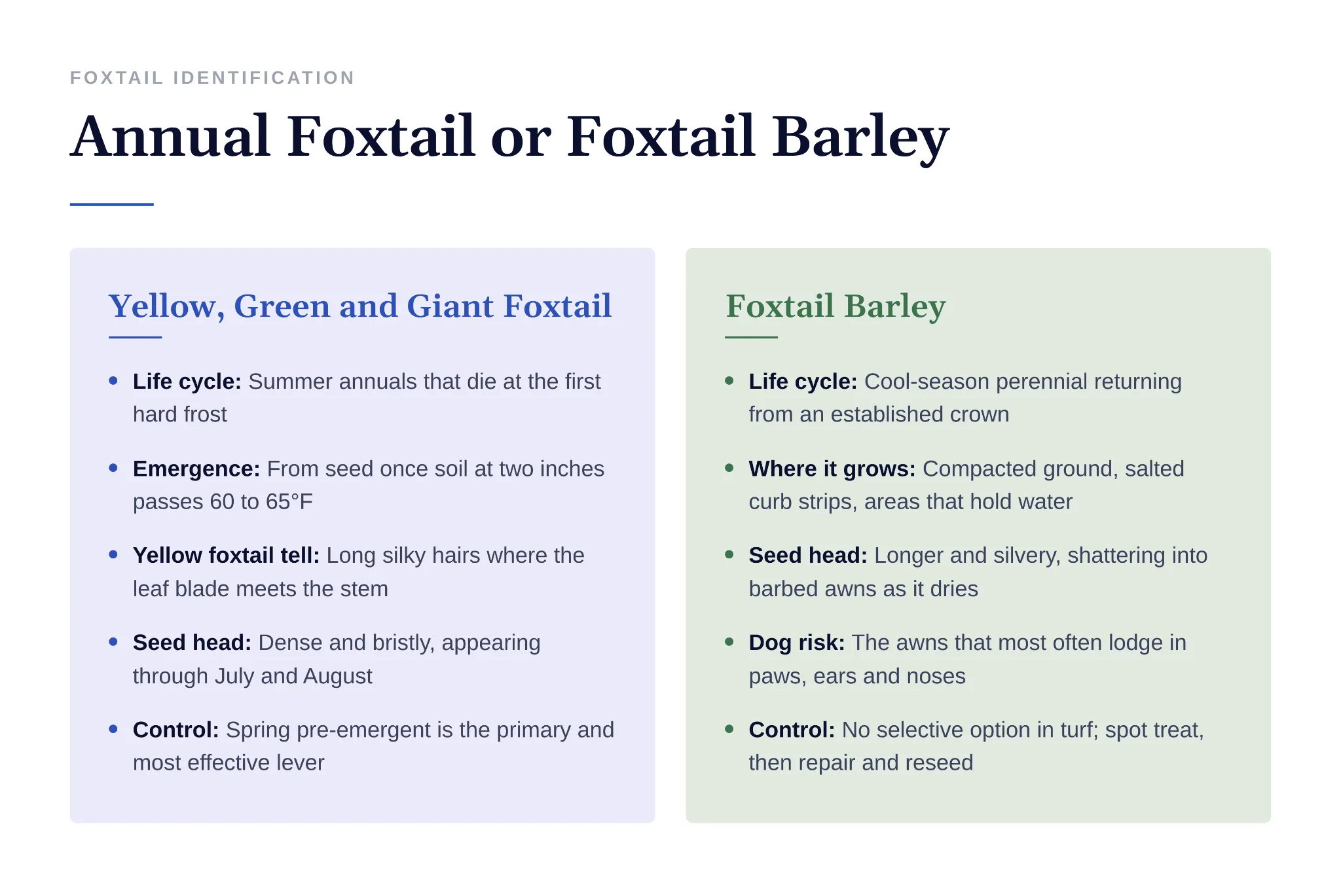
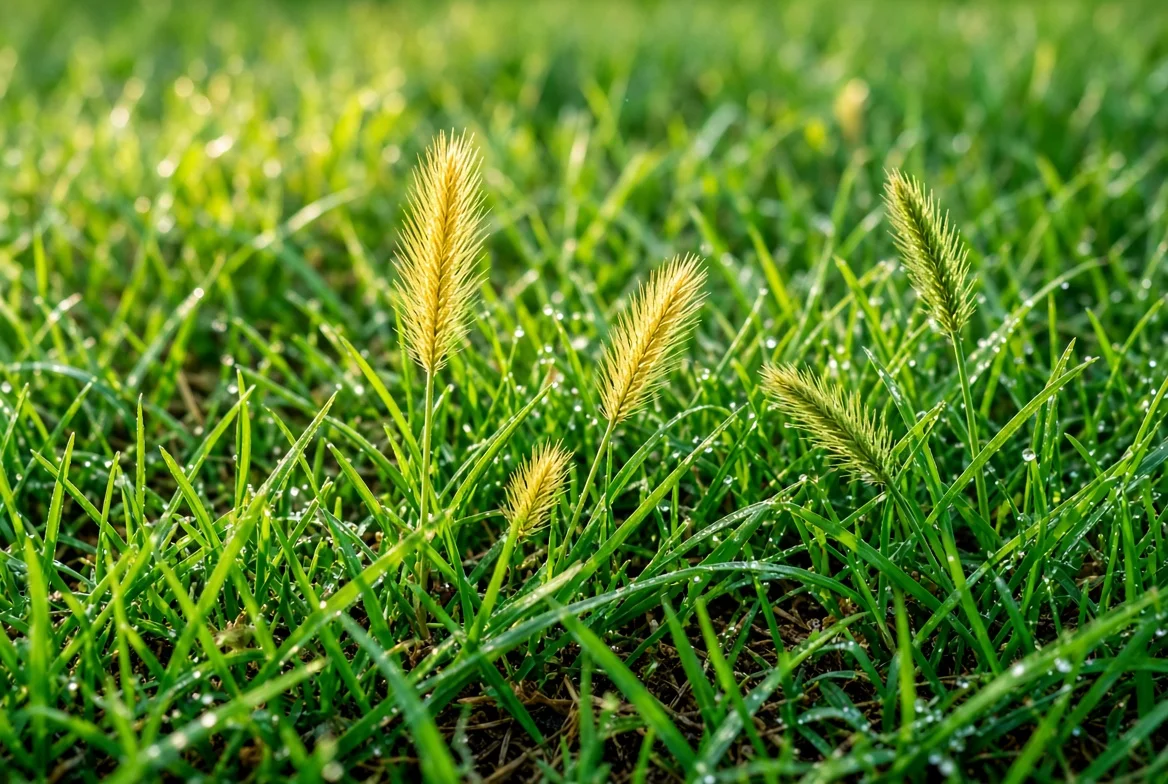
Yellow, green, and giant foxtail are summer annuals in the Setaria group.
They come up from seed in spring, run all summer, and throw those dense bristly seed heads in July and August. All three die at the first hard frost. Yellow foxtail is the one most homeowners are looking at. It gives itself away at the base of the leaf blade — long silky hairs right where the blade meets the stem, visible if you pull a blade back and look at the collar. Green foxtail is smoother, and its bristles stay green. Giant foxtail droops at the tip and grows tall enough that you’ll notice it from the driveway.
Foxtail barley is the perennial, and it’s a different plant entirely despite the name. Hordeum jubatum. It’s a cool-season, it comes back from the crown every year, and it shows up along driveways, curb strips, and anywhere the soil is compacted, salty, or poorly drained.
The seed head is longer, softer, and silvery, and it shatters into individual barbed awns when it dries. This is the one that does the most damage to dogs.
Pull one plant and look at the base. If there’s a persistent crown with old growth from last year still attached, it’s the perennial, and you should skip ahead to the section on it.
Handle the Seed Heads Before Anything Else
If there are mature seed heads standing in the lawn right now, the first job is removal, not treatment.
Mow and bag the clippings. Do not mulch them back into the turf. And do not leave the bag open in the garage, where a dog can get into it. Mowing does not kill foxtail — the plant will push a new seed head lower to the ground within a couple of weeks. But every head you remove is several thousand seeds that don’t reach the soil.
Then check the dog. Between the toes, inside the ears, along the belly. Watch the behavior too. Sudden, repeated sneezing means an awn probably went up the nose. Constant head-shaking or scratching at one ear points to an awn in the ear canal. A dog that won’t stop licking one paw usually has one working into a pad between the toes. Any of those signs, or an awn you can see migrating under the skin, needs a vet. The window where it’s easy to remove is short.
If the Whole Yard Is Already Foxtail
Spot treatment assumes a lawn that’s mostly grass with foxtail scattered through it. If the yard is the other way around — foxtail is the lawn, and what’s left of the turf is patches — spot treatment just wastes a season.
Scalp it first. Set the mower as low as the deck allows and cut the whole area down to bare stems. Then go over it again with a rake or a leaf blower and pull every seed head off the ground and out of the yard. Mowing scatters seed into the thatch; raking and bagging is what actually gets it off the property.
From there you have two paths. The first: kill everything and start over. Spray the whole area with glyphosate. Wait the interval on the label — typically one to two weeks — until it’s completely dead. Then till or dethatch and reseed with tall fescue or a fescue-clover mix. Clover and microclover compete hard for the same bare, sunny ground foxtail wants, which makes them a better bet than plain fescue alone for a lawn that’s failed once already.
The second path skips chemicals. Cover the area with a tarp, or several layers of cardboard and mulch, for four to eight weeks in full summer sun. That cooks both the existing plants and the seed sitting in the top inch of soil. It takes longer than glyphosate and looks worse while it’s happening, but it works without spraying anything.
Either way, reseed before frost. Bare dirt through winter is next year’s foxtail patch, not this year’s problem solved.
Apply Pre-Emergent in Two Rounds
Pre-emergent herbicide is the most effective way to control annual foxtail, and it only works if it goes down before the seeds sprout.
Foxtail sprouts once the soil two inches down stays above about 60 to 65°F. That’s later than crabgrass. Many homeowners apply pre-emergent once, in early spring for crabgrass. The barrier wears off by early summer, right as foxtail comes up in June and July. A second application closes that gap.
Here’s the schedule:
- Apply the first round in early spring. Put it down before the soil two inches deep stays above 55°F for five days in a row. In most of the US, that falls between mid-March and mid-April. Forsythia in full bloom is a good sign it’s time.
- Apply the second round six to eight weeks later. This is the round that stops foxtail. Lawns that skip it often have good crabgrass control but still fill with foxtail by August.
- Split the rate between the two rounds. Check the bag rate for your lawn’s square footage and use half of it for each round. Stay within the label’s total for the season.
Pick one of these products:
- Prodiamine lasts the longest and is the usual choice for a two-round program.
- Pendimethalin works well and is easy to find.
- Dithiopyr can also kill very young grassy weeds that have already sprouted, which helps if you apply a little late.
Water In the Pre-Emergent
Pre-emergent doesn’t start working until water dissolves the granules and carries them into the top layer of soil.
- Water within 24 to 48 hours of applying. Most labels call for a quarter to half inch of water. Check your product’s label for the exact amount.
- Avoid watering too little. Too little water leaves gaps in the barrier, and foxtail will grow through them.
- Avoid watering too much at once. On hard or sloped ground, heavy watering can push the product too deep or wash it into the street.
Measuring an exact amount of water with a hose-end sprinkler and a timer is difficult. The Aiper IrriSense makes it easier. It combines a controller, valve, and rotor sprinkler in one unit, covering up to 4,800 square feet with a 39-foot reach. It connects to a standard garden hose in about 15 minutes, with four ground stakes and no digging.
Here’s how it helps with pre-emergent:
- Watering by depth. You set the amount of water in the app, so a quarter inch means a quarter inch.
- Even coverage. EvenRain spreads water like light rainfall, which keeps the product in the soil and stops it from running off slopes.
- Rain and weather awareness. Built-in rain sensing and weather-aware scheduling skip watering when rain is coming, so extra water doesn’t dilute a fresh barrier.
- Zone control. You can water a shaded, slow-draining corner on its own schedule, separate from the rest of the lawn.
Zone control helps after the pre-emergent season too. Yellow foxtail thrives in wet soil, so keeping any part of the yard from staying soaked makes it harder for foxtail to take hold.
What to Spray If You Missed the Window
Selective post-emergent control of a grass inside a grass lawn is genuinely limited. Set expectations accordingly.
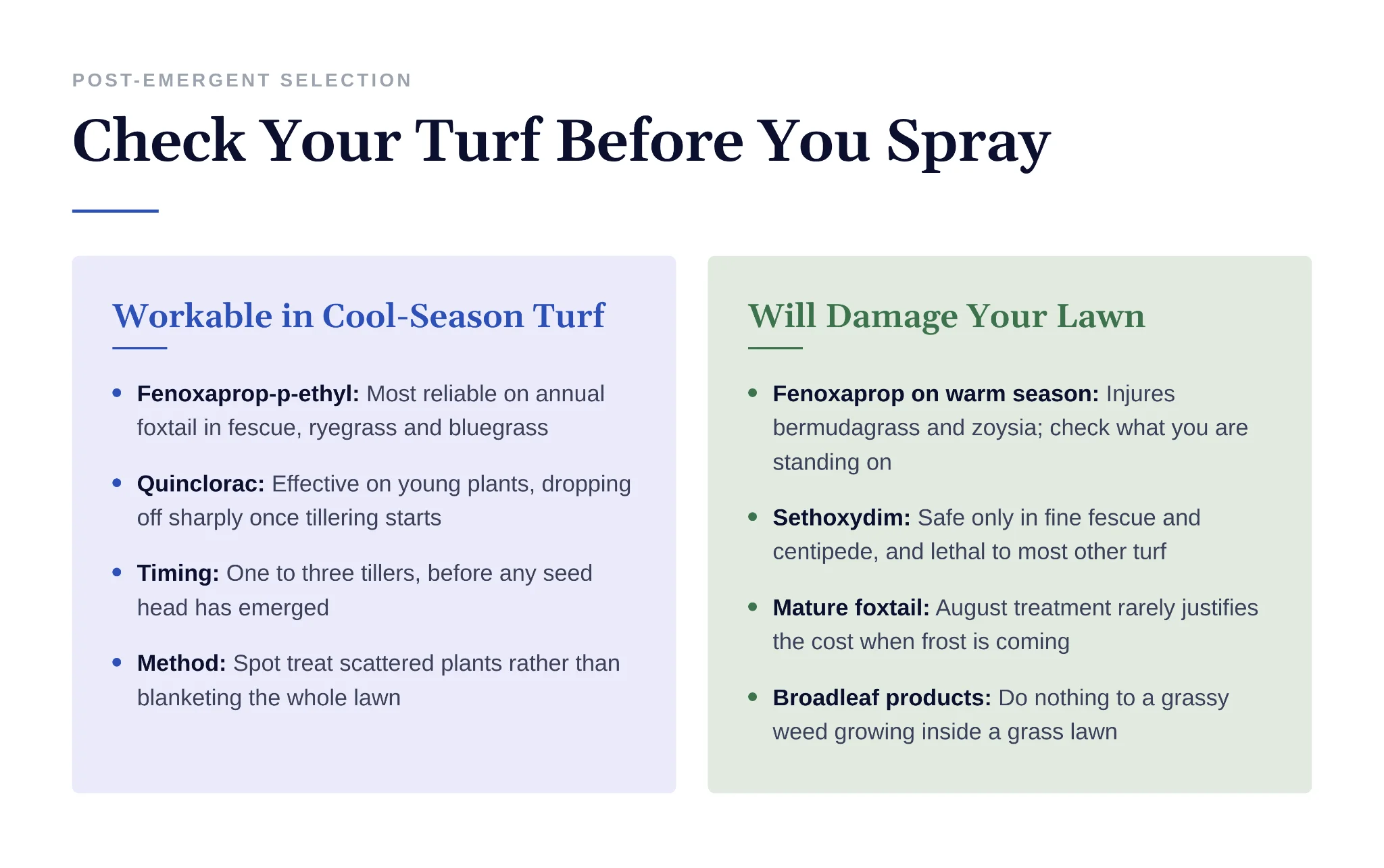
Fenoxaprop-p-ethyl is the most reliable option for annual foxtail in tall fescue, perennial ryegrass, and Kentucky bluegrass. It will injure bermudagrass and zoysia, so check what you’re standing on first.
Quinclorac lists foxtail on most labels and does reasonable work on young plants. Once foxtail has tillered out and started producing seed heads, results drop off sharply.
Sethoxydim works but is only safe in fine fescue and centipede. In anything else, it will take out the lawn along with the weed.
Timing beats product choice here. Foxtail at one to three tillers, before any seed head emerges, is controllable. Foxtail in August with mature heads mostly isn’t — and it’s going to die at frost anyway. At that point, your money is better spent on next spring’s pre-emergent than on a rescue spray.
For a handful of scattered plants, you don’t need a sprayer at all. Pull them by hand after watering or a rain, once the soil is soft. Foxtail’s root mass is shallow, but only a moist pull brings the whole thing out. A dry pull just snaps the top off and leaves the root to regrow.
Household vinegar at 5% acetic acid or higher works too, if you’d rather spray than pull. It only helps while the plant is young. Once the root system is established, vinegar burns the leaves, but the plant recovers from the roots within a couple of weeks. For anything past a handful of plants, spot treatment with a small sprayer and one of the products above is the right call. There’s no reason to blanket the yard for either.
Foxtail Barley Needs a Different Approach
No selective herbicide handles the perennial cleanly in a lawn. That’s the honest answer.
Spot-treat the crowns with a non-selective product, accept the dead patch, wait the label interval, then break up the soil and reseed. If you leave the bare spot, something else claims it before your grass does.
More usefully: foxtail barley is a symptom.
It colonizes compacted ground, saline soil near a salted driveway or sidewalk, and low areas that hold water after rain. Killing individual plants without changing those conditions means doing it again next year in roughly the same footprint. Core aerate the compacted strips. Regrade or improve drainage where water sits. Flush salt-affected soil in spring.
Mow High and Keep It Thick
Cool-season lawns at 3 to 3.5 inches. Foxtail seed needs light and warm bare soil at the surface to germinate, and a taller canopy denies it both.
Thin turf in August is next year’s foxtail patch. Overseed in early fall with a dense fescue or fescue-clover blend. Clover fills the gaps foxtail would otherwise take. But note the conflict: pre-emergent and new seed cannot coexist. If you seed in September, you’re not putting down a fall pre-emergent — and that’s usually the right trade.
Mark the Calendar for March
The foxtail you’re looking at right now already won. Its seed is on the ground, and a decent share of it will still be viable in three years.
What’s still in your control is whether it germinates. Soil thermometer, first pre-emergent pass at 55°F, second pass six weeks behind it, mowing deck raised, water going down evenly and on schedule instead of in whatever pattern the old sprinkler happened to throw.
Do that, and by the second August the bristles are gone from most of the lawn. By the third they’re a curb-strip problem, and curb strips are easy.
Get more pool and lawn care guides from Aiper on Google