How to Get Rid of Green Algae: The Most Common Invader

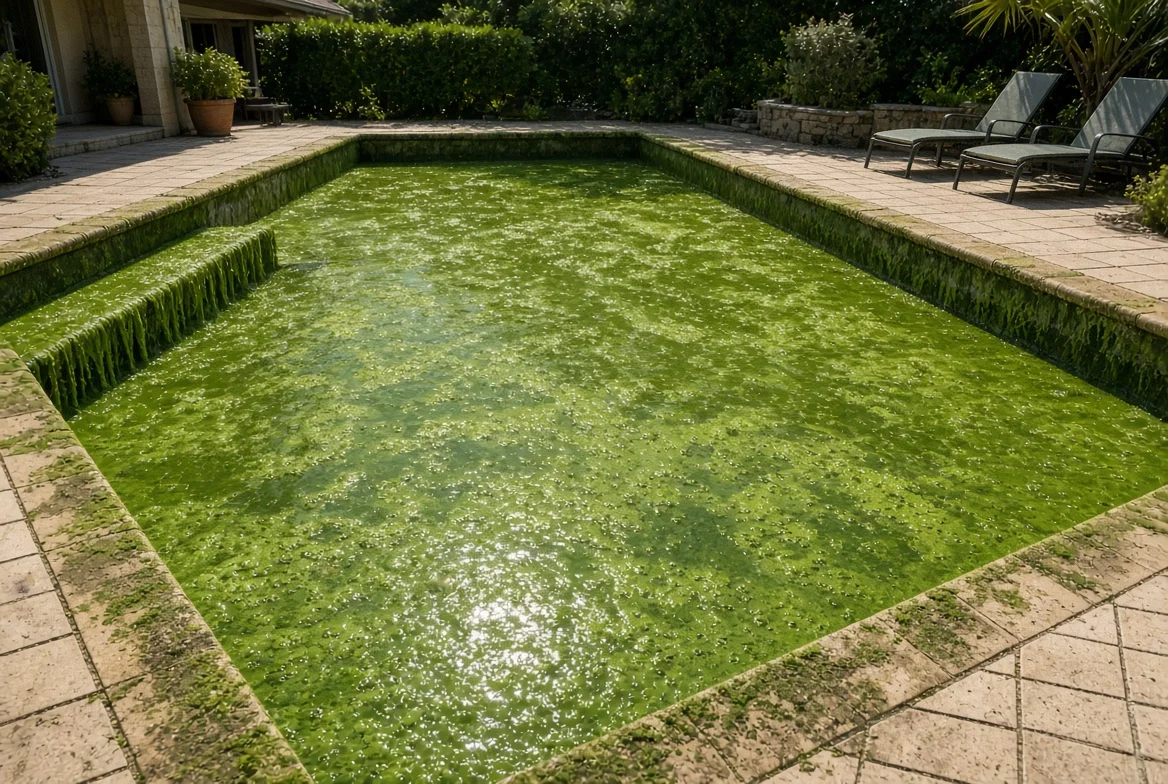
Green algae shows up after a heat wave, a week of storms, or a vacation when nobody checked the chlorine. A pool can go from clear to cloudy green in two or three days.
It is also the easiest algae to kill.
Most pools come back in two to five days with three things: enough chlorine, a stiff brush, and a filter that gets cleaned several times along the way. The order matters, and so does the timing. Pool owners who fight the same green pool for two weeks have usually skipped a step or shocked at the wrong time of day.
Confirm It’s Green Algae
Green algae is easy to spot. The water turns hazy teal first, then deepens to solid green, and the walls feel slick when you run a hand along them. In an early case, the green shows up only in corners, on steps, and along the waterline while the rest of the pool still looks fine.
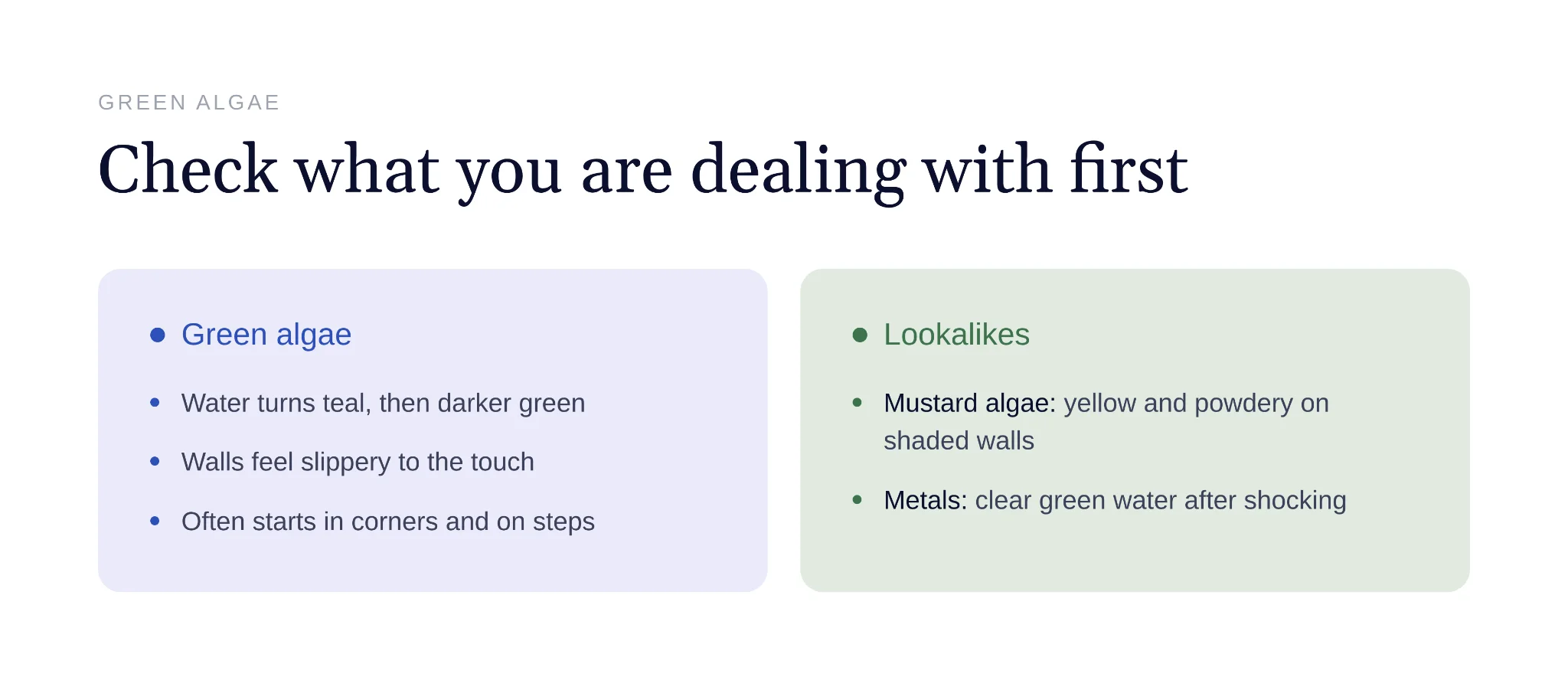
Two problems look similar and need different treatment:
- Mustard algae. Yellow or brownish, powdery, and usually sitting in shaded corners. It brushes away in a cloud and returns within days. It takes a heavier treatment than green algae.
- Metals in the water. If the water turns clear green right after shocking and the walls are not slimy, the cause is usually copper, often from an old heater or a copper-based algaecide. This needs a metal sequestrant from the pool store. More chlorine makes it worse.
Why It Took Over
Algae spores get into every pool constantly. Wind carries them in. So does rain, and so do swimsuits and floats that were last used at the lake. They stay dormant until the chlorine drops low enough for them to grow.
That drop usually comes from one of these:
- Several days above 90°F, which burns through chlorine fast
- Heavy rain that dilutes the chlorine and washes in dirt, pollen, and lawn fertilizer
- A pump timer set too short, or dead spots behind ladders and steps where water barely moves
- A dirty filter
- pH above 7.8, where chlorine loses much of its strength
One cause catches a lot of homeowners off guard. Chlorine tablets add stabilizer (cyanuric acid, or CYA) to the water every time they dissolve. After a full summer on tablets, stabilizer can climb past 100 ppm. At that level, a test strip can show a normal chlorine reading while algae grows anyway, because most of that chlorine is too tied up to work.
What to have on hand:
- A test kit or strips that read free chlorine, pH, alkalinity, and stabilizer
- Shock: calcium hypochlorite (cal-hypo, 65–73%) or liquid chlorine
- pH decreaser (muriatic acid or dry acid) and pH increaser
- A pool brush: nylon for vinyl and fiberglass, stainless steel for plaster and gunite
- A leaf net
- Pool clarifier
- Algaecide, preferably one labeled polyquat 60%
- Chemical-resistant gloves and eye protection
- A spare filter cartridge, if the pool uses a cartridge filter
Prep the Pool Before Shocking
Shock poured into a dirty, unbalanced pool gets used up before it reaches the algae. Take care of these first, ideally on the afternoon of the same day.
- Test the water: Write down free chlorine, pH, alkalinity, and stabilizer. If the kit is unreliable or the water is too green to read the color, most pool supply stores will test a sample for free.
- Remove debris: Net out leaves and twigs, empty the skimmer and pump baskets, and take out floats and toys. Every leaf on the floor uses up chlorine that should be going to the algae.
- Adjust pH to 7.2–7.4: Chlorine works much harder at the low end of the normal range. Keep alkalinity between 80 and 120 ppm so the pH holds. Give the pump a few hours to mix everything before moving on.
- Clean the filter and set the pump to run nonstop: It should stay on 24 hours a day until the water is clear.
- Brush every surface.
Brushing deserves more attention than it gets.
Algae forms a slimy layer on the walls and floor, and the cells underneath are protected from the chlorine in the water. Brushing breaks that layer so the shock can reach them. Skip it, and the pool can look clear for a few days before the walls turn green again.
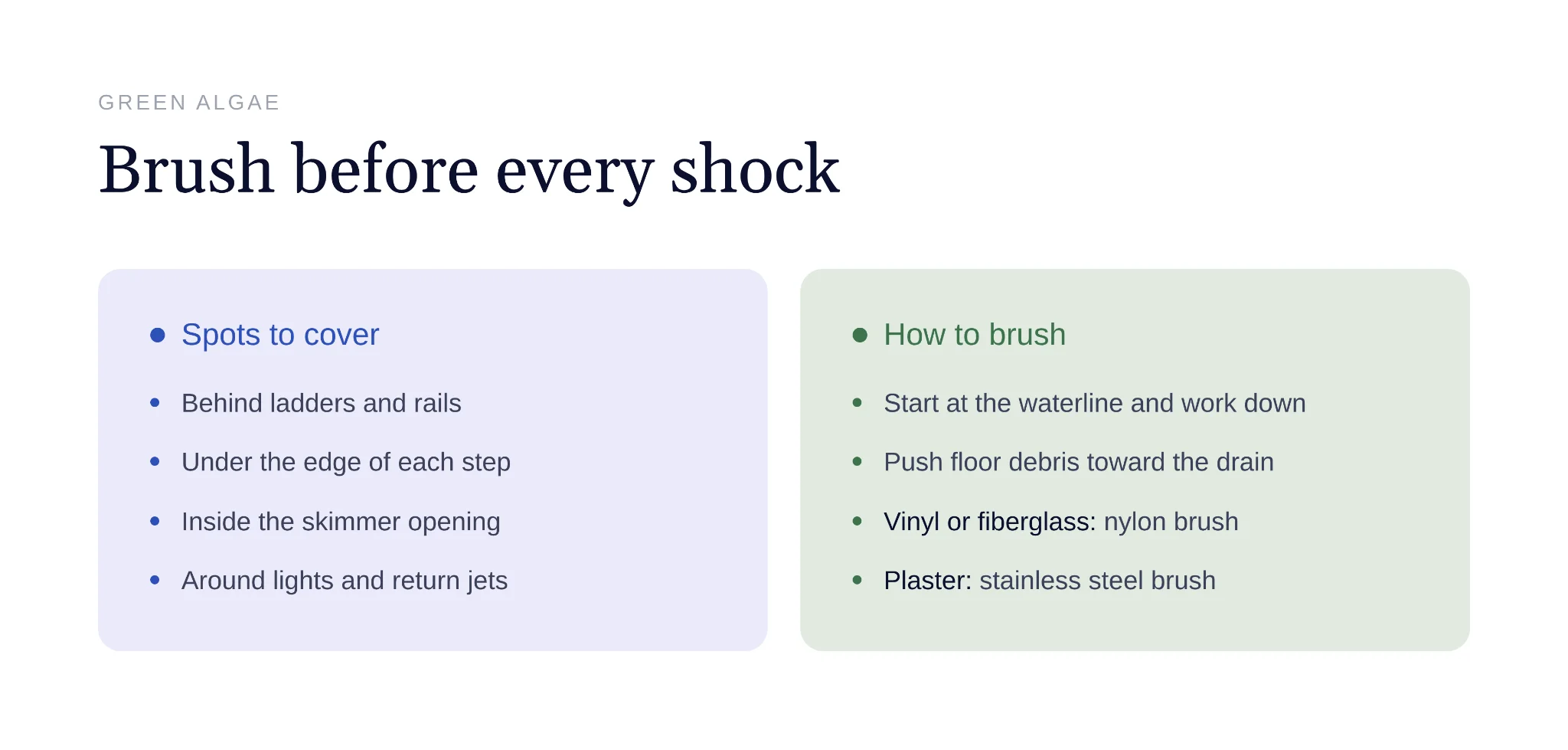
Brush the walls from the waterline down, then push everything on the floor toward the main drain. Pay close attention to the places algae holds on longest:
- Behind and under ladders and rails
- Under the lip of each step
- Inside the skimmer opening
- Around the light and the return jets
- The corners where the walls meet the floor
Shock the Pool at Dusk
Sunlight breaks down chlorine quickly. Shock added at noon can lose a large share of its strength before evening. Added after sunset, it gets the whole night to work.
Start with the pool’s volume, since every dose depends on it.
- Rectangular pool: length × width × average depth × 7.5
- Round pool: diameter × diameter × average depth × 5.9
A 32 × 16-foot pool with an average depth of 5 feet holds about 19,200 gallons.
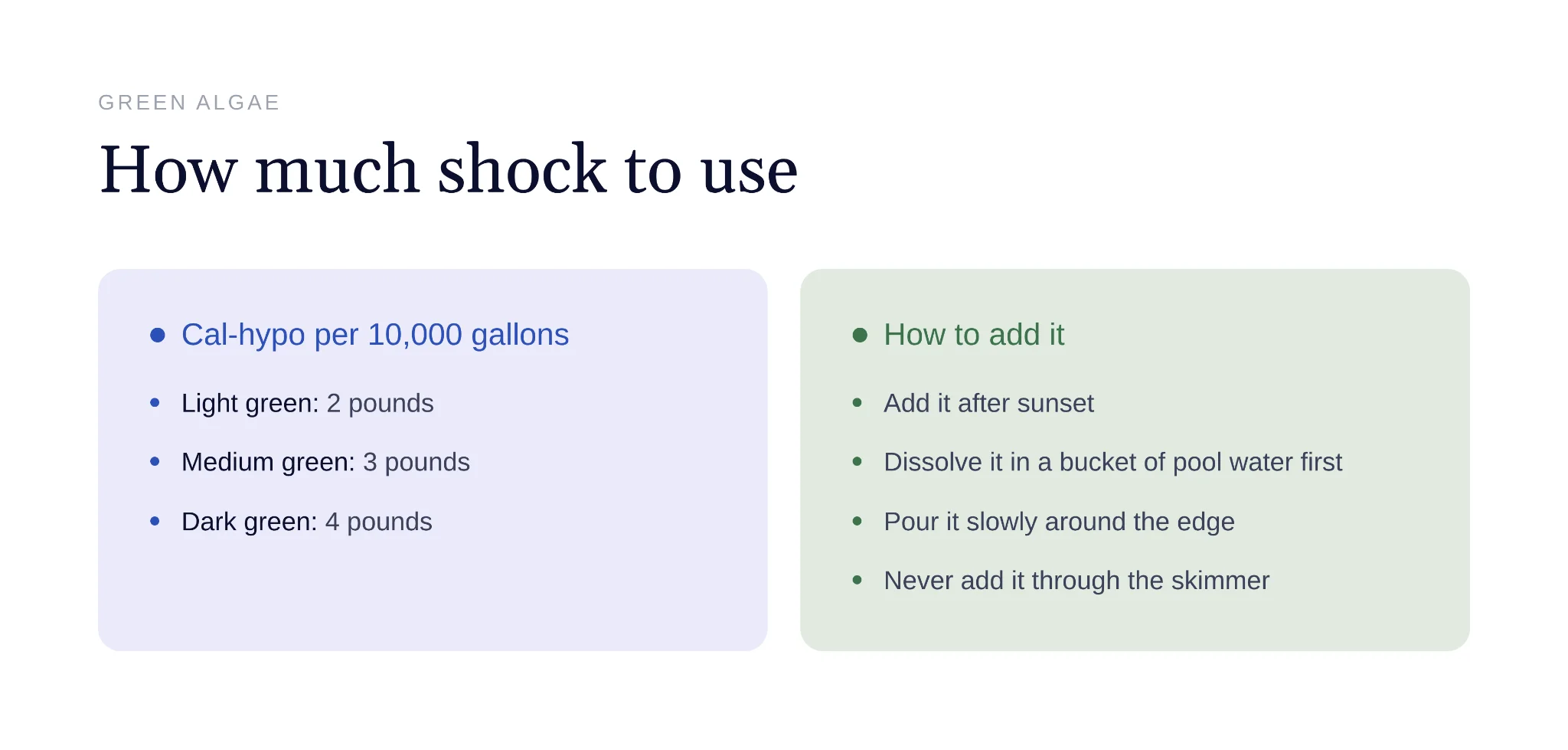
The standard cal-hypo dose is 1 pound per 10,000 gallons. Algae needs more, and the color of the water shows how much:
- Light green, floor clearly visible: 2 pounds per 10,000 gallons
- Medium green, floor hard to make out: 3 pounds per 10,000 gallons
- Dark green, floor not visible at all: 4 pounds per 10,000 gallons
For liquid chlorine, follow the algae dose printed on the jug, since strength varies by brand.
How to add it:
- Put on gloves and eye protection.
- Fill a clean 5-gallon bucket about three-quarters full with pool water.
- Add the cal-hypo to the water, stir with a stick until most of it dissolves, and pour it slowly around the edge of the pool with the pump running. Always add chemicals to water. Pouring water onto a pile of granules can cause a violent reaction.
- For liquid chlorine, pour it straight into the pool in front of a return jet.
On a vinyl pool, undissolved granules that settle on the liner will bleach it within hours, so pre-dissolving is mandatory there. Never add shock through the skimmer on any pool.
Salt pools need this same manual shock. A salt cell turned to 100% cannot produce chlorine fast enough to clear a green pool.
Remember to keep chemicals apart. Cal-hypo mixed with chlorine tablets, or even stored on the same shelf where the two can come into contact, can start a fire. Use a separate, clean scoop and bucket for each product.
Read our guide on how to store pool chemicals together.
If the stabilizer test came back above 80–100 ppm, standard doses may not hold long enough to finish the job. The practical fix is to drain part of the pool and refill with fresh water. Drain no more than about a third without talking to a pool professional first. Exposed vinyl liners can shrink, and in areas with high groundwater, an in-ground pool shell can shift.
Check the Water the Next Morning
Test free chlorine as soon as it’s light out.
A big overnight drop tells you the algae is still alive and consuming chlorine. If the reading fell by more than half and the water still looks green, brush the whole pool again and repeat the shock that evening.
The water should move through a clear sequence as the algae dies: green, then a cloudy blue-grey, then clear. The blue-grey stage is dead algae floating in the water, and it means the treatment is working.
Repeat the test, brush, and shock routine each day until three things are true:
- The water is clear
- Free chlorine drops by 1 ppm or less overnight
- The walls feel smooth
Rough timelines:
- Light green: 1–3 days
- Dark green: 3–5 days
- A pool left closed all season with debris on the floor: a week or longer
Clear the Cloudy Water
Once the algae is dead, the filter has to pull all of it out, and it clogs faster than usual.
- Sand filters: Backwash when the pressure gauge reads 8–10 psi above its clean reading.
- Cartridge filters: Remove the cartridge and hose it off every day during cleanup. Swapping in a spare keeps the pump running while the dirty one dries.
- DE filters: Backwash, then add fresh DE powder.
Clarifier helps the filter catch fine particles by clumping them together. It works with any filter type and usually clears the haze in a few days.
Flocculant is faster and more work. It sinks everything to the floor overnight with the pump off, and the settled layer then has to be vacuumed out on the “waste” setting so it skips the filter entirely.
That setting only exists on sand and DE filters with a multiport valve. Cartridge filter owners should stick with a clarifier.
Vacuum the floor once most of the debris has settled. A cordless robotic cleaner is especially useful at this stage because it collects the dead algae in its own filter basket and keeps it out of the main pool filter.
Empty the basket after each run, since it fills quickly during cleanup.
Add Algaecide After Chlorine Drops
Wait until free chlorine falls back below 5 ppm. At higher chlorine levels, algaecide breaks down before it does anything.
Choose polyquat 60%. It does not foam, and it contains no copper. Cheaper copper-based algaecides can stain light-colored plaster and turn blonde hair green.
Use algaecide as a follow-up after the shock, then at the weekly maintenance dose on the label.
Mistakes That Keep a Pool Green
- Shocking in the middle of the day. Much of the chlorine is gone before it reaches the algae.
- Stopping when the water turns blue. Cloudy blue water can still hold live algae on the walls. Keep going until the overnight chlorine test passes.
- Turning the pump off at night to save power. Shock sits in one spot, and dead zones stay green.
- Shocking with chlorine tablets or dichlor. Both add stabilizer, and repeated doses create the high-stabilizer problem described above.
- Swimming too soon. Wait until free chlorine is back under 5 ppm and pH reads between 7.2 and 7.8.
Keep Algae From Coming Back
Algae returns when chlorine dips, even for a day or two.
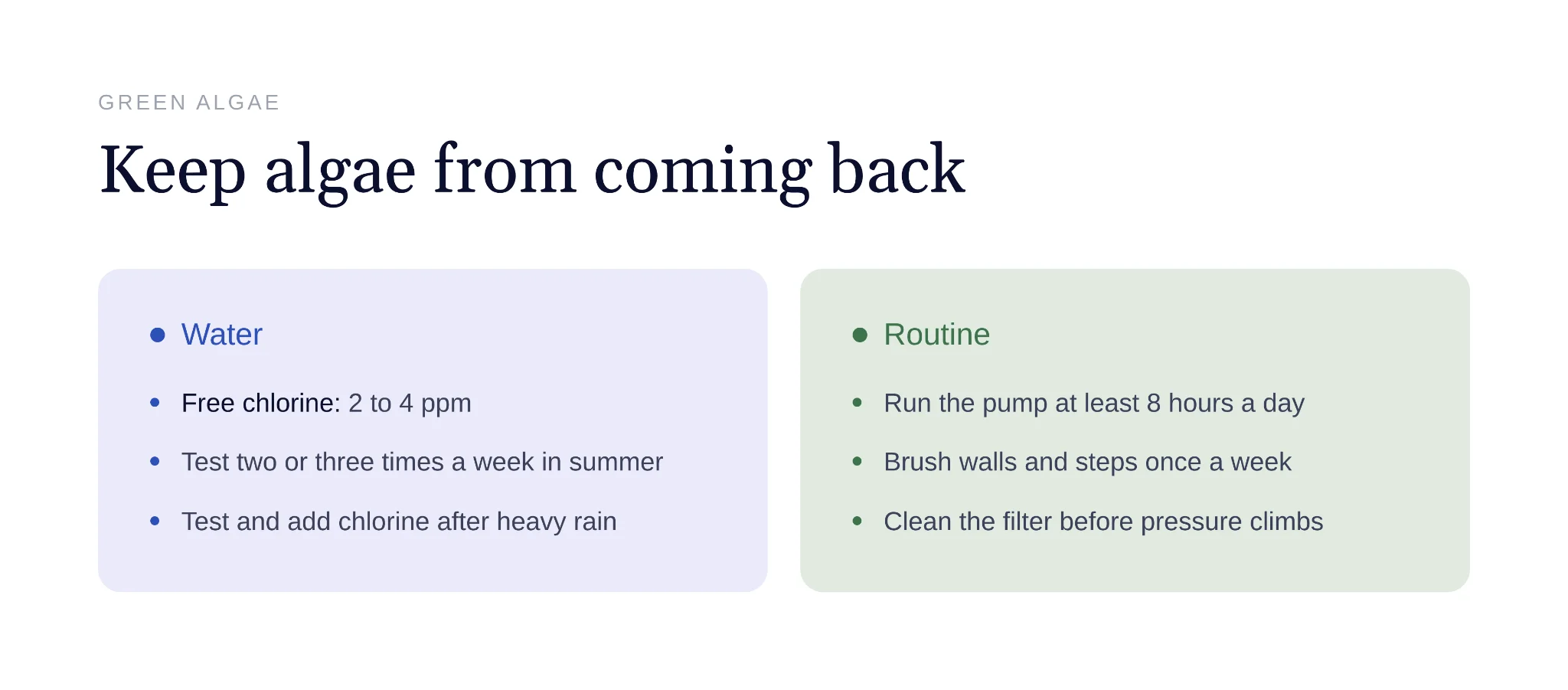
- Keep free chlorine between 2 and 4 ppm
- Test two or three times a week in summer, and daily during heat waves
- Run the pump at least 8 hours a day
- Brush the walls, steps, and waterline once a week
- Test and add chlorine after every heavy rain
- Clean the filter on a regular schedule, before pressure climbs
- Ask the pool store to test for phosphates if algae keeps returning
Regular cleaning removes the leaves, pollen, and dirt that algae feeds on. An Aiper robotic pool cleaner can run on a set schedule to scrub the floor, walls, and waterline, which covers the spots most owners miss between weekly brushings. It still needs properly balanced water to prevent algae, so the chlorine testing above stays part of the routine.
When to Call a Pool Professional
Call for help if the pool is still green after two full rounds of treatment, if the water is black with a thick layer of muck on the floor, or if stabilizer is high enough that a large drain looks necessary.
A pool professional should also check the equipment if the pump won’t hold prime or the filter pressure stays high after cleaning, since neither problem will clear with more chlorine.
Get more pool and lawn care guides from Aiper on Google