How to Keep Bees and Wasps Away From Your Pool

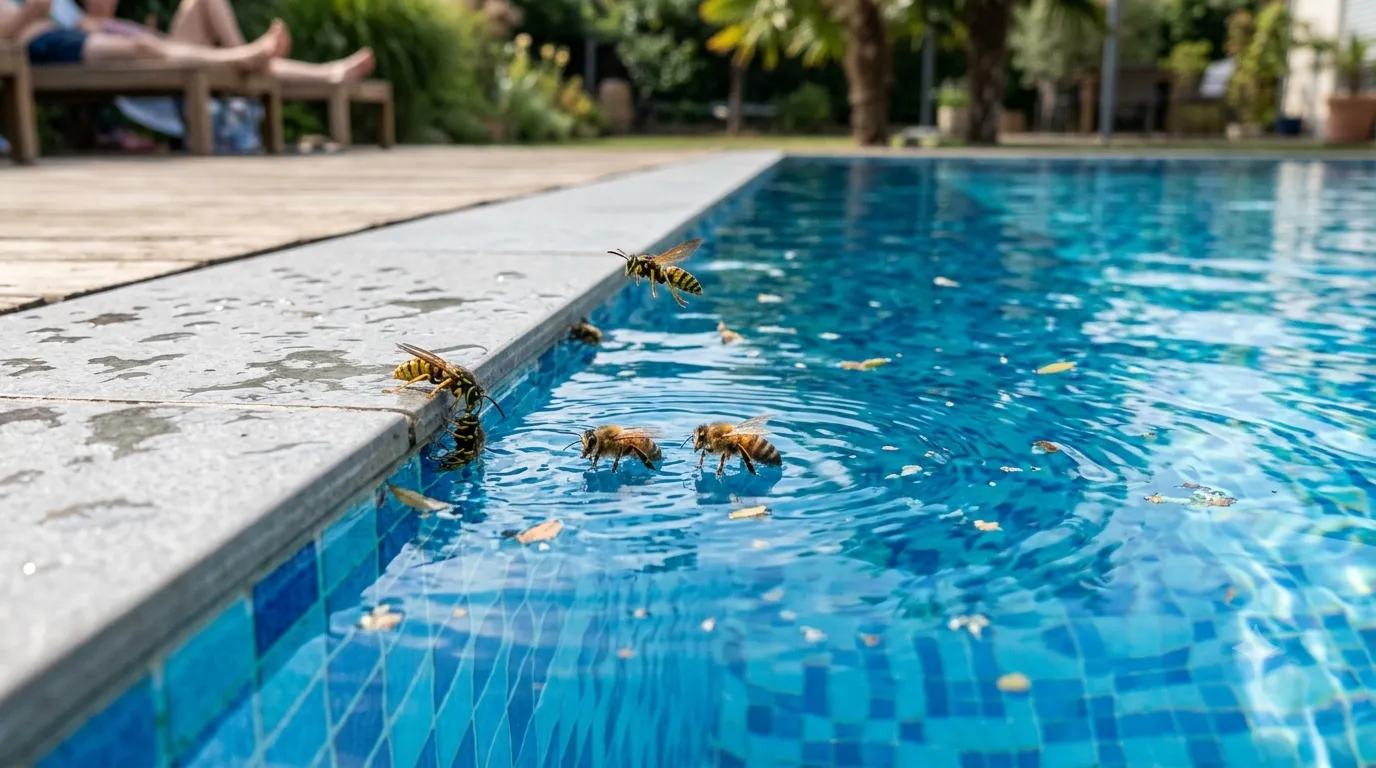
By the time most people call about this, the skimmer basket already tells the story. A wet gray mat of drowned bees pressed against the mesh, three inches deep, and someone standing there asking why it started this week when the pool has been open since May.
It started because something changed. Almost always it’s heat, and almost always the bees were already nearby and simply hadn’t needed you yet.
The single most useful thing you can do before spending a dollar is figure out what you’re actually dealing with, because honeybees and yellowjackets are two entirely different problems that happen to share a deck.
Honeybees Are There for Water, and They Will Not Negotiate
A honeybee colony cools itself by evaporation.
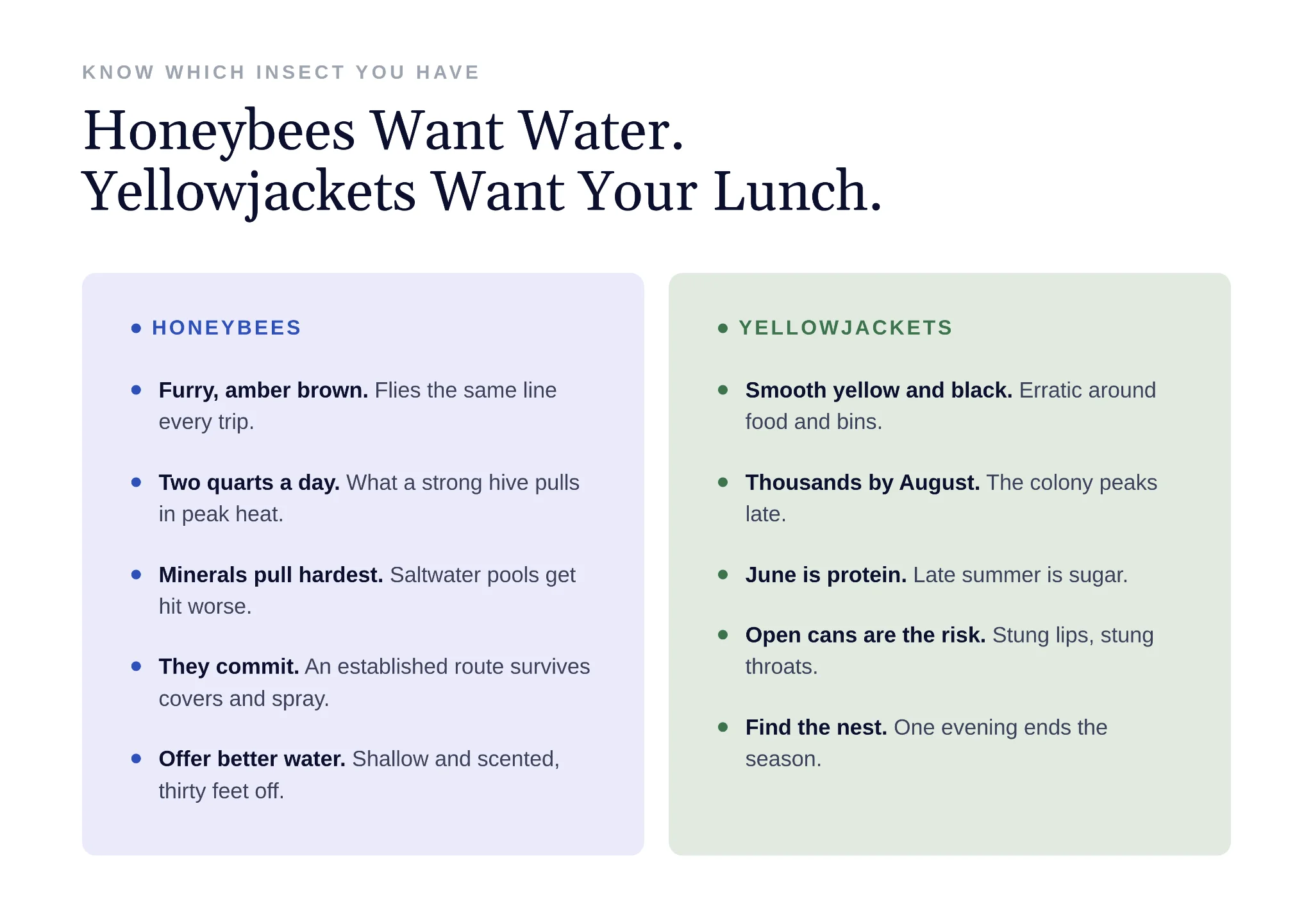
Foragers haul water back, spread it in thin films across the comb, and fan. In a serious July stretch, a strong hive can pull through a couple of quarts a day, and that water has to come from somewhere within a couple of miles.
Your pool is the most reliable water source in the neighborhood. It doesn’t dry up. It has a warm shallow edge, a wet coping stone, a damp spot where the autofill drips. Salt systems make it worse, bees show a real preference for water with some mineral content, and saltwater pools and mineral systems get hit noticeably harder than plain chlorine.
And they’re loyal to a water source.
A scout finds it, recruits, and within a few days you have a fixed foraging route with hundreds of individuals running it, and those individuals will keep running it after you cover the pool, after you spray, after you stand there waving a towel. They will land on wet concrete where the pool used to be. Breaking an established water route is genuinely hard. Preventing one is easy.
So if it’s early season and you’ve seen a handful, that’s the window to do the following:
- Set up water they like better, twenty or thirty feet away, in sun, before they’ve committed.
- Set up a shallow basin with rocks or corks so they don’t drown. A dripping hose bib onto gravel works.
- Add a pinch of salt, or a handful of leaves left to steep and go slightly foul, or wet burlap draped over the edge. Bees find scented water faster than clean water.
If your fountain is already established and they’ve locked onto it, you can sometimes shift them by placing the alternative source right beside the pool edge, letting them switch, then moving the basin a few feet a day toward where you want it.
You can call a local beekeeper and ask if anyone’s hives are near you. Backyard beekeeping is common enough now that this is a real conversation, and most beekeepers will voluntarily install water at their own apiary once they know their bees are in someone’s pool.
Do not kill honeybees. Beyond the obvious, it doesn’t solve anything, the hive replaces foragers faster than you can kill them, and you’ll be at it all summer.
Yellowjackets Are a Different Animal Entirely
They’re there for your food, your drink, your trash, and in late summer, for sugar specifically.
Yellowjacket colonies start small in spring with one overwintered queen and build all season.
In June, a nest might hold a few hundred workers. By late August the same nest holds thousands, the queen has stopped laying workers, the colony’s protein demand collapses, and every one of those adults switches to hunting carbohydrates with a kind of desperation. That’s why the second week of August feels like a completely different summer than the first week of July.
Which means the countermeasures are seasonal too, and people get this backward constantly.
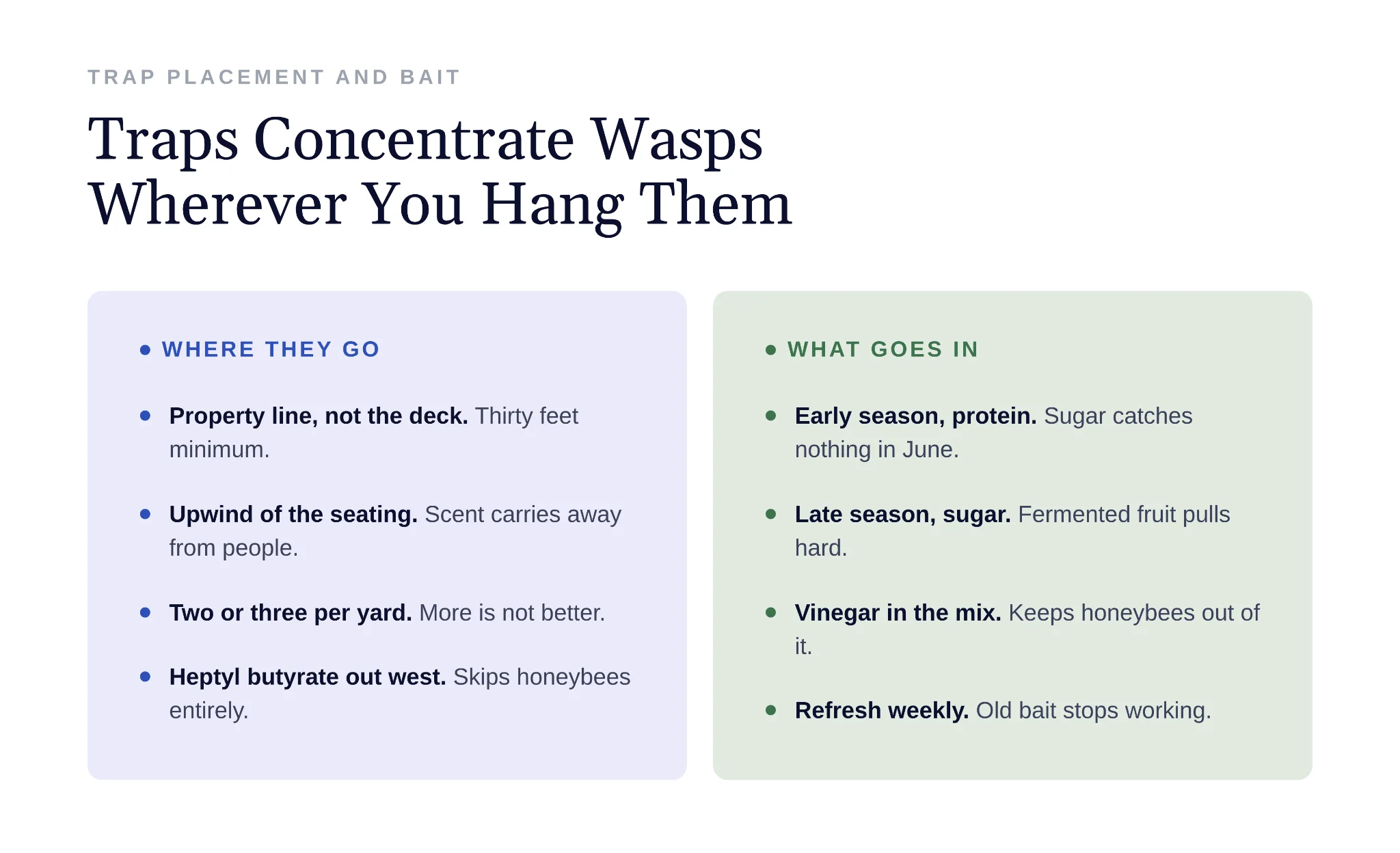
Early season, they want meat. Traps baited with sugar catch almost nothing in June. Late season, sugar and fermented fruit pull hard, and that’s when trapping actually earns its keep.
Trapping is worth doing, but understand what it does:
- Traps placed near your deck concentrate wasps near your deck.
- Put them at the property line, upwind if you can read the prevailing breeze, at least thirty feet out. You want an interception line, not an attraction at the table.
In the western states, heptyl butyrate lures are worth the extra money because they’re selective for the pest yellowjacket species and they leave honeybees alone.
Traps don’t eliminate a colony. Find the nest, and you’re done in one evening.
Finding the Nest Is the Whole Game
Stand still on the deck at midday and watch the ones flying in a straight line with intent. They go home in a straight line, and they come back on the same line.
Follow that line to a hole in the lawn, a gap in the retaining wall, the corner of the soffit, the irrigation valve box, the space under a loose piece of flashing.
Ground nests are the common ones around pools because the soil near a deck is dry, disturbed, and full of old vole tunnels. That means mulch beds, under the edge of a paver, or that crack where the concrete meets the planter.
Treat at full dark, and treat only at full dark:
- Red light on the flashlight, or set the light on the ground a few feet off the entrance instead of holding it.
- Long sleeves, gloves, ankles covered, and an exit route decided before you start.
- Dust into a ground entrance works better than aerosol because the workers track it through the nest. Aerosol jet spray works fine for exposed aerial nests if you can hit the entrance from eight or ten feet.
And plan for anaphylaxis before it’s relevant. If anyone in the household has ever had a reaction beyond local swelling, don’t do this yourself. Pay someone. It’s a hundred and fifty dollars against an ambulance ride.
The Things That Actually Bring Them In
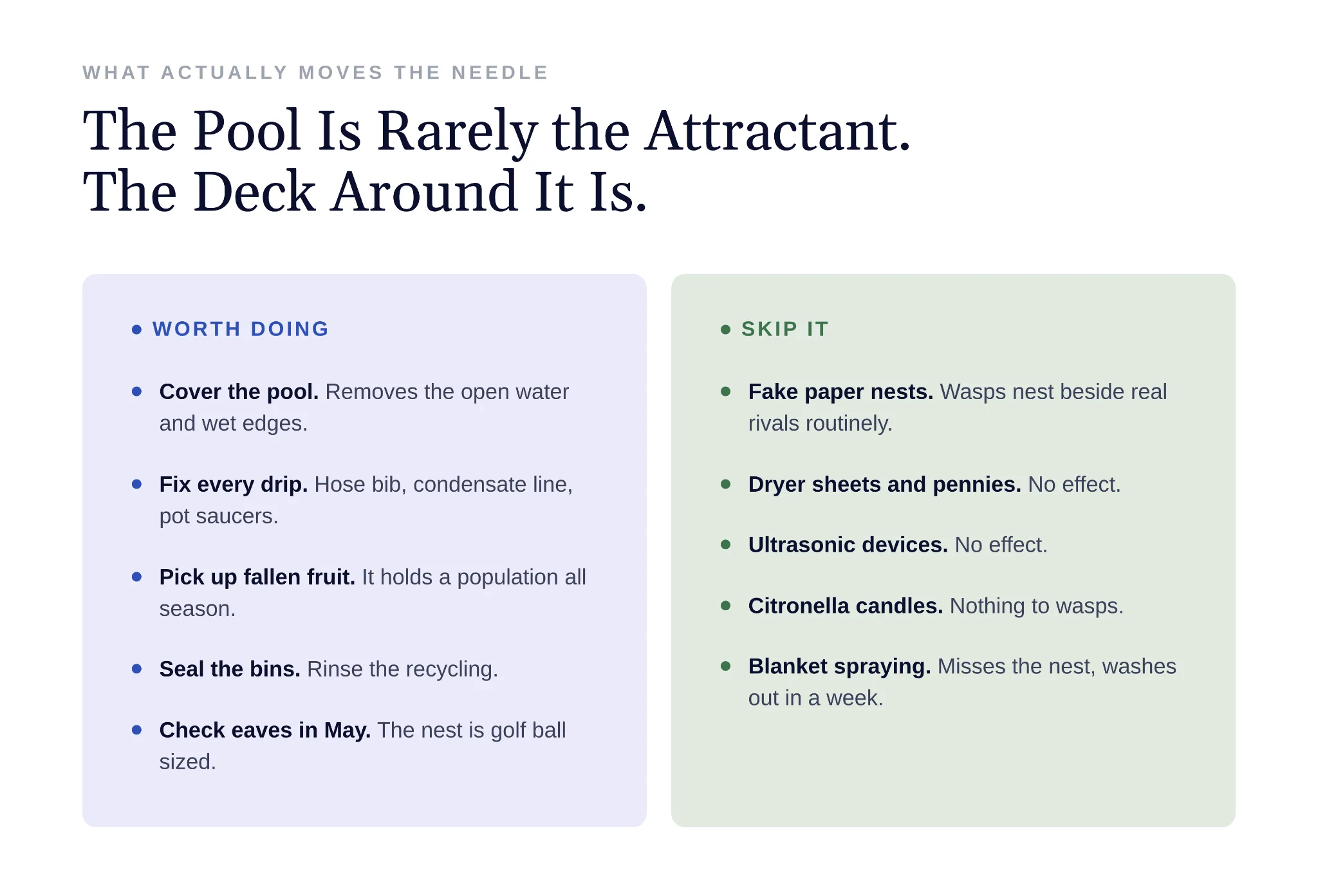
The pool isn’t the attractant. The environment around it usually is.
Sugary drinks in open cans are the classic, and the real hazard is the one that crawled inside. Cans get stung lips and stung throats. Use cups you can see into. Sounds like nothing. It’s the injury that actually happens.
Trash cans without lids, or with lids that don’t seal, twenty feet from the deck. Rinse the recycling. A single soda bottle with an inch of Coke in it, sitting in the sun, is a better yellowjacket lure than anything you can buy.
Fruit trees. Nobody wants to hear this one. Fallen plums or figs rotting in the grass will hold a yellowjacket population all season regardless of what you do at the pool. Pick them up.
Also the hummingbird feeder. Also the dog food bowl left out. Also the grill, unscraped, from Saturday.
Flowers, Standing Water, and Everything Wet You Didn’t Notice
Lavender, salvia, alyssum, anything in heavy bloom right along the deck line, move it or plan around it. You don’t have to strip the yard, but the bed directly beside the shallow end is the wrong place for a pollinator garden.
Then walk the whole area looking for water you’re not accounting for:
- The leaking hose bib
- The condensate line off the AC dripping onto gravel
- Puddles in the pool cover
- The kid’s water table
- Birdbaths
- Saucers under pots
Any of these can host bees just as reliably as the pool, and if you fix the pool and leave the dripping spigot, you’ve fixed nothing.
Wet coping and splash-out on hot stone is its own attractant, which is one reason the problem is worse around pools that get heavy use and worse in the afternoon.
What Doesn’t Work
Fake paper nests. The theory is territorial avoidance, and it has never held up in practice. Wasps nest a few feet from real competing colonies routinely.
Dryer sheets. Brown paper bags. Bowls of pennies. Ultrasonic devices.
Citronella candles do nothing to wasps essentially.
Perimeter spraying the whole yard kills a lot of insects that were doing nothing to you, doesn’t touch a nest, and gets rain-washed out in a week. Save it for a specific structural void where you know they’re entering.
Cover the Pool When You’re Not In It
A solar cover or safety cover removes the open water and the wet edges, which is the entire attraction for honeybees, and it removes the drowned-insect problem in the skimmer at the same time.
It’s the least clever thing on this list and one of the most effective, and the reason people skip it is that it’s tedious, not that it doesn’t work. The same cover is your first line of defense for keeping ducks and geese away from your pool.
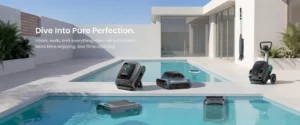
None of this fixes the skimmer basket itself, though. Even with the water covered and the routes broken, something is always going to end up floating on the surface between checks: a stray bee, a moth, whatever blew in overnight, and somebody still has to net it out before it sinks and starts feeding whatever’s already growing in there. An Aiper robotic pool cleaner picks that up on its own pass, floor and surface both, so the skimmer basket stops being the thing nobody wants to check.
Get more pool and lawn care guides from Aiper on Google