How to Get Leaves Out of a Pool (Without Wrecking Your Skimmer)

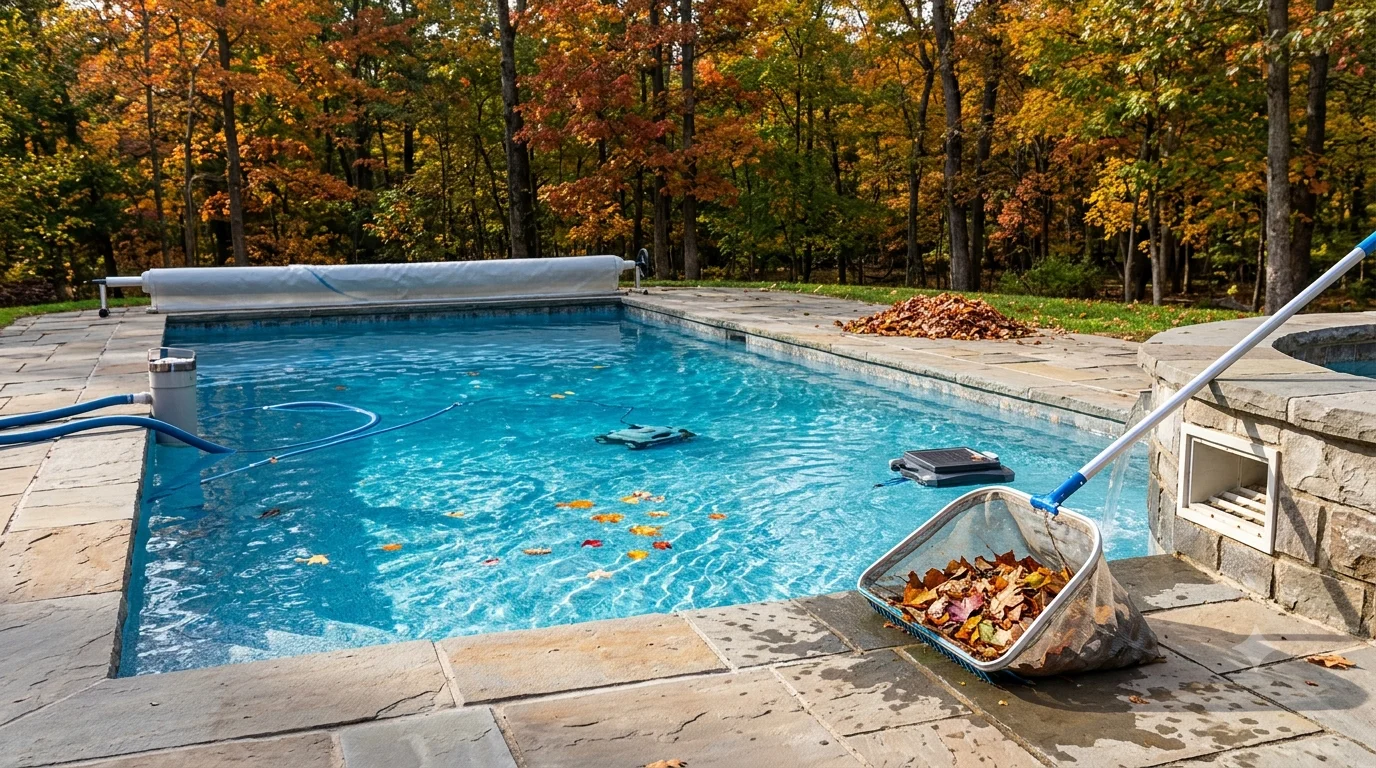
Every fall, pool owners destroy perfectly good equipment trying to solve a leaf problem.
Cracked skimmer baskets, burned pump seals, clogged suction lines that need a plumber to clear.
None of it comes from the leaves themselves. It comes from asking the skimmer to do a job it was never built for.
A wall skimmer is a maintenance device. It’s designed to sip a steady trickle of surface debris all day long, but it is not a leaf disposal system. Point a season’s worth of oak drop at it, and something gives. Usually the basket first, then the pump.
The Fastest Way to Get Leaves Out
Here’s the short version. The rest of this guide explains why each step matters and what to avoid.
- Skim the surface daily with a deep-bag leaf rake. Two minutes catches leaves while they still float.
- For leaves on the floor, reach for the leaf rake first, not the vacuum. It clears the bulk without feeding a carpet of wet leaves into your suction line.
- If you must vacuum, add a leaf canister between the vacuum head and the skimmer, then send the remaining silt to waste.
- Cut the supply. Trim overhanging branches and use a leaf net so fewer leaves land in the first place.
You don’t need a vacuum to clear leaves. A deep-bag leaf rake does most of the work for a fraction of the cost of a pump repair.
Why Leaves Are a Chemistry Problem
A leaf floating on the surface is annoying. A leaf sitting on the floor for a week is expensive.
Leaves release tannins as they break down, that’s the brown tea-stain color you see in a neglected pool.
They dump organic material into the water that chlorine has to burn through, so your sanitizer levels drop faster, and your chemical bill climbs. Left long enough on plaster or vinyl, they leave actual stains, brown or yellow shadows in the exact shape of the leaf that no amount of brushing removes.
And they feed algae. Decomposing organic matter is fertilizer. A pool with a leaf layer on the bottom in October is a pool fighting green water in November.
Does chlorine dissolve leaves? No. Chlorine sanitizes the water by killing bacteria and algae, but it doesn’t break down solid leaf matter. The leaf simply rots in place, feeding the very algae you’re trying to kill. Leaves have to come out of the water, not out of the chemistry.
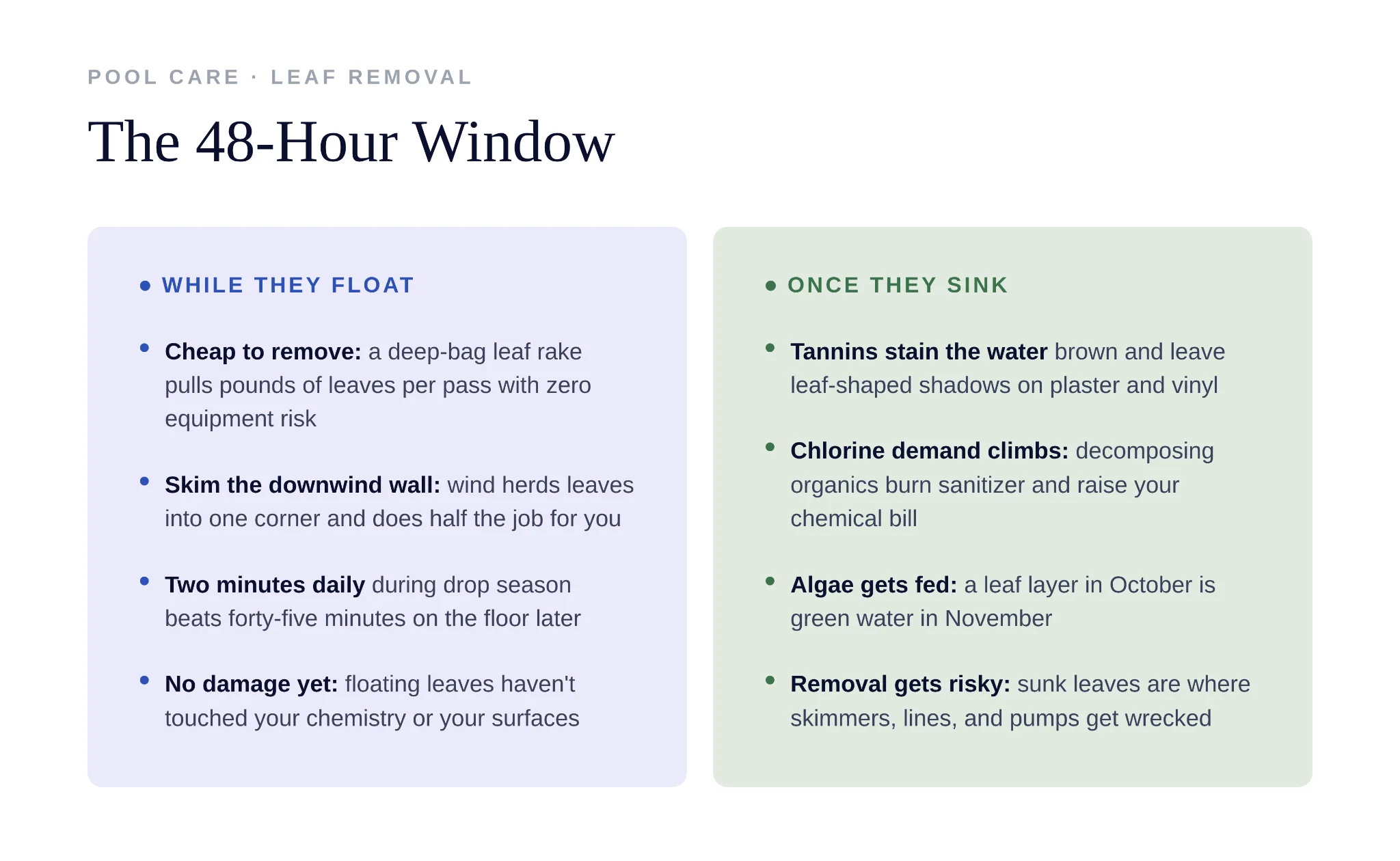
The timing rule that follows from this: leaves floating on the surface are cheap to remove and haven’t done any damage yet.
Leaves that have sunk are harder to remove and are actively costing you money. Every day you wait moves leaves from the first category to the second.
One scenario every guide skips: the water is so dark you can’t see the leaves you are supposed to be raking. Don’t vacuum blind, and don’t keep pouring shock into water you can’t see through. Net whatever floats, then run the pump and filter until you can find the floor. If the water still won’t clear, a flocculant settles the suspended muck into a layer you vacuum to waste. Only then do you rake or vacuum the floor, because you can’t clean what you can’t see.
Get Them While They Float
Roughly the first 24 to 48 hours after a leaf hits the water, it floats. That’s your window, and it’s where a manual leaf net earns its keep.
Two kinds of nets, and the difference matters more than people think:
A flat skimmer net is fine for a handful of leaves.
A deep-bag leaf rake is what you want for real volume. The bag holds pounds of wet leaves without spilling them back out, and the flat edge lets you scrape along the surface and later along the floor.
Buy the deep bag. Technique is simple: work the surface in overlapping passes, moving toward one end, so you’re herding rather than chasing.
Wind is your friend here, leaves pile up against the downwind wall, so skim that corner and half the job is done.
During heavy drop season, this is a daily two-minute job. Not weekly. Daily. Two minutes on the surface beats forty-five minutes on the floor.
The Floor: Where People Break Things
Sunk leaves are where equipment damage happens, because the obvious move, vacuum them up, is exactly wrong for heavy loads.
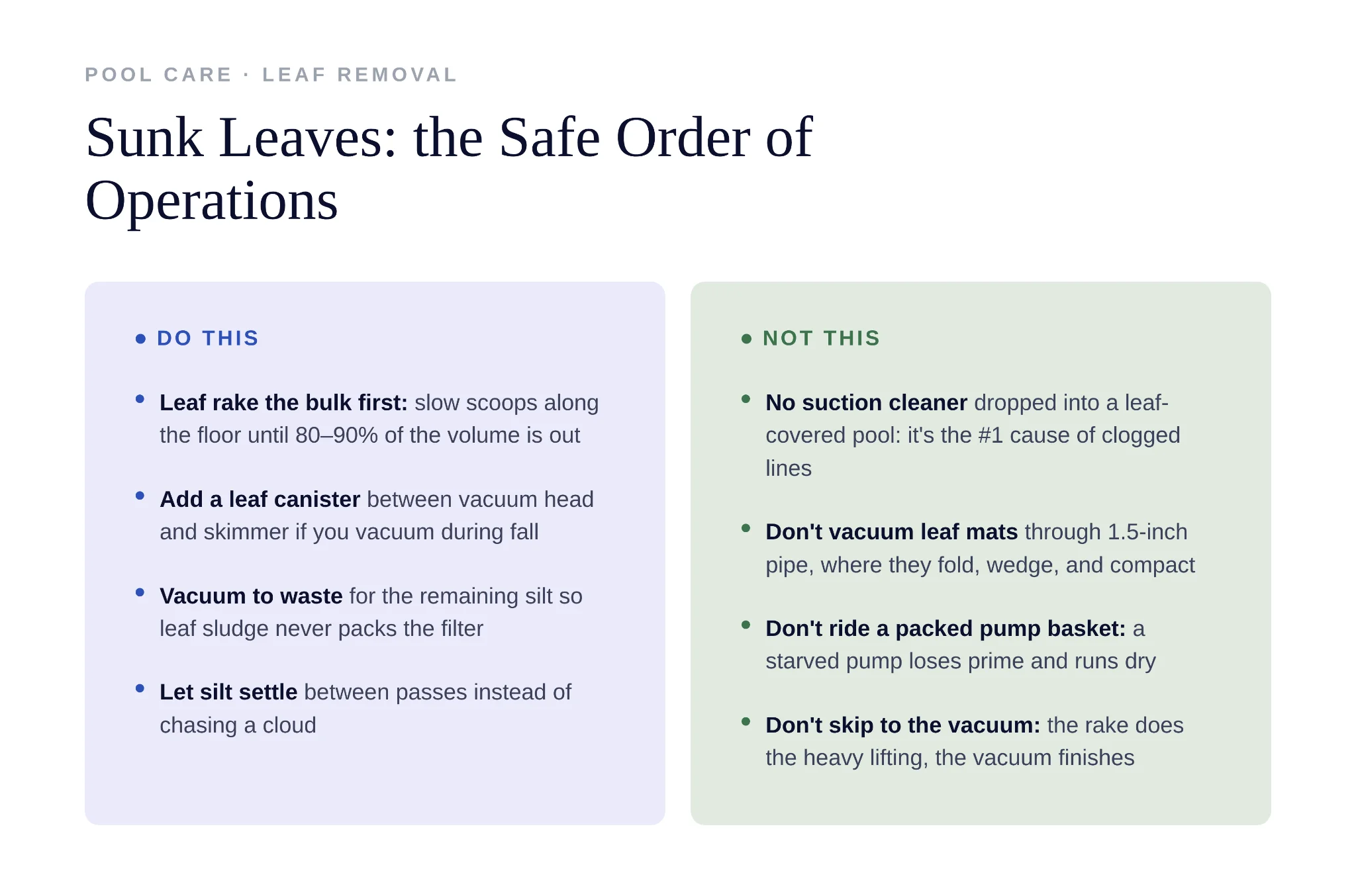
A manual vacuum or a suction-side cleaner pulls everything through the skimmer line to the pump basket and filter.
A few leaves, no problem. A carpet of them, and you’re feeding wet leaf mats into a 1.5-inch pipe. Leaves fold, wedge, and compact. Best case, the pump basket packs solid every ninety seconds, and you spend the afternoon opening and closing the pump lid.
Worst case, leaves jam in the underground line itself, your pump loses prime, and now you’re renting a drain bladder or calling someone who owns one.
For heavy floor debris, you have three sane options, in order of preference:
Leaf rake first: The same deep-bag net that handles the surface handles the floor. Slow, deliberate scoops along the bottom, letting silt settle between passes. Expect twenty to thirty minutes for a heavy leaf load. Get the bulk out this way before any vacuum touches the water.
A leaf canister if you must vacuum: An in-line leaf trap sits between the vacuum head and the skimmer, catching leaves in a large basket before they reach the plumbing. If you vacuum leaves without one during fall, you’re gambling with your suction line. Budget forty-five minutes for a full cleanup, and it’s still safer than vacuuming with a bare hose.
Vacuum to waste for the fine stuff: Once the bulk is out, the remaining silt and leaf fragments can go straight out the waste port (if your filter has a multiport valve) instead of through the filter media. You lose some water. You also don’t spend an hour backwashing a filter you just packed with decomposed leaf sludge. That last pass is a ten-minute job once the heavy stuff is gone.
The garden-hose leaf vacuum, for the two jobs nothing else fits: The leaf baggers and leaf eaters you see recommended everywhere run on water pressure from your garden hose, not the pool pump. The venturi effect pulls leaves up into a mesh bag clipped to the pole. They are genuinely useful in two cases: a pool with no skimmer or suction line to vacuum through, and the fine leaf silt left after you have already got the bulk out. For a carpet of intact leaves they are the wrong tool. The suction is weak, the sweep is slow, and you are running the hose the whole time, churning the water and adding to your bill. For that first pound of leaves, a rake is faster and free. Reach for the bagger for the last inch, not the first pound.
What you never do: drop a suction cleaner into a leaf-covered pool and walk away. That’s the single most common way suction lines get clogged, and it’s completely avoidable.
Which Leaf Tool Do You Actually Need?
Start with the cheapest tool that matches your leaf load, and add gear only when the volume forces it.
| Method | Cost | Effort | Best for |
|---|---|---|---|
| Flat skimmer net | $10 to $20 | Two minutes a day | A handful of floating leaves |
| Deep-bag leaf rake | $25 to $40 | Two minutes on the surface, twenty to thirty on the floor | Heavy fall drop, leaves on the bottom |
| Leaf canister | $30 to $60 | Forty-five minutes with a vacuum | Vacuuming leaves without clogging the line |
| Leaf bagger (venturi vacuum) | $40 to $80 | Slow sweep, runs a hose the whole time | No suction line, or fine silt after the bulk is out |
| Leaf net | $40 to $100 | One-time setup | Peak drop weeks, keeps leaves out entirely |
| Robotic pool skimmer | several hundred dollars | Set and forget | Continuous surface cleaning all season |
For most pools, a deep-bag leaf rake plus a leaf net solves 90% of the problem for under $100. Add a canister or a robot only if the volume stays high week after week.
Protecting the Skimmer Itself
The skimmer takes damage in boring, preventable ways.
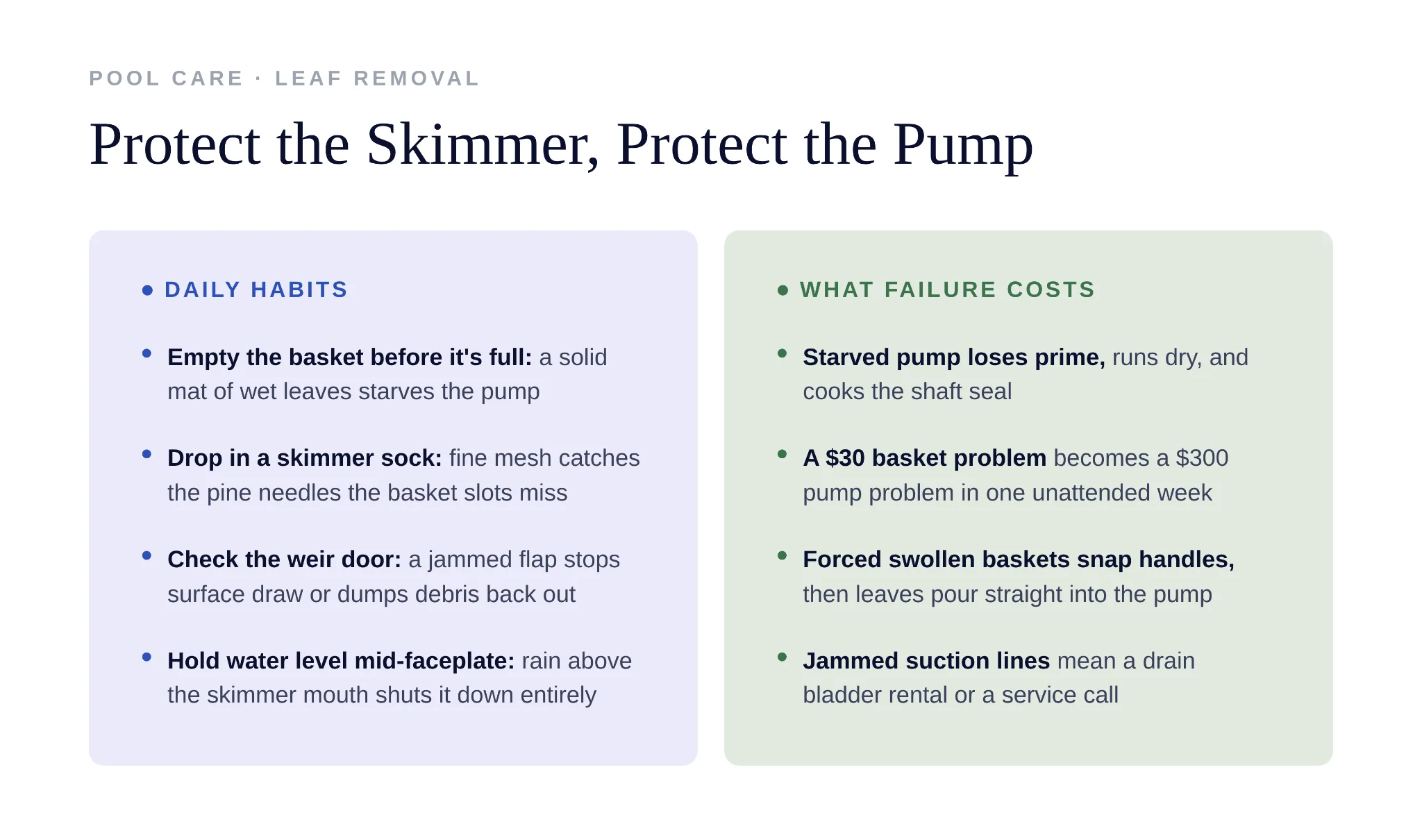
A packed basket starves the pump. Water can’t get through a solid mat of wet leaves, so the pump pulls against a blockage, loses prime, and runs dry.
Run a pump dry long enough and the shaft seal cooks. That’s a $30 basket problem becoming a $300 pump problem because nobody looked inside the skimmer for a week.
During leaf season: check the basket daily, empty it before it’s full, and never force a swollen packed basket out by the handle. The handles snap, and then you’re fishing the basket out with pliers while leaves pour past it into the pump.
A skimmer sock is a five-dollar upgrade that catches the small fragments and pine needles the basket slots let through. Cheap insurance for the pump basket downstream.
And check the weir door, the floating flap at the skimmer mouth. Leaves love to jam it half-open or half-shut. A stuck weir either stops the skimmer from drawing surface water at all or lets everything it caught float back out when the pump cycles off.
One more thing on the water level, because it quietly ruins skimmers: heavy rain plus falling leaves usually arrive together.
If rain pushes the water level above the skimmer mouth, the skimmer stops working entirely, and the whole leaf load stays in the pool. Keep the level at the middle of the skimmer faceplate through the fall.
Cut the Supply
Some of this is a landscaping problem wearing a pool-maintenance costume.
Trim branches that overhang the water. Not the whole tree, the specific limbs that drop directly into the pool. A weekend with a pole saw can cut your leaf load in half for years. The same trees causing fall leaf drop often trigger a spring surge too, and how to get rid of pollen in your pool covers dealing with that finer, wind-blown counterpart.
A leaf net over the pool during peak drop turns a month of daily skimming into one afternoon of dragging the net off. If you’re in a heavy-tree yard and you’re not using one during the worst two or three weeks, you’re volunteering for work.
And rake the deck. Leaves on the surrounding concrete are leaves that blow into the pool on the next windy day. The pool’s catchment area is bigger than the pool.
Pool Covers: Get Leaves Off Before They Damage the Cover
If you close or cover the pool for part of the year, the cover becomes its own leaf problem, and an expensive one if you ignore it.
A safety cover holding a foot of wet leaves and standing water is heavy, and dragging it off by the edges can tear it. If a tear has already started, here’s how to repair a pool cover before the season makes it worse. Pump the standing water off first with a submersible cover pump, then rake or blow the leaves off before they mat and stain the fabric. Work from the deck side outward. Never rake a cover from the pool edge, or the leaves slide right back into the water you spent a season protecting.
A mesh cover still lets fine debris and water through, so clear the leaves off it regularly rather than letting them rot in place. And the same leaf net you use over the pool during peak drop also works over a solid cover, so the leaves never pile up in the first place.
Frequently Asked Questions
Leaf stains are organic, so chlorine lifts them, not brushing. Test a small spot first: hold a chlorine tablet against it, or brush on a chlorine paste, and an organic stain fades within a minute or two. If the spot doesn’t budge, it’s a metal stain, usually iron or copper, and the fix flips to vitamin C instead: rub a crushed tablet over the stain and it lifts. Once you know which it is, treat the rest the same way, then rebalance the water, because the chemistry you used to lift the stain also throws your levels off.
Turn the pump off first, so it isn’t pulling against the jam. The usual tool is a drain bladder: a rubber bladder you screw onto a garden hose, feed into the line, and turn the water on. The bladder swells to seal the pipe, and the pressure shoves the wad of leaves out the far end. Work from the skimmer toward the pump first, then switch ends if it won’t budge. Don’t force it. If it still won’t clear, call a pro, because too much pressure can split an underground line and turn a clog into a dug-up yard. Once it’s clear, add a leaf canister in line and it won’t happen again.
The bottom main drain has a cover that only lets small fragments through, so full leaves rarely go down it. Anything that does rides the drain line to the pump strainer basket, where it collects until you empty it, and the finer bits carry on to the filter. So the drain is not a leaf disposal system. If the pump basket keeps filling with leaf pieces, check the drain cover for damage, and clear the basket before it starves the pump.
Not for the water. A blower just pushes floating leaves to the far side and churns up the surface, so you still end up raking them. Where a blower helps is on dry surfaces. Clear leaves off the deck, the coping, and a pool cover before they slide or blow into the water. Blow from the pool outward, and the leaves that would have ended up in the pool never get there.
Make the Surface Work Automatic
Everything above comes down to one principle: catch leaves while they’re floating, and the skimmer, the pump, the filter, and the pool floor all stay out of trouble.
The problem is that the floating window is short and it doesn’t wait for your schedule. Leaves drop on Tuesday whether or not you’re free on Tuesday.
That’s the job the Aiper EcoSurfer S2 exists for. It’s a solar-powered robotic skimmer that patrols the surface continuously, collecting leaves, pollen, and insects into a 4-liter basket with a 150-micron filter before any of it gets the chance to sink.
During drop season, it does the daily two-minute surface pass all day long, which means your wall skimmer goes back to doing the light-duty job it was actually designed for, and the leaves never make it to the floor, the plumbing, or the pump.
Get more pool and lawn care guides from Aiper on Google