How To Scarify A Lawn (And Whether You Actually Need To)

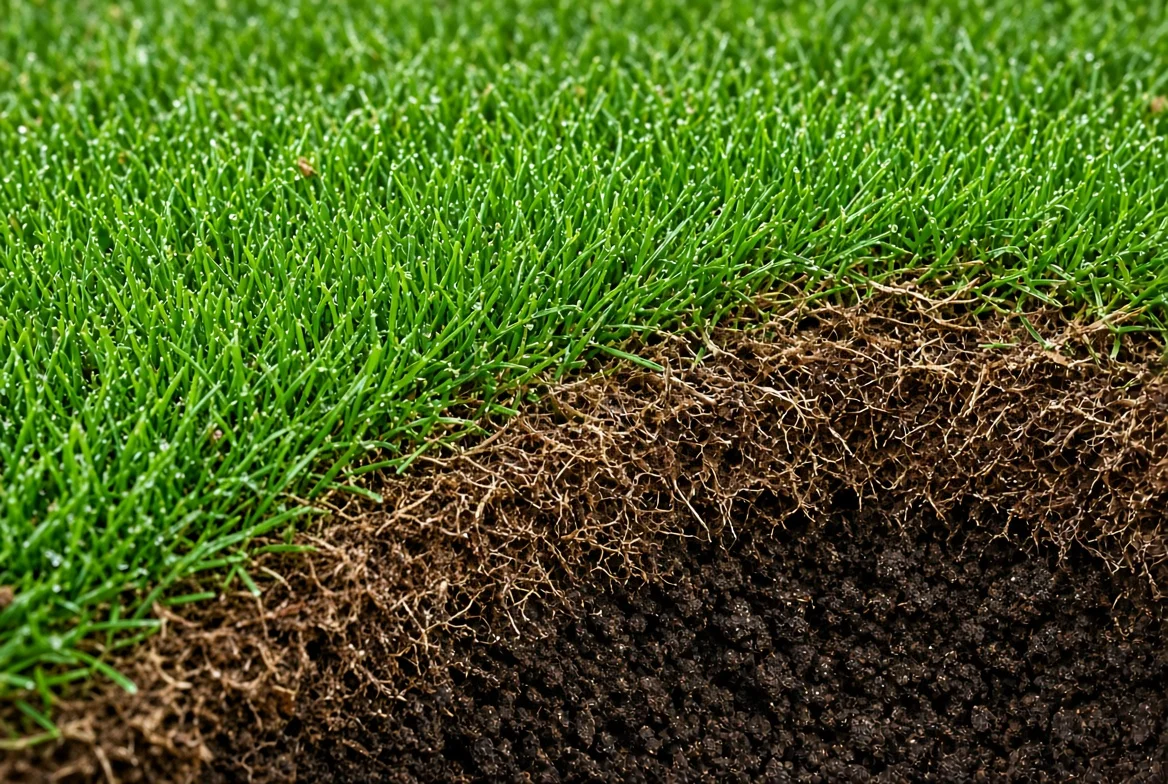
Scarifying is a major intervention, and many lawns don’t need it. The process removes the layer of dead and matted material between the grass and soil, but it can also damage healthy turf when done unnecessarily or at the wrong time.
The first step is to determine whether the lawn actually has a thatch problem and needs scarifying at all.
Cut A Plug And Look
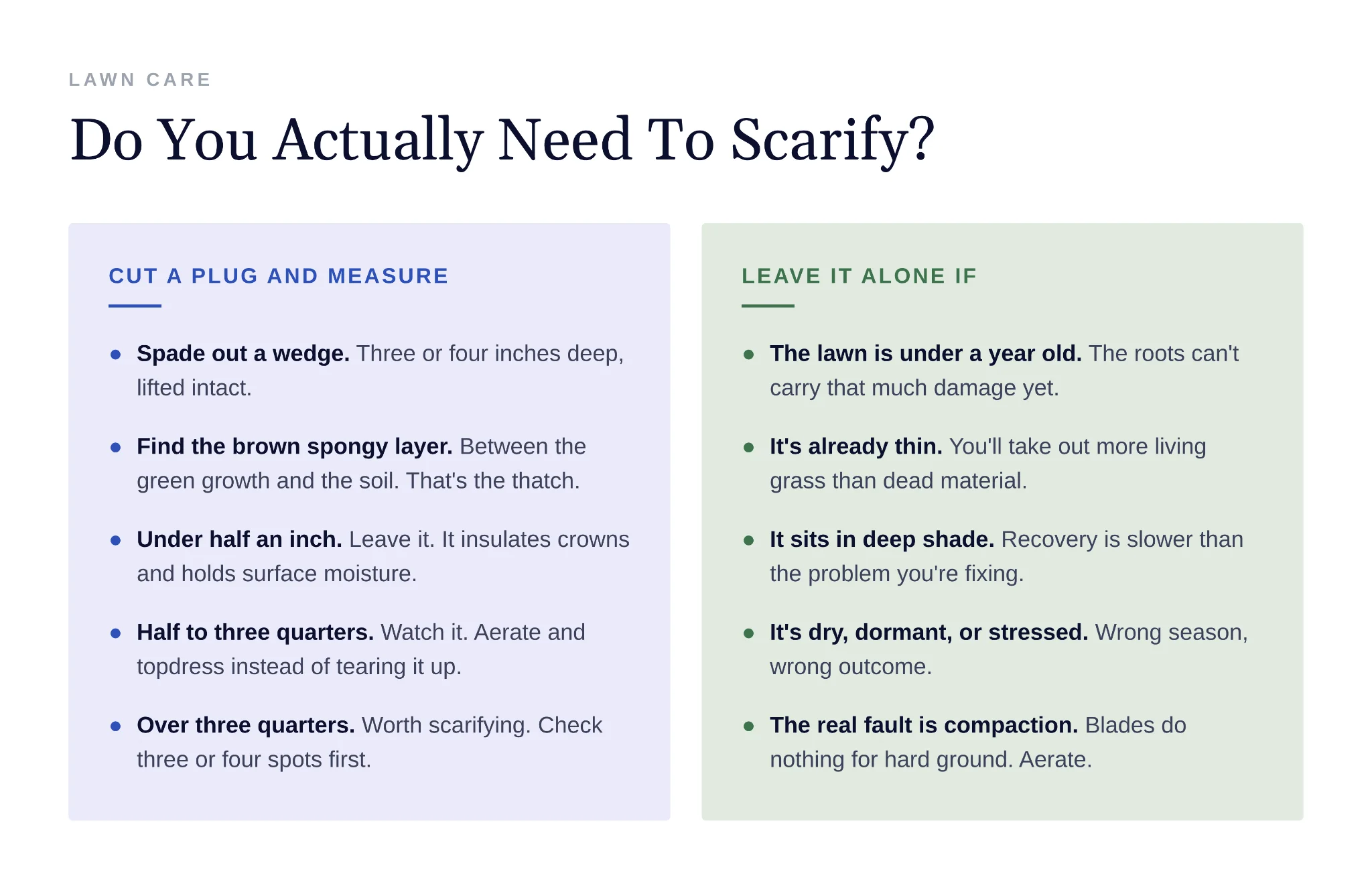
Take a spade and cut a wedge out of the lawn, three or four inches deep, and lift it out intact.
Look at the side of it. There’s green growth on top, soil at the bottom, and between them a brown fibrous layer that looks like matted straw and feels spongy when squeezed. That’s thatch. Measure it against a ruler.
Under half an inch is fine. Better than fine, actually, since a thin layer of thatch insulates the crowns, holds moisture at the surface, and cushions traffic. Leave it.
Between half an inch and three quarters is borderline. That’s a lawn to watch, aerate, and topdress rather than tear apart.
Anything over three quarters of an inch is worth scarifying, and by the time it’s over an inch, the lawn is already telling you in other ways.
Do this in three or four spots. Thatch isn’t even, and a plug from the one corner that stays wet won’t describe the rest.
What Thatch Actually Is
Not grass clippings. That myth has cost a lot of people a lot of unnecessary work.
Clippings are mostly water and break down in days. Thatch is the tougher tissue the plant leaves behind: stems, stolons, old crowns and roots, all of it high in lignin and slow to rot. It builds up when the grass produces that material faster than the soil life can digest it.
This points to why it happened, and that matters more than the removal does.
Heavy nitrogen feeding pushes growth beyond what the soil can process. Frequent shallow watering keeps the surface soft and the roots lazy, and keeps biological activity concentrated in the top inch where it does the least good.
Compacted or acidic soil suppresses earthworms and microbes. So do some pesticide programs. And certain grasses simply build thatch as a habit, particularly the aggressive creeping types that spread by runners rather than clumping.
A lawn that gets scarified without any of that changing will need scarifying again in two years.
The Symptoms Worth Trusting
The plug test is the answer. The symptoms just tell you when to go get the spade.
A lawn that feels springy underfoot, almost like walking on carpet underlay, is holding thatch. Footprints that stay visible longer than they should.
Water that sits on top and runs off instead of soaking in, or a lawn that goes dry in patches days after a soaking because the roots are living in the thatch layer rather than the soil. Fertilizer that produces no response. Mower scalping over small humps that weren’t there before. Moss taking hold in areas that get reasonable light.
Shallow roots are the tell that ties them together. Pull that plug and check whether the roots have gone down into soil or are running sideways through the mat.
Moss Isn’t Thatch. Treat It First.
UK lawns land in this conversation because of moss far more often than because of thatch. The two look related, and they aren’t.
Thatch is dead grass tissue. Moss is a live, shallow-rooted plant that moves into thin, wet, shaded, or underfed turf and holds a damp mat over the surface. It grows where the grass is weak, so it’s usually a symptom of a drainage, shade, or feeding problem, not the cause of one.
That matters, because scarifying does not kill moss. It shreds it and spreads it, and every broken fragment can regrow. You don’t remove a moss problem that way; you broadcast it evenly across the whole lawn.
So the order is fixed: treat the moss first, let it die and turn black, then scarify the dead material out.
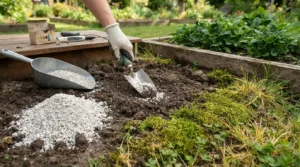
An iron-based moss killer does the job. Ferrous sulphate (sulphate of iron) is the classic, mixed at around 5 g per litre of water and applied at roughly a litre per square metre, though the exact rate is on the product label. Apply it two to three weeks before you plan to scarify, when the lawn is damp and the moss is actively growing. Black moss is dead moss.
Then address whatever let it in: cut back the shade where you can, fix the drainage, and feed the grass so it outcompetes the moss rather than surrendering to it. The full process, from identifying the moss to keeping it gone, is in our guide to getting rid of moss in a lawn.
When Not To Bother
Some lawns should not be scarified regardless of what the plug shows.
A lawn under a year old, because the root system isn’t established enough to survive the damage. A thin, patchy lawn, where the machine will take out more living grass than dead material and leave bare soil that fills with weeds. Deep shade under trees, where recovery is slow enough that the cure outlasts the disease. Anything in drought stress, dormancy, or the middle of summer heat.
And any lawn whose real problem is compaction. Scarifying does nothing for hard ground. That’s a different tool and a different job.
Timing Decides The Outcome
Scarifying only works if the grass has a strong growing window ahead of it to recover into. Everything else about the job is secondary to that.
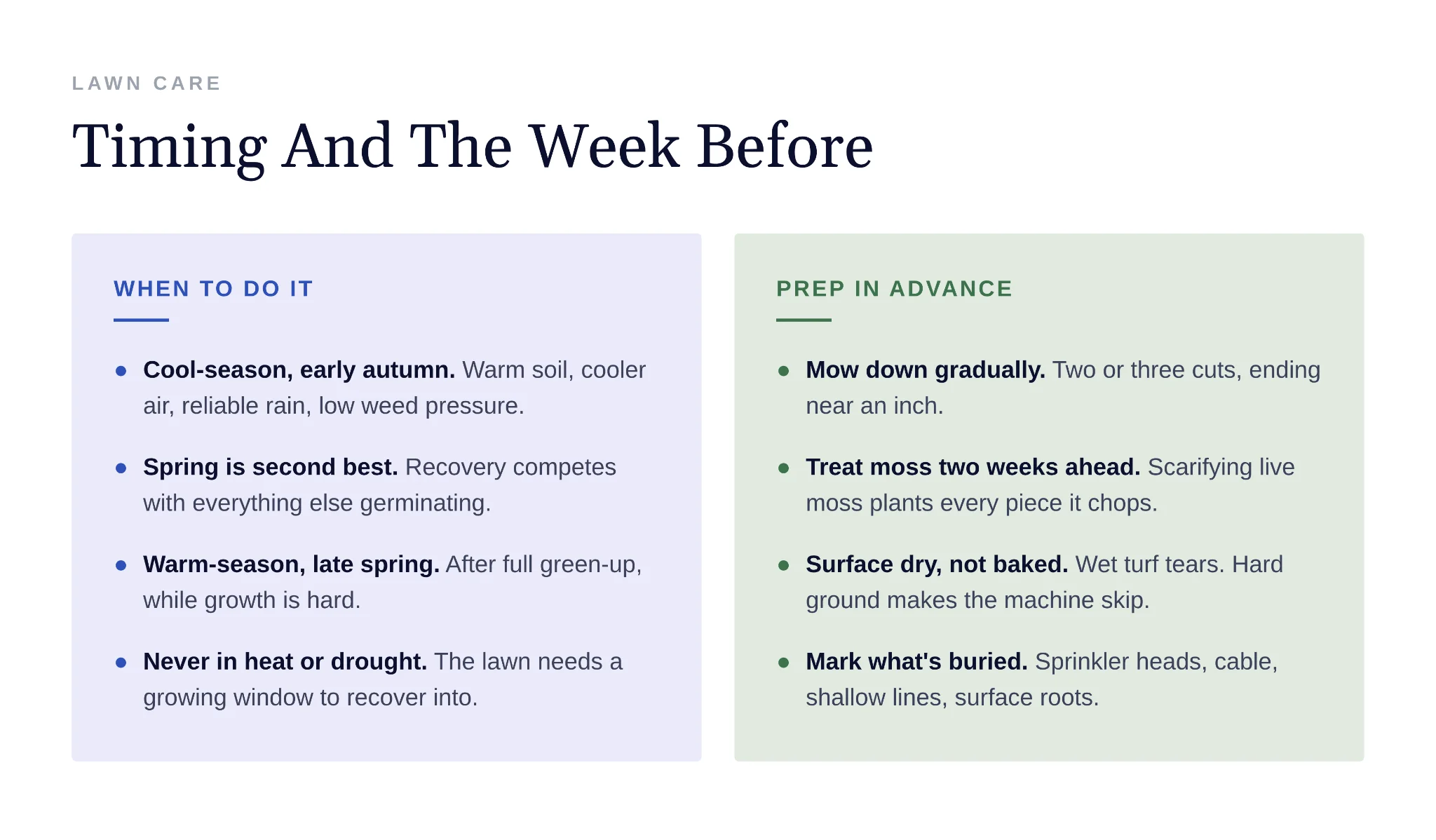
For cool-season grasses, early autumn is the best time by a wide margin. Soil is still warm, the air has cooled, rain is more reliable, and weed pressure has dropped off. Late August into September in most temperate climates.
Spring is the second option, once growth is properly underway and the soil has warmed, but the recovery competes with every annual weed germinating at the same time.
Warm-season grasses want late spring or early summer, after full green-up, when they’re growing hard.
Never during a dry spell. Never on frozen or waterlogged ground. And never as a tidy-up before an event, because the lawn will look considerably worse for at least three weeks.
In the UK, the calendar comes down to four windows:
| Window | Months | Verdict |
|---|---|---|
| Early autumn | September, into early October | The best window. Warm soil, cool air, reliable rain. Do the main scarifying here. |
| Spring | Late March to April | A workable second window once the soil has warmed, but expect weed competition. |
| Summer | June to August | Avoid. Heat and drought stress leave the lawn unable to recover. |
| Winter | November to February | Avoid. Cold, wet, or frozen ground. |
Warm-season lawns, and readers in Australia or the southern US, flip this: scarify in late spring or early summer, once the grass has fully greened up and is growing hard.
Before The Machine Comes Out
Bring the height down gradually over two or three cuts in the week beforehand, ending somewhere around an inch. Blades that have to fight through long grass just tear it rather than cutting into the thatch.
Moss needs treating two to three weeks ahead with an iron-based product, and it needs to have gone black before scarifying. Running a machine through live moss chops it into thousands of pieces and plants every one of them.
The lawn should be dry on the surface but not baked. Wet turf tears and the debris clogs the blades. Bone dry ground makes the machine skip and bounce.
Walk the lawn and mark anything hiding under the surface. Sprinkler heads, shallow irrigation lines, cable, the edge of a soakaway, the tree root that comes up under the birch. Blades and sprinkler bodies meet at speed, and only one of them survives.
Set The Blades High
The single most common mistake is setting depth by ambition rather than by result.
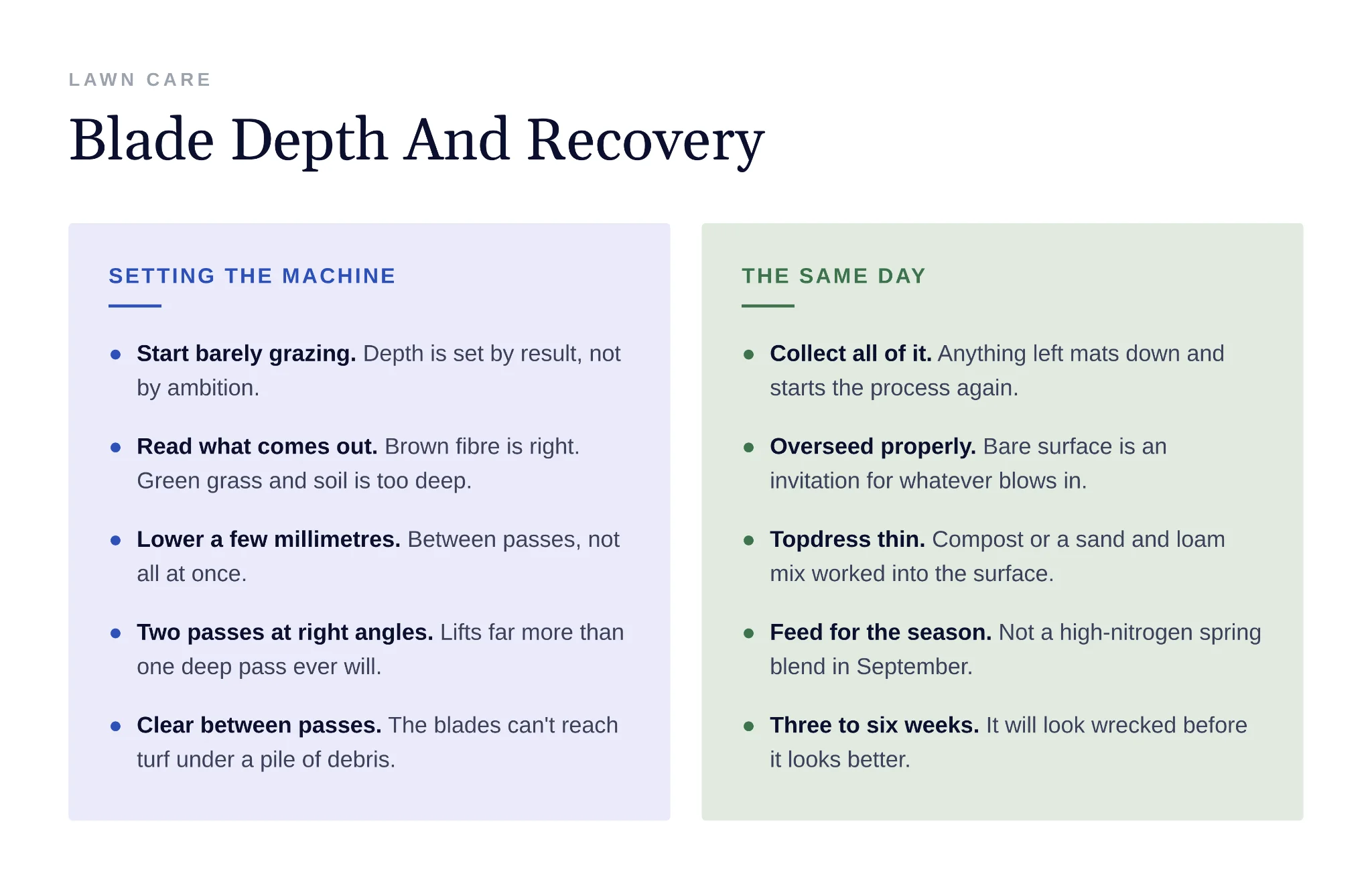
Start with the blades barely grazing the surface. Run one pass. Look at what’s coming out. If it’s mostly brown fibrous material, that’s right. If there’s live green grass and soil in the collection, it’s too deep, and going deeper removes more lawn.
Lower it a few millimeters at a time between passes, and stop when the debris coming out changes character.
Two passes at right angles to each other lift far more than one pass at double the depth. For a badly thatched lawn, a third at a diagonal. Between each one, clear the debris off, because the machine can’t reach the surface through a two-inch pile of what it already pulled out.
Hand raking is possible on a small lawn with a proper scarifying rake, and it is genuinely punishing work. Anything over a couple of hundred square feet, hire the machine.
The Part That Looks Like A Mistake
The volume of material that comes out of a thatched lawn is startling. Bags of it. On a bad lawn it can look like the turf has been removed entirely, and what’s left is thin, ragged, and brown with soil showing through.
That’s the job working. It isn’t a sign anything went wrong.
Rake and collect all of it, since anything left on the surface mats down and starts the process over. It composts well, given time.
Then repair immediately, the same day where possible. Overseed at a decent rate, top dress with a thin layer of compost or a sand and loam mix worked into the surface, and feed with something appropriate for the season rather than a high-nitrogen spring blend in autumn. Water consistently until the seed is up and established.
That watering window is where most reseeding fails. New seed on an opened surface needs light, frequent water for two to three weeks, which is a schedule almost nobody keeps by hand through a working week.
Aiper’s IrriSense 2 handles it unattended, with up to 10 zones set to their own depths and schedules, so a freshly scarified area can run short and often while the rest of the lawn stays on its normal cycle. It pauses itself when it rains, which matters when the surface is open and overwatering means washing seed into the low spots.
Three to six weeks to look like a lawn again, depending on the season and how hard the machine went.
Scarifying And Aerating Are Different Jobs
They get talked about together, and they fix opposite problems.
Scarifying removes organic matter from the surface. Aeration pulls plugs of soil out to relieve compaction and get air and water down into the root zone. A lawn can need one, both, or neither, and a plug that shows thin thatch over concrete-hard soil needs the aerator, not the blades.
When both are needed, scarify first, aerate second, then seed and topdress into the open holes. Doing it the other way round just fills the holes with debris.
Scarify, Dethatch, Or Power Rake?
If you’ve arrived here from the US, you may have searched “dethatch” and found this page. They’re the same family of job with different names and slightly different depths.
Scarifying, the UK term, runs vertical blades that slice through the thatch layer and just kiss the soil surface. Dethatching, as the word is used in the States, usually means a lighter pass aimed at lifting the thatch layer out. Power raking sits next to it: a machine that rakes the dead material up rather than slicing into it.
For a home lawn, the difference matters less than the principle running through this whole guide. Don’t set it deeper than the thatch you actually have. Whether the machine is called a scarifier, a dethatcher, or a power rake, the mistake is identical: going deep enough to take living grass and soil out with the thatch.
If dethatching is the job you’re actually after, we’ve covered the US process separately in our guide to how to dethatch a lawn.
The Reason It Came Back
If the same lawn needs scarifying again in two seasons, the scarifying wasn’t the problem being solved.
Feed less nitrogen and feed it more evenly across the year. Water deeply and infrequently so roots chase moisture downward. Topdress with compost annually, which is the slowest and most effective thing anyone does for thatch, because it puts the biology back that breaks the material down before it accumulates. Keep the soil pH in range and stop killing the earthworms.
Get that right, and a lawn that used to need the machine every other autumn goes ten years without it.
Frequently Asked Questions
Two light passes at right angles beat one deep pass, but only after the plug test says yes. Skip the test and even the best technique goes wrong.
Yes, and not in one go. Lower the height over two or three cuts the week before, ending around an inch. Cut too short at once and the lawn is stressed before you even start; leave it long and the blades tear instead of cutting into the thatch.
Four stand out: setting depth by ambition instead of result, scarifying live moss, doing it in the wrong season, and skipping the overseed and watering afterwards. Any one of these turns the job into wasted work.
Rake away all the debris the same day, then overseed, topdress thinly, and feed for the season. The real risk is the two to three weeks of light, frequent watering the new seed needs afterwards, which almost nobody sustains by hand.
Three to six weeks, and it looks worse before it looks better. The first week or two the lawn is thin and brown; that is the machine clearing the thatch out, not a mistake. Autumn recovery runs slower than spring.
Wait until the lawn is past its first full growing season. A lawn under a year old has not rooted deeply enough to survive the damage, so scarifying it just pulls young grass out before it has established.
Get more pool and lawn care guides from Aiper on Google