How to Get Rid of Moss in a Lawn (and Why It’s Really There)

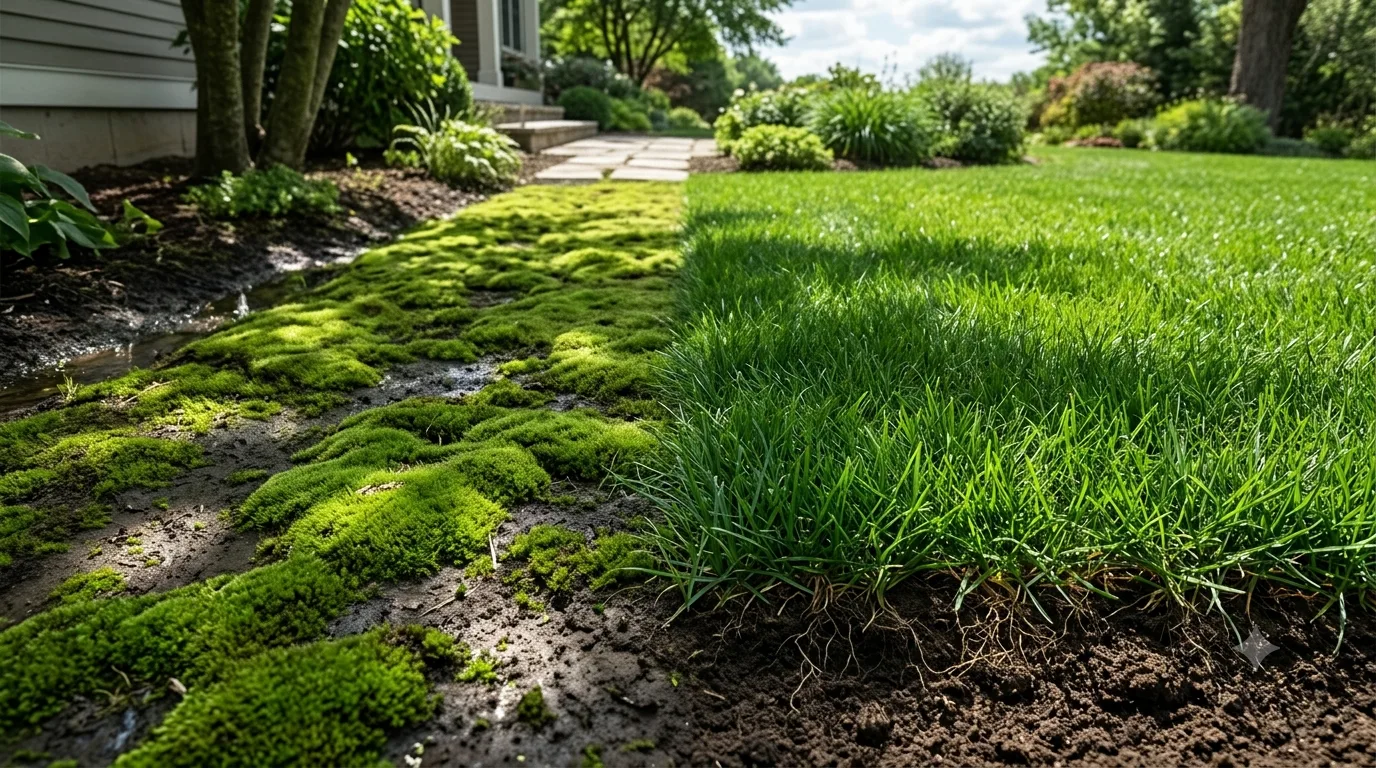
Moss doesn’t invade lawns.
That’s the first thing to get straight, because almost everything people do wrong about moss starts with treating it like an invader.
Grass loses ground, and moss moves into the vacancy. It’s an opportunist, not an aggressor. It has no real roots, it can’t compete with a healthy stand of turf, and it will lose that fight every single time the turf is actually healthy.
So when you stand over a green mat where your fescue used to be, the question isn’t how moss got there. The question is what killed the grass first.
Answer that, and the moss problem mostly solves itself. Skip it, and you’ll be back out there every April with a jug of iron sulfate, wondering why this keeps happening.
Kill the Moss First, Because It’s Easy
Let’s get the satisfying part out of the way. Moss is not hard to kill.
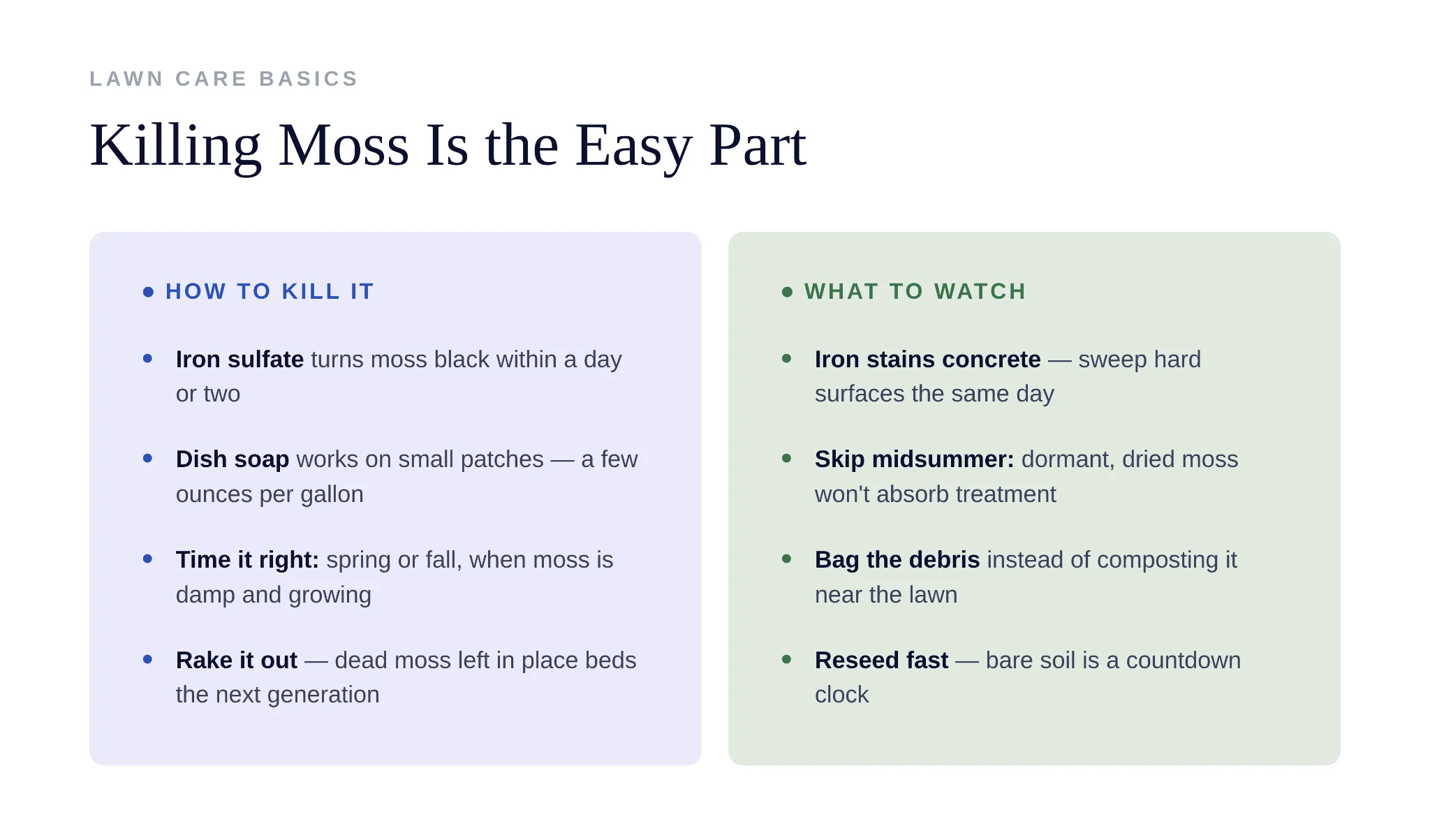
Iron. That’s the whole trick. Ferrous sulfate, sold as moss killer or lawn sand or in a dozen branded bottles, hits moss within hours.
You spray it or spread it, the moss turns black in a day or two, and then you rake out the dead material. The iron also greens up the surrounding grass, which is a nice side effect, turf loves iron, moss can’t tolerate it in concentration.
A few things worth knowing before you start:
Iron stains. Concrete, pavers, your driveway, the porch steps, anything it touches goes rust-orange and stays that way for a long time. Sweep granules off hard surfaces the same day. If you’re spraying liquid, watch your overspray and your boots.
Do it when the moss is actively growing and damp, usually early spring or fall. Hitting dormant, dried-out moss in July is spraying money at the ground.
Dish soap mixed with water works too, if you’d rather not buy anything: a few ounces per gallon, sprayed until the moss is soaked. It’s slower and less thorough than iron, but on a small patch it does the job.
Then rake. Dead moss doesn’t decompose in place fast enough to matter, and leaving a black felted mat on the soil just gives the next generation of spores a bed to land on. A spring-tine rake for small areas, a dethatcher for anything larger. Bag it out.
That’s it. Moss killed, moss removed. Two weekends, maybe.
The Moss Was Never the Problem
Every square foot of moss in your lawn is a diagnosis. It’s telling you, precisely and reliably, that the conditions in that exact spot favor a plant with no roots over a plant with deep ones.
Moss reads soil conditions better than any test kit. You just have to know what it’s saying.
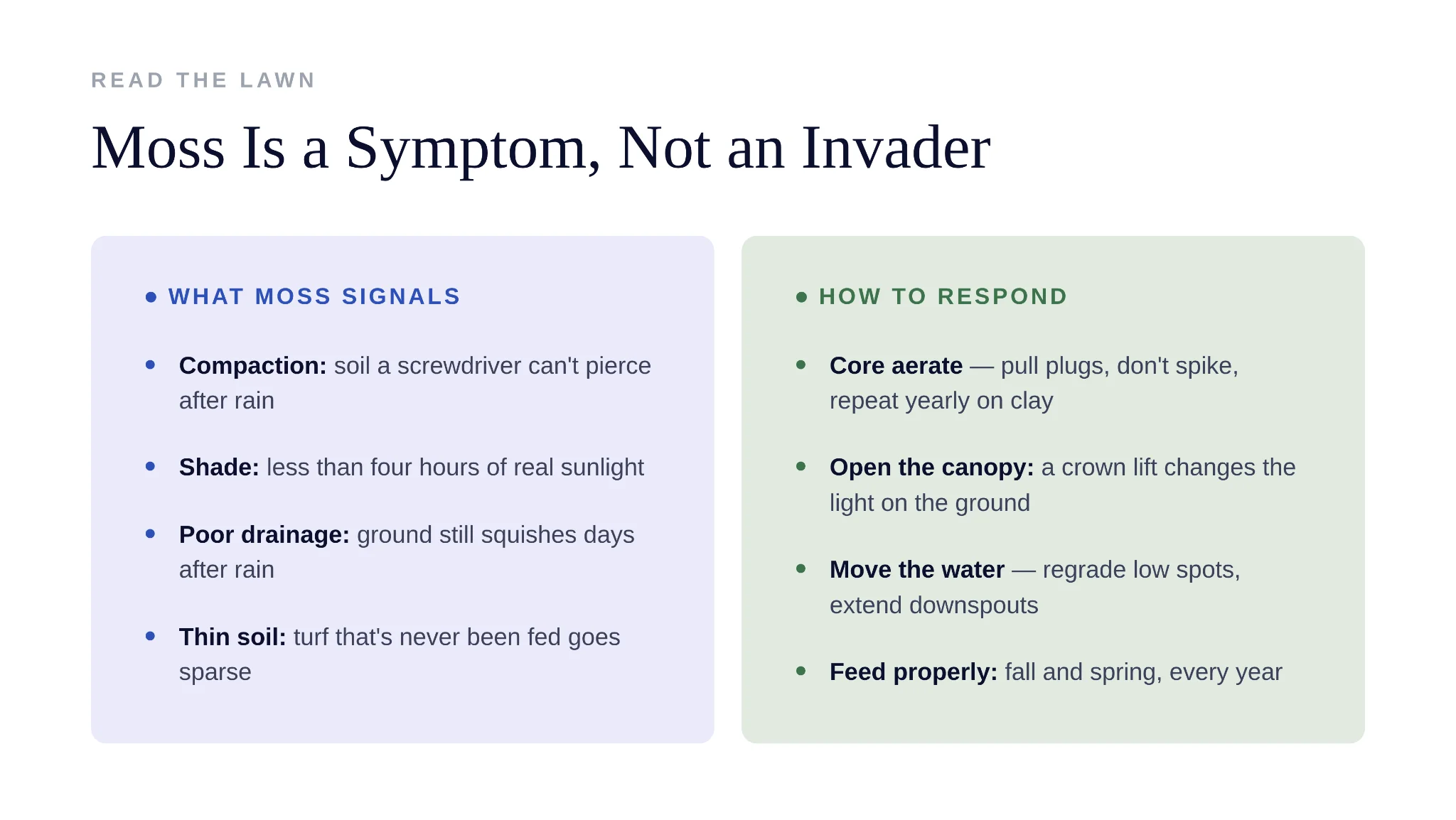
Usually it’s saying one of four things, and often two or three at once.
Compaction
This is the big one, and it’s the one people skip because fixing it involves actual labor. Grass roots need oxygen in pore spaces between soil particles.
Foot traffic, mower wheels, kids, dogs, clay soil that’s been rained on and walked on for a decade: it all presses those pore spaces shut.
Roots suffocate, grass thins, water stops penetrating and starts sitting on the surface. Moss, which has no roots and drinks through its leaves, thinks this is paradise.
Take a screwdriver out to the mossy patch after a rain. If you can’t push it into the soil with one hand, you’ve found your answer. Grass roots can’t push through what a screwdriver can’t.
The fix is core aeration that pulls plugs out, not the spiked shoes or the roller with spikes, which actually compact the sides of every hole they punch. Rent the machine, do the whole lawn, do it when the soil is moist but not soggy, and do it again next year, because one pass doesn’t undo ten years of compression.
Shade
Turf grasses want sun. Even the shade-tolerant fescues want four hours of decent light, and shade-tolerant on the seed bag means dies slower in shade, not thrives in it. Moss is fine with almost none.
The north side of the house. Under the maple that was a sapling when you moved in and is now sixty feet of canopy. Along the fence line. These are the spots, and you already know them. If new saplings are still popping up under that canopy or along the fence line, our guide on getting rid of tree saplings in a lawn covers pulling them before they turn into the next canopy tree.
You have three honest options here.
Prune the canopy up and thin it out to let real light through, a crown lift on a mature tree changes the light on the ground more than people expect.
Overseed with the most shade-tolerant grass you can get, usually a fine fescue blend, and accept a thinner stand.
Or stop fighting. Some spots will never grow good grass, and a deliberate moss lawn or a bed of shade perennials looks a lot better than the annual cycle of dead moss, patchy reseeding, and failure.
Drainage
Moss loves wet feet; grass roots rot in them. Low spots that hold water after rain, downspouts that dump onto the lawn, soil over buried construction debris that water can’t move through. If the mossy area squishes underfoot two days after the last rain, this is your issue.
Sometimes the fix is regrading a low spot with a few wheelbarrows of topsoil. Sometimes it’s extending a downspout ten feet. Sometimes it’s a French drain, which is a bigger conversation.
Thin, hungry soil
Grass that’s never fed gets sparse, and sparse turf is an open door. This one’s cheap to fix, a real fertility program, fall and spring, but it’s rarely the whole story on its own.
What to Know About pH
The standard advice says moss means acidic soil, so spread lime. It’s repeated everywhere, and it’s mostly a distraction.
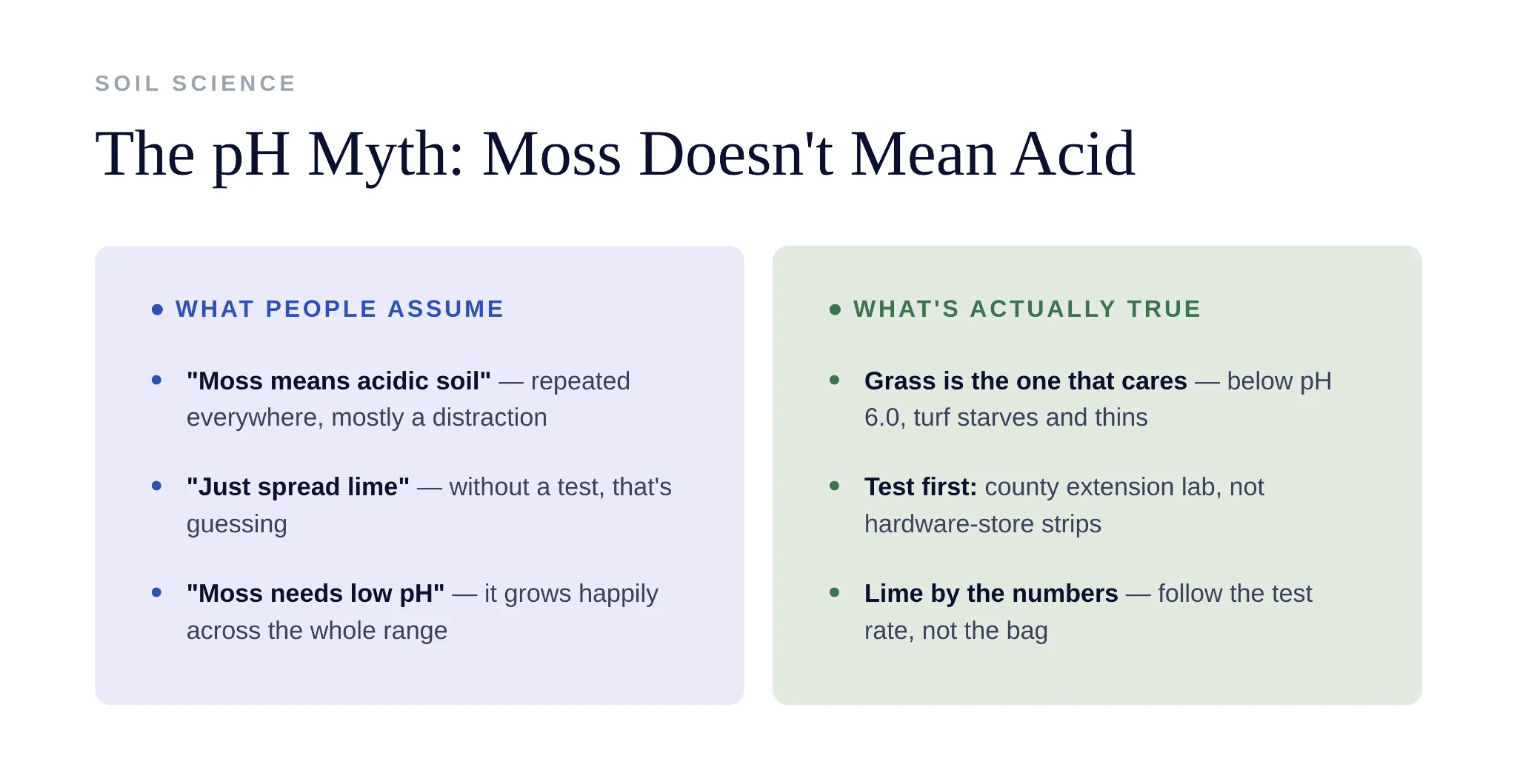
Moss grows happily across a wide pH range. Acidic, neutral, mildly alkaline, it doesn’t much care.
The reason acidity gets blamed is that grass cares. Below about 6.0, turf starts struggling to pull nutrients from the soil, the stand thins, and moss takes the opening.
So low pH can be the underlying reason grass failed, but liming a lawn without testing it first is guessing, and liming a lawn that’s already at 6.8 does nothing except waste a Saturday and possibly push your pH somewhere grass likes even less.
Get a soil test through your county extension office. It costs about the price of a bag of lime and tells you pH, phosphorus, potassium, organic matter, and the actual picture.
If it comes back at 5.4, then yes, lime, and follow the rate the test recommends rather than the bag. If it comes back fine, you’ve just saved yourself from years of pointless lime applications, and you can go look at the screwdriver test again.
Filling the Space Back In
Bare soil after moss removal is a countdown clock. Something is going to grow there. You get to choose what, but only if you move fast.
Overseed immediately after raking out the dead moss, the raking itself roughs up the soil surface, which is exactly the seed-to-soil contact you want.
Match the seed to the conditions you just diagnosed: fine fescue for the shady spots, a quality tall fescue or bluegrass blend for the open areas, and skip anything labeled contractor’s mix, which is filler.
Keep it damp until germination, which means light watering daily for two to three weeks, which means this is a spring or early fall project, not a July one. New grass in summer heat is a funeral you scheduled yourself.
Then mow the grass high. Three inches, minimum, forever. Tall grass shades the soil surface, and a shaded soil surface is hostile ground for moss spores trying to establish. Scalped lawns invite moss the same way compacted ones do. Of all the ongoing habits, this one costs nothing and matters most.
What This Actually Looks Like Over a Year
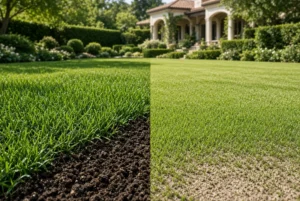
The moss might come back a little the first year in the worst spots. Less the second year. By the third, in most of the lawn, it’s gone, not because you kept killing it, but because there’s nothing left for it. Thick turf on open soil in decent light doesn’t leave a vacancy.
The Aiper IrriSense 2 maps up to 10 independent zones across 4,800 square feet, so the shady north strip and the open, fast-drying front yard each get watered on their own terms instead of one blanket schedule.
Weather-Sense skips cycles after rain and adjusts through dry stretches automatically, which means the soil surface gets a chance to dry out between waterings, grass roots stay fed, and moss loses its habitat.
The same principle as everything else in this guide: fix the conditions, and the moss has nowhere to come back to.
Get more pool and lawn care guides from Aiper on Google