How to Drain an Inground Pool Without Popping It

A pool full of water is one of the heaviest objects on a residential property. Empty, it becomes one of the lightest things buried in wet ground, and the physics holding it in place reverses.
That’s why contractors treat draining as a scheduled operation with conditions attached rather than something you do on a Saturday because the water looks bad.
A shell that lifts cracks across the floor, settles crooked, or takes a liner with it, and none of those are repairs measured in hundreds of dollars.
What Makes a Pool Pop
Groundwater sits in the soil around and under the shell and pushes upward. Full, the pool holds it down, water weighs about 62 pounds per cubic foot, which for an average residential pool means somewhere north of 150 tons of ballast.
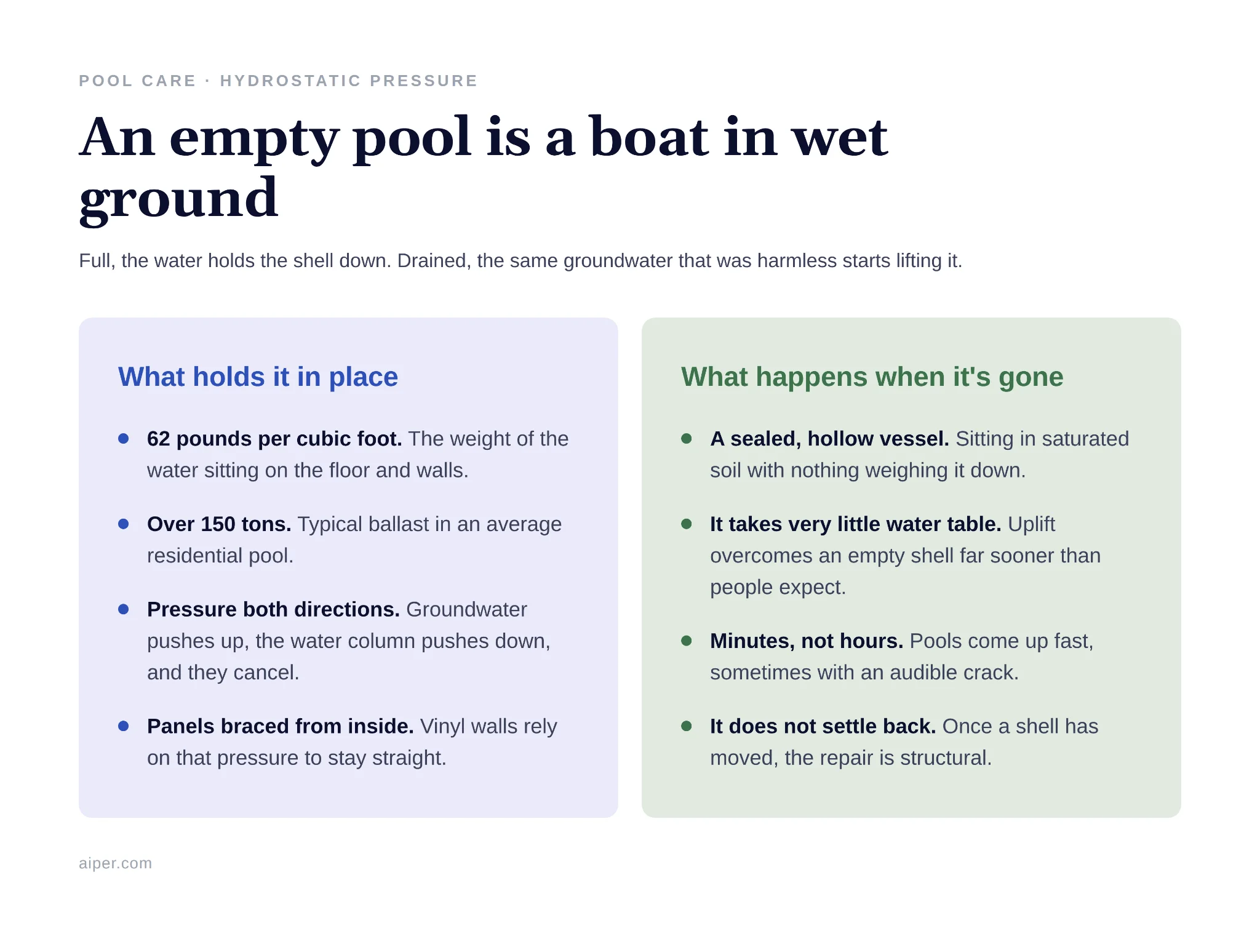
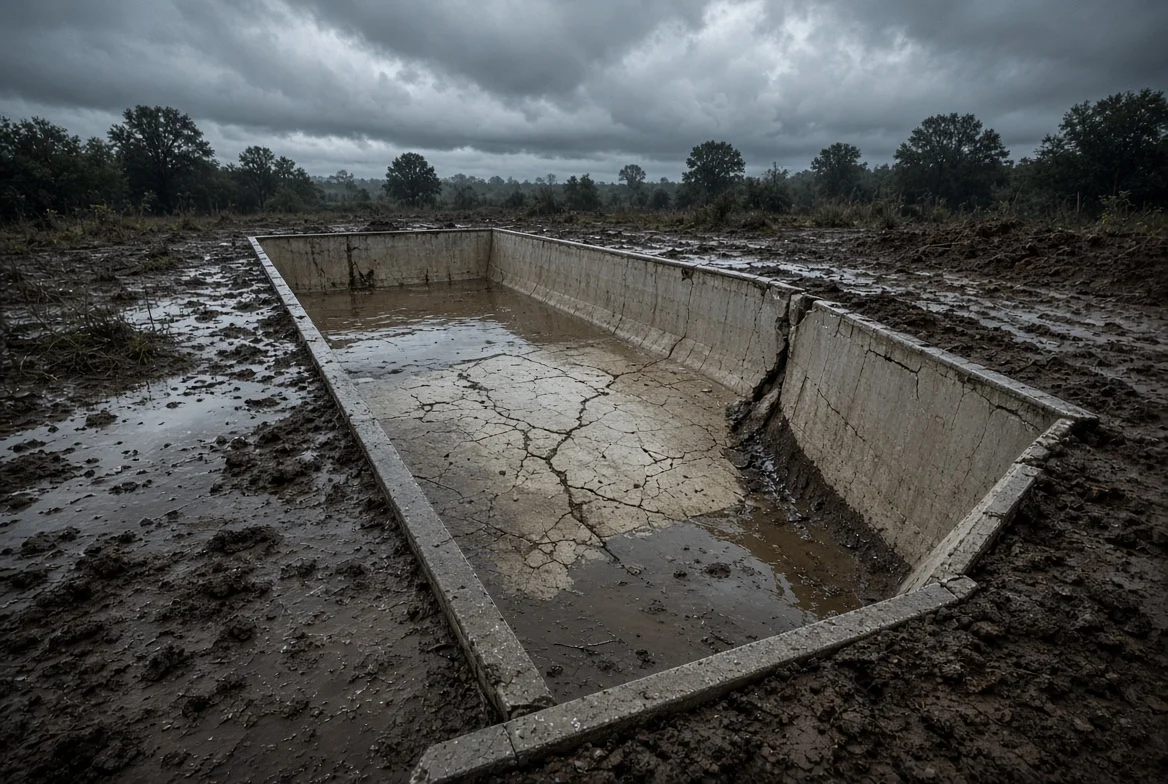
Drain it and what’s left is a large, hollow, watertight vessel sitting in saturated soil.
Uplift doesn’t need much of a water table to overcome an empty shell, and it doesn’t happen slowly enough to catch. Pools come up in minutes, sometimes with an audible crack, and once a shell has moved, it does not go back.
Check Whether You Need to Drain at All
Most drains that go wrong were unnecessary.
A full drain is genuinely required for replastering, liner replacement, structural crack repair, and acid washing stained plaster. That’s close to the whole list.
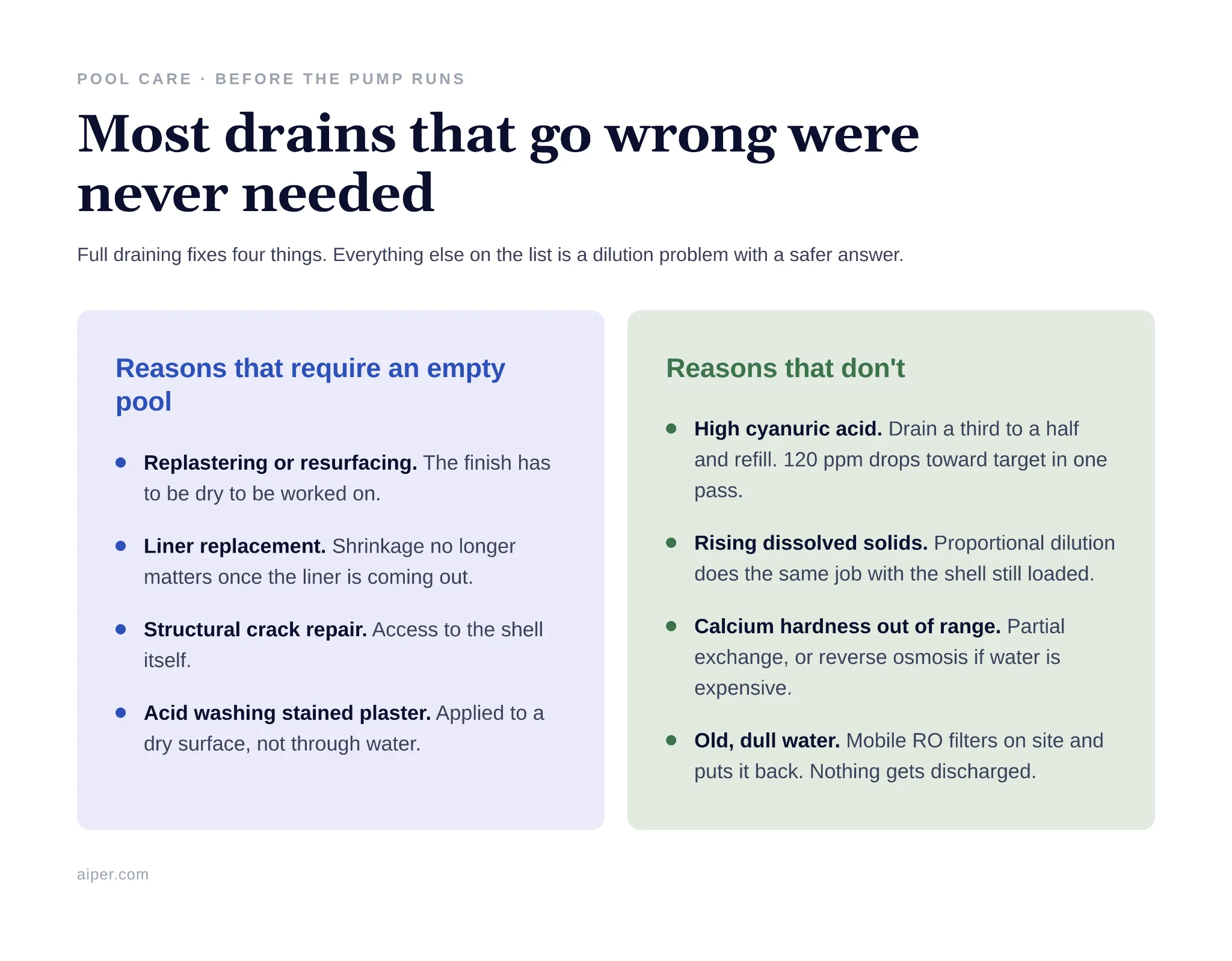
Everything else people drain for: cyanuric acid too high, dissolved solids climbing, calcium hardness out of range, water that’s simply old, is a dilution problem, and dilution doesn’t need an empty pool.
Draining a third to a half and refilling drops those numbers proportionally. CYA at 120 against a target of 50 gets most of the way there in one pass.
Reverse osmosis is the other route. Mobile services filter the existing water on site, strip the dissolved solids and stabilizer, and put it back. The level never drops far enough to matter, and nothing gets discharged. On a property with a known high water table, price it before anything else, because it removes the risk instead of managing it.
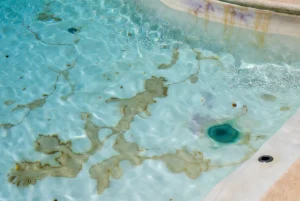
Of those four, one is preventable. Plaster stains from organic debris that sat in one place long enough to leach into the surface, and leaves collecting in the same corner every autumn are how a pool ends up needing an acid wash it was never going to need otherwise.
A robotic pool cleaner run on a regular cycle lifts that material off the floor and walls before it marks anything, which keeps the most avoidable reason for a full drain off the table.
Find Out Where the Water Table Sits
Do this before scheduling anything.
The simplest test uses the pool itself. At the deepest point, in the main drain sump, most concrete pools have a hydrostatic relief valve. Pull the plug with the pool full and watch. Water rising through the opening means the table is above the pool floor, and draining without dewatering will float the shell.
No valve, or a plug seized with scale? Drive a well point or auger a test hole a few feet from the pool wall, past the depth of the floor, and see where water stands in it after a day.
Other signals: a basement sump pump that runs regularly, standing water that lingers in the yard after rain, a creek or pond nearby, a neighbor whose pool has floated, a lot at the low end of a sloping street.
A high table doesn’t make the drain impossible. It makes it a job that requires dewatering.
Open the Hydrostatic Relief Valve
If the pool has one, it exists for exactly this.
Removing the plug lets groundwater flow into the empty shell rather than pushing against the underside of it. The pool partly fills from below, which looks alarming and is the system working.
Pressure equalizes, and the shell stays put.
Two failures come up constantly: a valve nobody opened because the drain cover was never lifted, and a valve that’s been submerged for fifteen years, packed with debris, and won’t move when it matters. Clean it and confirm it opens freely before the water goes down.
Leave it open the whole time the pool is empty. Re-plug it as the refill starts.
Rent a Well Point If the Table Is High
Where groundwater sits above the pool floor, the answer is to lower it temporarily. A well point is a perforated pipe driven into the ground beside the pool, connected to a pump that pulls groundwater out and discharges it away from the site.
Start it before the drain begins, run it the entire time the shell is empty, and stop only once the refill is underway.
This is standard practice in coastal areas, river valleys, and clay soils. It’s also the step homeowners skip, and a pool that pops with a well point running is rare.
Watch the Forecast, Not the Season
Dry season is necessary and not sufficient.
Groundwater responds to rainfall with a lag, so a heavy storm two days before the drain can put the table at its seasonal peak during a week that looks clear. Check the forecast across the entire window the pool will be down, not just the day you start.
Two inches overnight onto an empty pool is the classic scenario. Fine at 6 p.m., lifted before morning.
If the forecast turns mid-job, start refilling immediately, finished or not.
Vinyl Liner Pools Have a Second Problem
Uplift applies here too, and the liner adds a failure mode that has nothing to do with groundwater.
Vinyl shrinks. Dry and in the sun, a liner tightens within hours and will not stretch back, which turns a drain into a liner replacement. The wall panels are the other concern, because they’re braced by water pressure from the inside, and steel or polymer walls in wet soil can bow inward once that support is gone.
A vinyl pool shouldn’t be fully drained as routine maintenance. If it has to come down, work on an overcast day, keep the empty time to hours, and have the replacement liner on site before the pump starts.
Fiberglass Pools Float the Easiest
The shell is light, sealed, and a single piece, with less mass resisting uplift than anything else in the ground.
Most manufacturers void the warranty on a drain, and most require an authorized installer, active dewatering, and staged refilling.
Treat it as a contractor call with liability attached rather than a weekend project.
Confirm Where the Water Is Allowed to Go
This gets people fined, sometimes per day.
Chlorinated and salt water discharged to a storm drain reaches a creek or a bay untreated, and most jurisdictions prohibit it. Many require discharge to the sanitary sewer through a cleanout at a metered rate. Some allow landscape discharge only after chlorine has fully dissipated, and only for non-salt pools.
Salt water is a problem regardless of the rules. It kills turf and ornamentals, and the damage shows up weeks later in the shape of the discharge path.
One call to the local water authority settles it, and the answer varies enough between municipalities that assuming is a mistake.
Have Everything On Site Before the First Gallon Leaves
Empty time is the variable that matters, and nearly everything that goes wrong is a consequence of a shell sitting longer than planned.
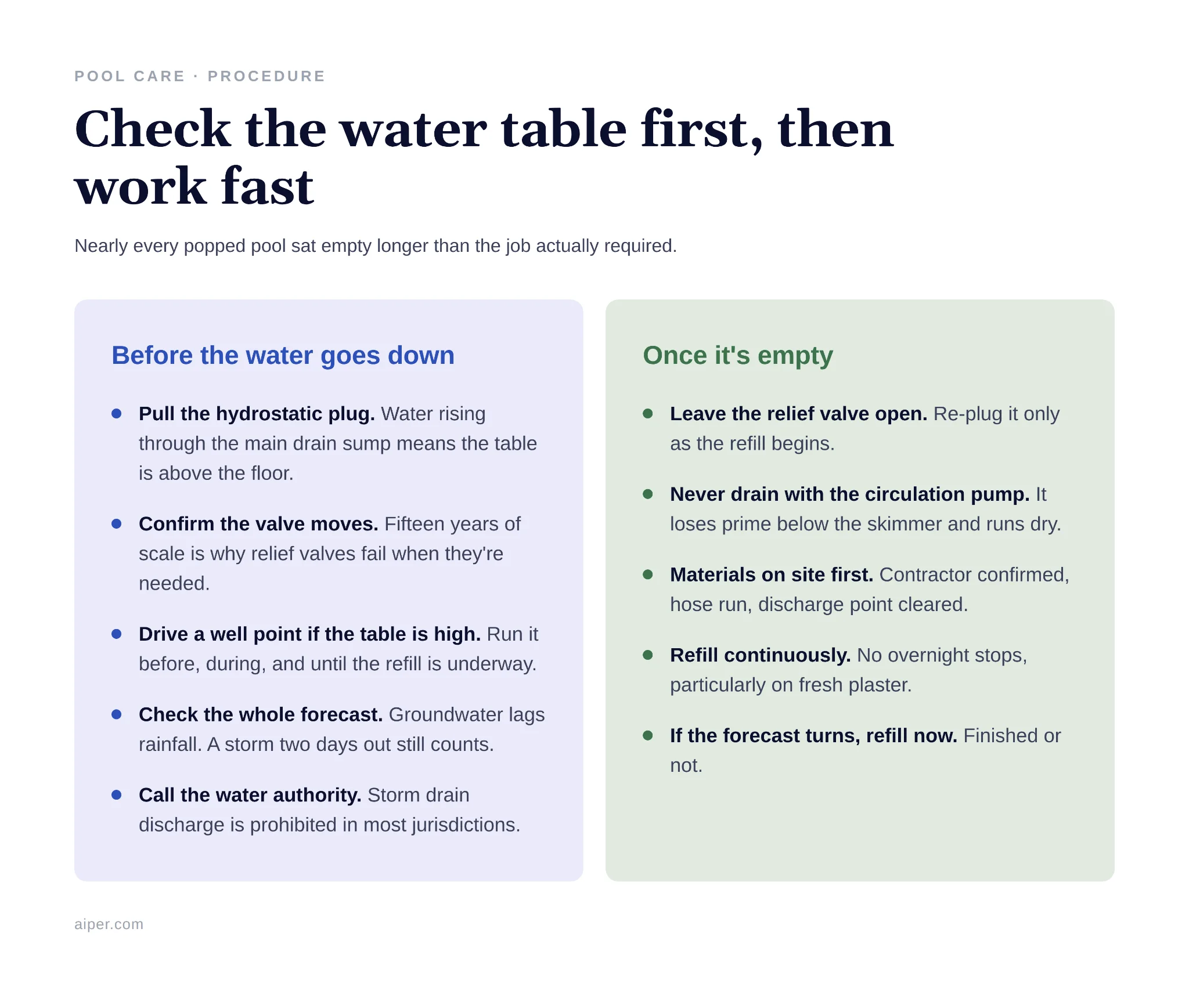
Materials delivered. Contractor confirmed. Pump tested, hose run, discharge point cleared. Relief valve open. Well point in and running if the site needs one.
Don’t use the circulation pump to empty the pool. It loses prime below the skimmer and runs dry, which takes out the seal and usually the motor. A rented submersible sized for the volume does it in hours.
Then refill continuously, without stopping overnight.
The Pools That Pop Are the Ones That Waited
Almost none come up during the drain itself.
They come up on the second night, or over a weekend when a part didn’t arrive, and the shell sat three extra days, or after a storm that wasn’t in the forecast when the job started.
Every hour past what the work actually requires is spent for nothing.
Get more pool and lawn care guides from Aiper on Google