Pool Temperature vs Air Temperature: Why They Disconnect and When to Care

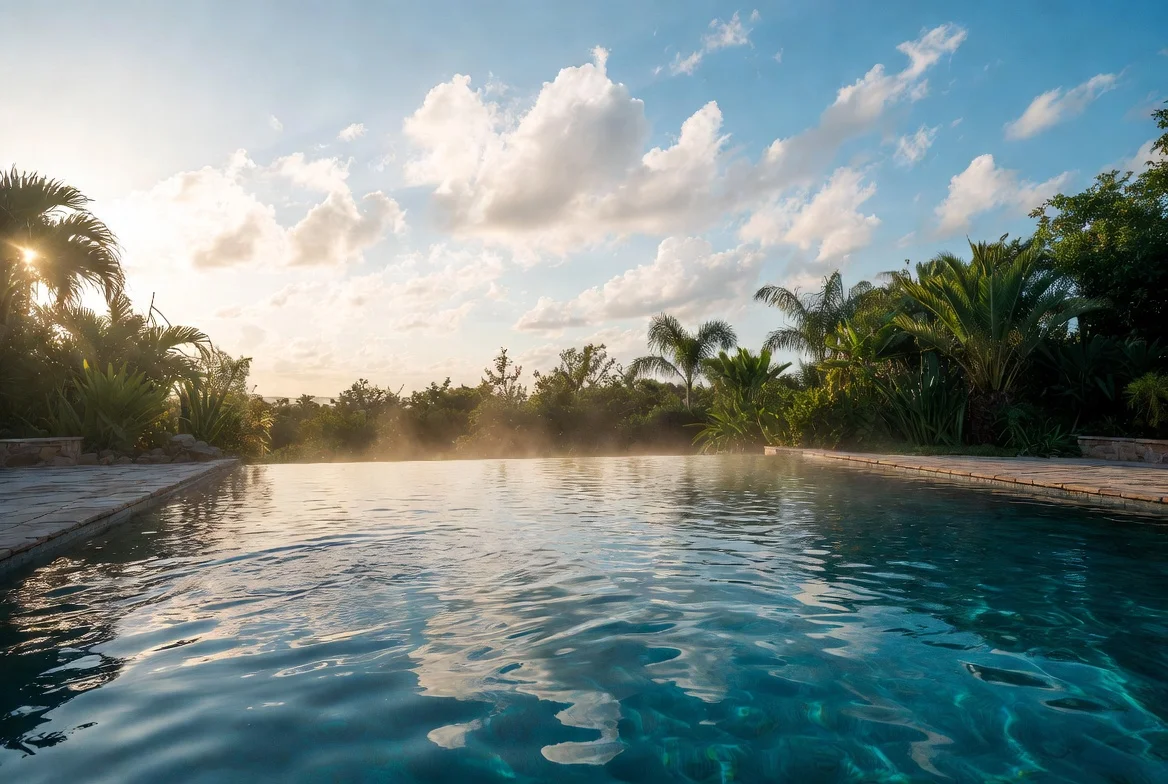
Ask ten pool owners how warm their water is and eight of them will glance at the weather app. That reflex is understandable and almost always wrong.
Water and air run on different clocks, and the gap between them is where most of the confusion lives: why the pool feels freezing on the first genuinely hot Saturday of the season, why it’s still swimmable in October when the mornings have turned cold, why your heating bill spikes in months that don’t look like heating months.
None of it is mysterious once you understand what water does with heat. But you have to stop expecting the two numbers to move together.
Water Holds Heat the Way Air Never Will
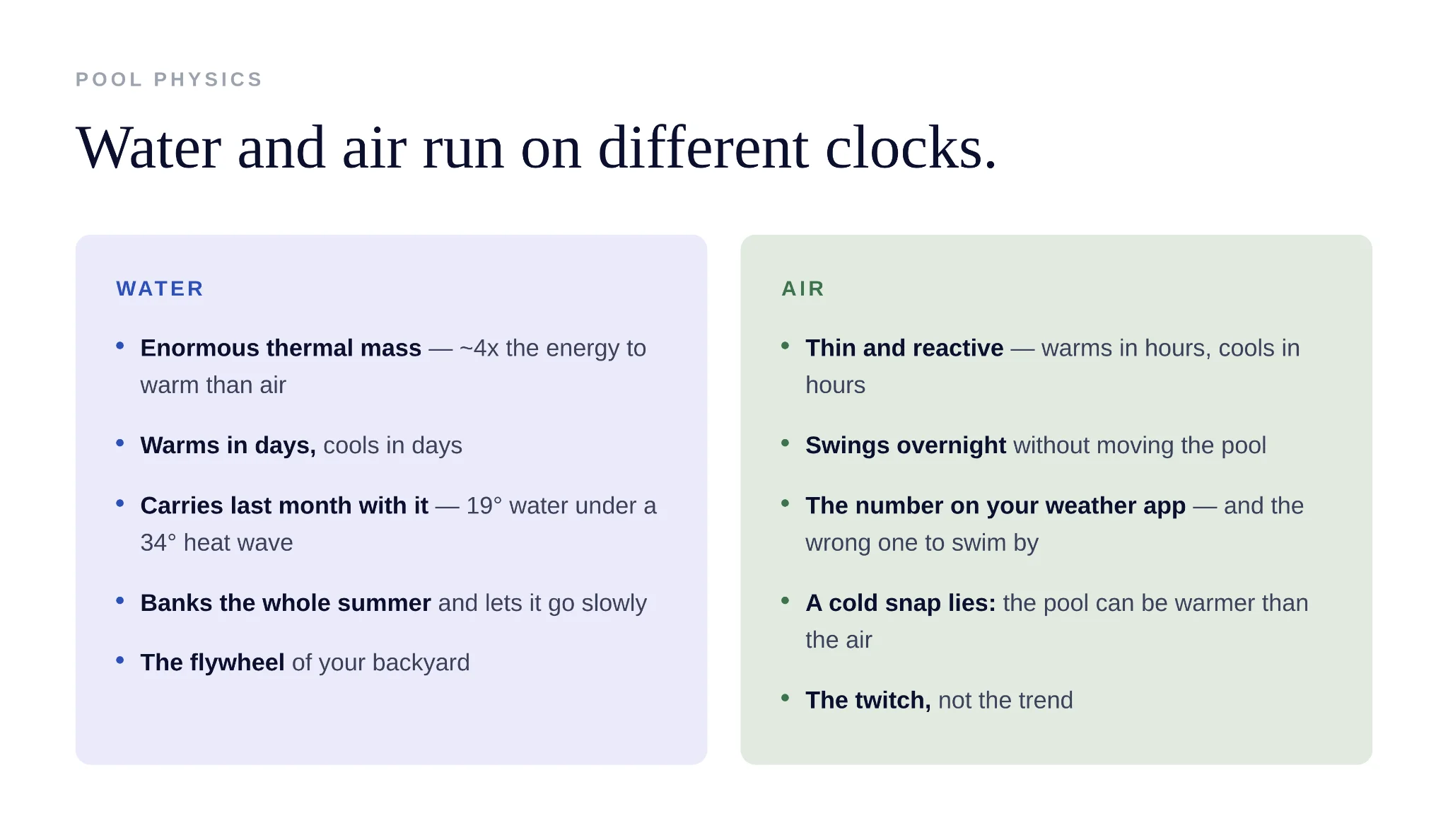
The physics fits in one paragraph. Water has enormous thermal mass. It takes roughly four times more energy to warm a kilogram of water by one degree than a kilogram of air, and your pool holds tens of thousands of kilograms of it.
Air is thin and reactive. It warms in hours and cools in hours. Water warms in days and cools in days.
That single fact explains almost every disconnect you’ll notice.
A three-day heat wave in May barely moves an unheated pool. The air hits 34 degrees, everyone’s sweating, and the water is sitting at 19 because it’s still carrying April in it. Reverse it in autumn: a cold snap rolls through in late September, the air drops to 14 overnight, and the pool is somehow still 26, warmer than the air around it, because it banked a whole summer and it lets go slowly.
The pool is a flywheel. Air temperature is a twitch.
The math shifts again if you’re running an above-ground pool. A steel-frame wall conducts ambient heat through its sides much faster than a resin one does, so two same-size pools can sit at noticeably different temperatures on an identical day — see our comparison of resin vs steel above-ground frames for how that plays out.
Where the Heat Actually Goes
Cold air gets blamed for cold pools, and it’s mostly innocent. The real losses happen at the surface, and they follow rules that have surprisingly little to do with the number on your weather app.
Three mechanisms do nearly all the damage, and they’re worth knowing separately because you defend against each one differently.
Evaporation is the thief
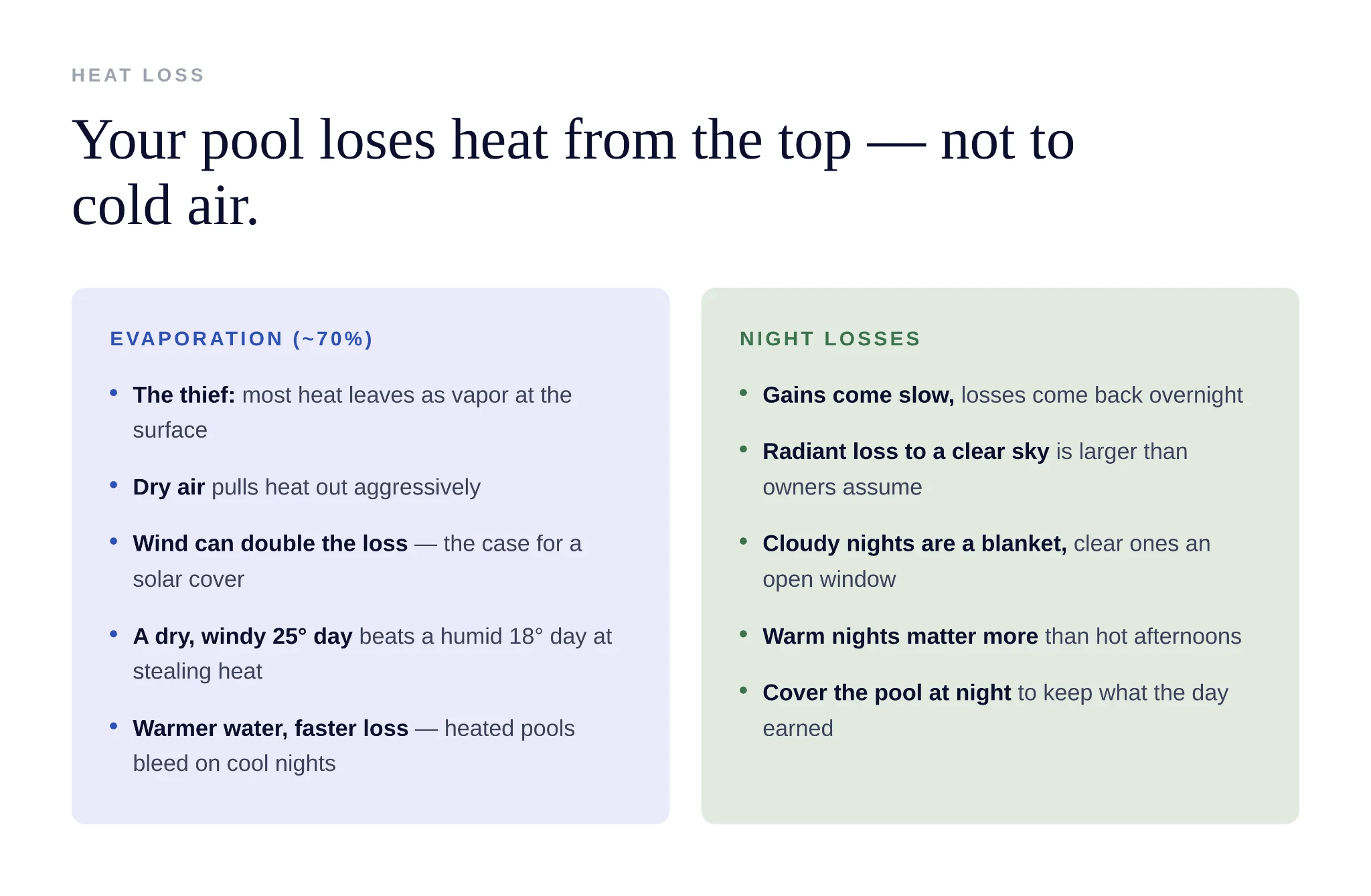
Somewhere around 70 percent of a pool’s heat loss goes out through water turning to vapor at the surface, and evaporation doesn’t care much about air temperature. What actually drives it:
Humidity. Dry air pulls moisture (and heat) out of the water aggressively. A dry, windy 25-degree day strips more heat from your pool than a still, humid 18-degree day — and so does a light-colored finish, which is why dark-bottom pools run warmer than light ones.
Wind. A steady breeze across an uncovered pool can double evaporative loss. This is the entire business case for a solar cover, and for that hedge you were thinking about planting anyway.
The water-air gap itself. The warmer the water relative to the air above it, the faster it evaporates, which is why heated pools bleed money on cool, dry nights.
This is also why a desert Southwest pool can feel cold in weather that looks perfect on paper, while a muggy Gulf Coast pool holds temperature in conditions that seem worse.
Nights cost more than days
A pool gains slowly through a hot afternoon and then hands a chunk of it back overnight. Radiant loss to a clear night sky is real and larger than most owners assume.
Cloudy nights are a blanket. Clear ones are an open window.
The Lag, and Why Timing Beats Temperature
Because water trails air by days to weeks, the seasons of your pool don’t line up with the seasons on the calendar. That lag shows up at both ends of the year, and it behaves differently in each direction.
Late summer runs long
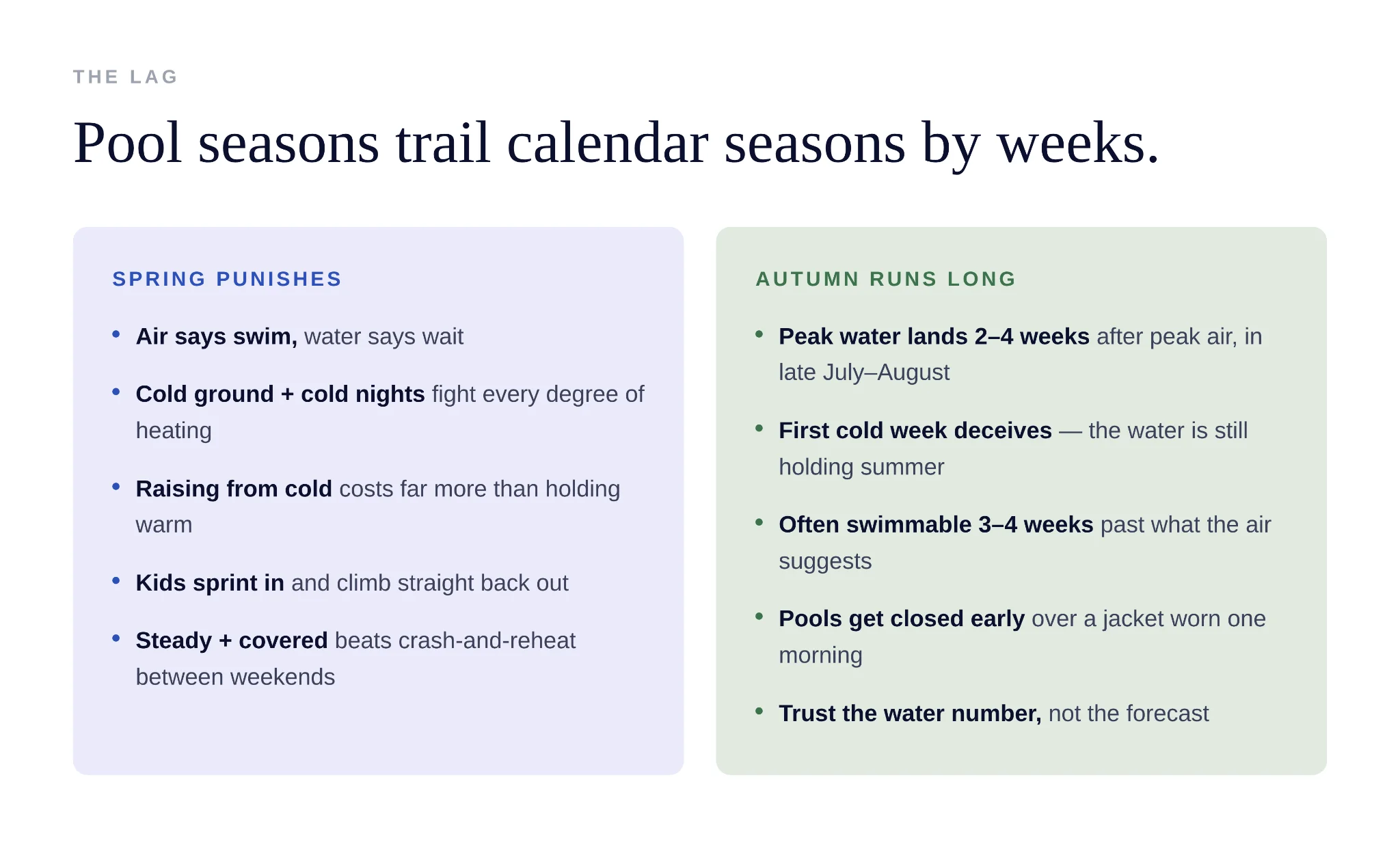
Peak air temperature in most regions hits in July. Peak water temperature often lands two to four weeks later, in late July or August, after the pool has had time to absorb the accumulated heat.
Same lag in reverse: the first cold week of fall feels like the end of the season, but the water frequently stays swimmable another three or four weeks past the point where the air says otherwise. People close their pools early every year based on a jacket they wore one morning. If you’re closing on water temperature instead of the calendar, the next step is clearing the plumbing, and blowing out pool lines once the water cools walks through each line in order.
Spring punishes hardest
The air says swim. The water says wait.
This is the season of kids sprinting in and climbing straight back out, and the season where pool heaters do their most expensive work, because heating a pool in spring means fighting cold ground, cold nights, and a water mass that spent months at 10 degrees.
If you heat, the lag carries a money lesson: raising a pool from cold takes vastly more energy than holding it warm. A pool allowed to crash between weekend swims costs more than one held at a steady, slightly lower temperature under a cover. The flywheel works for you or against you. Your choice.
When the Gap Actually Matters
Most of the time, the water-air disconnect is trivia. Sometimes it’s the whole ballgame, and the cases where it matters are exactly the cases where the weather app misleads you most.
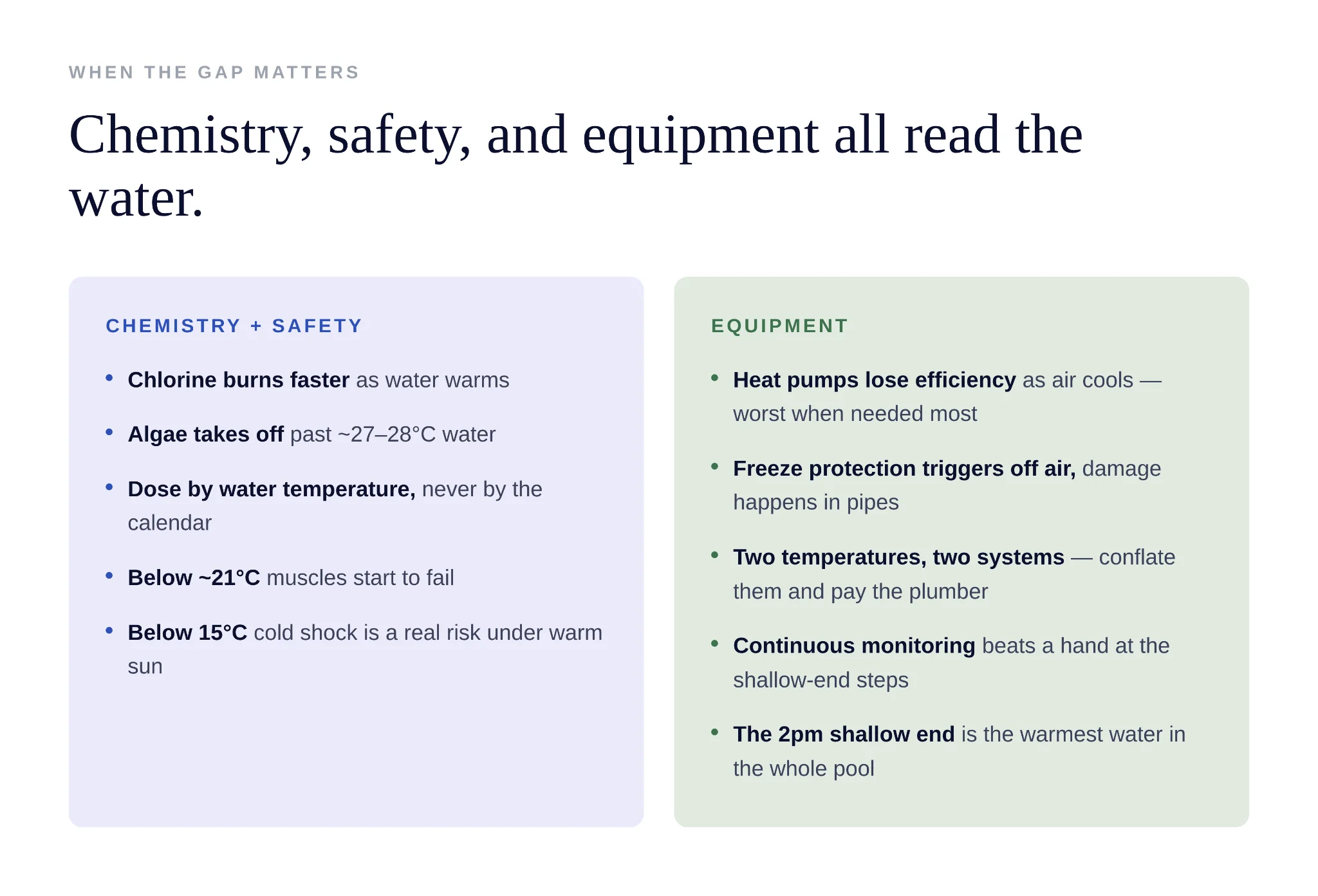
Chemistry tracks the water, not the sky
Sanitizer behavior follows water temperature. In practice that means:
Chlorine gets consumed faster as water warms. A pool at 30 degrees burns through sanitizer at a very different rate than the same pool at 20, even if the afternoons feel identical to you.
Algae blooms take off somewhere past 27-28 degrees. Warm water is a growth medium; warm air is not.
Owners who dose by the calendar instead of by water temperature spend late summer wondering why the pool went green during “the same routine that worked all year.”
Cold water under warm air is a safety trap
Water below about 21 degrees starts affecting muscle performance. Below 15, cold shock is a genuine risk even for strong swimmers. And because a warm sunny day can sit on top of dangerously cold water (early season, especially), the air is actively lying to you exactly when the stakes are highest. Judging the water by the weather is how people end up gasping in a 13-degree pool in April. That’s the kind of risk a barrier alone can’t manage — a fence or net keeps people from wandering in, but only checking the actual water temperature tells you whether it’s safe once they’re through the gate; see our comparison of pool safety nets vs fences for the access-control side of the equation.
Equipment reads both numbers
Heat pumps lose efficiency as air temperature drops, which means the coldest weeks are the weeks they work worst. Where each heater type wins is covered in heat pump versus gas heater climate and payback. Freeze protection triggers off air, but the damage happens in water and pipes. Two systems, two temperatures, one plumbing bill if you conflate them — settle the distinction with our guide to the real difference between pool spas and hot tubs.
Stop Guessing at the Number
Everything above assumes you actually know your water temperature, and most owners don’t, not really.
They know what the weather app says, and they know what their hand felt like at the shallow-end steps at 2 pm, which is the warmest water in the entire pool at the warmest moment of the day.
A floating pool thermometer costs little and checking it in the morning before you adjust chemicals takes about as long as opening the weather app you were going to check anyway. Water temperature is a chemical input, not just a comfort reading, and the pool that gets treated by the number in the water stays cleaner than the one that gets treated by the number in the sky.
Get more pool and lawn care guides from Aiper on Google