How to Keep Flying Ants Out of a Pool During Swarm Season

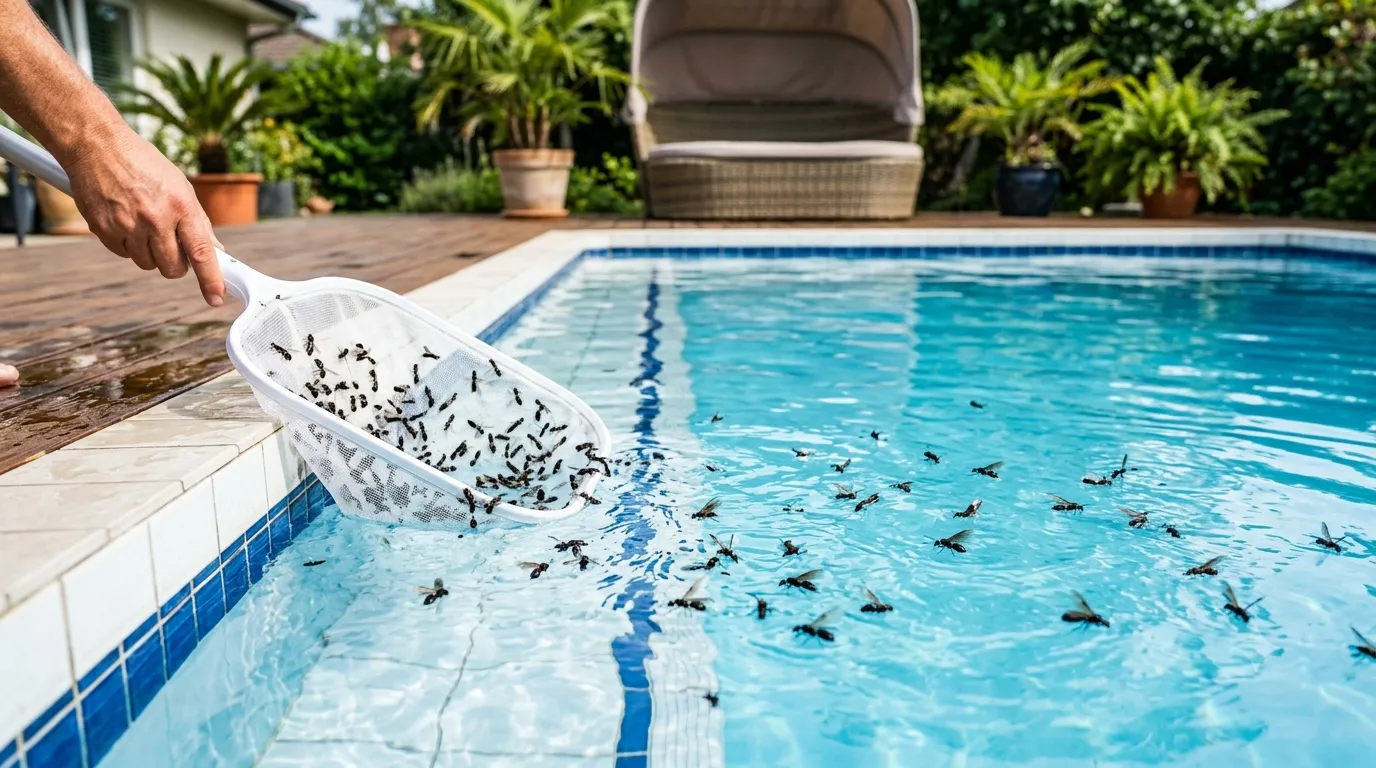
A flying ant swarm is a few hours of reproductive traffic that a colony has been building toward all year, and it ends on its own whether you do anything or not.
That’s the good news.
The bad news is that during those few hours, a swimming pool is close to the most attractive object in the landscape: a wide, flat, glinting sheet of water sitting in full sun in the middle of a warm, humid, windless afternoon.
By the time the flight is over, you can have a surface so thick with bodies and shed wings that it looks like someone emptied a vacuum bag into it.
So the goal is to know which afternoon it’s going to be, and be ready an hour before.
Know What You’re Looking At
Two-second check before anything else.
Ants have a pinched waist, elbowed antennae, and forewings noticeably longer than the hind pair. Termite alates have a straight, thick body, straight beaded antennae, and four wings all the same length that fall off almost immediately in a pile.
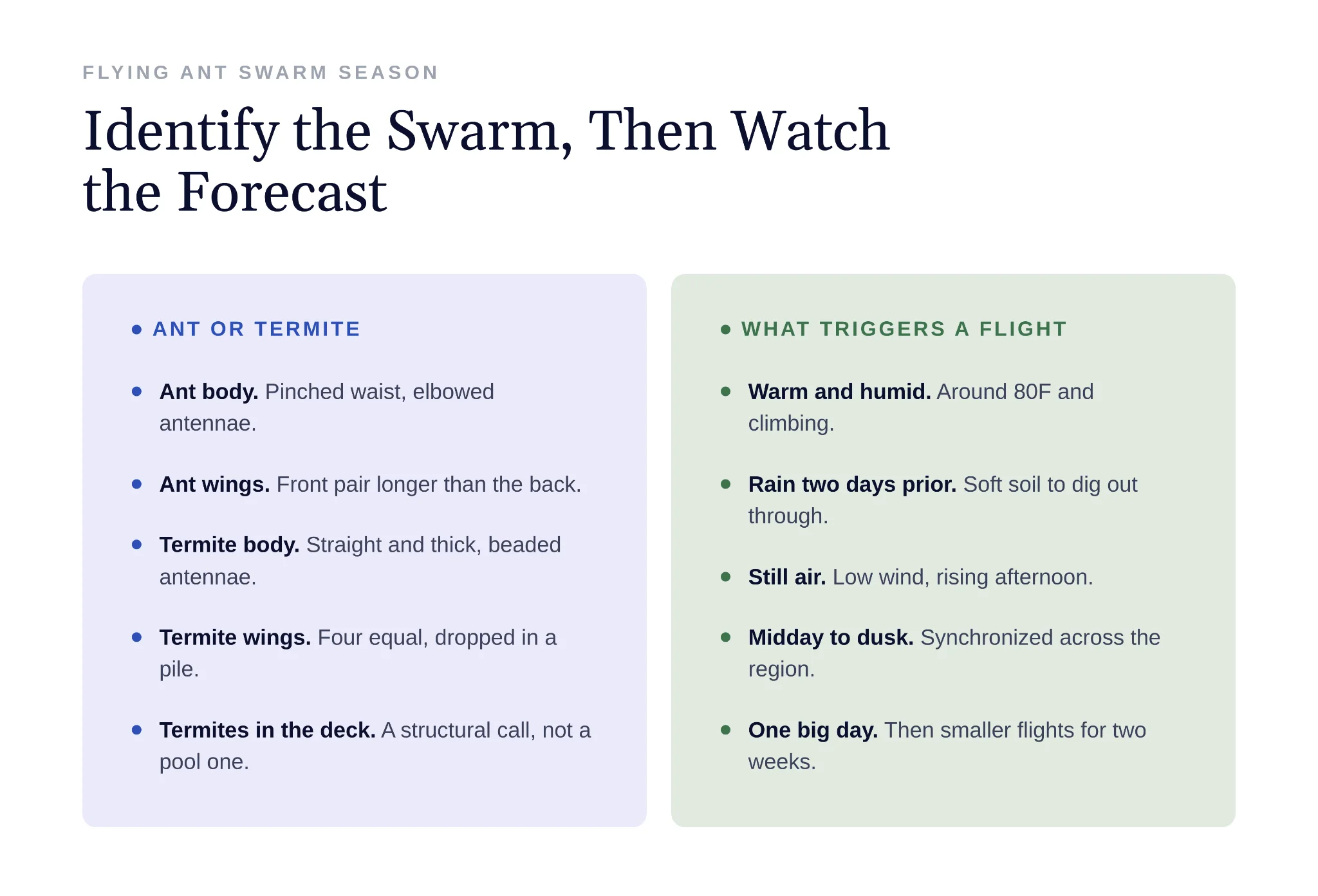
If termites are coming out of the pool deck or the pergola frame, stop reading about pool covers and call someone. That’s a structural problem wearing a swarm costume.
Ants, though, are just ants.
The Weather Tells You Two Days Out
Swarms are synchronized.
Colonies across a whole region release their alates at the same time because mating happens in the air between colonies, and a single colony flying alone accomplishes nothing. That synchronization runs on weather, which means it’s predictable in a way most insect problems aren’t.
What you’re watching for: a warm, humid day, usually mid to high twenties Celsius or eighties Fahrenheit, low wind, and rain in the previous day or two that softened the ground.
Soil moisture matters because the workers have to excavate the exit tunnels. Then a rising afternoon, still air, and it happens between roughly midday and early evening.
You’ll get one big day and then scattered smaller flights over the following two or three weeks. It isn’t a single date on a calendar no matter what the local paper says.
Learn to read your own yard’s version of this. After two seasons you’ll walk outside in the morning and know.
Cover It, and Cover It Before
Nothing else on this list comes close.
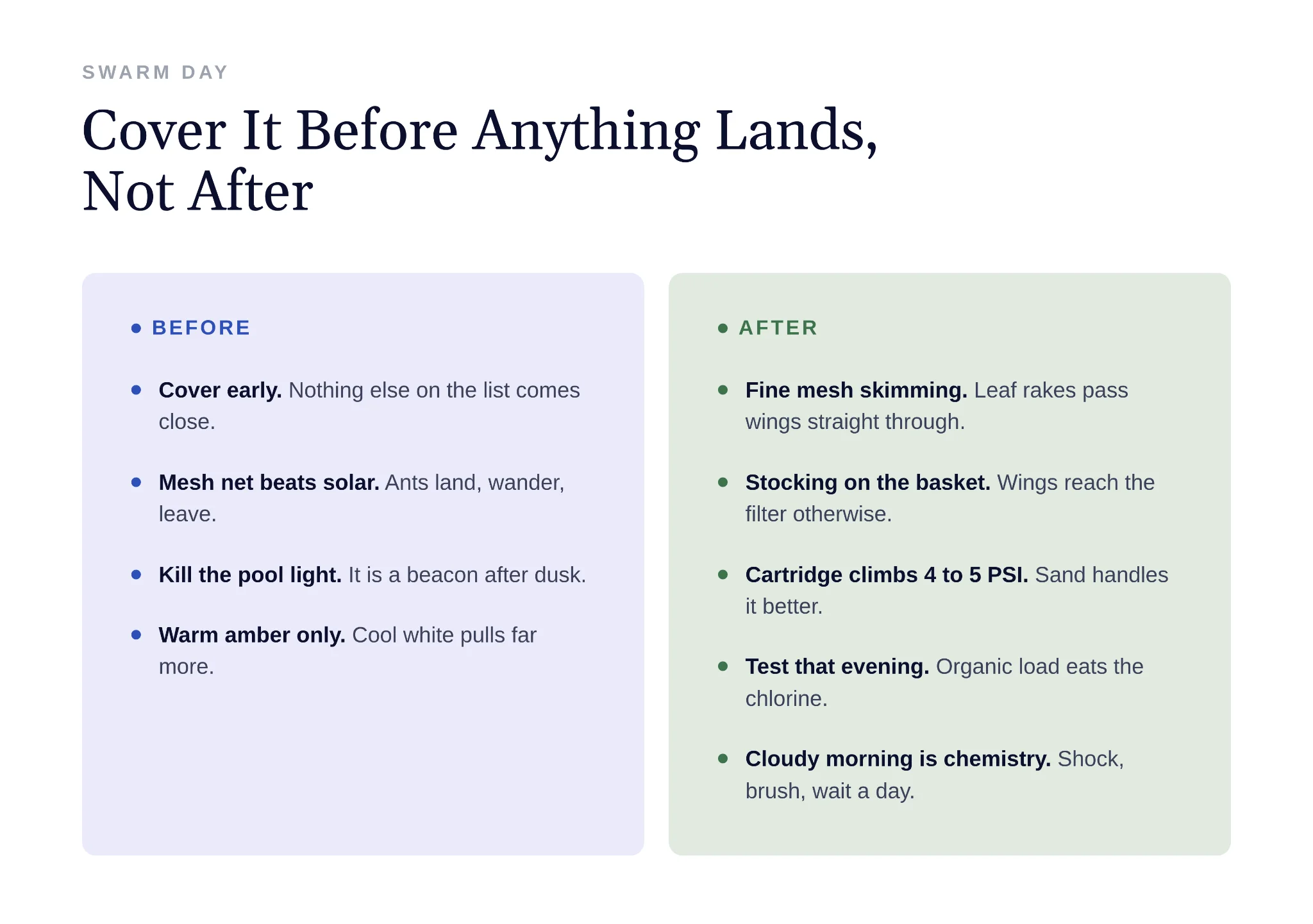
A solar cover, a safety cover, a mesh leaf net deployed before the flight starts. Once they’re on the water, you’ve just trapped a layer of ants and made them harder to reach, and a solar cover pulled over a swarming surface is one of the more unpleasant jobs in pool maintenance.
Mesh leaf nets are the better tool here if you own one, because the ants land on it, wander, and mostly leave, and you’re not sealing anything wet against warm plastic for six hours.
If you can only cover the pool for three hours on the right afternoon, that’s the whole solution. Everything below is for the case where you got the timing wrong.
Kill the Lights
Some species fly at dusk rather than midday, and those are the ones that will find an illuminated pool from a very long way off.
An u nderwater light in a dark yard is a beacon. So is the deck lighting, so is the string of bulbs over the patio, so is the porch light forty feet away that’s pulling them across your property to begin with.
On swarm nights, run the pool dark. If you need light out there, put it away from the water and make it warm-toned, amber and yellow pull far fewer flying insects than cool white and anything with UV in it.
Your Swarm Might Be Coming From Under Your Own Deck
Here’s the part that changes the problem from annual nuisance to something you can actually fix.
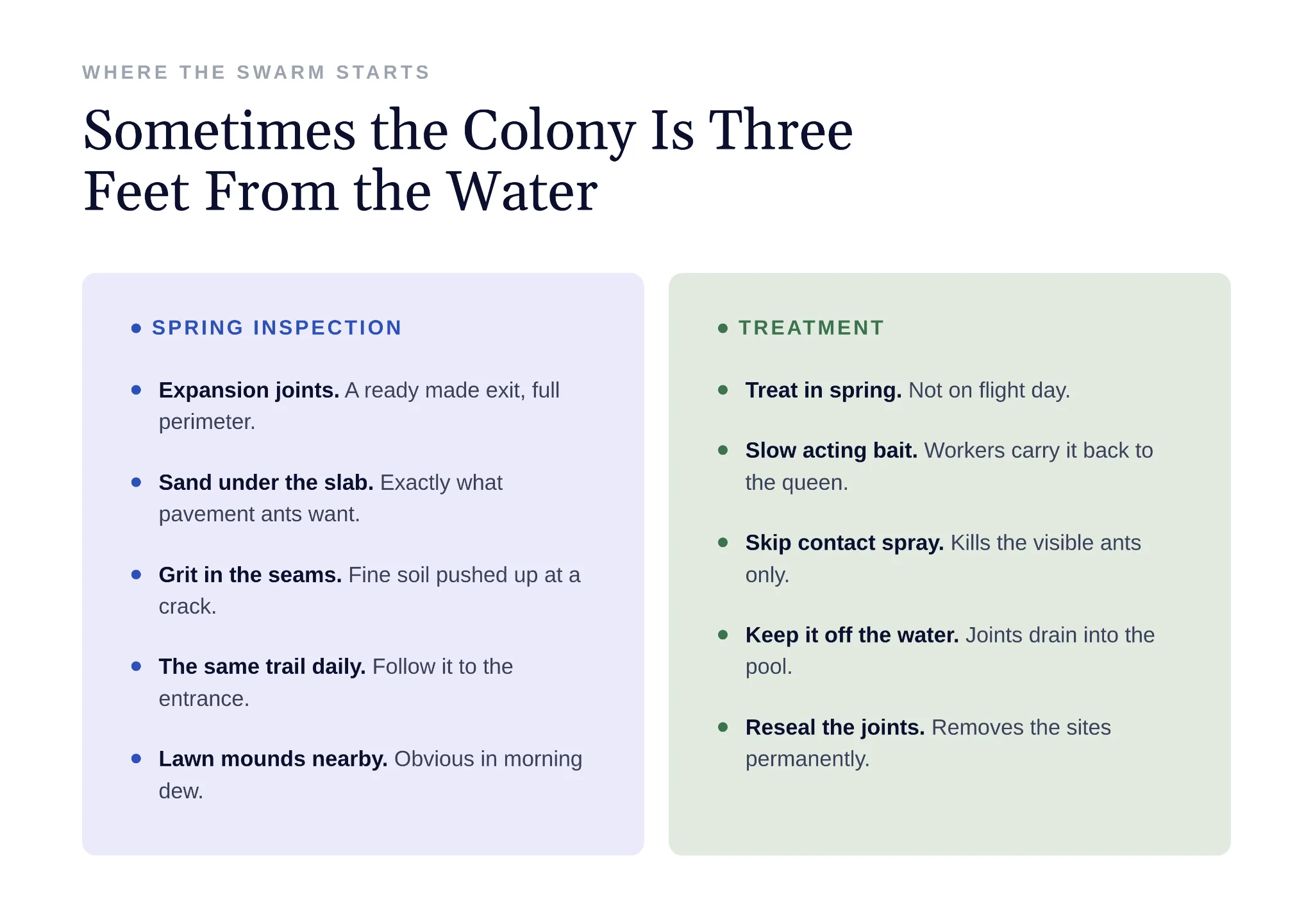
Pavement ants nest in exactly the conditions a pool deck creates: dry sand or crushed stone under a slab, a warm surface above, and an expansion joint or a coping seam that runs the whole perimeter as a ready-made exit. If you stand on the deck during a flight and the alates are pouring out of the joint between the coping and the concrete rather than drifting in over the fence, that colony is three feet from the water, and no cover schedule in the world fixes it.
Walk the deck in the week before the season:
- You’re looking for fine soil pushed up in the joints, a small fan of sand at a crack, ant traffic running the same line day after day.
- Lawn nests in the ten or fifteen feet around the pool count too, the mound is usually obvious in the morning dew.
Treat those in spring, not during the swarm.
A slow-acting gel or granular bait placed at the trail so the workers carry it back is the only approach that reaches the queen. Contact spray on a trail kills the visible ants and does nothing to the colony, which is why it feels like it’s working for two days and then doesn’t. And keep every product well clear of the water and the deck drainage, because whatever you put in the joints ends up in the pool with the next rain.
Seal the joints afterward. New sealant in the expansion joints and repointed coping removes the nest sites permanently, and that’s a job worth doing on its own merits.
When They’re Already in the Water
Skim early, skim often, and use the right net.
A wide leaf rake is the wrong tool. The mesh is too coarse, and the bodies go straight through, and the shed wings pass through anything you’d normally use. A fine-mesh surface skimmer, or a leaf rake with a nylon stocking stretched over it, catches what actually matters.
Read our guide on how to get rid of dirt out of the pool.
Get a sock over the skimmer basket too.
This is the small trick that saves you a real headache: without it, the wings go through the basket, through the pump strainer, and into the filter. On a cartridge filter they pack into the pleats, and the pressure climbs by four or five PSI and stays there until you pull the elements and hose every fold. On DE grids it’s worse. Sand handles it better than either.
Run the pump and keep running it. Circulation moves the surface load toward the skimmers instead of leaving it to raft in a corner.
Then check your chlorine that evening, because the residual will have taken a hit.
A heavy swarm dumps a serious amount of organic material into the water at once, and the sequence goes: thick day, cloudy water the next morning, someone assuming the filter has failed. It hasn’t. The chlorine got consumed. Shock it that night, brush the walls, and give it a day.
The formic acid people worry about is a non-issue at pool volumes. A few thousand ants in twenty thousand gallons will not move your pH.
What Happens After the Flying Stops
The males die within a day.
The females land, break off their own wings, and start looking for somewhere to found a colony, which is why the coping is scattered with loose wings the next morning and why you’ll find dazed wingless queens under the pool towels, in the skimmer lid recess, inside the folded umbrella, in the bottom of the pool bag.
The deck fix stops next year’s swarm. It doesn’t do anything about the four hours between now and when you notice the pressure gauge creeping up.
An Aiper robotic pool cleaner runs its own filtration independent of your pump and cartridge, so a surface load that would otherwise sit in a corner or get pulled into the skimmer basket gets picked up and pulled out of the system entirely, instead of packing into the pleats you’ll be hosing out for an hour next weekend.
Get more pool and lawn care guides from Aiper on Google