Soda Ash vs. Baking Soda: Which Does What in Pool Chemistry

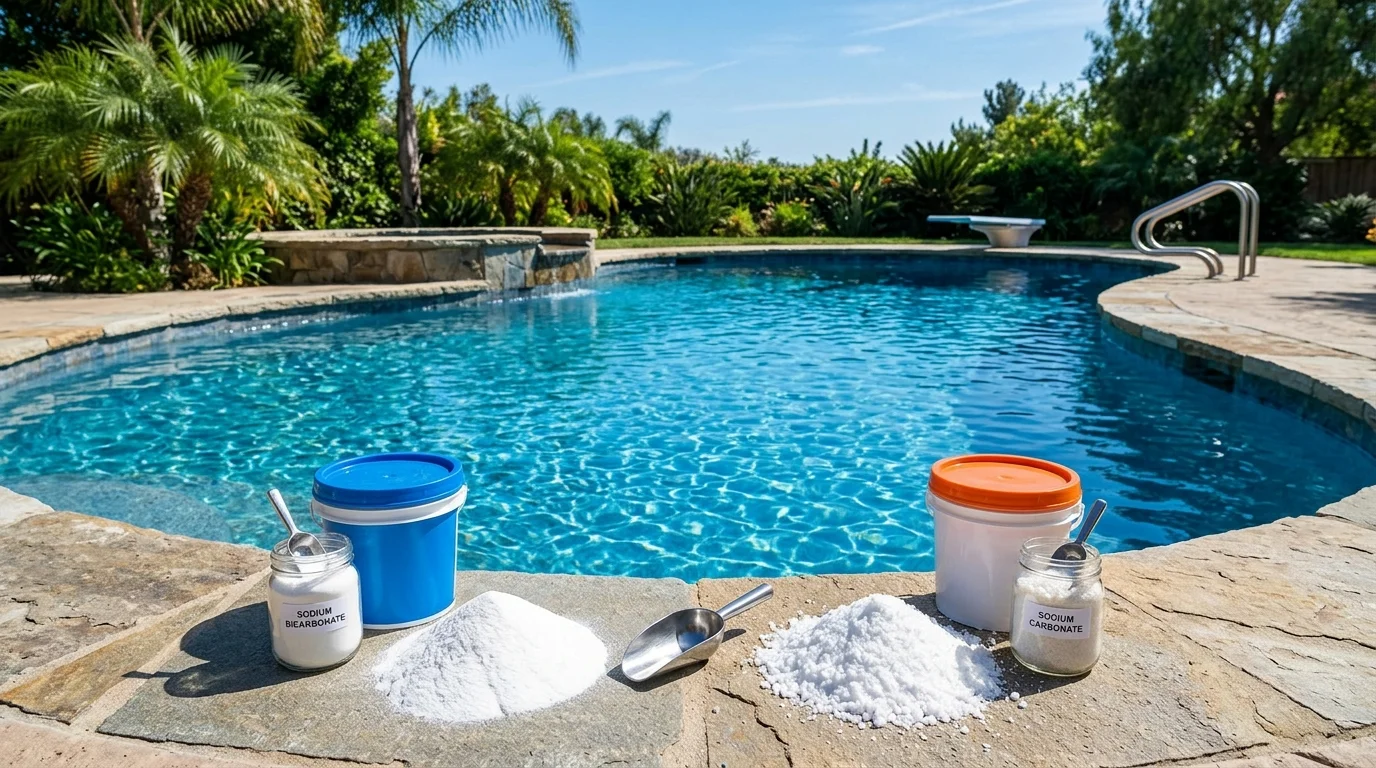
Two white powders, sold in nearly identical buckets, in the same aisle, at roughly the same price. One is labeled pH Increaser, and one is labeled Alkalinity Increaser, and a lot of people treat them as interchangeable.
They are not the same product, and they do not do the same job.
Here’s what each one actually is, and when you reach for which.
Soda Ash vs. Baking Soda: The Difference
Baking soda is sodium bicarbonate. In solution, it sits at a pH of about 8.3.
Soda ash is sodium carbonate. In solution, it runs somewhere around 11.4.
That gap matters because baking soda, at 8.3, is barely above where your pool already is. It nudges. Soda ash, at 11.4, is three full orders of magnitude more alkaline, and it shoves.
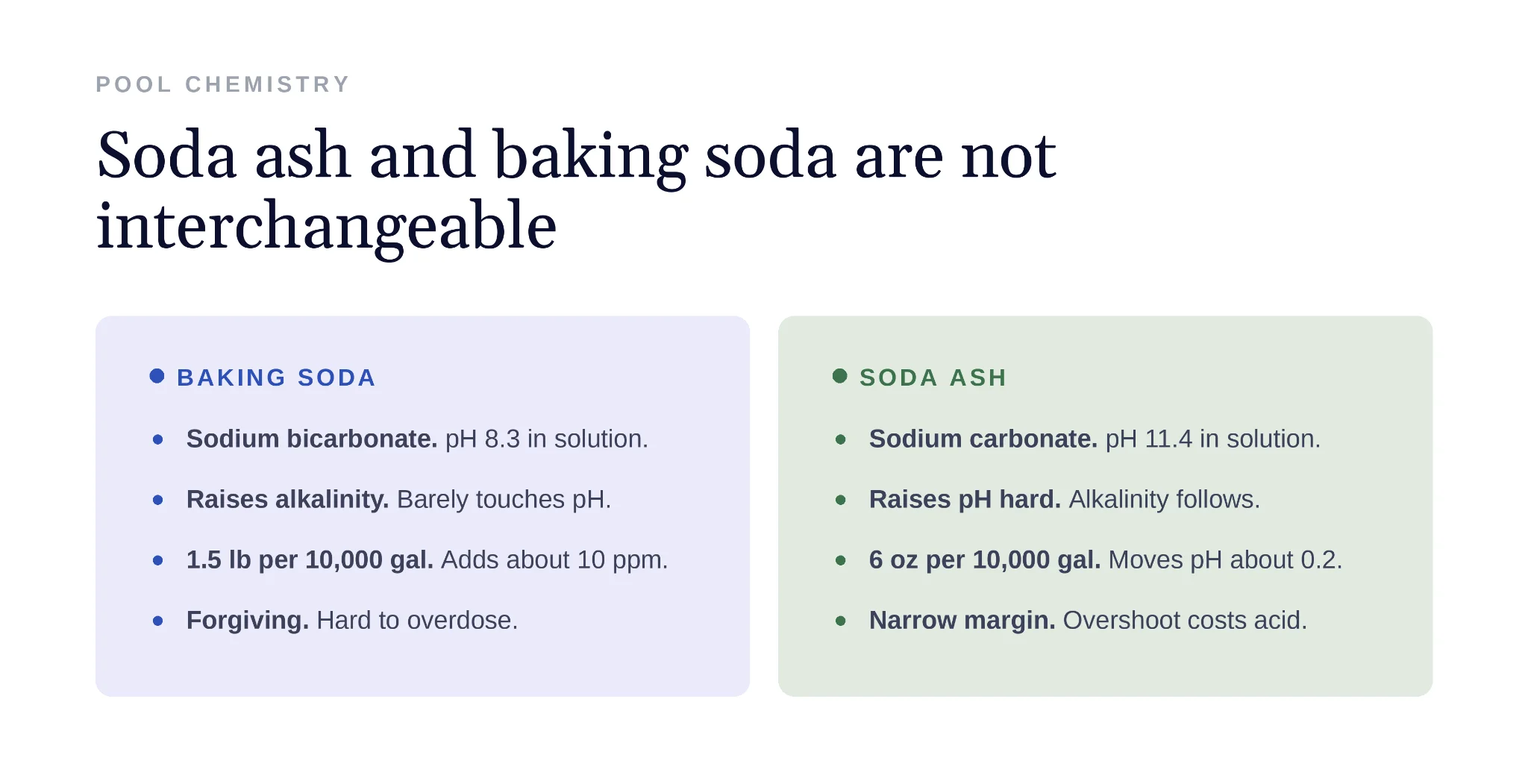
So baking soda loads the water with bicarbonate, which is what total alkalinity is a measure of, while moving pH very little. Soda ash moves pH hard and carries some alkalinity along as a side effect. Same family of chemistry, completely different tool.
Total alkalinity is the water’s buffering capacity, which is its resistance to being moved. Low alkalinity is why people say their pH “won’t hold.” It isn’t holding because there’s nothing there to hold it.
Push it too far the other way and pH becomes difficult to lower and the risk of scaling increases.
For most plaster pools, the useful window is 80 to 120 ppm. Vinyl and fiberglass are comfortable a little lower. Salt pools want lower still.
Use Baking Soda to Raise Alkalinity
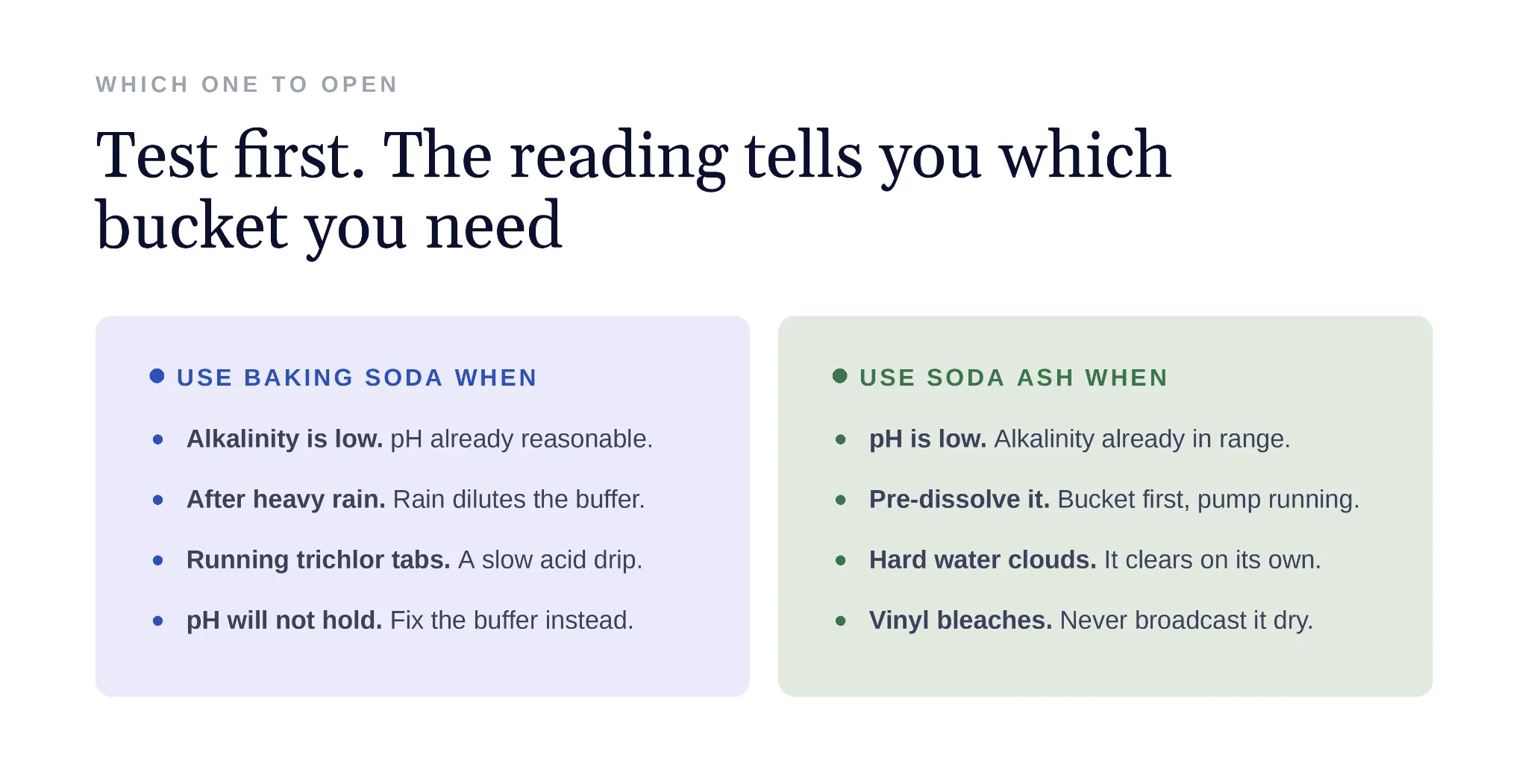
Alkalinity is low, and pH is somewhere reasonable. That’s it. That’s the case.
The clearest version: it rained for two days, you tested afterward, alkalinity came back at 45 ppm and pH at 7.2. Rainwater is mildly acidic and carries essentially no alkalinity, so a heavy storm dilutes your buffer and drops it. Baking soda puts it back.
Another common situation is a trichlor pool. Those tablets are acidic, so a pool running tabs all summer is getting a slow, steady acid drip, and alkalinity grinds down week over week.
Roughly a pound and a half per 10,000 gallons raises alkalinity about 10 ppm. It’s forgiving and difficult to overdose in a way that causes real damage.
What baking soda will not do is fix low pH. This is the mistake I see most often. Someone reads 7.0, grabs the baking soda because they know it’s alkaline, and keeps adding it. The pH moves only slightly while alkalinity climbs too high, and they’ve traded a solvable problem for a much more annoying one.
Use Soda Ash to Raise pH
Use soda ash when pH is low, and alkalinity is already fine.
That’s a narrower situation than most people expect, because soda ash is often reached for reflexively when pH reads low.
Six ounces per 10,000 gallons will move pH somewhere around two tenths of a point, though the actual response depends heavily on where your alkalinity sits. Well-buffered water fights back harder, so the same dose does less.
Run whatever you’re planning through a dosing calculator, then cut the result in half and retest before adding the rest. Overshooting pH with soda ash is easy, and correcting it means adding acid, which pulls alkalinity back down.
Soda ash can also turn hard pool water milky for a day or two. The high pH where the powder lands can cause calcium carbonate to come out of solution. Nothing is broken, and it will filter out or redissolve.
You can reduce the risk by pre-dissolving the soda ash in a bucket of pool water and pouring it slowly along the deep end with the pump running rather than broadcasting dry powder across the surface.
On vinyl, be more careful. A concentrated pocket of high-pH water sitting against a liner can bleach it, and that mark does not come out.
Know When Soda Ash Isn’t the Answer
There is one situation worth knowing because it looks like a reason to add soda ash when it isn’t: pH is low, but alkalinity is already high. Say 7.1 and 160.
Adding soda ash raises pH, but it pushes alkalinity even higher.
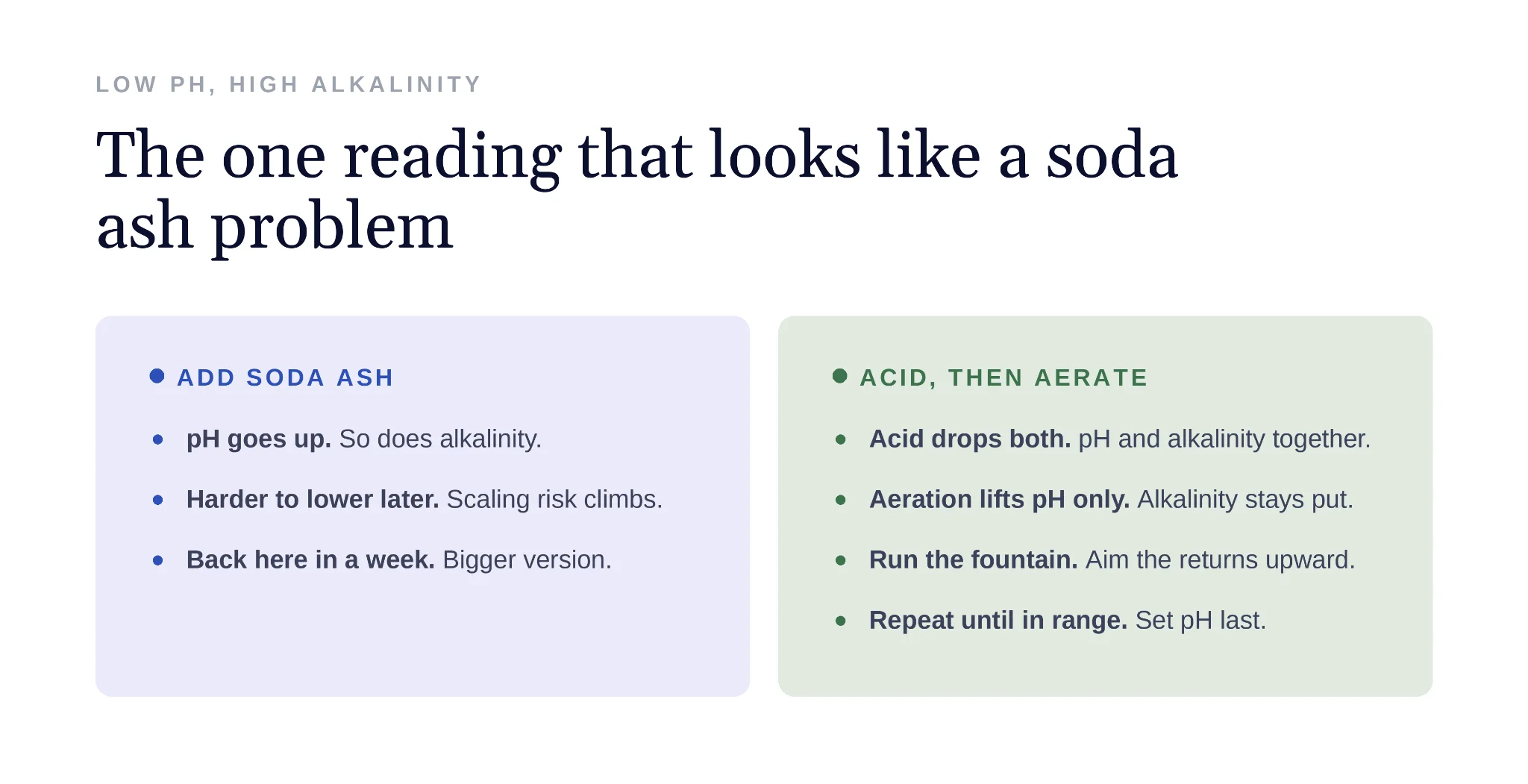
Muriatic acid lowers both pH and alkalinity. Aeration, running a fountain, aiming the returns up, turning on a spa spillover or waterfall, drives dissolved carbon dioxide out of the water, which raises pH while leaving alkalinity essentially untouched.
Add acid to bring pH down, and alkalinity drops with it. Then aerate. pH climbs back up while alkalinity stays where the acid left it. Repeat the cycle until alkalinity lands in range.
Once you understand that aeration is a pH-raising tool, soda ash becomes something you use deliberately rather than reflexively.
Fix Alkalinity First, Then pH
Order matters because adjusting alkalinity also moves pH.
Get alkalinity into the 80 to 120 ppm range. Let the pump circulate for six to eight hours. Retest. Then adjust pH if it still needs it, and sometimes it will have drifted into range on its own while you were fixing the buffer.
One addition at a time. Never two chemicals in the same hour, and never in the same bucket.
Clean the Pool Before Adjusting the Water
Decomposing leaves, pollen, and organic sediment consume chlorine and increase demand. Debris can also produce cloudiness that people misread as a calcium or alkalinity problem and try to correct chemically.
You can add soda ash to that pool all week, and it won’t get clearer, because the problem was never dissolved.
Consistent mechanical cleaning removes that variable before you start reading numbers. A robotic cleaner from Aiper’s pool cleaner lineup handles the floor and walls between service days and keeps the organic load down.
Then brush, especially after chemical additions and in corners and behind ladders where circulation is weakest.
Salt Pools Rarely Need Either One
If you’re running a chlorine generator, your problem is rarely that pH is too low.
Salt pools tend to drift upward in pH. Most salt pool owners therefore use muriatic acid far more often than soda ash.
The practical adjustment is to run alkalinity intentionally lower, around 70 to 80 ppm rather than 100 to 120. Lower alkalinity means less carbon dioxide available to off-gas, which means slower pH rise and fewer acid additions.
Baking soda still has a role there, but only when alkalinity has genuinely dropped too low and pH is getting unstable.
Check What You’re Actually Buying
Alkalinity Increaser is sodium bicarbonate. pH Increaser and pH Up are sodium carbonate. Read the ingredient line on the back of the bucket, because the front of the bucket is marketing and the back is chemistry.
The pool store version and the grocery store version are the same molecule. A bag of baking soda is the same sodium bicarbonate that’s in a pool-branded alkalinity increaser.
For sodium carbonate, washing soda can also be chemically the same thing, but confirm the label says 100 percent sodium carbonate with nothing else in it. Some laundry products contain surfactants or fragrances you don’t want in the water.
Store both dry and sealed. Sodium carbonate in particular pulls moisture out of humid air and can harden in storage.
Wear gloves with soda ash. The powder can dry out and irritate skin, and you don’t want it in your eyes.
Get more pool and lawn care guides from Aiper on Google