Uneven Sprinkler Coverage: Causes, Tests, and Fixes


Every irrigated lawn has a dry spot somewhere.
Usually the same one in the same corner or the same strip along the drive, and usually the response is to add five minutes to the zone, which waters the other ninety percent of the lawn that was already fine.
That’s the trap. Uneven coverage is not a run-time problem, and you cannot schedule your way out of it. When a single zone underperforms instead of the whole lawn, walk through an underperforming sprinkler zone and how to diagnose it before you start changing heads. Your entire zone is only as good as its driest quarter, because that’s the part dictating how long everything else has to run.
Rule Out Soil Problems Before You Touch a Head
Push a long screwdriver into the dry patch after a cycle. If it slides in six inches, the water got there, and something else is wrong.
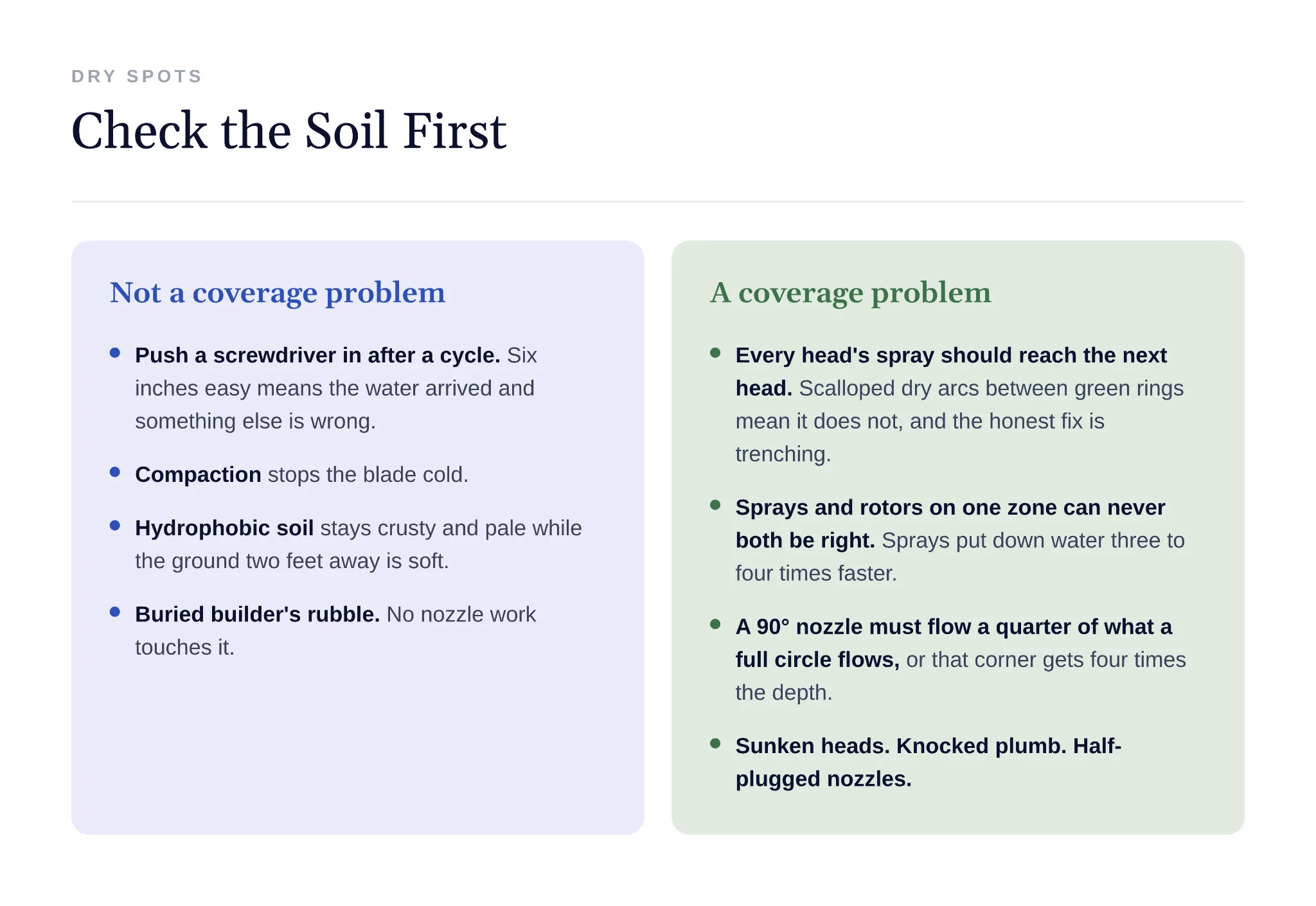
Compaction stops a screwdriver cold. Grub damage lifts turf like carpet.
Localized dry spot (soil becomes hydrophobic, water beading and running off instead of soaking) appears as a patch that stays crusty and pale, while the ground two feet away is soft. Buried construction debris under a new build does the same thing, and no amount of nozzle work will touch it.
Rule those out first. Then talk about heads.
Sprinkler Spacing: Every Head Must Reach the Next One
A sprinkler does not distribute water evenly across its own radius. Output is heaviest near the head and tapers off toward the edge of the throw, which means a single sprinkler covering its full circle leaves the perimeter badly under-watered.
The system is designed to compensate by overlapping. Every head’s spray should reach the next head. That’s head-to-head coverage, and it’s what makes the light edge of one pattern land on the light edge of another.
Get the spacing wrong by 20%, and you get scalloped dry arcs between heads. You’ll recognize the pattern once you know to look for it: green rings around each head, tired grass in the spaces between.
Retrofitting spacing means trenching and adding heads. It’s the expensive fix, which is why so many lawns limp along with it unaddressed for a decade.
There’s a way around that now. A single Aiper IrriSense 2 covers up to 4,800 square feet with a 39-foot spray range, and because it maps the lawn’s actual shape rather than throwing a fixed arc, the head-to-head overlap problem doesn’t arise, one unit replaces at least four traditional sprinkler heads. Setup runs on a standard garden hose with no digging. If your spacing was wrong from the day it went in, that’s a real alternative to opening up the yard.
Water Pressure: Too Low, Too High, and How to Measure It
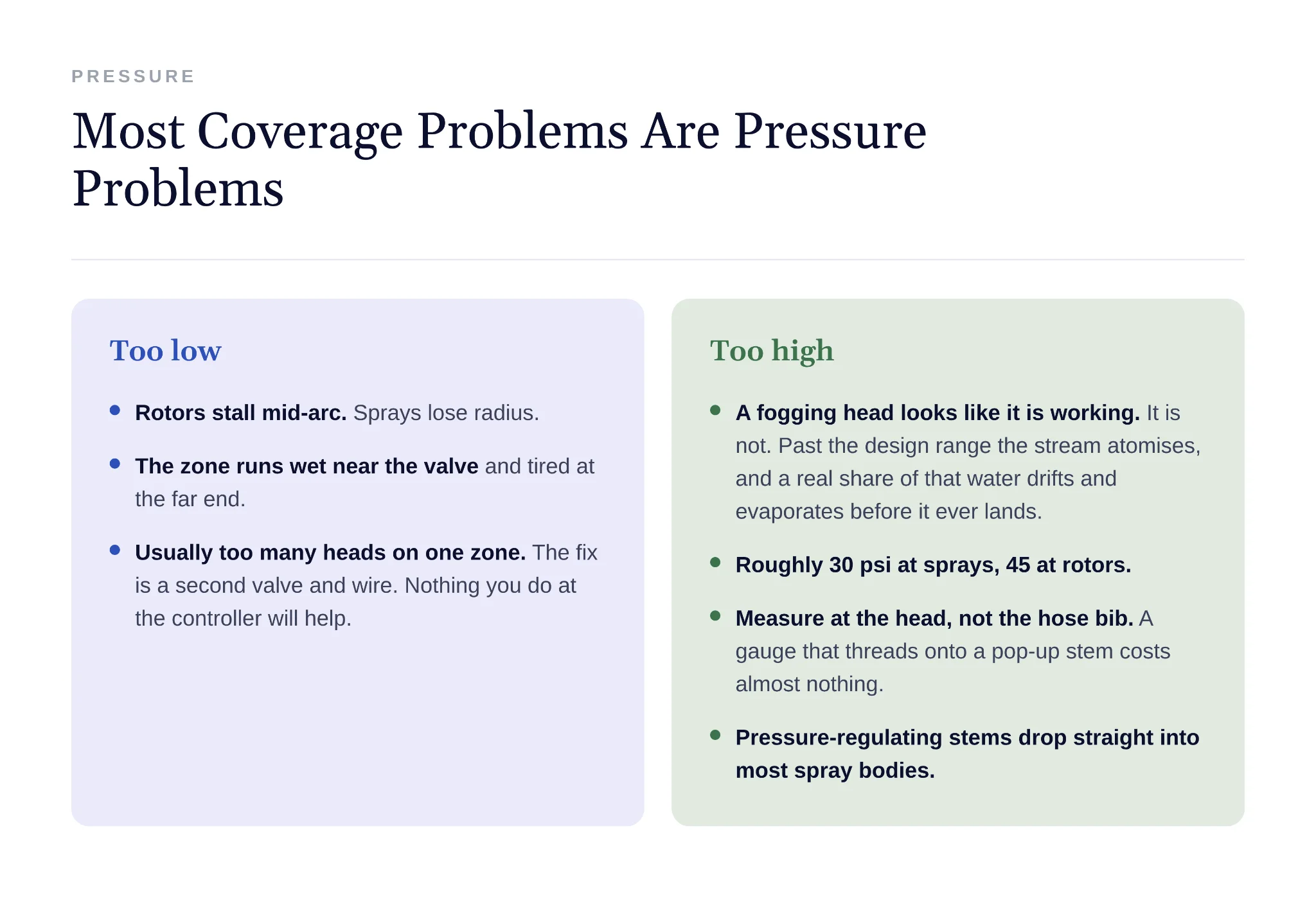
Here’s how to look at water pressure.
Too low and rotors slow down or stall mid-arc, spray heads lose radius, and the far end of the zone gets a fraction of what the first head puts out. Symptoms: heads that don’t complete a rotation, a zone that’s clearly wetter near the valve.
Too high is the one people miss entirely, because a head throwing a tall fine mist looks like it’s working beautifully. It isn’t. Above the design range, the stream atomizes, and a meaningful share of that water never reaches the ground. It drifts, it evaporates, it lands somewhere you didn’t intend. A fogging head is a head losing water.
Get a gauge. There are cheap pitot gauges and screw-on adapters that thread onto a pop-up stem, and you want a reading at the head, not at the hose bib. Check the first head on the zone and the last one. Spray heads want somewhere around 30 psi at the nozzle, rotors around 45, and the label on your specific nozzle will tell you its range.
If you’re high, pressure-regulating stems are the fix, and they’re a drop-in swap on most spray bodies. If you’re low, the usual culprit is too many heads on one zone. Splitting a zone means a valve and wiring, but nothing else will fix it.
Never Put Spray Heads and Rotors on the Same Zone
A fixed spray head puts down water roughly three to four times faster than a rotor. Same minutes, wildly different depth.
So if someone extended the system and dropped a couple of sprays onto a rotor zone, that zone is unfixable by scheduling. Run it long enough for the rotors, and the spray section floods.
The same logic applies within a head type. A 90-degree nozzle covers a quarter of the area a full-circle nozzle does, so it must flow a quarter of the water, or that corner gets four times the depth.
Matched precipitation rate nozzle sets handle this. The numbers on the nozzle change with the arc. Check that whoever adjusted the arcs last also changed the nozzles.
How to Run a Catch-Can Test and Read the Numbers
This is the only way to actually know what your system is doing, and it takes about forty minutes.
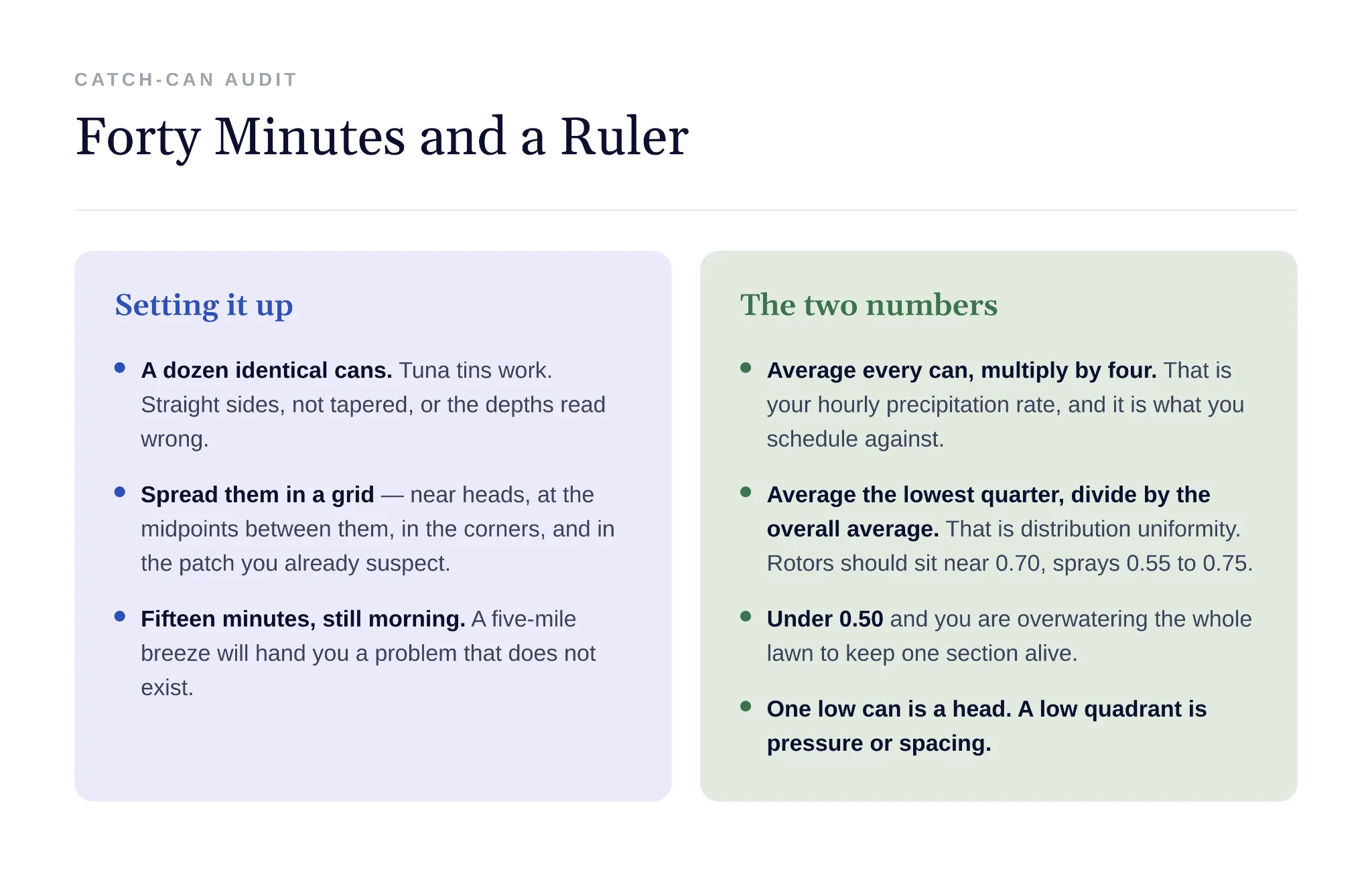
Collect a dozen or more identical straight-sided containers. Tuna cans and cat food cans work. Actual catch cups are better and cheap. What matters is that they’re all the same and the sides don’t taper, because a tapered container reads wrong.
Set them out across one zone in a rough grid, some near heads, some at the midpoints between heads, some in the corners, and definitely a few in the spot you already suspect. Cover the whole area, not just the interesting parts.
Run the zone for fifteen minutes. Then walk it with a ruler and write down the depth in every can, in millimeters if you can, because the numbers are small and the differences matter.
Now do two things with that data.
Average all of them. That’s your precipitation rate for the zone. Multiply by four to get inches or millimeters per hour, and that’s the number you actually schedule against.
Then take the lowest quarter of your readings, average those, and divide by the overall average. That ratio is distribution uniformity. Rotors in decent shape land around 0.70. Sprays run lower, maybe 0.55 to 0.75. Below 0.50, and you have a system that will overwater most of the lawn to keep one section alive, and no controller setting changes that. If the controller itself is due for a refresh, see how weather-based and soil-moisture-based models decide when to water before you pick one.
The cans also tell you where. A single can reading half of its neighbors points you at a specific head. A whole quadrant reading low points at pressure or spacing.
Do this once per zone. Do it on a still morning, because a five-mile-an-hour breeze will skew the numbers and give you a problem to chase that doesn’t exist.
Sunken Heads, Clogged Nozzles, and Failed Seals
Walk the zone while it’s running. It’s tedious, and it finds things.
Heads that have settled below grade, so turf blocks the pattern at ground level. Heads knocked out of plumb by a mower, spraying at an angle into the fence. Nozzles half-plugged with grit, throwing a thin lopsided stream. Arcs that got bumped and now water the sidewalk. Wiper seals gone, so a head geysers at the base and starves everything downstream on that lateral.
Riser extensions fix sunken heads. Straightening takes a shovel and five minutes. Nozzles unscrew and cost a couple of dollars. Pull the filter screen underneath while you’re in there, because that’s where the grit collects.
Low-head drainage, the lowest head on a slope dribbling out the whole lateral after every cycle and leaving a swamp, needs check valves. Most modern bodies have them built in.
Why Adding Run Time Makes the Problem Worse
Adding minutes to correct a coverage gap is how lawns end up with shallow roots, fungus in the low spots, and a water bill that doesn’t make sense.
Those low spots are also where it is worth learning how to identify and treat lawn fungus early before it spreads.
Hand-water the dry corner with a hose for a season if you need to. That’s a legitimate stopgap, and it’s better than drowning the rest of the yard. Just don’t let it become the permanent arrangement, because it means you’ve decided to keep paying for a defect indefinitely.
Set the cans out on a calm morning before it gets hot. The zone that looks worst is rarely the one with the worst numbers, and that’s usually the useful part.
Get more pool and lawn care guides from Aiper on Google