The Pool Stain Diagnosis Guide: How to Identify What You’re Looking at Before Treating

Pool stains get misdiagnosed constantly, and the misdiagnosis is expensive in a very specific way: the treatments contradict each other.
Shock an iron stain, and you’ll set it deeper into the plaster — deep-set stains are exactly when an acid wash is the answer for plaster staining. Pour ascorbic acid at an algae problem, and you’ve just crashed your chlorine to zero and fed the algae a nicer environment. Acid-wash a stain that a $6 vitamin C tablet would have lifted, and you’ve stripped a layer off your finish to fix something that was never in the finish to begin with.
So before any treatment touches the water, the stain has to answer three questions: what color is it, where is it, and what does it do when you test it. Scale from calcium silicate answers those same three questions differently than a typical stain — see our guide to removing calcium silicate scale from pool surfaces for the specifics.
Color Gets You a Suspect List, Not a Verdict
Color is where you start, and it’s genuinely useful, as long as you treat it as a shortlist rather than an answer. How a stain responds to treatment also depends on whether the surface is traditional plaster or a pebble finish — our comparison of pebble finish versus plaster digs into that difference.
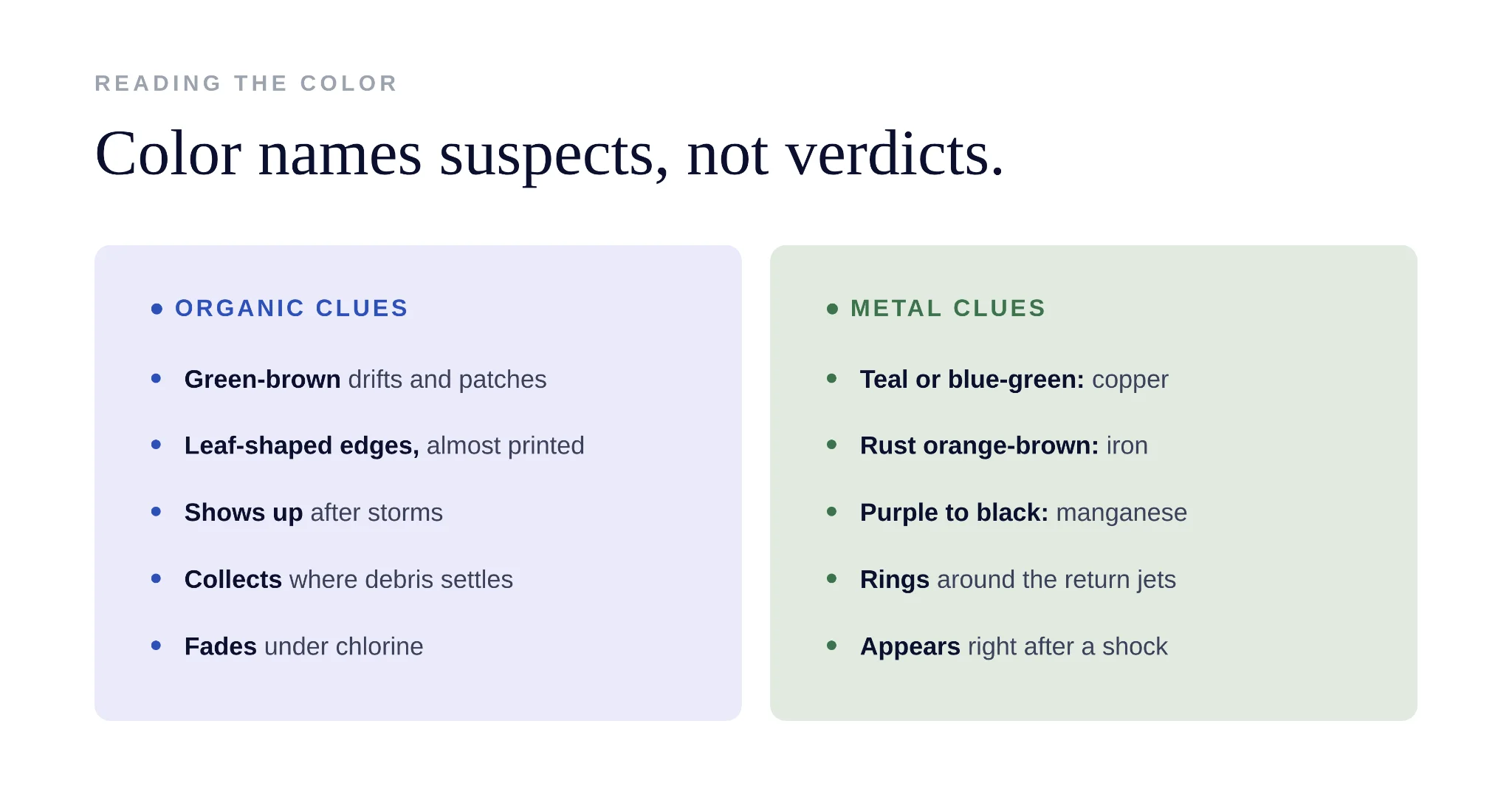
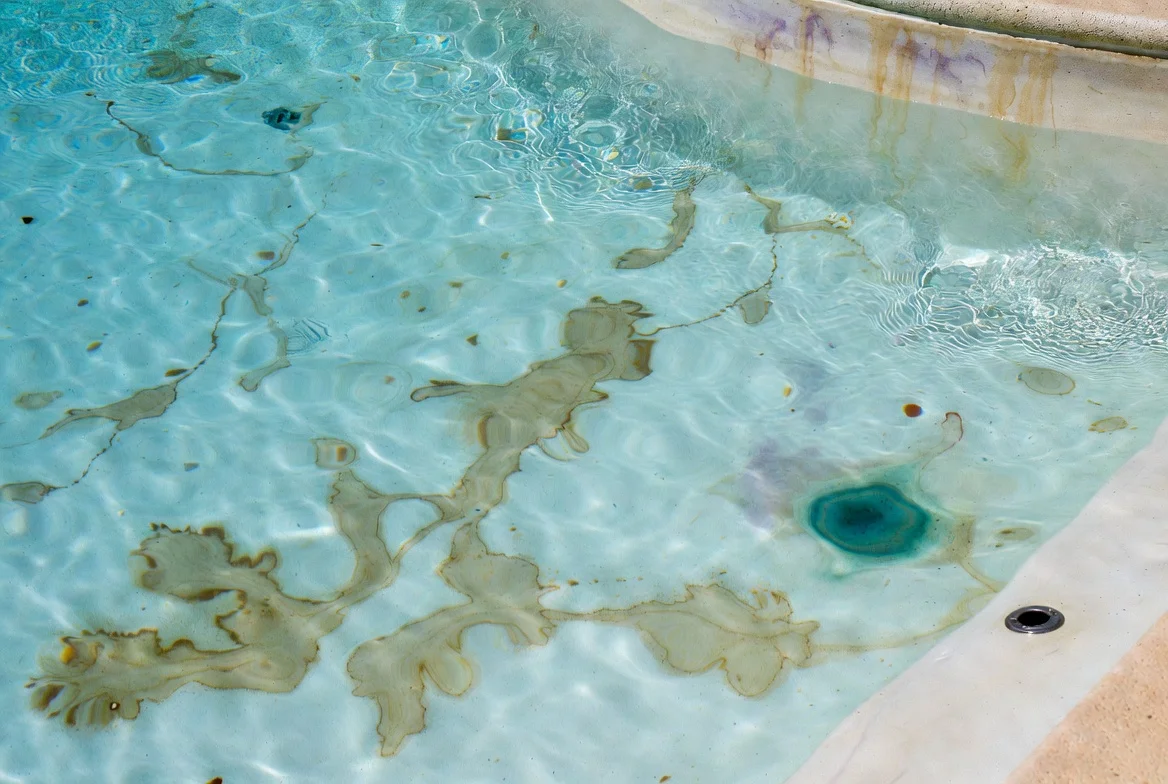
Green and brown, especially in drifts or patches where debris tends to collect, usually means organic: leaves, acorns, worms, tannins leaching out of anything that sat on the floor too long. Teal or blue-green points at copper. Rusty orange-brown says iron. Purple, gray, or black gets murkier, could be manganese, could be copper cyanurate, could be black algae, and those three have completely different treatments.
The reason color alone can’t convict anybody is overlap. A brown stain might be tannin from an oak leaf, or it might be iron that oxidized out of your fill water. Both look like weak tea on the plaster.
One lifts with chlorine, one gets worse with chlorine. Guess wrong, and you’ve upgraded the problem.
Location narrows things faster than people expect:
A ring of stain around your return jets is a metal signature, water carrying dissolved copper or iron hits the pool right there, concentrated.
A stain shaped exactly like a leaf, with edges that look almost printed, is a leaf.
Scattered rust-colored dots the size of a pencil eraser on the floor of a plaster pool are very often something metal sitting in or under the finish: a hairpin, a nail, a screw dropped during construction, occasionally rebar too close to the surface pushing rust through.
And staining concentrated at the waterline is its own category, usually scale, oxidized metals, or the buildup of sunscreen and body oils cooking in the sun.
The Two-Tablet Test
This is the part that settles most arguments, and it costs almost nothing.
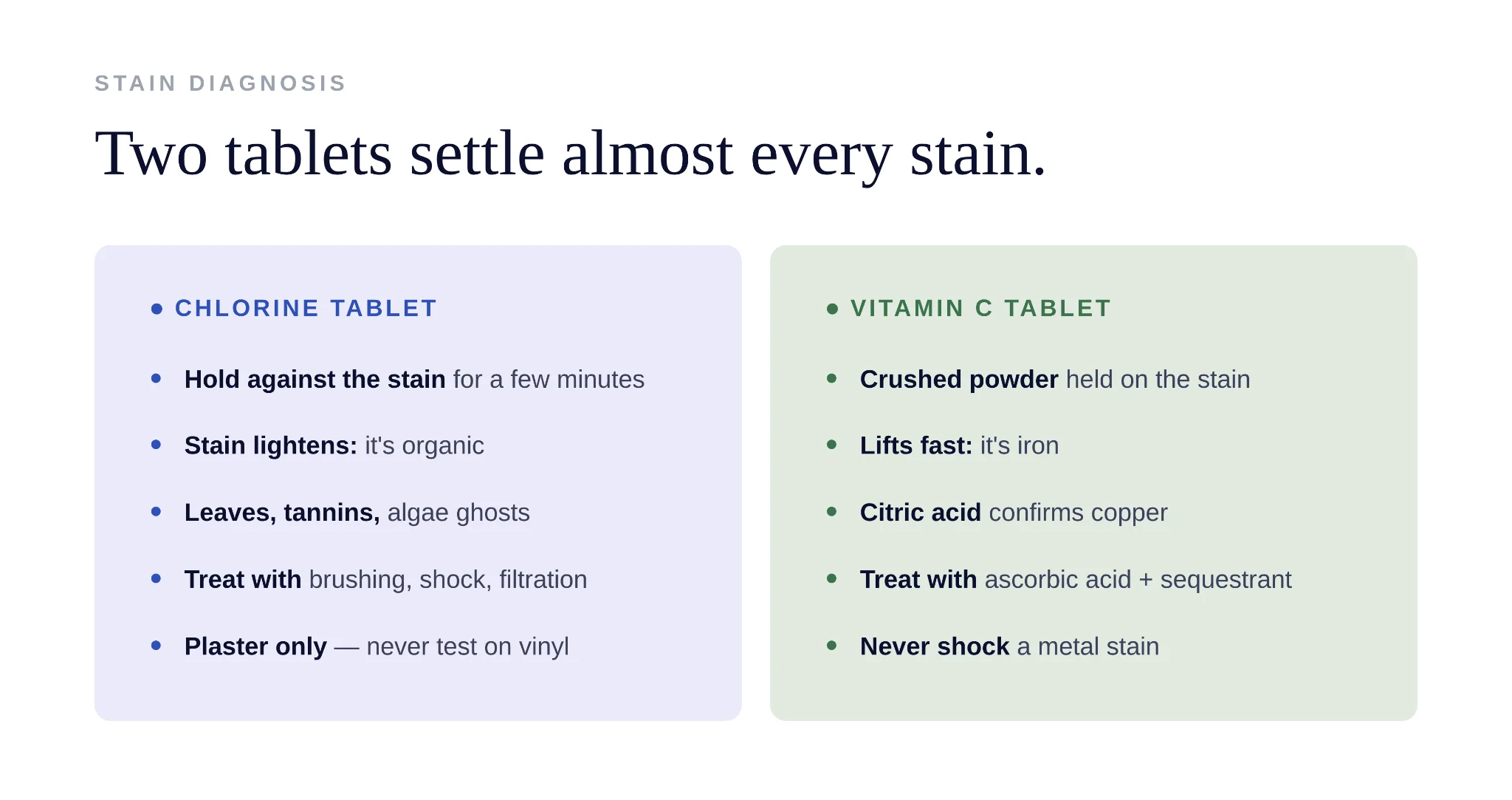
Take a trichlor tablet and hold it directly against the stain for a few minutes. Use a pole or wear gloves, and do this on plaster or pebble, not on vinyl, where concentrated chlorine can bleach the liner pattern permanently — vinyl needs gentler handling across the board, including when you’re removing wrinkles from a vinyl pool liner.
If the stain lightens noticeably where the tablet sat, it’s organic. Chlorine oxidizes organic material. Case closed, and the treatment is more of the same: brush, shock, run the filter, remove whatever was rotting there.
If chlorine does nothing, crush a vitamin C tablet and hold the powder against the stain in a sock or thin cloth. Iron stains lift under ascorbic acid fast, often within a minute, leaving a clean pale patch that looks almost too good. Copper responds better to citric acid than ascorbic.
Either way, if an acid lightens what chlorine couldn’t touch, you’re dealing with metals, and your entire treatment plan changes: no shocking, pH handled gently, ascorbic acid treatment followed by a sequestrant to keep the dissolved metal from redepositing the moment your chlorine recovers.
Two tablets, two results, four combinations:
Chlorine lifts it: organic.
Vitamin C lifts it: metal.
Neither touches it: you’re probably looking at scale or a deposit rather than a stain at all.
Both seem to affect it: mixed stain, usually organic material that trapped metals as it sat, treat the organic side first, then reassess.
Nothing else in pool care gives you this much diagnostic certainty this cheaply.
Organic Stains and What They’re Telling You
Organic stains are the most common, the easiest to fix, and the most honest. Every one of them is a record of something that sat on a surface longer than it should have.
A leaf that lands in a pool and gets skimmed the same day leaves nothing. The same leaf sitting on the floor for a week leaches tannins into the plaster beneath it and leaves a brown shadow.
Acorns are worse, they’re dense with tannins, and they sink immediately. Worms after a rainstorm, berries off an overhanging tree, a dead frog nobody noticed behind the step. Each one stains in proportion to how long it stayed.
The treatment is almost boringly simple: remove the source, brush the stain hard, raise chlorine with a shock, keep brushing daily, let the filter run.
Most organic staining fades within days. Stubborn shadows on plaster sometimes want an enzyme product or a granular chlorine application brushed directly into the spot.
Algae leaves its own version, the ghost that remains after a green pool gets cleared. The algae is dead; the stain is what it left behind. Same protocol. Sustained chlorine and mechanical brushing, and patience measured in days rather than hours.
But notice what this whole category has in common. Organic stains are not a chemistry failure. Pools with perfect water chemistry get organic stains constantly if debris is allowed to sit. It’s a housekeeping problem wearing a chemistry costume.
Find Where Metal Stains Come From
Lifting a metal stain without finding its source is a subscription, not a fix. The stain comes back because the metal is still arriving.
There are only a handful of suspects.
Fill water, especially well water, carrying dissolved iron or manganese in it before it ever reaches your pool.
Copper-based algaecides, which put copper directly and deliberately into the water, are great against algae, and the number one cause of teal stains and, in blond hair, green swimmers.
And the one people miss: the pool’s own equipment eating itself.
A heater has a copper heat exchanger, and water that runs acidic, low pH, low alkalinity, or aggressive trichlor use without monitoring, slowly dissolves it.
The copper rides the plumbing back to the pool and plates out on the surfaces. If your teal staining is worst near the returns and you can’t figure out where copper is coming from, check your pH history and look hard at the heater.
Dissolved metal is invisible right up until it isn’t.
The classic disaster sequence: metals sit dissolved and harmless in the water for months, then someone shocks the pool, the sudden oxidizer load flashes the metals out of solution, and the entire pool stains, or the water turns brown-green overnight. If you know or suspect your fill water carries metals, a sequestrant needs to be in the water before the shock, not after the stain.
Manganese deserves one line of its own: it stains purple to black, it’s common in well water, and it’s regularly misdiagnosed as black algae. The tablet test sorts them out, and so does texture, which brings up the next category.
Is It Even a Stain? Scale, Deposits, and Things That Are Alive
Run a fingernail across it.
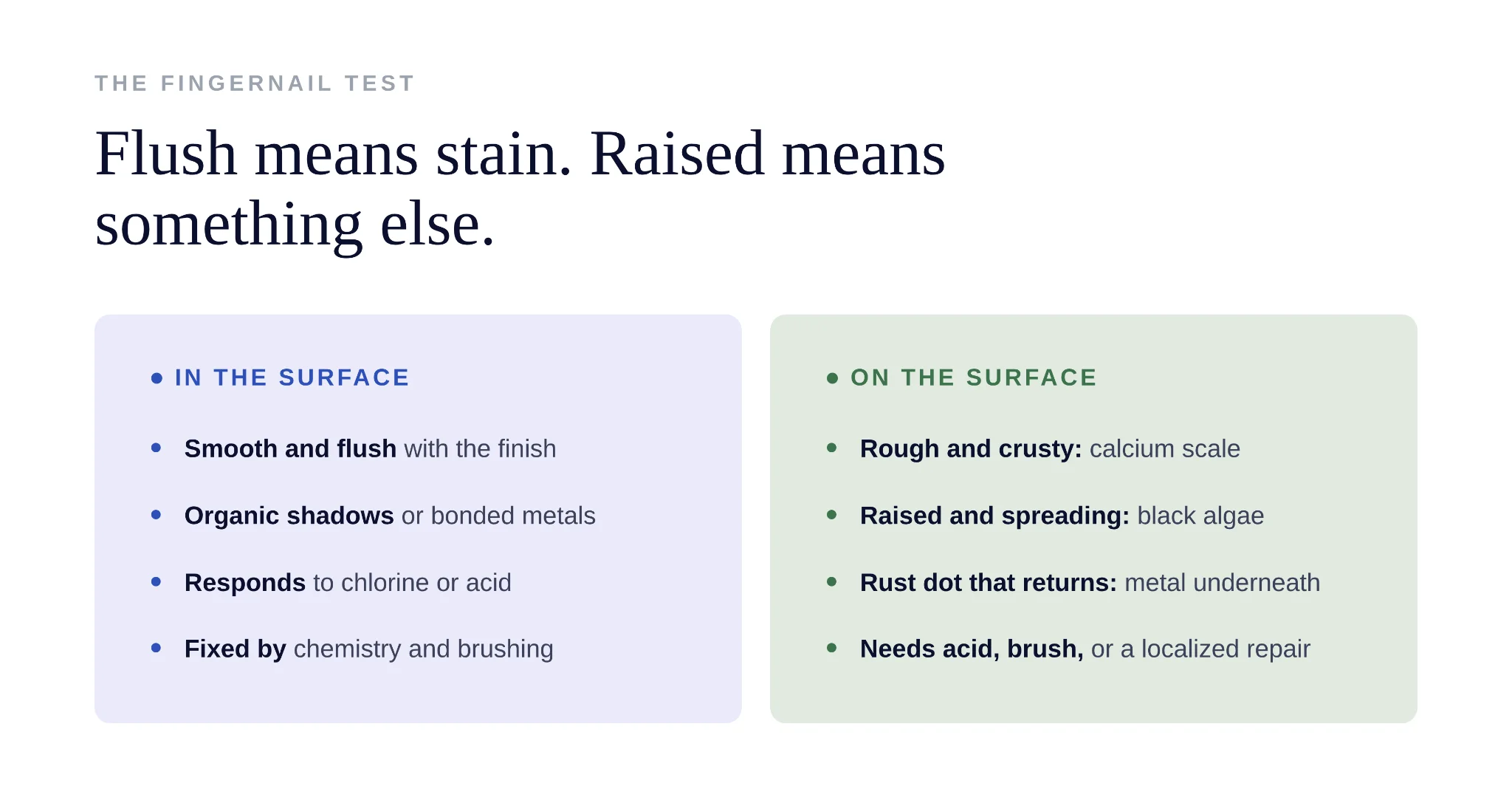
A stain is in the surface, smooth, flush, part of the finish.
If what you’re touching is raised, rough, or crusty, it’s a deposit sitting on the surface, and that’s usually calcium scale: white to gray, gritty, concentrated at the waterline or spread across walls in pools running high pH, high calcium hardness, or both.
Scale doesn’t respond to chlorine or vitamin C because there’s nothing to oxidize or reduce. It responds to acid, pumice (on plaster only), and fixing the saturation index that created it.
Black algae is the other imposter. It presents as black-blue-green spots, but the spots are raised, slightly slimy under a brush, and, the tell, they grow.
A manganese stain photographed in June looks identical in August. Black algae spreads. It also roots into plaster, which is why it needs aggressive brushing with a stainless brush plus sustained high chlorine, a completely different campaign from anything else in this guide.
Then there are the point-source rust spots.
A single spreading rust bloom that keeps returning in the same spot after every treatment usually has metal underneath it, rebar, a stray fastener, a staple in a vinyl pool’s structure.
No amount of water treatment fixes that. It’s a localized repair job: open the spot, remove or seal the metal, patch the finish.
Most Stains Are Just Time
Look back across the categories and one pattern dominates: the biggest, most common class of pool stains, the organic ones, are pure dwell time. Debris that gets removed the same day it arrives never stains anything. Debris that sits for a week almost always does.
That’s the practical case for putting the removal on autopilot, and it’s where Aiper’s robotic pool cleaners earn their spot in a stain-prevention plan. A robot that cleans the surface, floor, walls, and waterline daily removes debris before it has time to leach into the plaster or feed algae.
You’ll still want the two-tablet test on hand for whatever occasional stain does show up, whatever its source. But a pool that gets cleaned before debris has time to sit needs this guide far less often, since most stains never get the chance to form in the first place.
Get more pool and lawn care guides from Aiper on Google