How to Get Rid of Dandelions in Your Lawn Without Killing the Grass

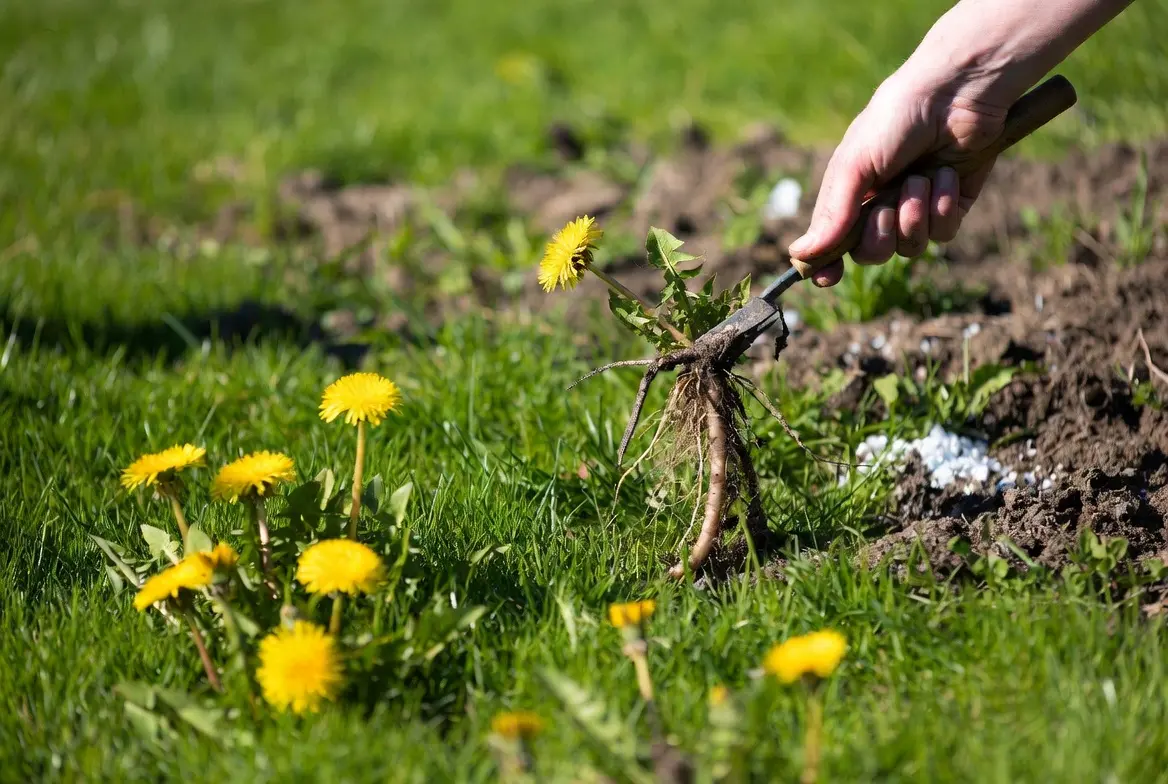
You walk out in April, see yellow everywhere, buy a spray, apply it, and feel like you’ve done something. The lawn looks better for a few weeks.
Then it’s July, and they’re back, maybe not as bad, but back, and you realize you’ve been treating an annual symptom of something that doesn’t change unless you change it.
That’s the thing nobody says plainly: dandelions are a soil and turf problem wearing a weed problem’s clothes.
The spray is real. The pulling is real.
But if you skip straight to those and ignore what made the lawn susceptible in the first place, you’re going to be doing this until you move. Quackgrass takes hold under the same neglected conditions, and it needs its own dedicated removal plan — see our guide to getting rid of quackgrass in a lawn.
What Actually Works
Three things actually work, and they work together, not instead of each other. Pull what you can reach, by hand, in wet soil, root and all. Spray what’s left with a selective broadleaf herbicide, timed for fall, not spring. And thicken the lawn underneath so the bare spots those weeds came from stop reopening.
Which one to lean on depends on what you’re looking at. A few dozen plants scattered across the yard: hand-pull them this weekend after rain, done. A lawn that’s more yellow than green: skip straight to soil test plus fall herbicide, because pulling that many one at a time isn’t a plan, it’s a hobby. Somewhere in between: do both, spray now, pull the stragglers, overseed in fall.
If you’d rather not spray at all, skip ahead to the corn gluten and mowing sections below. It’s slower, and it won’t touch plants that are already established, but it holds new ones back.
Is It Actually a Dandelion?
Worth thirty seconds before you treat anything, because several lawn weeds carry the same yellow flower and get sprayed, pulled, and blamed as dandelions.
A true dandelion has one flower per stem, and that stem is hollow, smooth, leafless, and unbranched. Young leaves are hairless, with jagged teeth that point back toward the crown. Snap any part of it, and you get milky white sap.
The common look-alikes:
Cat’s ear (false dandelion): The one most often mistaken for it. Stems branch, so one stem can carry more than one flower. Leaves are hairy with rounded lobes instead of teeth. It can form a taproot like a dandelion and is controlled by the same selective lawn herbicides, so if this is what you have, nothing in this guide changes.
Hawkweed: Hairy leaves, several small flowers clustered at the top of one stem, and a habit of spreading by runners along the soil surface. Pulling one plant leaves the runners. Treat the patch, not the plant.
Sow thistle: Leaves grow up the stem, not just at the base, and they have soft spines along the edge. This one is an annual. Mowing before it seeds and a spring pre-emergent handle it. Fall systemic spraying is wasted on it.
Wild lettuce and prickly lettuce: Tall, leafy, branching stems with a row of prickles along the underside of the leaf midrib. Also annual or biennial. Same approach as sow thistle.
The quick rule: leaves up the stem or more than one flower per stem means you are looking at something else. Horseweed is one of those — a tall annual with leaves all the way up the stem — so if it is colonizing your lawn, here is how to eliminate horseweed in your turf. Dandelion and cat’s ear are the two perennials here that can form deep taproots, and they are the two the rest of this guide is built around.
The Root Is the Whole Problem
A dandelion taproot on a plant that’s had two or three seasons to establish can go ten to twelve inches deep. Fleshy. Stores energy.
You can pull the top off that plant a dozen times, and the root just keeps regenerating. It has enough stored carbohydrate to rebuild the above-ground structure repeatedly without much effort.
First-year plants are different. Shallower, more brittle, smaller root mass. Both hand-pulling and chemical treatment work better on them.
This is why the same infestation can feel more or less manageable depending on where you are in the cycle of it.
The other thing about that taproot: it’s why timing matters so much with herbicides:
- Fall, when the plant is pushing sugars downward into the root to prepare for winter, is when a systemic broadleaf herbicide actually follows the plant’s own biology down to where it needs to go.
- Spring is when everyone notices the problem and runs to the store. Spring is almost the wrong time. The plant is pushing energy upward. It’s at peak vigor, and you’ll knock the leaves back and think you’ve won.
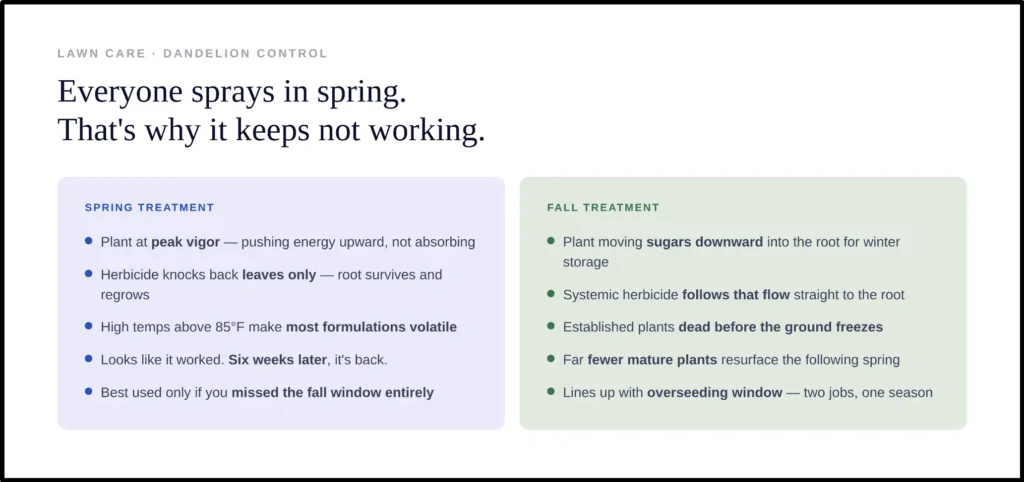
And six weeks later, you’ll find out you haven’t.
Hand-Pulling
It works. Under two conditions.
Wet soil, after a real rain or a thorough soak, and a proper tool. A fishtail weeder, a long-handled dandelion puller, something that lets you get four to six inches down alongside the root and lever the whole thing out rather than snapping it at the surface.
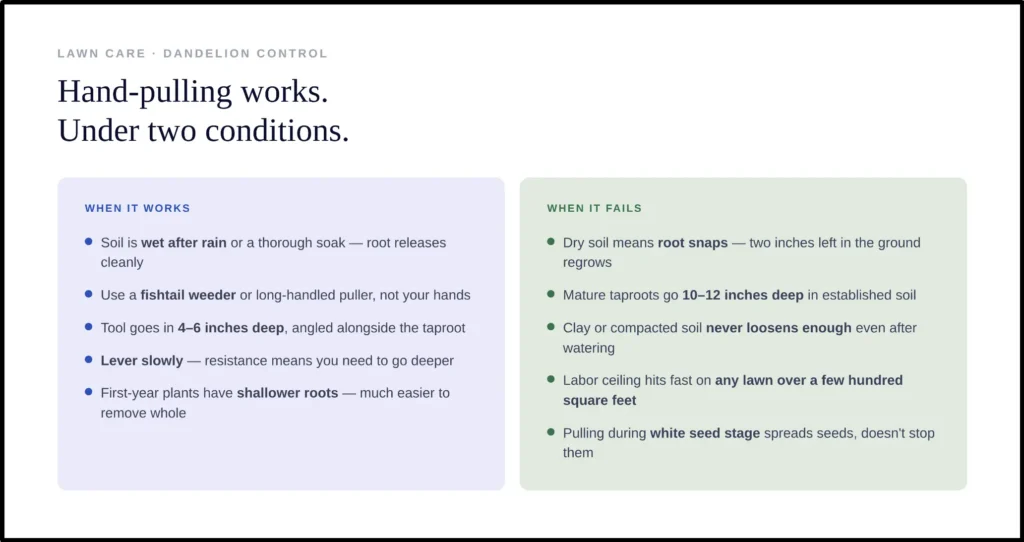
Pulling by hand in dry soil leaves two inches of root in the ground, and that’s enough to regrow. You’re just pruning the plant.
Push the tool in at an angle, parallel to the root. Go deep. Then lever slowly. If it resists, you’re not deep enough.
Where this falls apart is on any lawn bigger than a few hundred square feet with more than scattered plants.
One hour in, knees hurting, bag half full, and you can look up and see you’ve covered maybe fifteen percent of the lawn.
Once the plant is out, don’t leave the hole. Step down on the raised turf around it to close the gap, fluff the grass blades you flattened getting the tool in, and give the spot a quick drench. Skip this and that hole becomes the exact bare patch the next windblown seed lands in.
What Spray Does and Doesn’t Do
Selective broadleaf herbicide (products built around 2,4-D, mecoprop, dicamba, sometimes triclopyr) is what kills broadleaf plants while leaving grass largely standing.
Over-apply or spray in high heat, and you’ll see stress on the turf. Used correctly, the grass comes through fine.
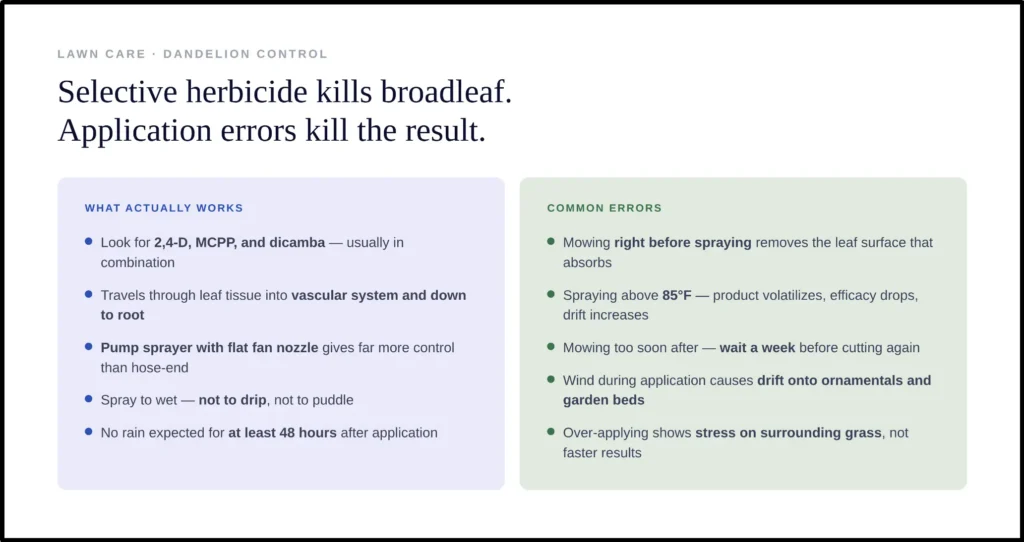
The active ingredients travel through the leaf tissue into the vascular system and down into the root.
That’s the mechanism. Which is also why the plant needs to be actively absorbing — stomata open, metabolism running, and why a plant in winter dormancy or drought stress is a harder target.
Don’t spray right before or after mowing.
The leaves need surface area. Mow, wait at least three days, then spray, and hold off on mowing for three days afterward. Don’t spray if rain is coming in the next 48 hours. Don’t spray when it’s above 85°F. Ester-based formulations volatilize and drift at that point; amine-based ones (which is what the products below are) are more forgiving, but heat still stresses the grass either way, so treat 85°F as the ceiling regardless of formulation.
Pick a still morning, not a breezy afternoon, to apply. Drift off a dandelion leaf can land on tomatoes, roses, or whatever’s growing on the other side of the fence, and broadleaf herbicide doesn’t distinguish a weed from a flowerbed. Gloves and long sleeves for the application itself, then wash up after. None of this is optional if you’ve got kids, pets, or a neighbor’s garden downwind.
A flat fan nozzle on a pump sprayer for spot treatment gives you far more control than a hose-end attachment, which throws more product than you think in directions you don’t intend.
Fall application, consistently done, will take out established plants in a way that spring spraying rarely manages.
The plants you treat in October are dead by the time the ground freezes. The bare spots they leave behind are what you overseed into. That’s the sequence.
You’ll still get new dandelions the following spring from seed blown in from everywhere. That’s normal and manageable. What you’re eliminating is the established root network that overwinters and regrows into mature plants year after year.
The Soil Underneath
If your lawn has heavy dandelion pressure, like not a few dozen plants but hundreds with real saturation, something in the growing conditions is working against your grass and working for the weeds.
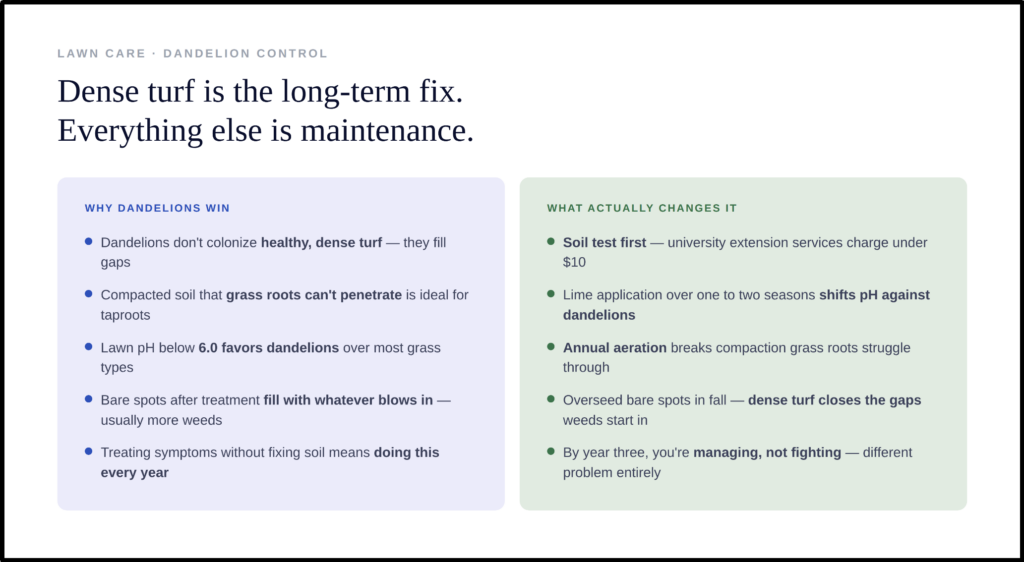
Compacted soil is the most common factor.
Dandelion taproots penetrate compacted soil that grass roots struggle in. Annual aeration, where you’re pulling cores and loosening the surface layer, changes what can establish. Not a fast fix. Takes a few seasons before you see it in the turf density.
Low pH is the other big one.
Dandelions tolerate acidic soil. A lot of grasses don’t thrive below a pH of 6.0. If your lawn is sitting at 5.5 or 5.6, which is more common than people think, especially in areas with heavy rainfall that leaches calcium, your grass is already behind. Lime changes over one to two seasons.
A soil test costs almost nothing. University extension services do them for under ten dollars in most states. If you’ve been fighting dandelions for years and haven’t tested your soil, that’s the first thing to do, not the last.
Bare Spots After Treatment
This is where most of the regrowth comes from. Not the roots you killed but the bare soil those plants occupied, which is now open to whatever blows in.
Overseed those gaps.
Fall timing lines up with herbicide application anyway: you’re killing weeds in September and October, seeding into bare spots through October and into November, depending on your region. Most grass types establish better in the fall than in the spring.
Scratch the surface lightly, spread seed at the rate on the bag for your grass type, keep it from drying out until germination.
Dense turf closes gaps. Gaps are where dandelions start. This is the loop, and the only way to actually break it.
The Methods That Get Repeated That Don’t Work
Boiling water burns whatever it touches, including the grass surrounding the plant you’re targeting. It doesn’t kill the root of anything with a real taproot. Fine for weeds in patio cracks. Useless on a lawn.
Vinegar at household concentration, 5% acidity, does almost nothing to a dandelion. Horticultural vinegar at 20% will burn the leaves off, but the root is unaffected, and the plant regrows. People use it because it feels like a natural solution. It isn’t a solution.
Mowing low doesn’t kill dandelions, it just clears the way for them. Scalping the lawn lets sunlight hit the soil and the crown of the plant, which is exactly what a dandelion wants. Keep the mower deck at 3 to 4 inches instead. Taller grass shades the soil, blocks light from reaching seeds trying to germinate, and out-competes seedlings before they get a taproot going. If the plant is in the white-seed stage when you mow, you’re spreading seeds rather than stopping them.
Which Product to Buy
The shelf is confusing because a dozen labels share the same three actives. What matters is the active ingredient, the formulation, and whether it is labeled for your grass type.
Ortho Weed B Gon Weed Killer for Lawns Concentrate: 2,4-D, MCPP, and dicamba. The standard three-way mix. Labeled for cool-season grasses and for bermuda, zoysia, centipede, and bahia at a reduced rate. Mix it for a pump sprayer rather than buying the hose-end version.
Spectracide Weed Stop for Lawns Concentrate: The same three actives at a lower price. Rainfast in about six hours. Same grass-type rules apply.
Ortho Weed B Gon Chickweed, Clover & Oxalis Killer: Triclopyr. Stronger on cat’s ear and the weeds that shrug off 2,4-D. Cool-season lawns only; it injures bermuda.
Ready-to-use trigger bottles of either Ortho or Spectracide: Fine for a handful of plants. Too expensive and too slow for anything more.
Weed and feed granules (Scotts Turf Builder Weed & Feed and similar): These need wet leaves to stick, get timed to the fertilizer schedule rather than the weed, and spread herbicide across the whole lawn whether it has weeds or not. Spot spraying beats them on both cost and results.
Espoma Organic Weed Preventer: Corn gluten meal, for the spring pre-emergent role described below. Sold as a granule to put down with a spreader.
Two grass-type warnings. St. Augustine and floratam are sensitive to most three-way mixes and are often excluded from the label, so check for your grass by name before buying. And on any warm-season lawn, skip the spring application entirely and treat in October or November once growth slows but the leaves are still green.
Outside the US, the shelf looks different but the chemistry doesn’t. In Canada, Ortho Killex is the same three-way mix, 2,4-D, mecoprop-P, and dicamba, sold under a different name. In the UK, Verdone Extra (fluroxypyr, clopyralid, MCPA) is the standard lawn-safe option for dandelion and clover. In Australia, Amgrow Bin-Die (MCPA, clopyralid, diflufenican) covers dandelion, bindii, and clover on couch, buffalo, and most home lawns. Match the active ingredients, not the brand name, and the grass-type warnings above still apply.
Corn Gluten Meal
This one is legitimately useful but only in a specific role. It’s a pre-emergent, it interferes with seed germination, and it also adds nitrogen to the soil, which the grass benefits from.
Applied in early spring before soil temperatures climb above 50°F, it reduces the population of seedlings that would otherwise establish. It does nothing to mature plants. Nothing to existing roots.
The window is tight, and if you miss it, the product just sits there feeding the lawn without doing the germination-suppression work.
People who use it as part of a multi-year approach, with pre-emergent in spring, systemic herbicide on established plants in fall, and overseeding into gaps, see cumulative results.
The dandelion population shrinks each year because you’re cutting off two of its three means of persistence: new seedlings and existing root systems. The third, seed blown in from outside your property, you can’t control. You can only close the gaps it lands in.
What the First Two Seasons Look Like
Fall of year one: soil test. Lime if pH is low. Broadleaf herbicide application, properly timed, once temperatures have dropped and the plants are moving sugars downward. Overseed bare areas.
The following spring: corn gluten application before 50°F soil temperatures. Hand-pull anything that comes up, there will be less of it. Don’t spray in spring unless you missed the fall window entirely.
Fall of year two: evaluate what you still have. If it’s scattered, hand-pull and spot treat. If it’s still significant, full herbicide application again. Aerate if the soil is compacted.
By the third spring, you’re usually managing rather than fighting. The character of the problem changes. Instead of a lawn that’s being colonized, you have a lawn that occasionally gets new dandelions from seed, which you pull or spot-treat before they establish.
That’s a different relationship with the problem entirely, and it’s achievable. It just takes more than one season of doing the right things in the right order.
The Other Half of Healthy Grass Is Water
Everything in this guide is about creating conditions where grass can actually compete. Dense, well-rooted turf doesn’t give dandelions the gaps they need to establish.
Water is what holds that turf through the stretches where it would otherwise thin out and create those gaps.
That means watering deeply once or twice a week, not a light sprinkle every day. A quick daily rinse wets the top half-inch of soil and trains grass roots to stay shallow, which is exactly the weak, thin turf dandelions move into. Long, infrequent watering pushes roots down, and deep roots build the kind of dense turf that doesn’t leave gaps.
The Aiper IrriSense 2 maps up to 10 independent zones across 4,800 square feet, so shaded areas, sun-exposed turf, and fast-draining slopes each get treated on their own schedule.
Weather-Sense adjusts automatically, skips a cycle after rain, runs longer through a dry stretch, so the lawn isn’t sitting dry at the moment it’s most vulnerable.
Common Questions
Cool-season lawns in the North: mid-September through early November, on a day above 50°F. Warm-season lawns in the South: October into November. A light frost does no harm as long as the leaves are still green and growing.
Usually the timing did. A spring application knocks the plants back, but many recover by fall because the root survives. Repeat in fall and the same product will hold.
Yes, with a gap. Spray first, wait the interval on the label, usually three to four weeks, then seed. Seeding first means waiting until the new grass has been mowed at least three times before any herbicide goes down.
Until the spray has dried, which is a few hours on a warm day. Granules need to be watered in first. The label gives the exact re-entry time.
They are early forage, and in a yard with nothing else blooming in April, they matter. Where there are other flowers, they are one option among many. A workable compromise is letting them bloom and mowing before the seed heads form, or leaving one untreated strip along a fence.
Yes, for first-year plants. Their roots are shallow, and their stored energy is at its lowest, so a spring pull in wet soil takes the whole plant. Save the mature ones for the fall spray.
Soil test first, it’s cheap and it tells you if pH is the reason grass is losing this fight. Then a fall herbicide application across the whole lawn, not spot treatment, once temperatures drop. Overseed the bare ground that opens up. Hand-pulling isn’t the plan at this scale, it’s what you do to the stragglers in year two.
If any plants have already gone to seed, or are about to, snap the flower heads off before they turn into the white seed heads. It won’t kill the plant, but it stops that one from reseeding the yard while you wait.
Get more pool and lawn care guides from Aiper on Google