The Complete Guide to Keeping Pests Out of Your Pool

Most pool pest problems are food problems. The clerk sells you a floating trap or a bottle of something, you go home, and three weeks later the bugs are back.
Because the bugs were never the issue. The algae they were eating was the issue. The standing water on your cover was the issue. The floodlight you leave on until midnight was the issue.
Fix the conditions and the pests handle themselves.
This guide works through the ones that actually show up in residential pools, what each one is really there for, and what removes the reason instead of the symptom.
Water Boatmen and Backswimmers
If you’re scooping small oval bugs out of the water every morning, you almost certainly have two species and one root cause.
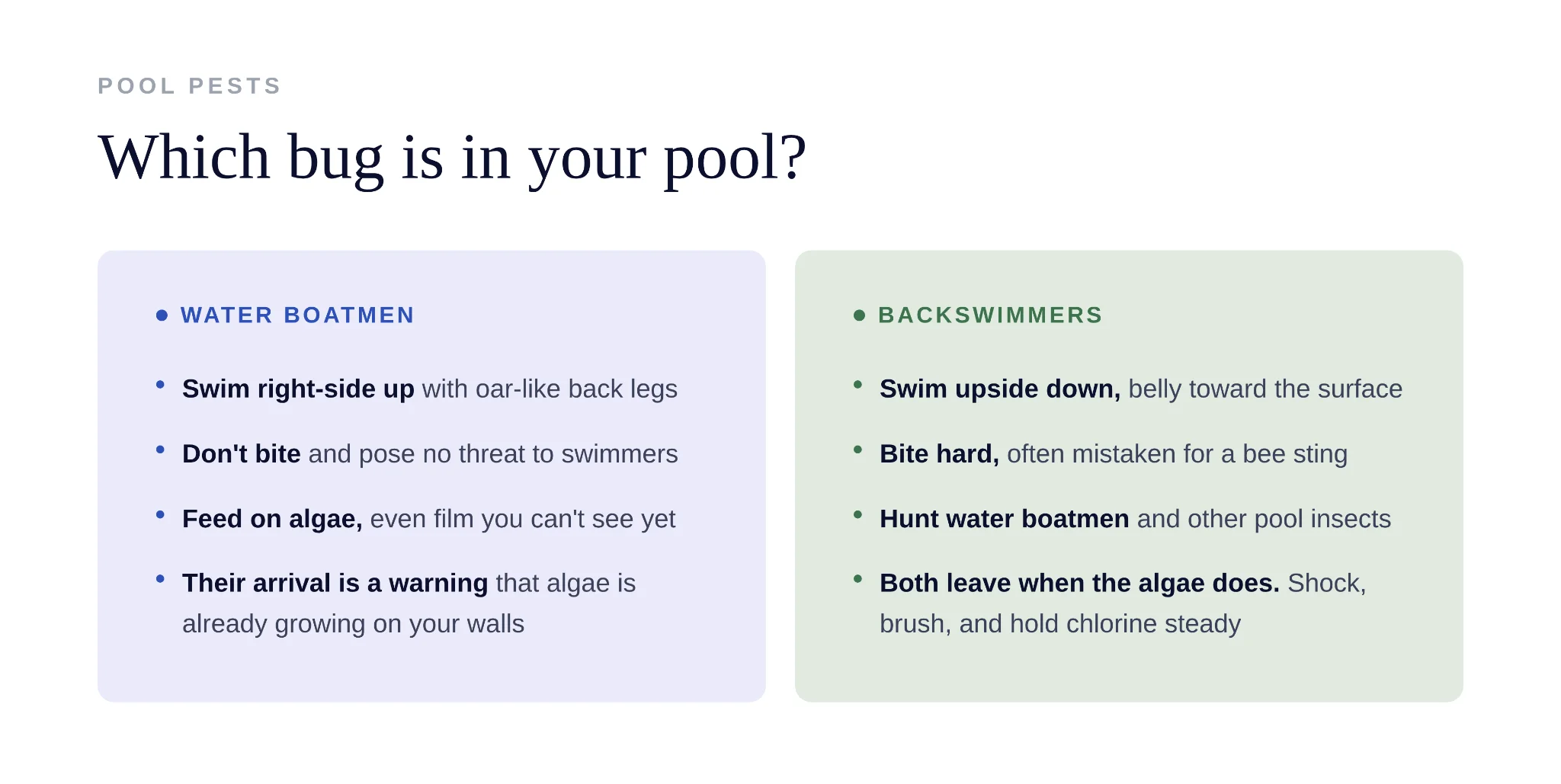
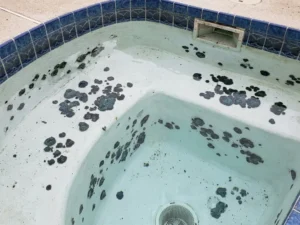
Water boatmen are the harmless ones. They swim right-side up, they don’t bite, and they’re in your pool for exactly one reason: they eat algae. If boatmen have moved in, there’s algae in your water, even if the pool looks clear. Algae doesn’t announce itself with green water on day one. It starts as a film on the walls, in the corners behind the ladder, along the waterline where the brush never quite reaches. Boatmen find it before you do.
Backswimmers are the ones to worry about.
They swim upside down, they’re predators, and they bite hard enough that people mistake it for a bee sting. And here’s the part that matters: backswimmers eat water boatmen. They’re the second link in a food chain that your pool is now hosting.
So the sequence goes: algae feeds boatmen, boatmen feed backswimmers, backswimmers bite your kid.
Shock the pool, brush every surface, walls, steps, behind the ladder, the shaded corner that never gets circulation, and run the filter hard for 24 hours.
Then keep free chlorine where it belongs and brush weekly. Both species lay eggs on and in algae, so a pool with nothing growing on its walls has nothing for them to eat and nowhere for them to breed. They fly. They’ll leave.
Mosquitoes
A maintained pool is one of the worst places in your yard for a mosquito to lay eggs. Moving water, chlorine, a skimmer pulling the surface, larvae can’t survive it. Mosquito problems around pools come from everywhere except the water you swim in.
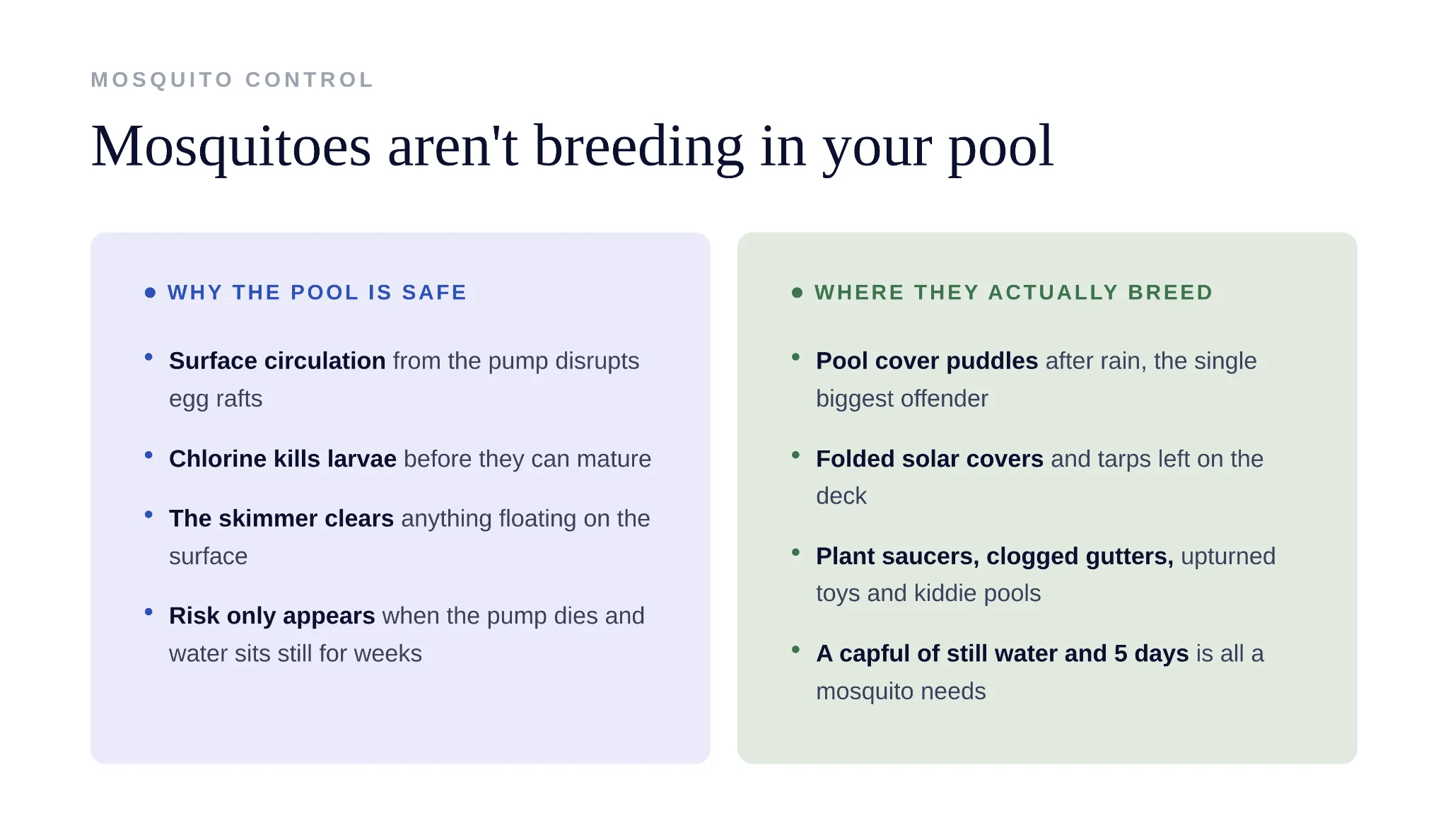
The pool cover is the usual offender. Rain collects in the low spots, sits there for a week in July heat, and you’ve built a nursery. Same with the winter cover in spring, the folded solar cover on the deck, the tarp over the pump equipment. A mosquito needs about a bottle cap’s worth of still water and five days.
Then there’s the perimeter: plant saucers, clogged gutters, the kickboard that landed upside down, the kiddie pool nobody dumped, the wheelbarrow behind the shed.
Females don’t travel far from where they hatched. If you’re getting eaten alive on your own deck, the source is probably within a hundred feet.
The pool itself only becomes a breeding site when it stops being a pool, dead pump, green water, no circulation for two weeks. At that point it’s a pond, and ponds breed mosquitoes at scale.
Run the pump daily. Drain or pull the cover taut. Walk the yard after rain and tip everything holding water. That’s the whole program.
Wasps and Bees
Late summer, dry spell, and suddenly wasps are skimming the surface of your pool every afternoon. They’re not nesting in it. They’re drinking from it and hauling water back to cool the nest.
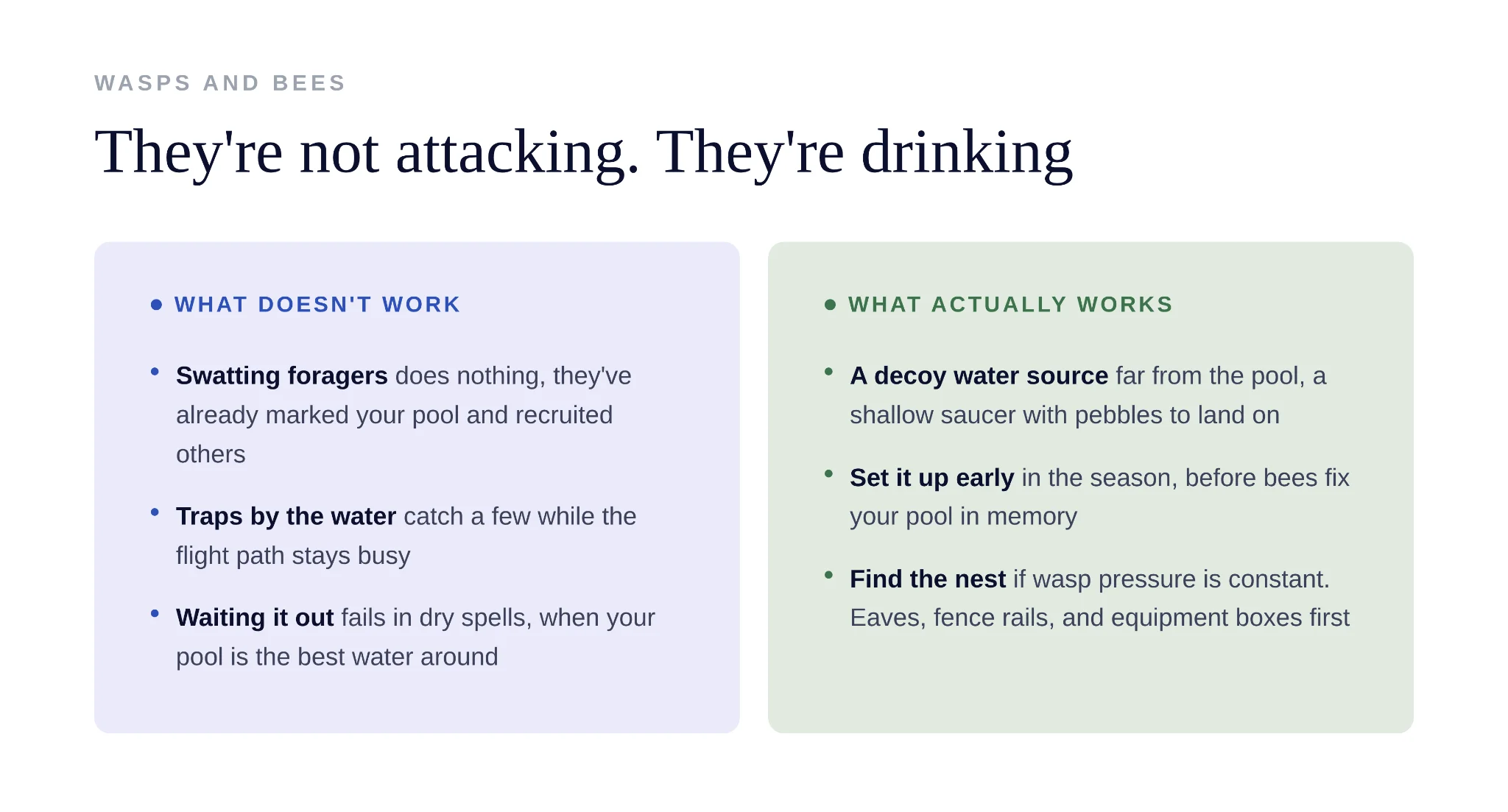
The frustrating part is that swatting individual wasps does nothing, because the ones you see are foragers who have already marked your pool as a water source and recruited others. Kill ten and ten more arrive on the same flight path.
Two things actually work.
First, a decoy water source.
Set up a shallow basin on the far side of the yard, away from the pool, and keep it filled. Wasps and bees prefer a calm, easy landing over a pool surface where they drown by the dozen. Give them a better option and most of the traffic reroutes within a week or two.
Second, find the nest.
If the wasp pressure is heavy and constant, there’s a nest close — under the eaves, in the pool equipment box, inside the hollow rail of the fence. Deal with the nest (or have someone deal with it) and the pool traffic collapses.
Bees get gentler treatment. If honeybees are working your pool in numbers, the decoy water source is the move, placed early in the season before they’ve fixed the pool in memory. Bees are stubborn about a known water source.
Retraining them takes weeks; preventing the habit takes days.
Earwigs, Beetles, and Everything Your Lights Invite
Open the skimmer basket on a summer morning and count the bodies: June beetles, moths, earwigs, the occasional diving beetle. Most of them didn’t wander in. They flew at your lights and fell.
Pool lighting and landscape lighting are insect magnets, and every insect that circles a light above water eventually ends up in the water. If your deck lights burn until midnight, you’re running a trap line straight into your pool.
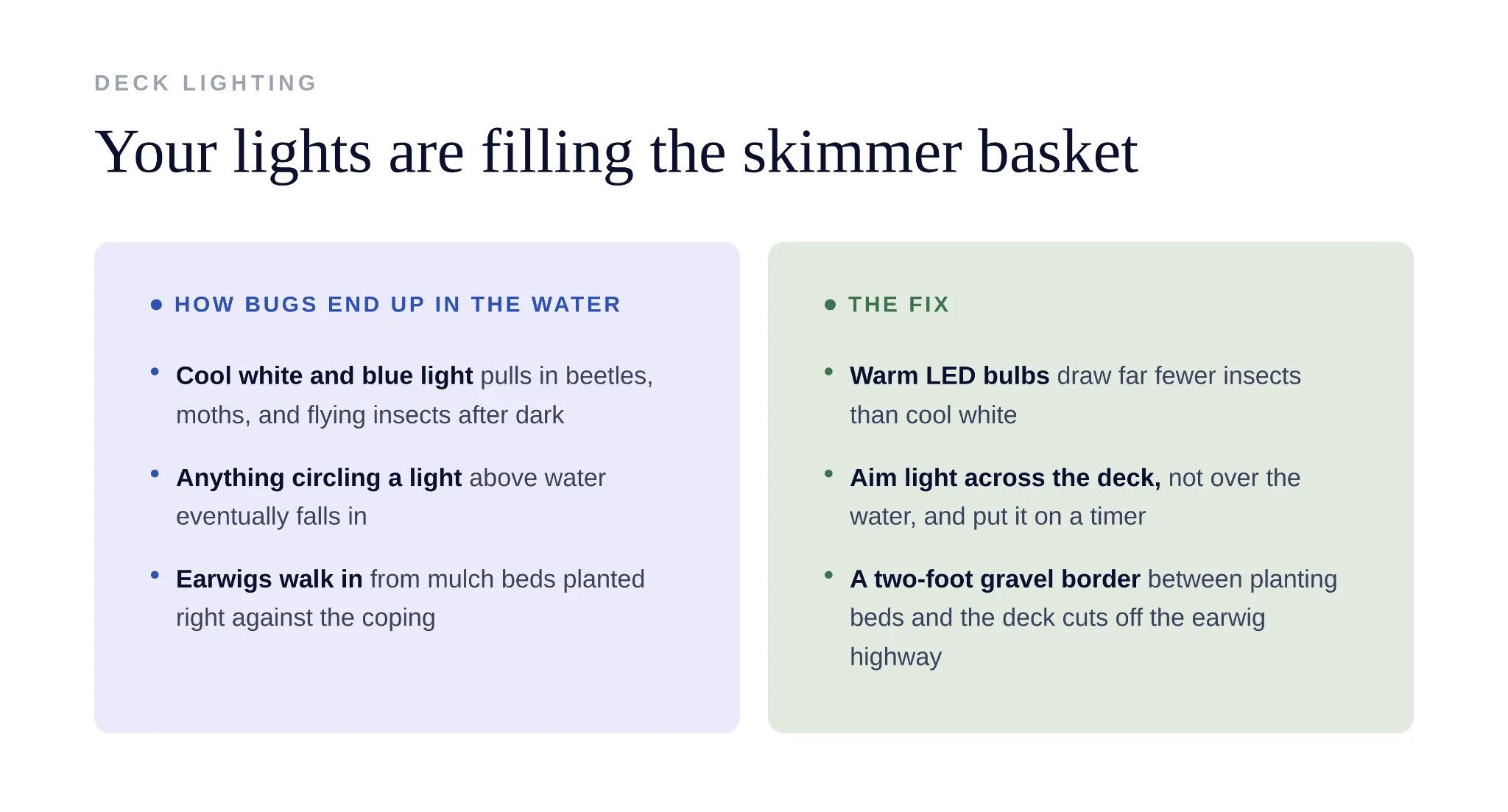
Switch to warm-temperature LED bulbs. Insects respond far less to warm light than to cool white or blue. Position lights to shine across the deck rather than over the water. Put them on a timer. The morning skimmer count drops noticeably, usually within the first week.
Earwigs are a slightly different story. They’re not falling from the sky; they’re walking in from the mulch bed you’ve got planted right up against the coping. Earwigs live in damp organic cover, mulch, leaf litter, the wet gap under a pool mat left on the deck.
A two-foot gravel or bare border between the planting beds and the pool deck removes the highway feel. It’s not pretty in every landscape plan, but it works, and it also cuts down ants.
Ants, for their part, come to the pool for moisture, especially in dry stretches. If you’re seeing trails along the coping and drowned ants clustering in the skimmer, follow the trail back. The fix is at the colony, not the waterline.
Frogs
A frog in your pool is information. Frogs eat insects, and they don’t hang around places without food. If frogs keep showing up, you have an insect population around the pool worth investigating, usually lights running late or vegetation crowding the water.
They’re also a maintenance problem in their own right. Frogs get in and can’t climb smooth walls to get out, so they swim until they exhaust and drown, and you find them in the skimmer basket.
A frog log, a floating ramp anchored at the edge, gives them an exit and saves you the morning ritual. Cheap, ugly, effective.
Long-term, the same measures that cut your insect load cut your frog visits. Fewer bugs, fewer frogs. Trim the vegetation back from the water, kill the lights earlier, and keep the deck dry overnight.
Ducks
One duck landing in your pool is a photo.
A pair scouting it in spring is a problem, because if they nest nearby, you’ll have ducks all season and duck droppings carry bacteria (E. coli, Salmonella) that your chlorine has to fight in concentrated doses every time they visit.
The window to act is the first few days. Ducks settle where they feel safe, and they feel safe in calm, open, undisturbed water. Break any one of those conditions. Run the pool cleaner while they’re scouting. Movement in the water unnerves them.
Put a couple of beach balls on the surface overnight. Use the cover during the weeks they’re house-hunting. Some people swear by predator decoys; in my experience, the decoys work for about a week, and then the ducks figure it out, so rotate or move them if you go that route.
Once ducks have committed to a nearby nest, most of this stops working, and in many places waterfowl are protected.
You can discourage, but you can’t touch the nest. Act early or live with them until fall.
The Boring Truth
The pools that struggle are the pools where cleaning slips, where leaves sit on the bottom for a week feeding the algae that feeds the boatmen, where the waterline film builds because brushing is a chore that keeps losing to Saturday plans.
This is honestly the strongest argument for a robotic pool cleaner.
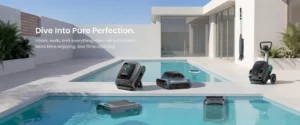
An Aiper robotic cleaner runs the floor and walls on its own schedule, pulling out the organic debris before it becomes food and scrubbing the surfaces where algae gets its start.
You’re removing the bottom of the food chain that every one of these pests depends on. The pool stays clean whether or not you had time this week, and a consistently clean pool is a pool that pests fly past.
Get more pool and lawn care guides from Aiper on Google