How to Get Iron Out of Pool Water: Causes, Tests, Sequestration

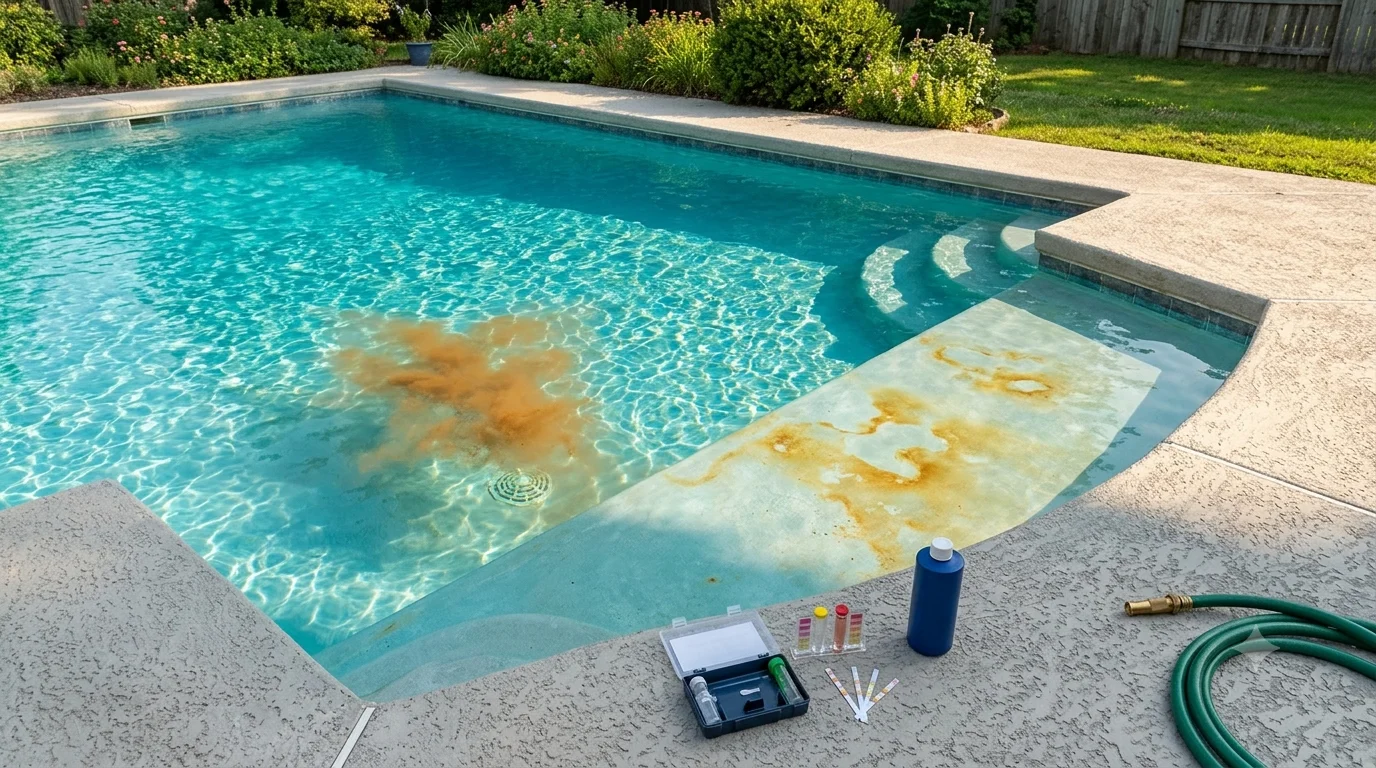
The classic call goes like this. Somebody topped up their pool from a well, shocked it the same weekend, and by Monday the water looks like weak tea. They’ve already dumped in algaecide, because green-brown water means algae, right?
It doesn’t. Not this kind. And every product they throw at the algae makes the iron problem worse, because the thing that turned their water brown is oxidation, and shock is oxidizer by the pound.
Iron is one of the most misdiagnosed problems in residential pools, which is a shame, because the diagnosis takes about thirty seconds once you know what to look at. A similar quick-diagnosis approach applies to a pool that’s running high on pH — see our guide to lowering pH in a pool without over-correcting.
Brown but Clear Is the Tell
Algae water is green and cloudy. It has body to it, a haze, a slime on the walls, a texture. Iron water is discolored but clear. Green-tinted, tea-colored, brown, sometimes nearly black in bad well-water cases, but you can still see the main drain. Discolored-but-transparent is dissolved metal, close to every time.
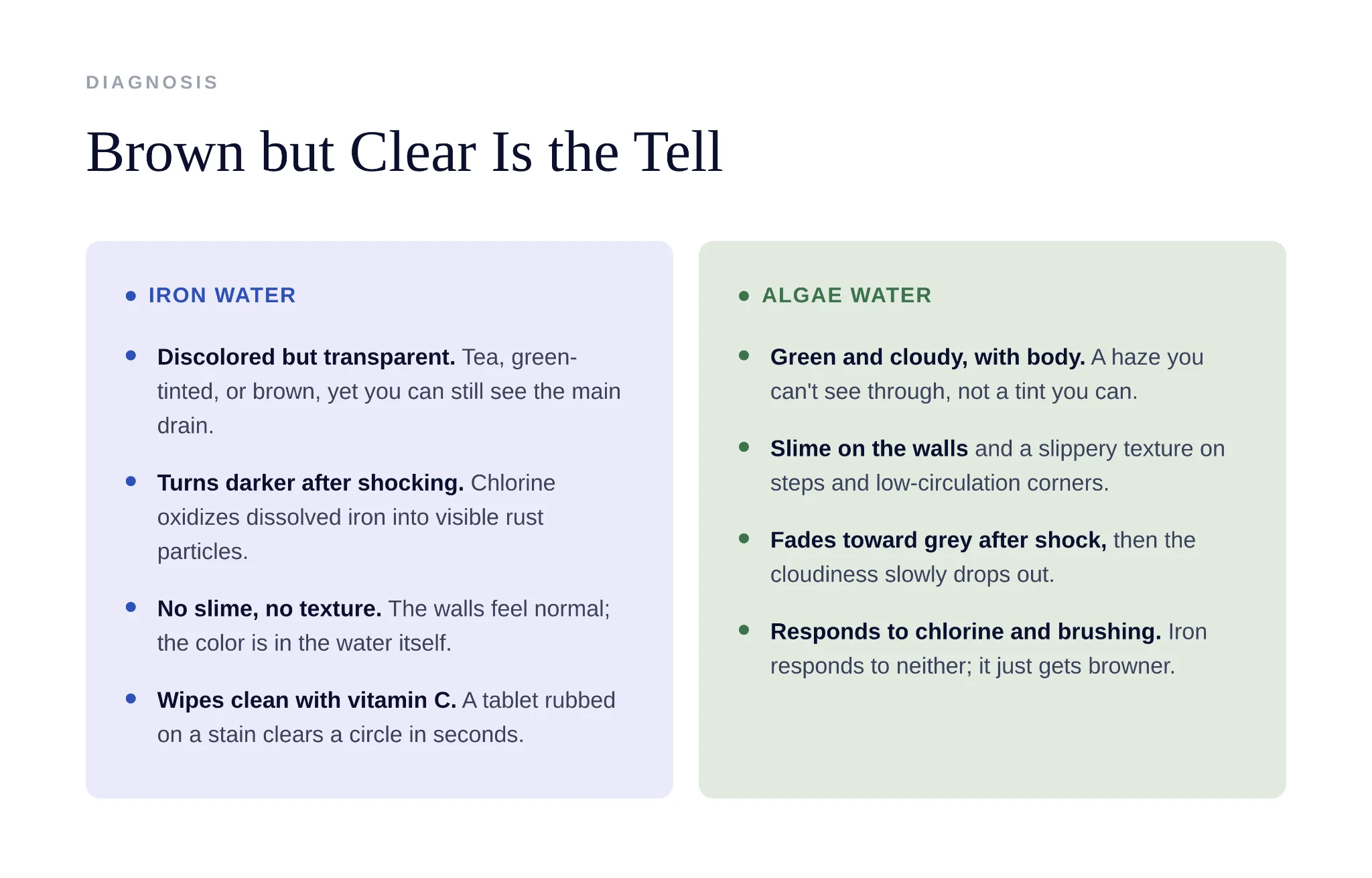
The confirmation test costs nothing: take a bucket of pool water and add a little chlorine, or just watch what happens in the pool after you shock:
Algae dies toward grey-white, and the cloudiness eventually drops.
Iron goes the other way, darker, browner, more dramatic.
Chlorine oxidizes dissolved iron into visible rust particles, which is exactly why the water suddenly turned the day after shocking.
The iron was there all along, invisible, dissolved. The shock just developed the photograph.
Copper, for the record, runs green to blue-green and stains black or teal. Iron runs yellow-brown-rust. Different metal, different chemistry, mostly the same playbook.
Where It’s Getting In
Well water. Start there, because that’s the answer in most iron pools. Plenty of wells run 0.3, 0.5, even several ppm of dissolved iron, and every top-up is a fresh delivery. The pool’s threshold for staining trouble sits around 0.2 ppm.
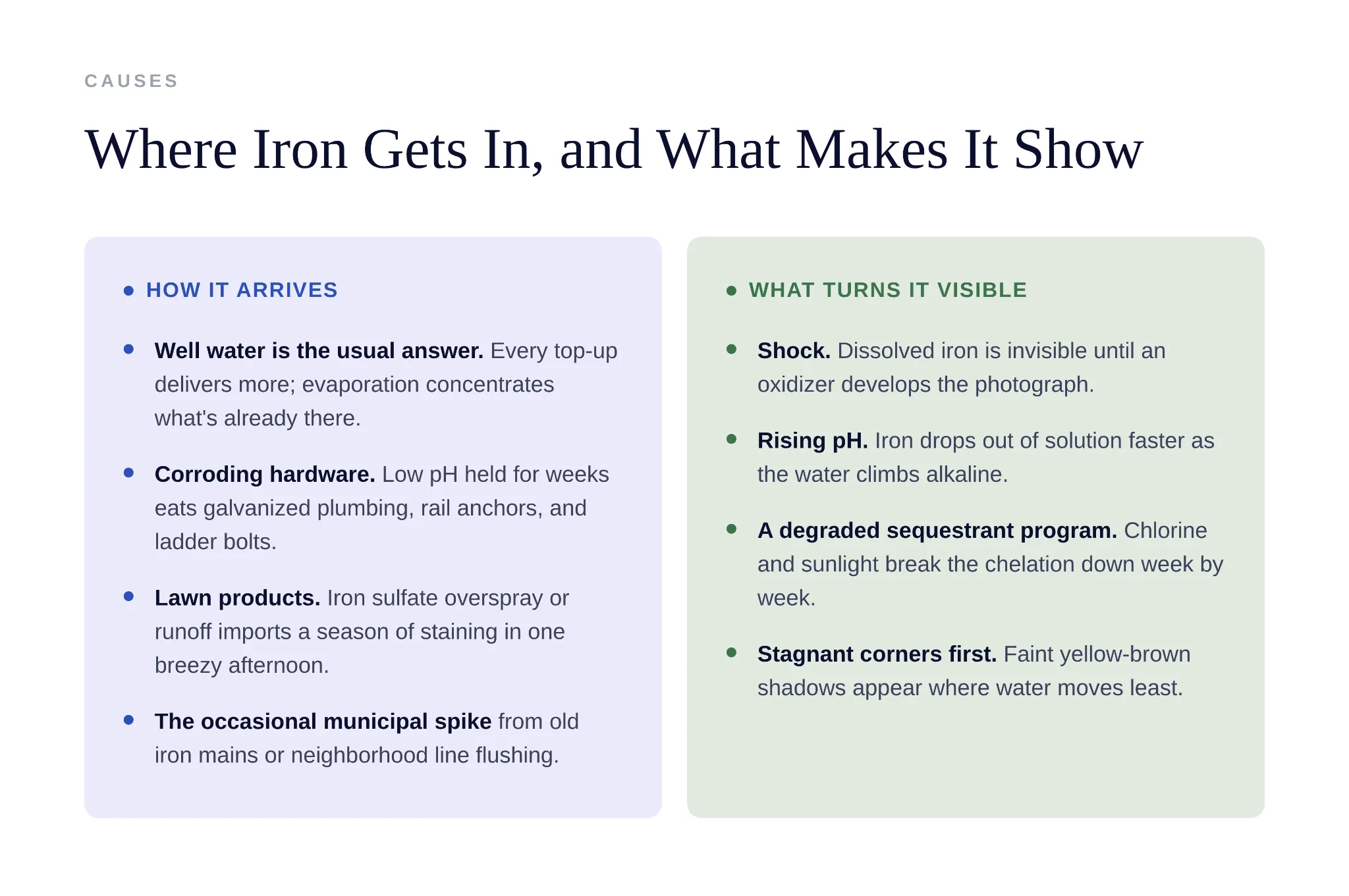
Do the math on a few thousand gallons of evaporation makeup per summer, and the pool becomes an iron concentrator: the water evaporates, the metal stays. Well water rarely carries iron alone, either — if your fill water is leaving scale as well as rust, our guide on softening pool water covers the methods that deal with the calcium side of the same problem. If that scale has already hardened into a crusty, gray-white buildup on plaster or tile, our guide to removing calcium silicate scale covers the removal steps softening alone won’t undo.
Municipal water usually tests near zero, but not always; old iron mains and neighborhood flushing events can spike it.
The pool itself contributes when the chemistry has been abusive. Water held at low pH for weeks quietly eats any ferrous metal it touches: old galvanized plumbing, corroding light niches, the rusting anchor of a handrail, a cheap ladder bolt.
If the iron readings climb even though nothing new went in the water, something in the water is dissolving.
And then the lawn. Iron sulfate moss-and-green-up products are wonderful on turf and catastrophic in a pool.
One breezy application day, or runoff from a treated slope, and you’ve imported a season of staining. If the pool deck gets orange freckles after the lawn service visits, you already know.
Test the Tap, Not Just the Pool
An iron test on pool water tells you where you are. An iron test on your fill water tells you why, and that second test is the one people skip.
Get a drop-count metal kit or decent iron strips, pool store testing works fine for this too. Test the pool, then test straight from the hose you fill with.
If the hose water shows iron, no in-pool treatment is ever going to be finished; you’ll be managing a supply line, not an incident. That just changes the strategy: prevention at the hose instead of repeated cures in the pool.
Anything at or above 0.2 ppm in the pool deserves action. Zero is the actual target.
What Sequestrant Actually Does
Here’s the sentence that saves people the most money and confusion: sequestrant does not remove iron.
A sequestrant (the good ones are HEDP-based, phosphonic acid chemistry) is a chelating agent. It grabs dissolved metal ions and holds them in a bound complex so they can’t oxidize into particles or plate onto your plaster as stains.
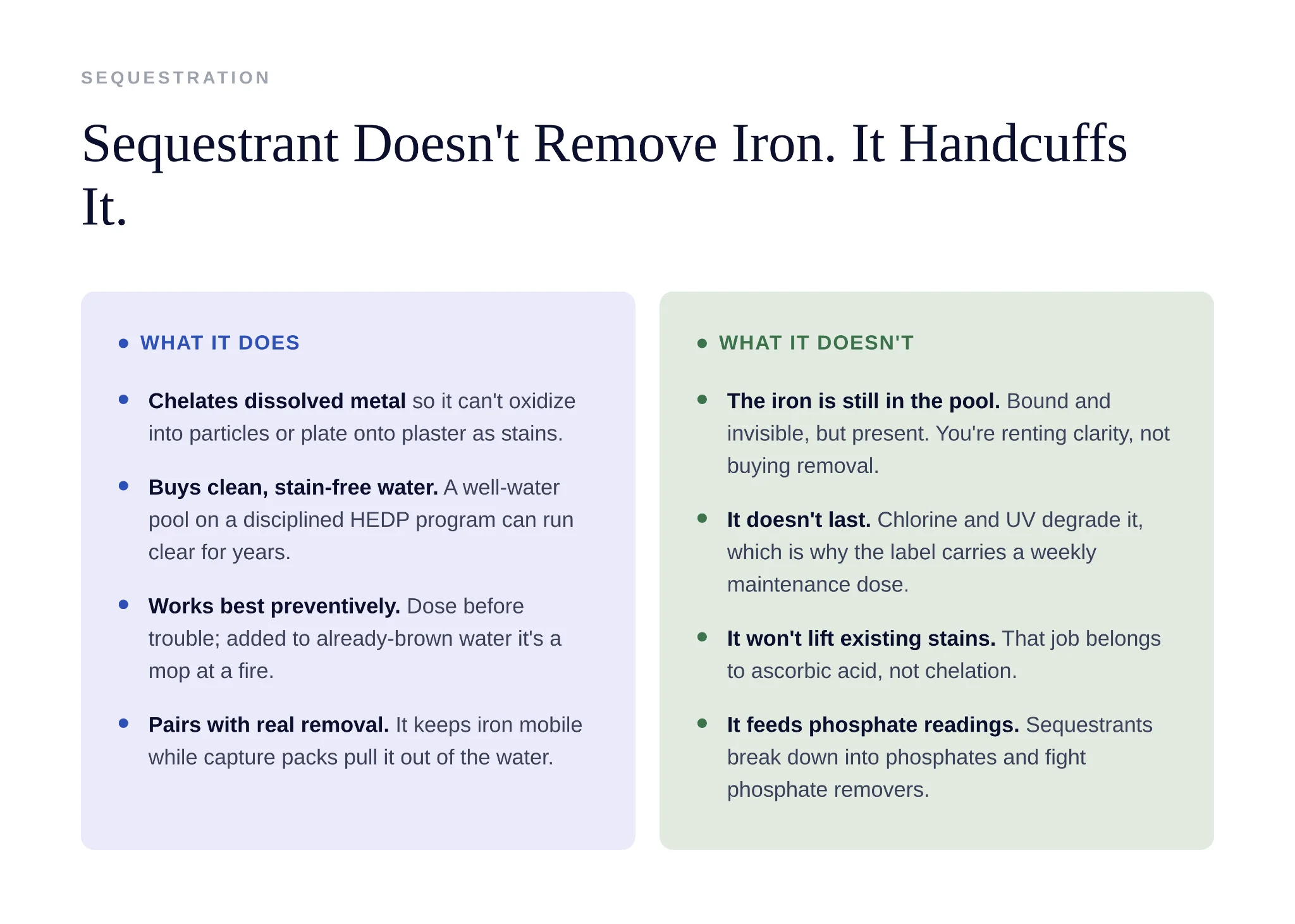
The iron is still in the water. Invisible, handcuffed, but present. Stop dosing, and the handcuffs come off, because chlorine and sunlight steadily break sequestrant down.
That’s why the label has a weekly maintenance dose on it.
So sequestration is management, and genuinely good management: a well-water pool on a disciplined HEDP program can run stain-free for years.
But go in with eyes open: you are renting clarity, not buying removal. Two side notes worth knowing. Sequestrants degrade into phosphates, so if you also run phosphate remover, the two products will quietly fight each other.
And dose before trouble: sequestrant added to already-stained, already-brown water is a mop brought to a fire.
Actually Getting It Out
Three real removal paths, in rough order of how often they make sense.
Partial drain and refill, but only if your fill water is cleaner than your pool water. Draining a well-water pool and refilling from the same well is an expensive way to change nothing.
If the well is the source, refill through a hose-end pre-filter that catches metals, or in stubborn cases, truck in water. Slow the fill down; pre-filters strip metals best at low flow.
In-pool metal-capture packs, the little pouches of polymer resin that hang in the skimmer basket and physically bind metals out of circulation. Slow, unglamorous, and they genuinely remove iron rather than hiding it.
They pair well with a sequestrant program: the sequestrant keeps the iron dissolved and mobile, the pack pulls it out of the water over weeks.
The floc-and-vacuum route, for water that’s already turned brown: let the oxidation finish (the chlorine already started it), nudge pH up slightly so the iron precipitates fully, let it settle overnight with the pump off, then vacuum to waste. Not through the filter, or you’re just redistributing rust through your sand. Old-school, laborious, effective.
Lifting Stains Off the Plaster
Iron that already stained the surface responds to ascorbic acid, plain vitamin C, and the transformation is genuinely satisfying to watch. Rub a vitamin C tablet on a small stain, and it wipes a clean circle in seconds. That’s your confirmation it’s iron.
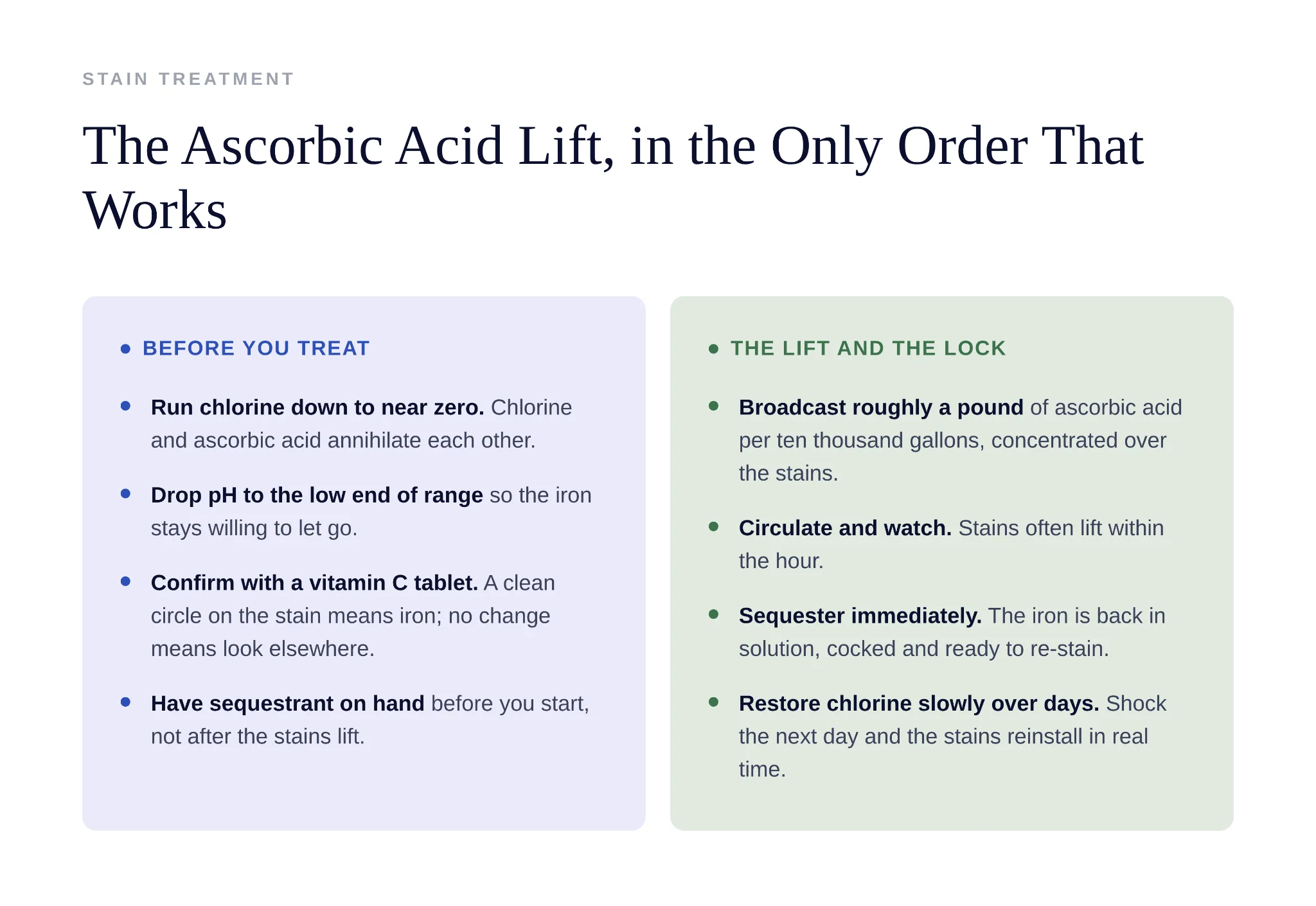
The full treatment has an order of operations, and the order is the whole trick.
Run chlorine down to near zero first, chlorine and ascorbic acid annihilate each other, and treating at 3 ppm FC just burns your acid for nothing. Drop pH to the low end of range.
Broadcast ascorbic acid, roughly a pound per ten thousand gallons, concentrating over the stains, and circulate. The stains lift, sometimes within the hour.
Then the step everyone forgets: that iron didn’t leave. It’s back in solution, dissolved, cocked and ready to re-stain the moment chlorine comes back up. Add a full initial dose of sequestrant immediately after the lift, run it a day, and restore chlorine slowly over several days rather than shocking.
Shock the day after an ascorbic treatment, and you get to watch your stains reinstall themselves in real time. Then start the removal work: packs, partial drain, while the sequestrant holds the line.
Keeping It Out
Pre-filter every fill if you’re on a well, no exceptions, and add a maintenance dose of sequestrant after any big top-up. Keep pH out of the corrosive basement so the pool stops donating its own hardware to the problem.
The other habit that matters is seeing trouble early, and that’s mostly a cleanliness function. Iron staining announces itself as faint yellow-brown shadows in the corners and low spots where water moves least, easy to catch on a clean surface, invisible under a film of dirt and leaf debris, where settled organics deepen the discoloration on their own.
A robotic cleaner like an Aiper keeps the floor and walls consistently clean and the debris out of the equation, so the first hint of metal shows up while it’s still a maintenance dose, not an ascorbic-acid weekend.
Get more pool and lawn care guides from Aiper on Google