How to Get Rid of Mushrooms in a Lawn (And Should You?)

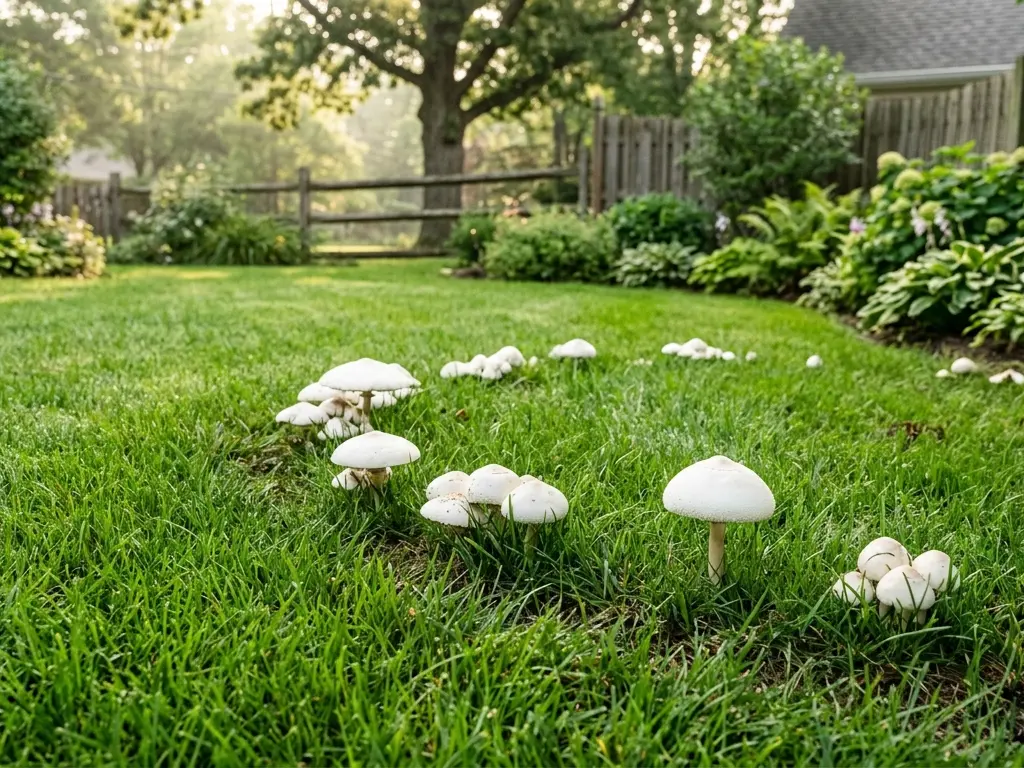
You walk out one morning, and there’s a cluster of mushrooms near the back fence. Or a ring of them cutting across the middle of the yard. Or one large, thick-stemmed specimen sitting in the grass like it’s been there for weeks, because it probably has.
The instinct is to kick them over — and mostly, that’s fine. Mushrooms in a lawn are almost always harmless to the grass itself; they’re just the fruiting body of a fungus already living in the soil, feeding on something buried and encouraged by shade and moisture. Whether you actually need to deal with them depends less on the mushroom and more on who walks on that lawn. Sometimes you’ve been kicking them over for three summers, though, and they keep coming back in the same spot, and you still don’t know why.
Here’s what to do about that.
Why Are Mushrooms Growing in My Lawn?
It’s a symptom. The organism is underground, a web of white fungal threads called mycelium running through the soil, sometimes for years, before a single cap appears above the surface. What you see in the grass is the fruiting body.
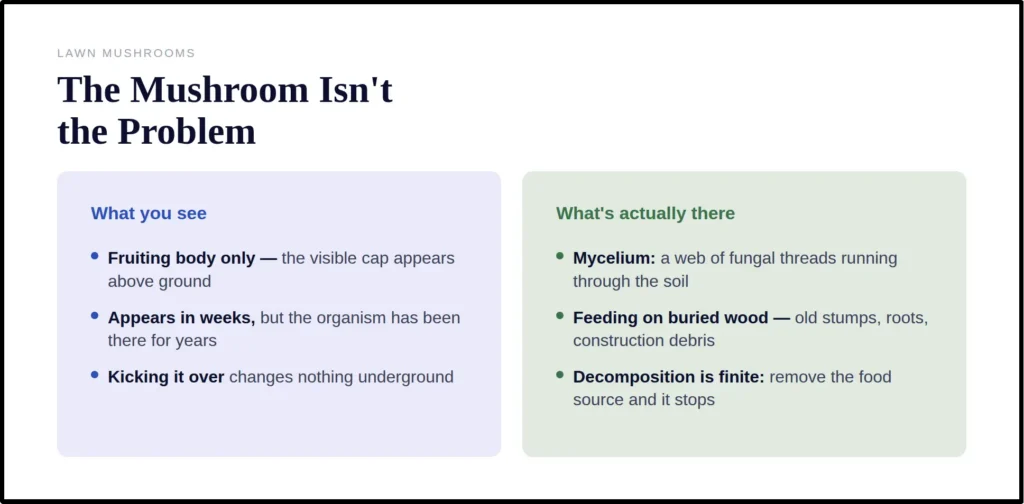
The functional part of the fungus is invisible and has been there far longer than you’ve been noticing mushrooms. Three conditions bring it to the surface:
- Buried organic matter. That mycelium is almost always feeding on something buried: a dead tree root, an old stump that got ground down but was never excavated, lumber scraps from construction grading, wood that was buried and forgotten.
- Excess moisture. Heavy rain, frequent watering, or poor drainage keep the soil damp enough for the mycelium to fruit. Lawns that stay wet overnight produce mushrooms far more consistently than lawns that dry out during the day.
- Shade. Areas that don’t get direct sun stay moist longer after rain or watering, which is why mushrooms cluster under trees, along fences, or on the north side of the house more than in open, sunny turf.
So when you remove mushrooms, and they come back in two weeks in the same location, the wood is still there. The mycelium is still there. Nothing about the situation has changed except that you removed the visible part. Deciding whether a lawn problem falls under routine lawn care or a landscaping job is its own question — see our guide comparing landscaping and lawn care as two different trades.
This matters because most advice on lawn mushrooms stops at removal. And removal, by itself, is not a solution.
Should You Get Rid of Lawn Mushrooms?
Here’s the honest version: most lawn mushrooms are harmless to your grass, and their presence usually just means the soil has enough organic matter and moisture to support fungal activity. Not good, not bad, just normal.
Some are harmless to people. Some aren’t, and you can’t tell which is which from appearance alone, not reliably, not without genuine mycological knowledge that most people don’t have and shouldn’t pretend to.
If you have kids or dogs using the lawn, remove them on sight.
The ones that cause serious harm don’t look distinct from the ones that don’t, and the downside risk is severe enough that the calculus is simple.
The question buried in the title: Should you get rid of them, has a real answer: it depends almost entirely on who has access to the lawn, and not at all on how they look or how many there are.
Common Lawn Mushrooms
With that caveat in place, it is still useful to know what usually shows up in turf. Recognizing the group tells you where the food source is and how much caution the situation calls for. It never clears a mushroom as safe to eat or safe to leave near a dog.
- Fairy ring mushroom (Marasmius oreades): Small tan caps on thin, tough stems, usually in an arc or full circle. They dry out in sun and revive after rain. The most common ring-former in lawns.
- Lawnmower’s mushroom (Panaeolus foenisecii): The little brown mushroom that appears by the dozen the morning after mowing or watering. Cap fades from dark brown to tan as it dries. Feeds on thatch and clippings, so it turns up on lawns with no buried wood at all.
- Shaggy mane (Coprinus comatus): A tall white cylinder with shaggy scales that collapses into black ink within a day or two. Common on recently disturbed soil and new lawns.
- Puffballs: Round, white to tan, no stem and no gills. Small ones look like golf balls. Cut one lengthwise: a true puffball is solid white inside. Any outline of a cap or stem inside means it is the egg stage of a different mushroom, and some of those are deadly.
- Green-spored parasol (Chlorophyllum molybdites): Large white caps on tall stems, often in rings, gills that turn grey-green as the cap ages. This is the most common cause of mushroom poisoning in North America, and it is a lawn mushroom. Severe vomiting and cramping, rarely fatal, always a hospital visit.
- Amanitas (death cap, destroying angel): White or pale caps, white gills, a skirt on the stem, and a cup or sac at the base that sits below the soil line. They partner with tree roots, so they appear in lawns near oaks, pines, and birches rather than in open turf. A few caps can be fatal to a person or a dog.
- Stinkhorns: Orange or red, foul smell, flies on them. They come from mulch and wood chips, not the lawn itself. Harmless, offensive, and gone in a day.
Two of these matter for safety. When you pull a mushroom, wear a glove and dig, don’t pluck. A cup at the base of the stem or a large white cap with greenish gills goes straight into a bag and the trash. Everything else gets the same treatment on a lawn kids or dogs use, so in practice the rule from the previous section stands.
Fairy Rings Are Different
A cluster of mushrooms near a buried stump is one thing. A ring or a partial arc is another.
Fairy rings expand outward from a central point year after year, following the mycelium as it moves through the soil in search of food. The diameter of an established ring roughly tracks its age. A twelve-foot ring didn’t appear this season.
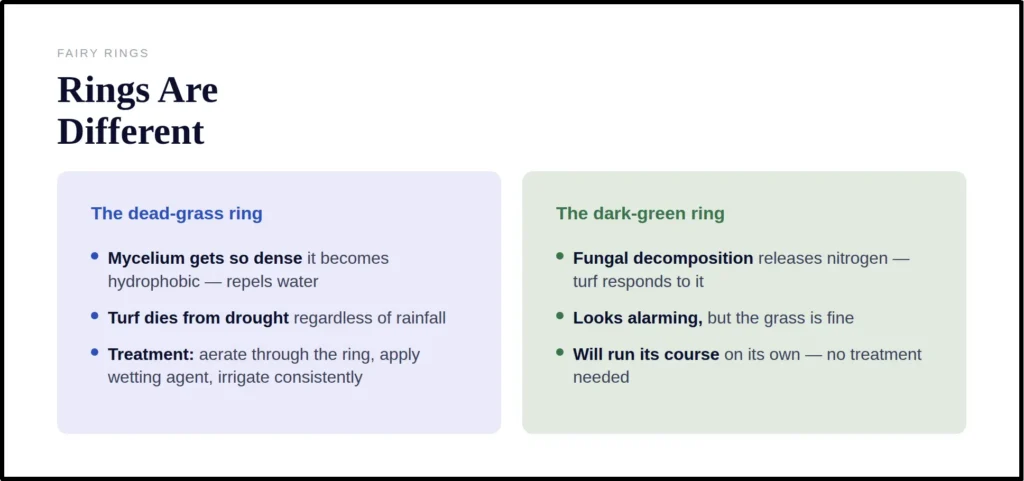
Some rings produce dark green grass inside the arc, the fungal decomposition releases nitrogen, and the turf responds to it. Some rings produce a band of dead grass because the mycelium gets so dense it becomes hydrophobic, actually repelling water, and the turf in that zone dies from drought regardless of rainfall. And some rings just produce mushrooms with no visible turf effect at all. Since mushrooms love chronically wet turf, when to water your lawn explains how to dry the surface out between cycles.
The dead-grass version is the one worth treating aggressively.
Aerate through the ring heavily, apply a wetting agent directly into the affected zone to break the water repellency, and irrigate consistently in that area until the soil behavior normalizes. It takes time. If the buried food source is still intact, the ring will keep expanding at its edges while you’re managing the center.
The nitrogen-ring version looks alarming because the color difference is stark, but the turf is fine. It will run its course.
What to Do About the Mushrooms Right Now
Pick them or rake them. Don’t leave a knocked-over mushroom sitting on the grass, as it’s still releasing spores and still decomposing on the surface. Remove the material from the lawn entirely.
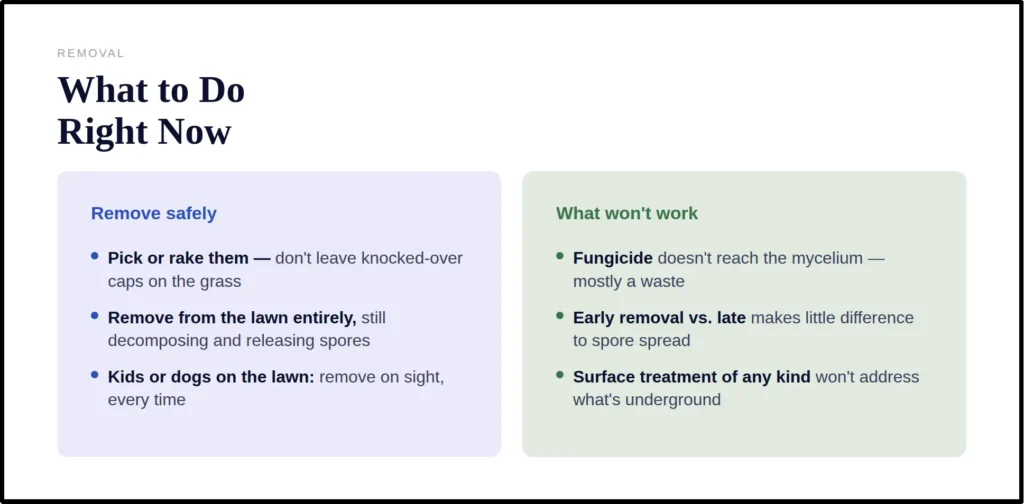
Earlier is marginally better if you’re trying to limit spore spread. But in a lawn context, this matters less than people think. The mycelium spreads through soil on its own, independent of whether surface fruiting is removed.
You’re not meaningfully containing the fungus by removing mushrooms early versus late.
Fungicide is mostly a waste of money here. Surface applications don’t penetrate to where the mycelium is active, and nothing labeled for residential turf is going to address established fungal networks in the soil. It can suppress fruiting temporarily in isolated cases. It won’t solve anything.
How Do You Prevent Mushrooms From Coming Back?
If excavation is feasible, if you know where the stump or root mass is, and getting it out is practical, that’s the most direct path to actually ending the problem.
Remove the food source, and the mycelium eventually exhausts itself and the mushrooms stop appearing.
For large root systems from trees that were removed years ago, or construction debris scattered through fill soil, excavation isn’t realistic.
In those cases, the answer is time. Fungal decomposition is finite. The wood breaks down, the food source disappears, and the mycelium declines. Most residential situations resolve within a few years once the organic matter is fully processed. Not a satisfying answer, but the accurate one.
In the meantime, three changes reduce how often mushrooms fruit while that process finishes:
- Shift watering to early morning so the surface dries during the day. Fungi fruit most aggressively in wet conditions like prolonged soil moisture after rain, or lawns that stay wet overnight from evening irrigation. Areas that drain poorly and stay waterlogged after rain will produce more mushrooms more consistently than areas with good drainage. Those same soggy spots are usually where lawn moss moves in too, and for largely the same underlying reason.
- Thin overhanging branches or shrubs so more direct sun reaches the damp, shaded patches where mushrooms cluster. Shade keeps the surface wet longer after every rain or watering cycle, which is exactly the environment mycelium needs to fruit.
- Manage thatch. A thick thatch layer creates the moist, carbon-rich near-surface environment that mycelium colonizes readily, and lawns with heavy thatch accumulation tend to have more persistent mushroom problems. Dethatching doesn’t eliminate the buried food source, but it changes the surface environment in ways that reduce how hospitable it is.
None of this is unique advice. Iowa State University Extension’s guidance on managing lawn and garden mushrooms lands on the same core recommendation: improve drainage and reduce the organic matter feeding the fungus, rather than treating the mushrooms themselves.
Topdressing after dethatching that area? Use the Mulch Calculator to get the right amount before you buy.
The Stump Grinding Situation
Worth addressing separately because it catches people off guard.
When a tree is removed and the stump is ground down, the grinding process chips the stump into wood material that gets mixed into the soil of that area. A lot of it.
That material decomposes over years, not months, and it will produce mushrooms regularly while that process is ongoing. Reseeding over the area and top-dressing with soil doesn’t change this. The wood chips are still there, several inches down, still feeding whatever mycelium has colonized them.
Expect mushrooms around former stump sites for two to five years. No intervention meaningfully accelerates this. Removal on sight is the management approach, not a solution.
Are Lawn Mushrooms Poisonous to Dogs and Kids?
Pets and young children are the ones most likely to eat a lawn mushroom, so this is where most of the real risk sits. Here are the questions that come up most often, with answers.
Are lawn mushrooms poisonous to dogs?
Some are, and dogs are the main patients. They eat mushrooms out of curiosity, they find them by smell in long grass, and they swallow them whole. The green-spored parasol causes days of vomiting. Amanitas cause liver failure. The small brown ones are unpredictable because so many species look alike.
How fast do symptoms show?
Vomiting within an hour or two usually means a milder type. The dangerous mushrooms are the slow ones. Amanita poisoning can look like a stomach upset that clears up, followed a day later by liver damage. That gap is why waiting for symptoms is the wrong plan.
What about toddlers?
Same risk profile as a dog. Children under three put things in their mouths, and a single cap is a large dose for a small body.
How do you make the lawn safer?
Walk the yard every day, ideally in the morning after rain or irrigation, since caps can appear overnight. Pull them with a gloved hand, bag them, and put the bag in the trash, not the compost. Keep dogs off fresh mulch and wood-chip beds, where stinkhorns and Amanita lookalikes tend to come up. Reduce overnight wetness, which is covered in the section above.
Who do you call? Poison Control for people: 1-800-222-1222. ASPCA Animal Poison Control for pets: 888-426-4435 (a fee applies). Both run all day, every day.
If Someone Eats One
Don’t try to identify the mushroom. Call Poison Control or your veterinarian immediately. Bring the mushroom or a photo if you have it, but don’t spend time on identification when the call should already be happening.
Most lawn mushrooms aren’t toxic. That statement offers very little comfort in the moment and shouldn’t delay anything. Not every lawn invader comes from the soil. Some walk right onto it. Canada geese can turn a healthy lawn into a mess of torn-up grass and droppings in a single afternoon. If that sounds familiar, our guide on how to keep geese off your lawn covers the effective deterrents. The spiny ones are a hazard all their own, and getting rid of prickly weeds in your lawn protects bare feet and pets alike.
What Actually Changes Long-Term
Mushrooms are a symptom of what’s happening in the soil, and so is uneven watering.
Lawns that stay wet overnight fruit more consistently than lawns that dry out during the day.
The Aiper IrriSense 2 schedules across 10 independent zones up to 4,800 square feet and adjusts automatically based on weather conditions, so cycles run in the morning and skip after rain without you managing it manually.
It won’t change what’s underground. But drier surface conditions reduce how often the mycelium fruits while the buried wood finishes breaking down.
Common Questions
Something got wet enough for long enough. A stretch of rain, a new irrigation schedule, or a shaded spot that stopped drying out. The fungus was already there.
Rarely. The only exception is a dead-grass fairy ring, where the dense mycelium blocks water from reaching the roots.
The caps do, within days once the surface dries. The fungus stays until its food is used up.
It kills the caps you spray, which were going to collapse anyway, and it can burn the grass. None of it reaches the mycelium.
Yes, if nobody vulnerable uses the lawn. Bag the clippings that pass, since chopped caps left on the surface still shed spores. Where kids or dogs play, pick them before mowing.
They mean it has organic matter breaking down and enough moisture to fruit. That is normal, not a grade.
Get more pool and lawn care guides from Aiper on Google